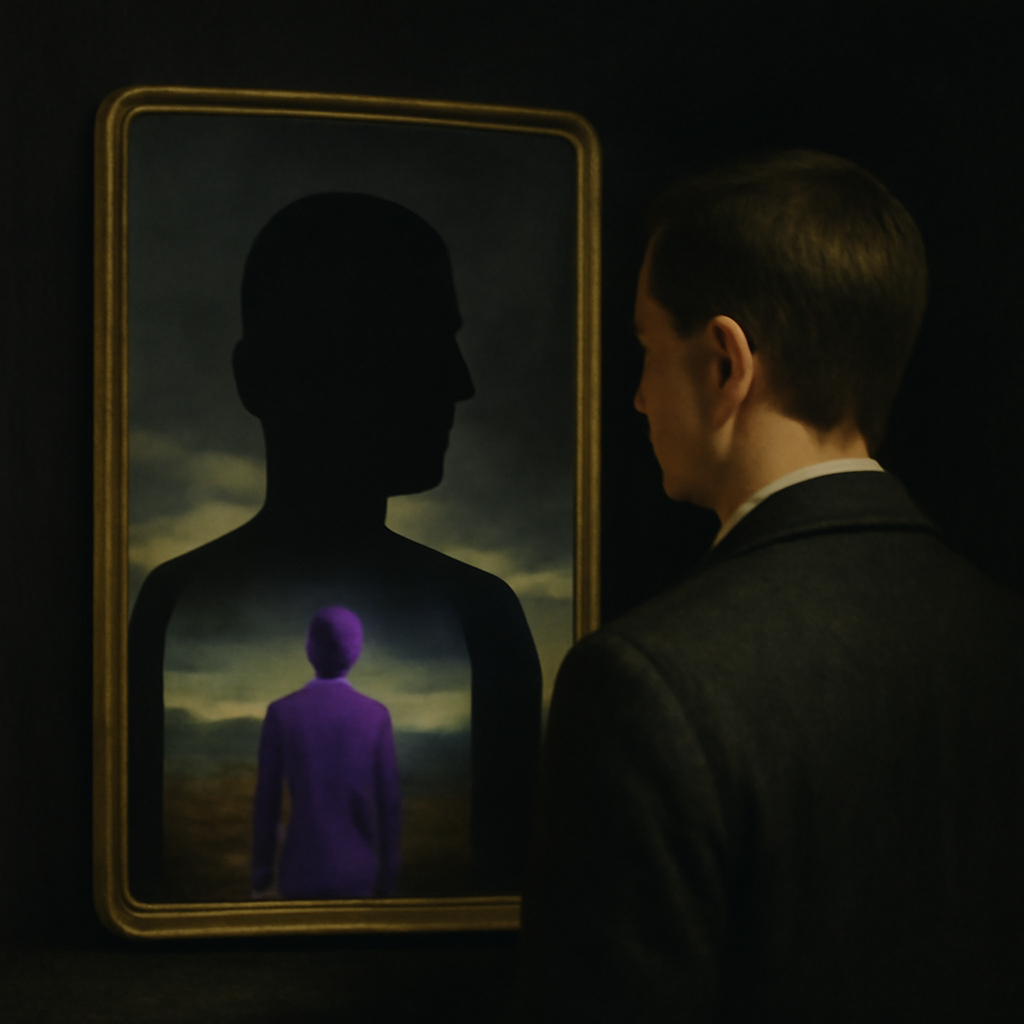
Ever looked at your own hand and felt like it belonged to someone else? It is a spooky feeling, but it is actually a common trick your brain plays when it gets overwhelmed. This sensation is called depersonalization. Think of it as your brain's built-in safety switch. When stress, anxiety, or extreme tiredness get too high, the brain pulls the plug on your emotions to protect you. This makes your own body feel like a puppet you are watching from the outside.
Scientists can actually recreate this feeling with a simple test called the Rubber Hand Illusion. By hiding your real hand and stroking a fake rubber hand at the exact same time, your brain gets confused and starts to believe the fake hand is yours. This shows that your sense of physical ownership is fragile. It is constantly being rebuilt by your brain using sight and touch. When those signals get slightly out of sync, the illusion of 'me' temporarily breaks down.
✨
Wonder Moment
“Your brain can be tricked into adopting a fake rubber hand as its own in just a few seconds using only a paintbrush and a mirror.”
Reflect
If our sense of having a body is just a trick of the brain, who are we when that trick stops working?
2 sources·Established confidence·Investigated 16 Aug 2026(11 days ago)·Source-verified·May need refresh
Your next question, in
Visual Trail
See Why Your Body Can Feel Like a Stranger
A guided visual explanation assembled from QE artwork and sourced documentary images.
01 / 05
QE visual interpretation
Frame 01
Why Your Body Can Feel Like a Stranger
When you feel disconnected from your body, it is usually your brain's natural safety switch flipping on to protect you from high stress.
Image provenance and limitation
Source: AI-generated visual interpretation
Creator: Question Everything
Limitation: This image explains or evokes the subject. It is not documentary evidence and should not be used to verify a factual claim.
Evidence
What do we know?
Verified claims with confidence scoring and cited sources.
1 of 3 findings need extra caution. Finding 1 rests on weaker sourcing than the other findings.
Living footnotes
Claims remain in the reading flow. Select a citation number to inspect the source behind it.
01
ObservationalNot confirmed
The human brain can disconnect from the body as a protective shield during times of extreme stress or trauma.
Think of dissociation as your brain's automatic circuit breaker. When stress or trauma gets too heavy, this safety switch trips to protect you. It creates a mental distance between you and your physical body. It acts as a psychic escape route when you cannot physically run away. This is why people going through scary events often feel like they are floating above themselves, watching a movie instead of living it.
02
ObservationalSupported
Mild forms of feeling disconnected happen to almost everyone during normal daily activities.
You do not need to go through a major crisis to feel a disconnect. Everyday moments of spacing out are actually mild forms of dissociation. For example, you might get so lost in a good book that you lose track of the room. Or you might drive all the way home on autopilot and realize you do not remember the turns. Your brain naturally slips into these states to save energy.
03
ExperimentalSupported
The brain relies on a constant mix of sight, touch, and movement to decide which body parts belong to you.
Your brain is always solving a puzzle to figure out where you end and the world begins. It combines what you see, what you feel, and how you move. Scientists study this using body ownership illusions, like the famous rubber hand experiment. By brushing a fake hand and your hidden real hand at the same time, your brain gets confused. It quickly accepts the fake hand as your own.
The complete record below preserves every citation, confidence input and recorded limitation.
Read the full evidence record3 findings · citations · limitations
Evidence review3 findings2 openable sources
01
Finding 1 of 3ObservationalNeeds caution
0/0 verified
The human brain can disconnect from the body as a protective shield during times of extreme stress or trauma.
Think of dissociation as your brain's automatic circuit breaker. When stress or trauma gets too heavy, this safety switch trips to protect you. It creates a mental distance between you and your physical body. It acts as a psychic escape route when you cannot physically run away. This is why people going through scary events often feel like they are floating above themselves, watching a movie instead of living it.
Not confirmedmodel score 30%
Scored as if sourced, but every citation failed verification.
NO SURVIVING CITATION
›View sources and limits— limits
Supporting passage
Think of dissociation as your brain's automatic circuit breaker. When stress or trauma gets too heavy, this safety switch trips to protect you. It creates a mental distance between you and your physical body. It acts as a psychic escape route when you cannot physically run away. This is why people going through scary events often feel like they are floating above themselves, watching a movie instead of living it.
Citations (0 of 1 survived verification)
Nothing openable. Every citation was removed by provenance validation.
What limits this
All 1 citation on this claim failed verification and were removed. Nothing openable supports it.
02
Finding 2 of 3Observational
0/1 verified
Mild forms of feeling disconnected happen to almost everyone during normal daily activities.
You do not need to go through a major crisis to feel a disconnect. Everyday moments of spacing out are actually mild forms of dissociation. For example, you might get so lost in a good book that you lose track of the room. Or you might drive all the way home on autopilot and realize you do not remember the turns. Your brain naturally slips into these states to save energy.
Supportedmodel score 90%
One source, not peer-reviewed. Thinner than the score suggests.
REFERENCE
›View sources and limits— 1 citation, limits
Supporting passage
You do not need to go through a major crisis to feel a disconnect. Everyday moments of spacing out are actually mild forms of dissociation. For example, you might get so lost in a good book that you lose track of the room. Or you might drive all the way home on autopilot and realize you do not remember the turns. Your brain naturally slips into these states to save energy.
Rests on a single source. No independent corroboration.
No peer-reviewed source among the citations.
The generator scored this 90%, which would read as “Established”. Its citations reach only “Supported”, so that is what is shown.
03
Finding 3 of 3Experimental
1
0/1 verified
The brain relies on a constant mix of sight, touch, and movement to decide which body parts belong to you.
Your brain is always solving a puzzle to figure out where you end and the world begins. It combines what you see, what you feel, and how you move. Scientists study this using body ownership illusions, like the famous rubber hand experiment. By brushing a fake hand and your hidden real hand at the same time, your brain gets confused. It quickly accepts the fake hand as your own.
Supportedmodel score 95%
A single peer-reviewed source. No independent corroboration.
PRIMARY STUDY
›View sources and limits— 1 citation, limits
Supporting passage
Your brain is always solving a puzzle to figure out where you end and the world begins. It combines what you see, what you feel, and how you move. Scientists study this using body ownership illusions, like the famous rubber hand experiment. By brushing a fake hand and your hidden real hand at the same time, your brain gets confused. It quickly accepts the fake hand as your own.
Rests on a single source. No independent corroboration.
The generator scored this 95%, which would read as “Established”. Its citations reach only “Supported”, so that is what is shown.
Interactive Exploration
Touch, drag, and discover
These visualizations respond to your curiosity. Interact to go deeper.
spectrum
The Dissociation Spectrum
Fully PresentDeep Disconnection
10%
Active Focus
35%
Daydreaming
70%
Depersonalization
95%
Identity Fragmentation
process flow
The Brain's Emergency Shutoff
Overwhelming Stress
The Switch Trips
Sensory Detachment
The Movie Effect
Visual Gallery
Images & artifacts
Historical images, diagrams, and visual knowledge from Wikimedia Commons.
Perspectives
How is this interpreted?
Enter a viewpoint. Notice what it reveals, what it leaves out, and whether it changes the question for you.
The EmpiricistScientific viewpointEstablished lens
Scientists view the feeling of body ownership as a continuous calculation. Your brain takes in clues from your eyes, skin, and muscles, then makes a best guess. When these sensory signals do not line up perfectly, the calculation fails. This glitch makes your arm or leg feel like an object rather than a part of you. It is not madness; it is just a processing delay in your brain's mapping system.
What this lens notices
01Body ownership is a brain calculation
02Sensory mismatch causes the glitch
03The brain can easily adopt fake body parts
Application
Why does this matter to you?
Personal reflections and applications for your life.
Thought experimentPractical
Can you use your five senses to anchor yourself right now?
Why it changes the question
When you feel floaty or disconnected, your brain has lost its physical anchor. Engaging your senses tells your brain that you are safe and present in this exact moment.
Try this
Try the 5-4-3-2-1 method: name five things you see, four you can touch, three you hear, two you smell, and one you taste.
Media
QE Smart Glass
Curated media selected for this investigation.
QE Glass
YOUTUBE
Are you a body with a mind or a mind with a body? - Maryam Alimardani
TED-Ed
Download a free audiobook version of “The Three Body Problem" and support TED-Ed's nonprofit mission: ...
QE Glass
YOUTUBE
7 Signs Your Mental Health is Falling Apart
TherapyToThePoint
7 signs your mental health is falling apart—and what you can actually do about it. It doesn't always show up as a full-on ...
QE Glass
YOUTUBE
Your Brain Can Heal Your Body! Dr. Mandell
motivationaldoc
QE Glass
YOUTUBE
Train Your Brain to Be Less Anxious
Therapy in a Nutshell
You can train your brain to be less anxious — just like a muscle. Anxiety isn't your fault, but how you respond to it can reshape ...
QE Glass
YOUTUBE
The Rubber Hand Illusion - Horizon: Is Seeing Believing? - BBC
BBC
Subscribe and to the BBC https://bit.ly/BBCYouTubeSub Watch the BBC first on iPlayer https://bbc.in/iPlayer-Home ...
QE Glass
PODCAST
Out of Body
Radiolab
An episode exploring how the mind can slip out of the body during extreme moments.
Keep Going
Where this leads
Questions this investigation opens up — and what QE has already looked into.
No AI help here — no suggestions, no autocomplete, nothing finishing your sentences. That is deliberate. Working out what you think is effortful, and the effort is the part that changes you: reasoning is trained like a muscle, and a muscle that is always carried gets weaker. Let something else do the thinking and you keep the answer but lose the capacity to have reached it.
Write your current position.
Not what the page says. What you think, having read it.0 words · Nothing written yet.
Sign in to leave a mark. Your draft is saved here in the meantime.