The Moving Mind: How the Body Unlocks… | Question Everything
psychology67% confidencepartly supported
24 min deep dive
Complexity
The Moving Mind: How the Body Unlocks Creative Thought
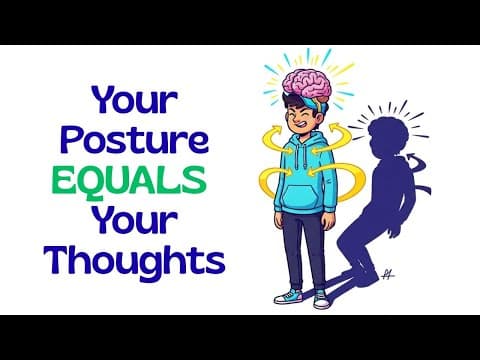
We often picture the great thinker as a statue. Still. Silent. Locked in a room. But science reveals a far more dynamic truth. Our minds do not end at our skulls. Instead, the brain is deeply, beautifully wired to the entire body. When we move, we think differently. A simple walk can break a mental deadlock, sending waves of fresh energy through our neural networks. This is embodied cognition—the profound reality that our physical actions actively shape our mental horizons.
By stepping away from our desks, we open the floodgates of creativity. Gesturing with our hands helps us grasp abstract ideas. Walking in nature coaxes the brain into a state of relaxed focus, perfect for making unexpected connections. It is a liberating realization. We are not biological computers trapped in stationary boxes. We are moving, sensing beings. By simply changing our posture, we can actively design our own moments of genius.
✨
Wonder Moment
“We do not just think with our brains and move with our bodies; the physical act of moving through space actively builds the very thoughts and creative breakthroughs we once believed occurred only in silence.”
Reflect
If our physical environments and bodily gestures shape our deepest insights, how might the design of our modern, sedentary workspaces be silently limiting the boundaries of human imagination?
3 sources·Established confidence·Investigated 26 Aug 2026(yesterday)·Source-verified
Your next question, in
Evidence
What do we know?
Verified claims with confidence scoring and cited sources.
2 of 3 findings need extra caution. Finding 2, Finding 3 rest on weaker sourcing than the other findings.
Living footnotes
Claims remain in the reading flow. Select a citation number to inspect the source behind it.
01
ExperimentalWell supported
Physical movement actively stimulates and preserves mental resources during creative problem-solving tasks.
When we move, we do not just burn energy. We engage in a dynamic dialogue with our environment. Research demonstrates that task-relevant physical movement acts as an active cognitive tool. It helps us direct, stimulate, and preserve precious mental resources. For instance, allowing people to physically write down ideas or manipulate objects reduces the heavy cognitive load of purely mental tracking. This physical freedom allows the mind to wander into richer, more original territory.
02
ObservationalMixed evidence
Hand gestures allow us to formulate and grasp complex problem-solving strategies before we can express them in words.
Watch a child solving a complex puzzle or a scientist explaining a theory. Their hands fly. These gestures are not merely theatrical. They are active components of the thinking process itself. Studies show that gesturing helps us map out abstract ideas and mathematical relationships in physical space. By externalizing these complex concepts, we reduce our cognitive load. This physical scaffolding makes it far easier to discover novel solutions that would otherwise remain hidden in the abstract.
03
ObservationalMixed evidence
Motor creativity and cognitive creativity are closely linked in childhood development, sharing common roots in self-regulation and fluid intelligence.
We often separate physical education from intellectual study, but nature does not. Recent developmental research tracking primary school children reveals that motor creativity—the ability to invent novel movements—is deeply intertwined with cognitive creativity. Both are powered by the same underlying traits, including fluid intelligence and emotional self-regulation. When children engage in physical challenges, their motor creativity helps them navigate emotional demands, directly feeding back into their ability to think flexibly and solve problems creatively.
The complete record below preserves every citation, confidence input and recorded limitation.
Read the full evidence record3 findings · citations · limitations
Evidence review3 findings4 openable sources
01
Finding 1 of 3Experimental
2
0/2 verified
Physical movement actively stimulates and preserves mental resources during creative problem-solving tasks.
When we move, we do not just burn energy. We engage in a dynamic dialogue with our environment. Research demonstrates that task-relevant physical movement acts as an active cognitive tool. It helps us direct, stimulate, and preserve precious mental resources. For instance, allowing people to physically write down ideas or manipulate objects reduces the heavy cognitive load of purely mental tracking. This physical freedom allows the mind to wander into richer, more original territory.
Well supportedmodel score 90%
2 sources agree, 1 peer-reviewed.
PRIMARY STUDYREFERENCE
›View sources and limits— 2 citations, limits
Supporting passage
When we move, we do not just burn energy. We engage in a dynamic dialogue with our environment. Research demonstrates that task-relevant physical movement acts as an active cognitive tool. It helps us direct, stimulate, and preserve precious mental resources. For instance, allowing people to physically write down ideas or manipulate objects reduces the heavy cognitive load of purely mental tracking. This physical freedom allows the mind to wander into richer, more original territory.
Nothing further is recorded. QE stores no methodology field, so absence here is not a clean bill of health.
02
Finding 2 of 3ObservationalNeeds caution
0/1 verified
Hand gestures allow us to formulate and grasp complex problem-solving strategies before we can express them in words.
Watch a child solving a complex puzzle or a scientist explaining a theory. Their hands fly. These gestures are not merely theatrical. They are active components of the thinking process itself. Studies show that gesturing helps us map out abstract ideas and mathematical relationships in physical space. By externalizing these complex concepts, we reduce our cognitive load. This physical scaffolding makes it far easier to discover novel solutions that would otherwise remain hidden in the abstract.
Mixed evidencemodel score 55%
Verification was mixed across 1 source.
REFERENCE
›View sources and limits— 1 citation, limits
Supporting passage
Watch a child solving a complex puzzle or a scientist explaining a theory. Their hands fly. These gestures are not merely theatrical. They are active components of the thinking process itself. Studies show that gesturing helps us map out abstract ideas and mathematical relationships in physical space. By externalizing these complex concepts, we reduce our cognitive load. This physical scaffolding makes it far easier to discover novel solutions that would otherwise remain hidden in the abstract.
1 of 2 citations failed verification and are not shown.
Rests on a single source. No independent corroboration.
No peer-reviewed source among the citations.
Verification was mixed — some citations supported the claim and some did not.
03
Finding 3 of 3ObservationalNeeds caution
0/1 verified
Motor creativity and cognitive creativity are closely linked in childhood development, sharing common roots in self-regulation and fluid intelligence.
We often separate physical education from intellectual study, but nature does not. Recent developmental research tracking primary school children reveals that motor creativity—the ability to invent novel movements—is deeply intertwined with cognitive creativity. Both are powered by the same underlying traits, including fluid intelligence and emotional self-regulation. When children engage in physical challenges, their motor creativity helps them navigate emotional demands, directly feeding back into their ability to think flexibly and solve problems creatively.
Mixed evidencemodel score 55%
Verification was mixed across 1 source.
REFERENCE
›View sources and limits— 1 citation, limits
Supporting passage
We often separate physical education from intellectual study, but nature does not. Recent developmental research tracking primary school children reveals that motor creativity—the ability to invent novel movements—is deeply intertwined with cognitive creativity. Both are powered by the same underlying traits, including fluid intelligence and emotional self-regulation. When children engage in physical challenges, their motor creativity helps them navigate emotional demands, directly feeding back into their ability to think flexibly and solve problems creatively.
These visualizations respond to your curiosity. Interact to go deeper.
process flow
The Embodied Creative Loop
Physical Action
Sensory Feedback
Cognitive Offloading
Creative Insight
comparison table
Classic Cognition vs. Embodied Cognition
Classic Cognitivism
Embodied Cognition
The Mind's Role
An isolated computer processing symbolic inputs
An active, predictive organ bound to the body
Physical Action
A simple output of completed mental processes
An active partner that helps construct thoughts
The Environment
A passive stage where thinking takes place
A dynamic extension of our mental workspace
Learning Style
Abstract, rule-based memorization
Sensory-motor, hands-on engagement
Tap any row to highlight and compare
Perspectives
How is this interpreted?
Enter a viewpoint. Notice what it reveals, what it leaves out, and whether it changes the question for you.
The EmpiricistScientific viewpointLive tension
From a modern cognitive science perspective, the brain is not a sealed computer processing passive inputs. Instead, it is a highly active, predictive organ that collaborates continuously with the body and the environment. This '4E' framework—embodied, embedded, extended, and enactive—suggests that thinking is something we do with our entire system. Movement provides the raw sensory-motor data that the brain uses to predict and construct our reality, making physical action a fundamental component of creative exploration.
What this lens notices
01The brain acts as an active organ of prediction rather than a passive processor.
02Cognition is distributed across the brain, body, and external environment.
03Sensory-motor experiences directly shape the boundaries of abstract thought.
Application
Why does this matter to you?
Personal reflections and applications for your life.
Thought experimentPractical
How can you redesign your next brainstorming session to get your body moving?
Why it changes the question
Sitting perfectly still forces your brain to work harder to maintain focus and manage ideas. By introducing simple movements, you free up mental bandwidth for creative leaps.
Try this
Try a walking meeting or sketch your ideas on a whiteboard using large arm movements instead of typing on a small screen.
Media
QE Smart Glass
Curated media selected for this investigation.
QE Glass
YOUTUBE
127. Your Body Knows: The Science of Embodied Cognition
Dr. Amy Backos
Ask me a question or let me know what you think! (https://www.buzzsprout.com/2199359/fan_mail/new) The body remembers the ...
QE Glass
YOUTUBE
Thinking with your Body and Other Things | David Kirsh | Design@Large
Design Lab
Abstract: Thinking with your Body and Other Things Where does thought, creativity and understanding come from? For the past ...
QE Glass
YOUTUBE
What Is Embodied Cognition | Health
Abdul Hakkim A
What is Embodied Cognition? Have you ever wondered what's actually going on when you find yourself thinking about something ...
QE Glass
YOUTUBE
The REAL truth about embodiment that everyone misses
Natalie Tischler
Everyone's talking about embodiment these days, but they're all missing the most life-changing part. In this episode, I'm breaking ...
QE Glass
YOUTUBE
What is embodiment? 🤔 (2019) | Life Artists
Life Artists
The basic foundation of all I am teaching at Life Artists is Embodiment. But what is embodiment actually? We think, we dream, we ...
QE Glass
YOUTUBE
Arangam: A Three-Step Embodied Ritual to Explore the Psyche (An Organic Inquiry) by Hema Swaminathan
East-West Psychology CIIS
An East-West Psychology Doctoral Dissertation Defense by Hemalatha Swaminathan Arangram: A Three-Step Embodies Ritual to ...
QE Glass
YOUTUBE
Thinking With Your Hands? The Science Of How Your Body Shapes Your Mind | India Today
India Today
This report explores the science of embodied cognition, which challenges the belief that thinking occurs only in the brain.
QE Glass
PODCAST
The Body as Mind
Radiolab
A deep dive into the surprising ways our physical organs and bodily movements influence our decisions, memories, and creative breakthroughs.
Connected context
Connected entities
The people, places, concepts, and events that matter here.
Keep Going
Where this leads
Questions this investigation opens up — and what QE has already looked into.
No AI help here — no suggestions, no autocomplete, nothing finishing your sentences. That is deliberate. Working out what you think is effortful, and the effort is the part that changes you: reasoning is trained like a muscle, and a muscle that is always carried gets weaker. Let something else do the thinking and you keep the answer but lose the capacity to have reached it.
Write your current position.
Not what the page says. What you think, having read it.0 words · Nothing written yet.
Sign in to leave a mark. Your draft is saved here in the meantime.