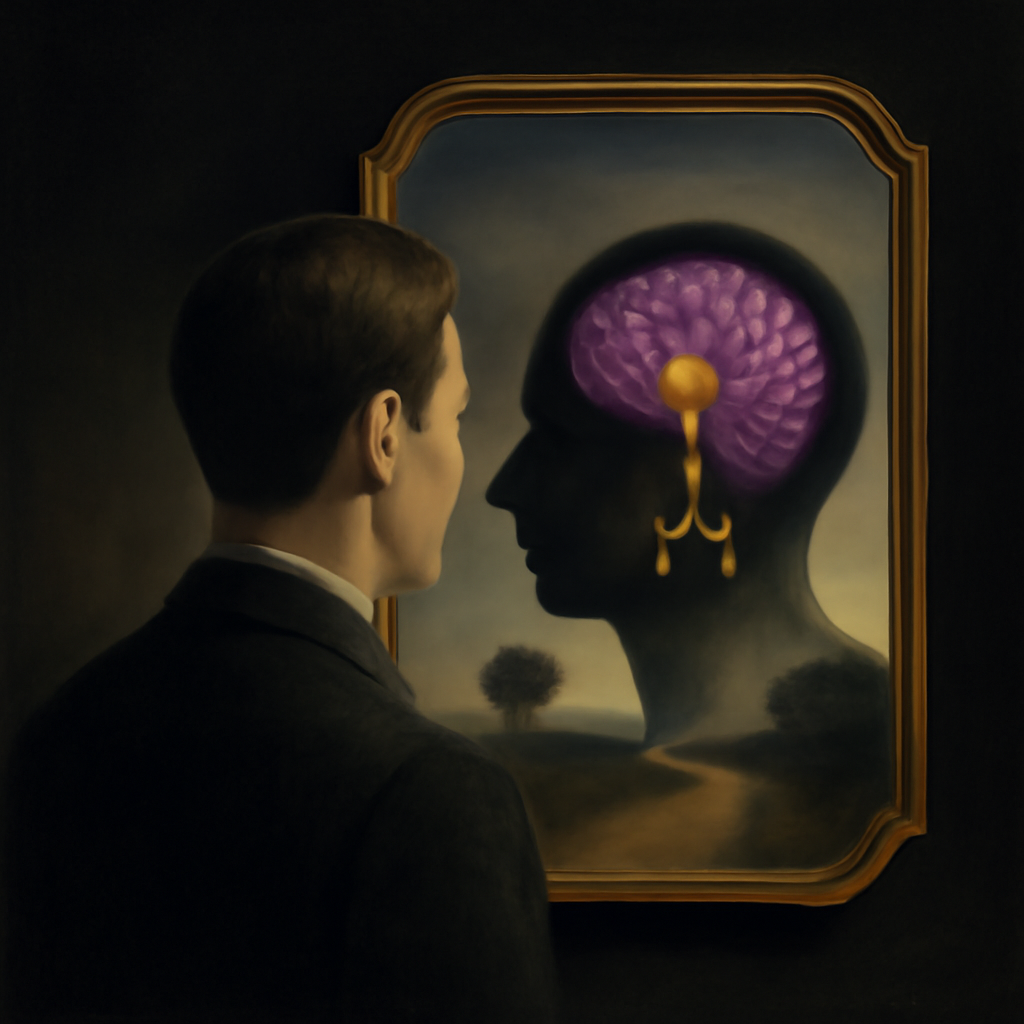
Think of your brain as a dense forest. Every time you do something rewarding—like grabbing a sugary donut with your morning coffee—dopamine acts like a bulldozer. It clears a path. Dopamine isn't actually the feeling of pleasure itself. It is the chemical of anticipation. It is the whisper that says, "Hey, remember how good that chocolate tasted? Do it again." Before you know it, that path in your brain becomes a paved highway. Your brain loves saving energy, so it zips down this highway on autopilot.
This is why breaking a habit feels like fighting your own biology. When you see a trigger—like walking past your favorite bakery—your brain floods with dopamine before you even take a bite. It creates an itch you feel forced to scratch. To break the loop, you have to actively build a new path in the forest, which takes time and constant practice.
✨
Wonder Moment
“When you see something linked to an old reward, your brain floods with dopamine even if you are not paying attention to it.”
Reflect
If our surroundings can trigger dopamine cravings without us even realizing it, how much of our daily behavior is truly our own choice?
1 source·Developing confidence·Investigated 19 Aug 2026(8 days ago)·Source-verified·May need refresh
Your next question, in
Visual Trail
See Wired for Craving: The Real Reason Habits Stick
A guided visual explanation assembled from QE artwork and sourced documentary images.
01 / 02
QE visual interpretation
Frame 01
Wired for Craving: The Real Reason Habits Stick
Dopamine doesn't make us feel pleasure; it drives the intense craving that forces our brain onto autopilot before we even realize it.
Image provenance and limitation
Source: AI-generated visual interpretation
Creator: Question Everything
Limitation: This image explains or evokes the subject. It is not documentary evidence and should not be used to verify a factual claim.
Evidence
What do we know?
Verified claims with confidence scoring and cited sources.
2 of 3 findings need extra caution. Finding 1, Finding 2 rest on weaker sourcing than the other findings.
Living footnotes
Claims remain in the reading flow. Select a citation number to inspect the source behind it.
01
ExperimentalNot confirmed
Seeing a cue from a past reward triggers a dopamine release in the brain even if you are not paying attention to it.
Researchers at Johns Hopkins University found that our brains are biased by past pleasures. When you spot something you once enjoyed, your brain gets a sudden splash of dopamine. This happens even if you are not looking for a reward or even consciously noticing the object. It is like an automatic radar for pleasure, which explains why a dieter cannot stop thinking about cake the moment they walk past a bakery.
02
ObservationalNot confirmed
Dopamine acts as a driver of neuroplasticity to physically change how brain cells connect.
When you experience something rewarding, your brain releases dopamine. This chemical is not just about feeling good. It actually rewrites your brain's physical wiring. It acts like a construction crew, building stronger pathways between your environment and your actions. Over time, these pathways become like paved superhighways. This makes the habit feel completely automatic, turning a simple action into a routine that is incredibly hard to stop.
03
AcademicSupported
High cognitive load or stress makes people more likely to fall back on automated habits.
Your brain has a constant battle between two areas. Think of the front part as a wise CEO and the deeper part as a factory floor. When you are tired, stressed, or carrying a heavy mental load, the CEO gets exhausted. This is when the factory floor takes over. Because habits require almost no mental energy to run, your brain defaults to these old, automated routines to save its strength.
The complete record below preserves every citation, confidence input and recorded limitation.
Read the full evidence record3 findings · citations · limitations
Evidence review3 findings1 openable sources
01
Finding 1 of 3ExperimentalNeeds caution
0
0/0 verified
Seeing a cue from a past reward triggers a dopamine release in the brain even if you are not paying attention to it.
Researchers at Johns Hopkins University found that our brains are biased by past pleasures. When you spot something you once enjoyed, your brain gets a sudden splash of dopamine. This happens even if you are not looking for a reward or even consciously noticing the object. It is like an automatic radar for pleasure, which explains why a dieter cannot stop thinking about cake the moment they walk past a bakery.
Not confirmedmodel score 30%
Scored as if sourced, but every citation failed verification.
NO SURVIVING CITATION
›View sources and limits— limits
Supporting passage
Researchers at Johns Hopkins University found that our brains are biased by past pleasures. When you spot something you once enjoyed, your brain gets a sudden splash of dopamine. This happens even if you are not looking for a reward or even consciously noticing the object. It is like an automatic radar for pleasure, which explains why a dieter cannot stop thinking about cake the moment they walk past a bakery.
Citations (0 of 1 survived verification)
Nothing openable. Every citation was removed by provenance validation.
What limits this
All 1 citation on this claim failed verification and were removed. Nothing openable supports it.
02
Finding 2 of 3ObservationalNeeds caution
0/0 verified
Dopamine acts as a driver of neuroplasticity to physically change how brain cells connect.
When you experience something rewarding, your brain releases dopamine. This chemical is not just about feeling good. It actually rewrites your brain's physical wiring. It acts like a construction crew, building stronger pathways between your environment and your actions. Over time, these pathways become like paved superhighways. This makes the habit feel completely automatic, turning a simple action into a routine that is incredibly hard to stop.
Not confirmedmodel score 30%
Scored as if sourced, but every citation failed verification.
NO SURVIVING CITATION
›View sources and limits— limits
Supporting passage
When you experience something rewarding, your brain releases dopamine. This chemical is not just about feeling good. It actually rewrites your brain's physical wiring. It acts like a construction crew, building stronger pathways between your environment and your actions. Over time, these pathways become like paved superhighways. This makes the habit feel completely automatic, turning a simple action into a routine that is incredibly hard to stop.
Citations (0 of 1 survived verification)
Nothing openable. Every citation was removed by provenance validation.
What limits this
All 1 citation on this claim failed verification and were removed. Nothing openable supports it.
03
Finding 3 of 3Academic
1
0/1 verified
High cognitive load or stress makes people more likely to fall back on automated habits.
Your brain has a constant battle between two areas. Think of the front part as a wise CEO and the deeper part as a factory floor. When you are tired, stressed, or carrying a heavy mental load, the CEO gets exhausted. This is when the factory floor takes over. Because habits require almost no mental energy to run, your brain defaults to these old, automated routines to save its strength.
Supportedmodel score 90%
A single peer-reviewed source. No independent corroboration.
PRIMARY STUDY
›View sources and limits— 1 citation, limits
Supporting passage
Your brain has a constant battle between two areas. Think of the front part as a wise CEO and the deeper part as a factory floor. When you are tired, stressed, or carrying a heavy mental load, the CEO gets exhausted. This is when the factory floor takes over. Because habits require almost no mental energy to run, your brain defaults to these old, automated routines to save its strength.
These visualizations respond to your curiosity. Interact to go deeper.
process flow
The Dopamine Habit Loop
The Trigger
The Craving
The Routine
The Reward
comparison table
Brain Control: CEO vs Factory Floor
Prefrontal Cortex (The CEO)
Basal Ganglia (The Factory Floor)
Mental Energy Required
Very high, easily exhausted
Almost zero, runs on autopilot
Primary Driver
Long-term goals and logic
Immediate rewards and habits
When It Takes Control
When you are fresh, calm, and focused
When you are stressed, tired, or distracted
Tap any row to highlight and compare
Perspectives
How is this interpreted?
Enter a viewpoint. Notice what it reveals, what it leaves out, and whether it changes the question for you.
The EmpiricistScientific viewpointEstablished lens
Modern brain science views habits as highly efficient survival tools. In the past, automating actions saved precious energy. Today, this same system backfires. Dopamine seals these loops so tightly that logical thinking gets bypassed. Our brains treat a phone notification or a sugary snack with the same urgency as finding water in a desert, making willpower alone a very weak tool against deeply carved neural pathways.
02Automated habits consume far less energy than active decisions
03The brain cannot easily distinguish between healthy and unhealthy rewards
Application
Why does this matter to you?
Personal reflections and applications for your life.
Thought experimentBehavioural
What is the very first visual cue that starts your worst habit?
Why it changes the question
Because dopamine triggers before you even realize you are looking at a cue, willpower is often too late to help. To break a habit, you must hide the visual trigger entirely.
Try this
If you scroll your phone too much in bed, put the charger in another room before you go to sleep.
Media
QE Smart Glass
Curated media selected for this investigation.
QE Glass
YOUTUBE
How to Rewire Your Brain to Enjoy Discipline (Dopamine Detox Explained)
HustleCore
Your brain isn't broken — it's hijacked. In this video, you'll learn the science behind why motivation fades, why discipline feels ...
QE Glass
YOUTUBE
Controlling Your Dopamine For Motivation, Focus & Satisfaction
Andrew Huberman
This episode serves as a sort of “Dopamine Masterclass”. I discuss the immensely powerful chemical that we all make in our brain ...
QE Glass
YOUTUBE
Dopamine Expert: Doing This Once A Day Fixes Your Dopamine! What Alcohol Is Doing To Your Brain!
The Diary Of A CEO
Dr Anna Lembke is Professor of Psychiatry at Stanford University School of Medicine and chief of the Stanford Addiction Medicine ...
QE Glass
YOUTUBE
Addiction Explained, Rises & Falls in Dopamine | Dr. Andrew Huberman
Huberman Lab Clips
Dr. Andrew Huberman discusses the science of addiction, focusing on the role of dopamine to understand why quick rewards ...
QE Glass
YOUTUBE
Improve Your Baseline Dopamine for Motivation & Drive | Dr. Andrew Huberman
Huberman Lab Clips
Dubbed by ElevenLabs Dr. Andrew Huberman discusses how to enhance your baseline dopamine levels for sustained motivation ...
QE Glass
YOUTUBE
How to Trick Monkey Brain To Like Doing Hard Things (Dopamine Detox)
Monkey Mind 101
Buy Monkey a Banana: https://ko-fi.com/monkeymind101 one banana = legal dopamine hit. Monkey loves TikTok, games, and ...
QE Glass
YOUTUBE
The Science of How Your Brain Forms Habits (and How to Take Control)
Dr. Tracey Marks
UNLOCK YOUR BRAIN'S FULL POTENTIAL! My free 2-minute quiz reveals your unique "Brain Operating System" and gives you ...
QE Glass
PODCAST
Protocols for Creating & Breaking Habits
Huberman Lab
A deep dive into the neuroscience of task bracketing, dopamine baselines, and practical tools to shift behaviors.
Keep Going
Where this leads
Questions this investigation opens up — and what QE has already looked into.
No AI help here — no suggestions, no autocomplete, nothing finishing your sentences. That is deliberate. Working out what you think is effortful, and the effort is the part that changes you: reasoning is trained like a muscle, and a muscle that is always carried gets weaker. Let something else do the thinking and you keep the answer but lose the capacity to have reached it.
Write your current position.
Not what the page says. What you think, having read it.0 words · Nothing written yet.
Sign in to leave a mark. Your draft is saved here in the meantime.