The Armour We Wear: How Masculinity S… | Question Everything
psychology30% confidenceweakly supported
20 min deep dive
Complexity
The Armour We Wear: How Masculinity Shapes Men's Style and Bodies
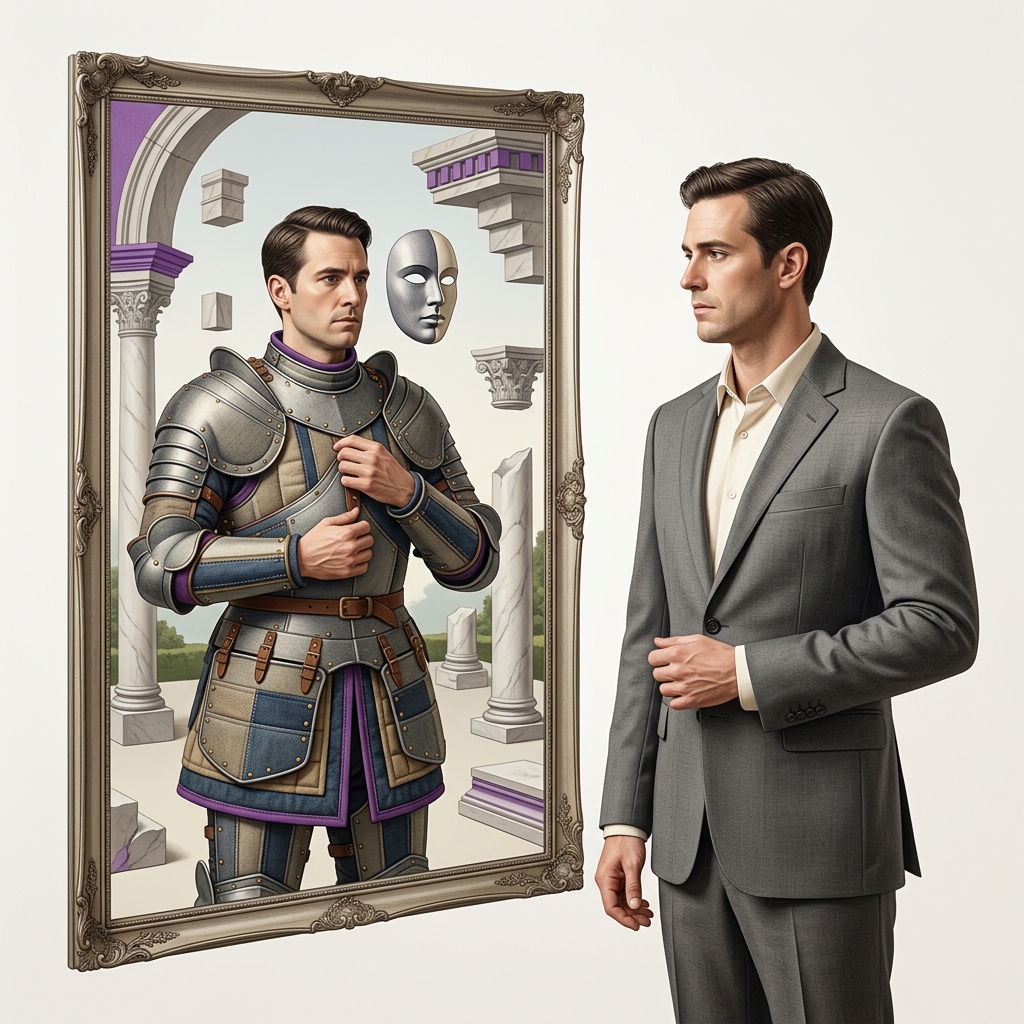
For generations, an unwritten rulebook has told men to be strong, silent, and physically imposing. This pressure shapes how men look in the mirror. Many feel forced to chase a V-shaped body—broad shoulders and a tiny waist—just like a real-life action figure. When they do not fit this mold, anxiety creeps in, turning the simple act of getting dressed into a daily struggle to hide perceived weaknesses.
This desire to look tough directly dictates what men wear. To appear bigger and more masculine, they often choose dark, boxy clothes that mimic military gear or heavy workwear. Soft fabrics, bright colours, or tight fits are often avoided out of fear of looking "weak." Ultimately, clothing becomes a form of social armor, used to project a strength that men are taught they must always display.
“Boys begin to adopt rigid, traditional ideas about how a man should look and act when they are just eight years old.”
Reflect
If the clothes we choose are just a silent language, what story are your daily outfits trying to tell the world?
Research·5 sources·11 primary·13 independent publishers·Limited evidence coverage·Preliminary confidence·Investigated 4 Oct 2026(1 month ago)·Sources retrieved; claim check not completed
Your next question, in
Evidence
What do we know?
Verified claims with confidence scoring and cited sources.
Living footnotes
Claims remain in the reading flow. Select a citation number to inspect the source behind it.
01
ObservationalNot confirmed
Looking at perfect bodies on social media directly increases body dissatisfaction and drives men to change their eating and exercise habits.
When young men scroll through social media and see highly muscular fitness influencers, they constantly compare themselves. This mental loop makes many men feel deeply unhappy with their own size. Studies show this dissatisfaction directly leads to unhealthy dieting, extreme workouts, and taking risky supplements. It is a quiet struggle to chase a physical ideal that is mostly fake.
02
AcademicNot confirmed
Boys start adopting rigid ideas about masculinity and physical expectations as early as eight years old.
Society starts shaping how males view themselves long before they reach adulthood. By the age of eight, young boys already begin absorbing cultural rules about being tough and looking strong. This early pressure sets up a lifelong habit of measuring their worth against unrealistic physical standards. It often leads to severe muscle dissatisfaction and workout obsessions when they grow up.
03
AcademicNot confirmed
Modern men are increasingly defining their identity and masculinity through their physical appearance and fashion choices rather than just their jobs.
Historically, society judged men almost entirely by their occupations. Today, a new and highly flexible version of masculinity has emerged, especially among younger generations. Men are spending twice as much on grooming and using fashion to express their inner selves. Many are now happily blending traditional gender boundaries by wearing fabrics and styles that society once labeled as strictly feminine.
The complete record below preserves every citation, confidence input and recorded limitation.
Read the full evidence record3 findings · citations · limitations
Evidence review3 findings5 openable sources
01
Finding 1 of 3Observational
0/2 verified
Looking at perfect bodies on social media directly increases body dissatisfaction and drives men to change their eating and exercise habits.
When young men scroll through social media and see highly muscular fitness influencers, they constantly compare themselves. This mental loop makes many men feel deeply unhappy with their own size. Studies show this dissatisfaction directly leads to unhealthy dieting, extreme workouts, and taking risky supplements. It is a quiet struggle to chase a physical ideal that is mostly fake.
Not confirmedmodel score 30%
No source survived verification. Treat as unconfirmed.
PRIMARY STUDYREFERENCE
›View sources and limits— 2 citations, limits
Supporting passage
When young men scroll through social media and see highly muscular fitness influencers, they constantly compare themselves. This mental loop makes many men feel deeply unhappy with their own size. Studies show this dissatisfaction directly leads to unhealthy dieting, extreme workouts, and taking risky supplements. It is a quiet struggle to chase a physical ideal that is mostly fake.
QE used this research source for direct evidence relevant to the claim.
“AIM: Negative body image increases the risk of engaging in unhealthy dieting and disordered eating patterns. This review evaluated the impact of habitual social media engagement or exposure to image-related content on body image and food choices in healthy young adults (18-30 years). METHODS: A systematic search of si…”
This passage was selected for relevance. It has not been checked against the claim.
QE used this as an authoritative first-party source.
“body dissatisfaction, lowered self-esteem, and unhealthy behaviors. [...] In applying the framework of hegemonic masculinity, I aim to explore how fitness culture on social media reinforces specific masculine ideals and affects young men’s perceptions of their bodies. This research will also investigate whether exposu…”
This passage was selected for relevance. It has not been checked against the claim.
Retrieved 04/10/2026
What limits this
Nothing further is recorded. QE stores no methodology field, so absence here is not a clean bill of health.
02
Finding 2 of 3Academic
1
0/1 verified
Boys start adopting rigid ideas about masculinity and physical expectations as early as eight years old.
Society starts shaping how males view themselves long before they reach adulthood. By the age of eight, young boys already begin absorbing cultural rules about being tough and looking strong. This early pressure sets up a lifelong habit of measuring their worth against unrealistic physical standards. It often leads to severe muscle dissatisfaction and workout obsessions when they grow up.
Not confirmedmodel score 30%
No source survived verification. Treat as unconfirmed.
PRIMARY STUDY
›View sources and limits— 1 citation, limits
Supporting passage
Society starts shaping how males view themselves long before they reach adulthood. By the age of eight, young boys already begin absorbing cultural rules about being tough and looking strong. This early pressure sets up a lifelong habit of measuring their worth against unrealistic physical standards. It often leads to severe muscle dissatisfaction and workout obsessions when they grow up.
QE used this as an authoritative first-party source.
“nce engagement in disordered eating, supplement intake, and muscle-building activity (Grogan et al., 2019; Jankowski et al., 2018; Wei et al., 2021). While body image concerns can arise at any point during one’s lifetime, research shows that boys begin to invest in masculine gender norms as early as eight years old (T…”
This passage was selected for relevance. It has not been checked against the claim.
Retrieved 04/10/2026
What limits this
Rests on a single source. No independent corroboration.
03
Finding 3 of 3Academic
2
0/2 verified
Modern men are increasingly defining their identity and masculinity through their physical appearance and fashion choices rather than just their jobs.
Historically, society judged men almost entirely by their occupations. Today, a new and highly flexible version of masculinity has emerged, especially among younger generations. Men are spending twice as much on grooming and using fashion to express their inner selves. Many are now happily blending traditional gender boundaries by wearing fabrics and styles that society once labeled as strictly feminine.
Not confirmedmodel score 30%
No source survived verification. Treat as unconfirmed.
REFERENCEPRIMARY STUDY
›View sources and limits— 2 citations, limits
Supporting passage
Historically, society judged men almost entirely by their occupations. Today, a new and highly flexible version of masculinity has emerged, especially among younger generations. Men are spending twice as much on grooming and using fashion to express their inner selves. Many are now happily blending traditional gender boundaries by wearing fabrics and styles that society once labeled as strictly feminine.
QE used this as an authoritative first-party source. It appeared in 2 complementary searches.
“McNeill and Douglas (2011) consider men to now be defined by appearance, instead of occupation, so they may shop for clothing to externally be perceived as attractive. Men care about their appearance and use fashion to construct and express their ideal version of the new masculinity (Barry & Martin, 2015). Because the…”
This passage was selected for relevance. It has not been checked against the claim.
QE used this as an authoritative first-party source.
“One plausible reason why little scholarly attention has been given to men’s body image and fashion consumption is due to greater sociocultural pressures on women’s appearance than on men. Another reason can be due to the false perception that men are less interested in grooming, physical appearance, and apparel shoppi…”
This passage was selected for relevance. It has not been checked against the claim.
Retrieved 04/10/2026
What limits this
Nothing further is recorded. QE stores no methodology field, so absence here is not a clean bill of health.
The reference archive
Sources & Further Reading
Continue exploring the research, reporting and reference material available on this subject.
These were found while researching this question but are not used as evidence for any claim above.
These visualizations respond to your curiosity. Interact to go deeper.
spectrum
The Masculinity & Fashion Spectrum
Traditional HegemonicThe New Masculinity
10%
Functional Utility
35%
The Protective Uniform
75%
Gender-Blurring Aesthetics
90%
Fluid Self-Expression
statistics card
The Growing Cost of Male Appearance
2x
Grooming Spending Increase
Between 1997 and 2009, male consumers in the U.S. doubled their spending on grooming products, showing a massive shift in how much men care about their physical appearance.
8 years old
The Age Insecurity Begins
Boys start investing in rigid masculine gender norms and appearance expectations at an incredibly young age, setting up lifelong body image patterns.
Perspectives
How is this interpreted?
Enter a viewpoint. Notice what it reveals, what it leaves out, and whether it changes the question for you.
The EmpiricistScientific viewpointLive tension
Modern psychology shows that societal pressures and media portrayals of hyper-muscular men create a massive gap between how men actually look and how they feel they should look. This painful gap triggers body dissatisfaction and drives extreme fitness behaviors. Online influencers and movie superheroes set a physical bar so high that it is virtually unreachable for normal men without resorting to extreme, unhealthy measures.
What this lens notices
01Media constantly portrays hyper-muscular, lean, and athletic male bodies as the ideal.
02Upward social comparison on social media platforms directly lowers male self-esteem.
03Conforming to these rigid physical expectations is linked to exercise dependence and eating issues.
Application
Why does this matter to you?
Personal reflections and applications for your life.
Thought experimentSelf-Reflection
When you look in the mirror or choose an outfit, whose voice are you actually listening to?
Why it changes the question
We often think our style choices are entirely our own. In reality, deep-seated cultural rules about strength, power, and masculinity quietly guide what we pull out of the closet.
Try this
Spend a week wearing one item of clothing that feels slightly outside your usual 'tough' or 'functional' comfort zone, and notice how it changes your mood.
Media
QE Smart Glass
Curated media selected for this investigation.
QE Glass
YOUTUBE
How Fashion Affects Your Brain | ELLE
ELLE
Ever wanted to feel smarter? Maybe a simple answer could be switching out your favorite jacket to a lab coat. Teaming with ...
QE Glass
YOUTUBE
Gender Roles and Stereotypes
AMAZE Org
People have occasionally felt pressure to act or look a certain way based on their gender. This pressure can make people ...
QE Glass
YOUTUBE
Why men are still obsessed with the Golden Era bodybuilders - Golden Era Bookworm
Gentlemen's Collective Podcast
Why men are still obsessed with the Golden Era bodybuilders - Golden Era Bookworm #shorts.
QE Glass
PODCAST
The Secret Struggle of Male Body Image
Science Vs
An episode looking at how fitness culture and social media algorithms impact young men's mental health and their relationship with the gym.
Keep Going
Where this leads
Questions this investigation opens up — and what QE has already looked into.
No AI help here — no suggestions, no autocomplete, nothing finishing your sentences. That is deliberate. Working out what you think is effortful, and the effort is the part that changes you: reasoning is trained like a muscle, and a muscle that is always carried gets weaker. Let something else do the thinking and you keep the answer but lose the capacity to have reached it.
Write your current position.
Not what the page says. What you think, having read it.0 words · Nothing written yet.
Sign in to leave a mark. Your draft is saved here in the meantime.