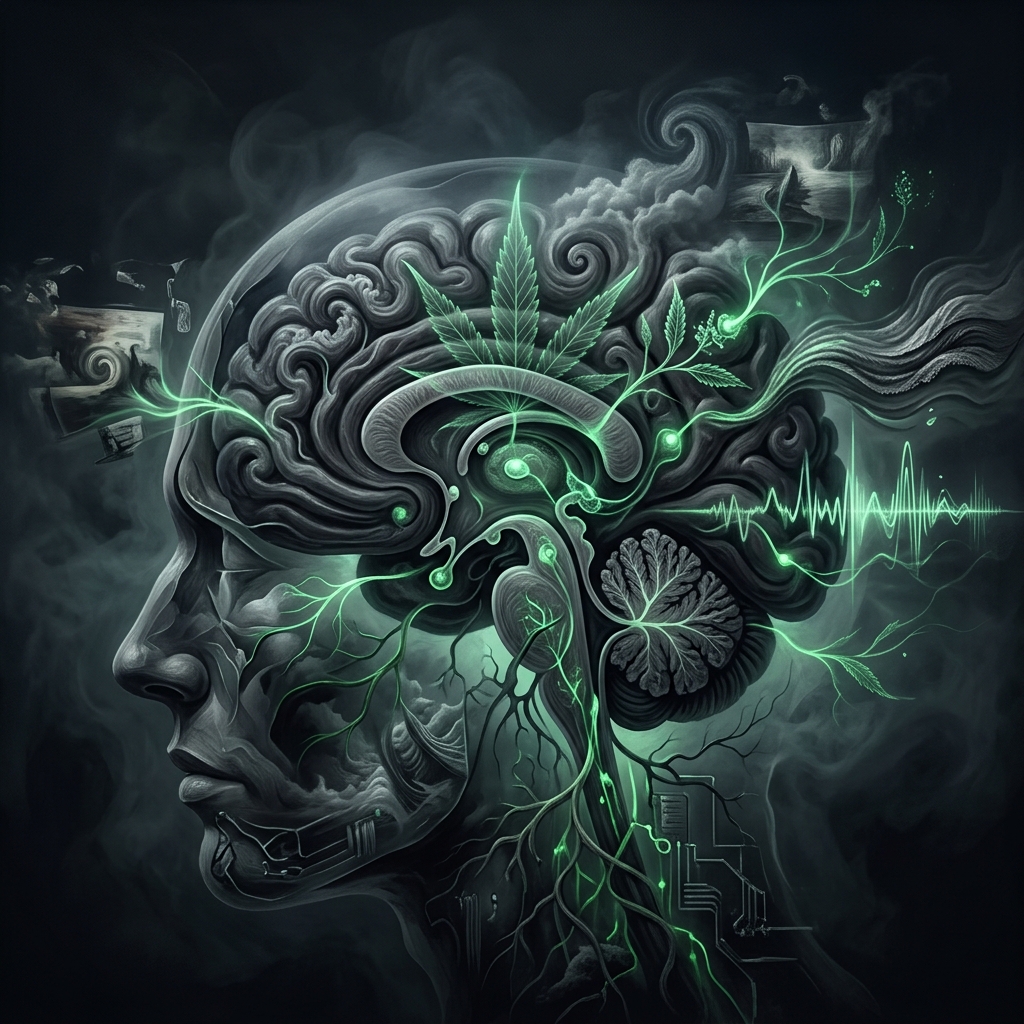
Your Brain on Weed: What Cannabis Actually Does Inside Your Head
Picture your brain as a bustling city. Millions of tiny chemical messages fly across the streets every single second. They control how you feel, think, move, and remember. Usually, this traffic flows perfectly. But when you use cannabis, a chemical called THC floods the system. It acts like a master key, unlocking doors all over the brain and changing how these messages get sent.
This isn't a random glitch. Your brain actually has a built-in system designed to receive these chemicals. We make our own natural versions of them to keep our mood and memory in balance. When cannabis enters the mix, it mimics these natural chemicals but with a much louder voice. It turns down some signals and cranks others all the way up.
The result is the classic high. Time seems to stretch. Food tastes amazing. You might feel deeply relaxed, or suddenly paranoid. By looking at how cannabis changes our brain wiring, we can understand why it makes us feel so different, and what it really does to our mental health.
“Your brain has receptors specifically designed for cannabis-like chemicals because you make your own 'bliss molecule' called anandamide. Cannabis is essentially a plant that speaks your brain's native language, just much louder.”
Reflect
If our brains evolved to have a built-in system that perfectly fits cannabis molecules, what does that say about our deep, ancient relationship with nature?
2 sources·Established confidence·Investigated 14 Jul 2026(1 month ago)·Investigation may be outdated
Your next question, in
Visual Trail
See Your Brain on Weed: What Cannabis Actually Does Inside Your Head
A guided visual explanation assembled from QE artwork and sourced documentary images.
01 / 05
QE visual interpretation
Frame 01
Your Brain on Weed: What Cannabis Actually Does Inside Your Head
Cannabis changes how your brain cells talk to each other by mimicking a natural chemical we all make.
Image provenance and limitation
Source: AI-generated visual interpretation
Creator: Question Everything
Limitation: This image explains or evokes the subject. It is not documentary evidence and should not be used to verify a factual claim.
Evidence
What do we know?
Verified claims with confidence scoring and cited sources.
Generated without source retrieval. QE did not fetch sources for this investigation, so no citation here was checked against a retrieved set. Claims reflect the model’s training data. 1 of 3 findings carry no openable link at all.
1 of 3 findings need extra caution. Finding 3 rests on weaker sourcing than the other findings.
Living footnotes
Claims remain in the reading flow. Select a citation number to inspect the source behind it.
01
ObservationalSupported
THC mimics a natural brain chemical to hijack your brain's communication system.
Your brain cells talk to each other using chemical keys and locks. Usually, your brain uses its own key, called anandamide (often called the 'bliss molecule'), to calm things down when you get too stressed.
THC, the active ingredient in cannabis, looks almost identical to this bliss molecule. Because it looks the same, it can fit into the same locks. But while your brain releases its own chemical in tiny, controlled amounts, THC floods the entire brain at once, turning on locks that are usually kept closed.
02
ExperimentalSupported
Cannabis temporarily disrupts your brain's notepad, making you forgetful.
There is a part of your brain shaped like a banana called the hippocampus. Think of it as your brain's sticky-note pad. It holds onto short-term memories before writing them down in your permanent memory book.
This area is packed with locks that THC fits into. When THC attaches to them, it pauses the notepad. This is why people on cannabis might forget what they were saying mid-sentence, or find it hard to learn new information while high.
03
AcademicNot confirmed
Cannabis triggers your brain's reward center, releasing dopamine.
When you eat chocolate, hug a friend, or win a game, your brain releases a chemical called dopamine. This is your brain's way of saying 'Good job, do that again.'
THC triggers this exact same reward system. It removes the normal brakes on dopamine, letting it flood your brain. This is what creates the feeling of euphoria, or the 'high.' It is also why things like music or movies can feel incredibly exciting and intense when using cannabis.
The complete record below preserves every citation, confidence input and recorded limitation.
Read the full evidence record3 findings · citations · limitations
Evidence review3 findings2 openable sources
01
Finding 1 of 3Observational
0/1 verified
THC mimics a natural brain chemical to hijack your brain's communication system.
Your brain cells talk to each other using chemical keys and locks. Usually, your brain uses its own key, called anandamide (often called the 'bliss molecule'), to calm things down when you get too stressed.
THC, the active ingredient in cannabis, looks almost identical to this bliss molecule. Because it looks the same, it can fit into the same locks. But while your brain releases its own chemical in tiny, controlled amounts, THC floods the entire brain at once, turning on locks that are usually kept closed.
Supportedmodel score 98%
One source, not peer-reviewed. Thinner than the score suggests.
REFERENCE
›View sources and limits— 1 citation, limits
Supporting passage
Your brain cells talk to each other using chemical keys and locks. Usually, your brain uses its own key, called anandamide (often called the 'bliss molecule'), to calm things down when you get too stressed.
THC, the active ingredient in cannabis, looks almost identical to this bliss molecule. Because it looks the same, it can fit into the same locks. But while your brain releases its own chemical in tiny, controlled amounts, THC floods the entire brain at once, turning on locks that are usually kept closed.
Generated without source retrieval — citations here were not verified against a retrieved set.
Rests on a single source. No independent corroboration.
No peer-reviewed source among the citations.
The generator scored this 98%, which would read as “Established”. Its citations reach only “Supported”, so that is what is shown.
02
Finding 2 of 3Experimental
1
0/1 verified
Cannabis temporarily disrupts your brain's notepad, making you forgetful.
There is a part of your brain shaped like a banana called the hippocampus. Think of it as your brain's sticky-note pad. It holds onto short-term memories before writing them down in your permanent memory book.
This area is packed with locks that THC fits into. When THC attaches to them, it pauses the notepad. This is why people on cannabis might forget what they were saying mid-sentence, or find it hard to learn new information while high.
Supportedmodel score 95%
One source, not peer-reviewed. Thinner than the score suggests.
REPORTING
›View sources and limits— 1 citation, limits
Supporting passage
There is a part of your brain shaped like a banana called the hippocampus. Think of it as your brain's sticky-note pad. It holds onto short-term memories before writing them down in your permanent memory book.
This area is packed with locks that THC fits into. When THC attaches to them, it pauses the notepad. This is why people on cannabis might forget what they were saying mid-sentence, or find it hard to learn new information while high.
Generated without source retrieval — citations here were not verified against a retrieved set.
Rests on a single source. No independent corroboration.
No peer-reviewed source among the citations.
The generator scored this 95%, which would read as “Established”. Its citations reach only “Supported”, so that is what is shown.
03
Finding 3 of 3AcademicNeeds caution
0
0/0 verified
Cannabis triggers your brain's reward center, releasing dopamine.
When you eat chocolate, hug a friend, or win a game, your brain releases a chemical called dopamine. This is your brain's way of saying 'Good job, do that again.'
THC triggers this exact same reward system. It removes the normal brakes on dopamine, letting it flood your brain. This is what creates the feeling of euphoria, or the 'high.' It is also why things like music or movies can feel incredibly exciting and intense when using cannabis.
Not confirmedmodel score 92%
Written from the model's own knowledge. No source was retrieved or checked.
UNVERIFIED — NO RETRIEVAL
›View sources and limits— limits
Supporting passage
When you eat chocolate, hug a friend, or win a game, your brain releases a chemical called dopamine. This is your brain's way of saying 'Good job, do that again.'
THC triggers this exact same reward system. It removes the normal brakes on dopamine, letting it flood your brain. This is what creates the feeling of euphoria, or the 'high.' It is also why things like music or movies can feel incredibly exciting and intense when using cannabis.
Citations (0 of 1 survived verification)
Nothing openable. No sources were retrieved for this investigation, so none were checked.
What limits this
This investigation was generated without source retrieval. The model named a source but gave no link, and no verification step ran against it.
The claim reflects the model's training data, not a checked citation.
The generator scored this 92%, which would read as “Established”. Its citations reach only “Unresolved”, so that is what is shown.
Interactive Exploration
Touch, drag, and discover
These visualizations respond to your curiosity. Interact to go deeper.
process flow
The Journey of a Puff: How THC Reaches the Brain
Inhalation
The Express Route
The Hijack
The Chemical Shift
relationship map
Where Cannabis Lands in Your Brain
Mapping relationships…
Drag nodes to rearrange — tap for details
spectrum
The Cannabis Chemical Scale
CBD (Calming/Body)THC (Psychoactive/Mind)
10%
Pure CBD
50%
Balanced Strains
90%
High THC Strains
statistics card
The Numbers Behind the High
25 Years
Brain Maturity
The human brain isn't fully built until age 25. Using cannabis before this can change how the brain wires itself permanently.
3x to 5x
THC Strength Increase
Weed today is much stronger than it was in the 1970s, making side effects like panic attacks more common.
Visual Gallery
Images & artifacts
Historical images, diagrams, and visual knowledge from Wikimedia Commons.
Perspectives
How is this interpreted?
Enter a viewpoint. Notice what it reveals, what it leaves out, and whether it changes the question for you.
The EmpiricistScientific viewpointEstablished lens
Scientists view cannabis as a powerful tool that interacts with a massive, ancient network in our bodies called the endocannabinoid system. This system acts like a dimmer switch for our brain. If there is too much electrical activity, it turns it down. Scientists are fascinated by how THC can calm overactive brain networks, which is why it can help stop seizures or reduce chronic pain in some medical patients.
What this lens notices
01It acts as a natural brake for overactive brain cells.
02It helps regulate sleep, appetite, and pain.
03Some components, like CBD, can reduce seizures in children with epilepsy.
Application
Why does this matter to you?
Personal reflections and applications for your life.
Thought experimentSelf-Reflection
How do you naturally relax your brain when it is running too fast?
Why it changes the question
Your brain has its own built-in system for calming you down, which cannabis mimics. Activities like deep breathing, exercise, or being in nature naturally boost your body's own 'bliss molecules' without any side effects.
Try this
Next time you feel stressed, try a deep breathing exercise for three minutes to see if you can trigger your brain's natural calming system.
Media
QE Smart Glass
Curated media selected for this investigation.
QE Glass
YOUTUBE
What Does Cannabis Do To The Brain? | Earth Science
BBC Earth Science
Greg Foot explains the effect that cannabis has on the brain. Footnotes: 1 ...
QE Glass
YOUTUBE
Your Brain: Who's in Control? | Full Documentary | NOVA | PBS
NOVA PBS Official
Dive into the subconscious to see what's really driving the decisions you make. Official Website: https://to.pbs.org/3pUGv1s ...
QE Glass
YOUTUBE
Is marijuana bad for your brain? - Anees Bahji
TED-Ed
Explore how marijuana's two main active compounds, THC and CBD, affect your brain and body, and what risk factors to watch ...
QE Glass
YOUTUBE
How Psychedelics Change the Brain
NOVA PBS Official
Psychedelics might interact with the brain by turning off the brain's default mode network and affecting a thin sheet of gray matter ...
QE Glass
YOUTUBE
How Marijuana Affects the Brain & Body | Dr. Andrew Huberman
Huberman Lab Clips
Dr. Andrew Huberman explains how cannabis affects the brain and body. Dr. Andrew Huberman is a tenured professor of ...
QE Glass
YOUTUBE
Your Brain: Perception Deception | Full Documentary | NOVA | PBS
NOVA PBS Official
Neuroscientists discover the tricks and shortcuts the brain takes to help us survive. Official Website: https://to.pbs.org/3Ic9dRS ...
QE Glass
YOUTUBE
We Have To Talk About Weed
Kurzgesagt – In a Nutshell
Discover Odoo https://www.odoo.com/r/Ye2 The first app is free for life.Thanks to Odoo for sponsoring this video! Join us in ...
QE Glass
YOUTUBE
Your Brain on Marijuana
AsapSCIENCE
A fast, colorful, and highly visual explanation of exactly how THC affects your brain cells.
QE Glass
PODCAST
The Effects of Cannabis (Marijuana) on the Brain & Body
Huberman Lab
An easy-to-follow breakdown by a brain scientist on how cannabis impacts memory, hormones, and health.
Keep Going
Where this leads
Questions this investigation opens up — and what QE has already looked into.
No AI help here — no suggestions, no autocomplete, nothing finishing your sentences. That is deliberate. Working out what you think is effortful, and the effort is the part that changes you: reasoning is trained like a muscle, and a muscle that is always carried gets weaker. Let something else do the thinking and you keep the answer but lose the capacity to have reached it.
Write your current position.
Not what the page says. What you think, having read it.0 words · Nothing written yet.
Sign in to leave a mark. Your draft is saved here in the meantime.