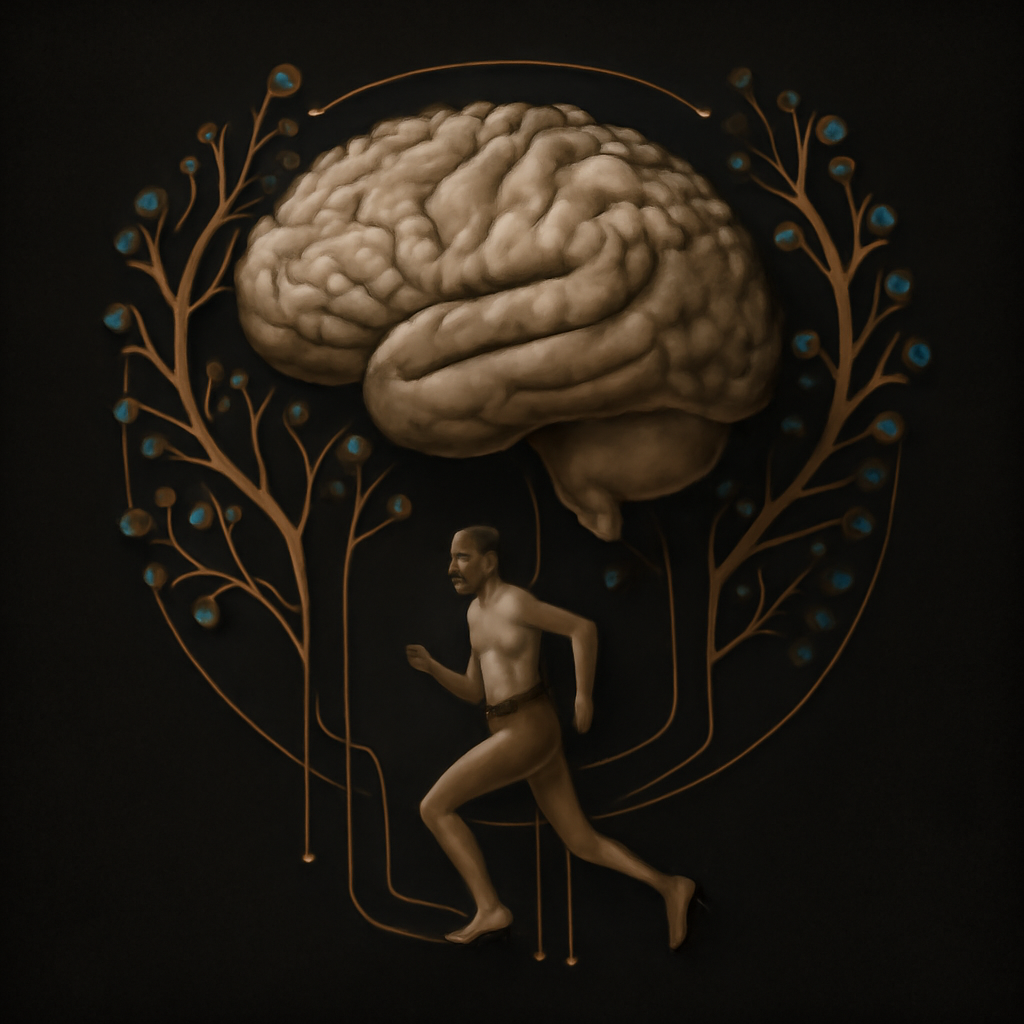
Imagine your brain is a crowded concert. Dopamine is the music, but you need speakers—called receptors—to actually hear it. When we get stressed, eat poorly, or sit around too much, our brains pack away these speakers. We feel sluggish, bored, and unmotivated. But when you start moving, something incredible happens. Exercise acts like a construction crew, building brand-new dopamine receptors in your brain.
This physical change rewires how you experience the world. With more receptors, your brain becomes highly sensitive to the joy of everyday things, from a good meal to a sunset. It is not just about burning calories; it is a physical upgrade to your brain's reward system, making you naturally more resilient to stress and sadness.
✨
Wonder Moment
“Regular exercise actually grows more dopamine receptors in your brain, meaning you literally build a greater capacity to feel joy in everyday life.”
Reflect
If moving our bodies changes how we experience pleasure, could a sedentary lifestyle slowly numb us to the simple joys of being alive?
1 source·Established confidence·Investigated 19 Aug 2026(8 days ago)·Source-verified·May need refresh
Your next question, in
Visual Trail
See How Exercise Rewires Your Brain's Joy Receivers
A guided visual explanation assembled from QE artwork and sourced documentary images.
01 / 02
QE visual interpretation
Frame 01
How Exercise Rewires Your Brain's Joy Receivers
Yes, moving your body actually builds more dopamine receptors, making your brain much better at feeling joy and motivation.
Image provenance and limitation
Source: AI-generated visual interpretation
Creator: Question Everything
Limitation: This image explains or evokes the subject. It is not documentary evidence and should not be used to verify a factual claim.
Evidence
What do we know?
Verified claims with confidence scoring and cited sources.
1 of 3 findings need extra caution. Finding 2 rests on weaker sourcing than the other findings.
Living footnotes
Claims remain in the reading flow. Select a citation number to inspect the source behind it.
01
ObservationalSupported
Regular physical exercise increases the number of dopamine receptors in the brain's reward system.
Think of dopamine receptors as tiny docks waiting for a happy chemical to land. When you exercise regularly, your brain actually builds more of these docks. This remodeling process makes your brain far more sensitive to joy. This means that over time, things that used to bring you mild pleasure—like a good conversation or a sunset—can start to feel much more rewarding. It is like upgrading your brain's emotional antenna to catch clearer signals.
02
ExperimentalNot confirmed
High-intensity interval training increases specific dopamine D2 receptor levels in the brain.
Scientists studied how intense, short bursts of exercise affect the brain. They found that six weeks of interval training significantly boosted a specific type of receiver called the D2 receptor. Why does this matter? D2 receptors are crucial for feeling motivated and keeping your mood stable. By doing quick, sweaty workouts, you are actively upgrading the hardware in your brain that helps you feel driven and excited about life.
03
ExperimentalSupported
Exercise can help restore dopamine receptors that were damaged by substance abuse.
Using addictive substances can severely damage your brain's reward system. It wipes out dopamine receptors, leaving people feeling depressed, unmotivated, and unable to enjoy normal life. But research shows that exercise can actually reverse this damage. By jumping on a treadmill or lifting weights, you help your brain rebuild those lost receptors. It is like a natural repair crew, slowly restoring your ability to feel ordinary happiness again.
The complete record below preserves every citation, confidence input and recorded limitation.
Read the full evidence record3 findings · citations · limitations
Evidence review3 findings2 openable sources
01
Finding 1 of 3Observational
0/1 verified
Regular physical exercise increases the number of dopamine receptors in the brain's reward system.
Think of dopamine receptors as tiny docks waiting for a happy chemical to land. When you exercise regularly, your brain actually builds more of these docks. This remodeling process makes your brain far more sensitive to joy. This means that over time, things that used to bring you mild pleasure—like a good conversation or a sunset—can start to feel much more rewarding. It is like upgrading your brain's emotional antenna to catch clearer signals.
Supportedmodel score 90%
One source, not peer-reviewed. Thinner than the score suggests.
REFERENCE
›View sources and limits— 1 citation, limits
Supporting passage
Think of dopamine receptors as tiny docks waiting for a happy chemical to land. When you exercise regularly, your brain actually builds more of these docks. This remodeling process makes your brain far more sensitive to joy. This means that over time, things that used to bring you mild pleasure—like a good conversation or a sunset—can start to feel much more rewarding. It is like upgrading your brain's emotional antenna to catch clearer signals.
Rests on a single source. No independent corroboration.
No peer-reviewed source among the citations.
The generator scored this 90%, which would read as “Established”. Its citations reach only “Supported”, so that is what is shown.
02
Finding 2 of 3ExperimentalNeeds caution
0
0/0 verified
High-intensity interval training increases specific dopamine D2 receptor levels in the brain.
Scientists studied how intense, short bursts of exercise affect the brain. They found that six weeks of interval training significantly boosted a specific type of receiver called the D2 receptor. Why does this matter? D2 receptors are crucial for feeling motivated and keeping your mood stable. By doing quick, sweaty workouts, you are actively upgrading the hardware in your brain that helps you feel driven and excited about life.
Not confirmedmodel score 30%
Scored as if sourced, but every citation failed verification.
NO SURVIVING CITATION
›View sources and limits— limits
Supporting passage
Scientists studied how intense, short bursts of exercise affect the brain. They found that six weeks of interval training significantly boosted a specific type of receiver called the D2 receptor. Why does this matter? D2 receptors are crucial for feeling motivated and keeping your mood stable. By doing quick, sweaty workouts, you are actively upgrading the hardware in your brain that helps you feel driven and excited about life.
Citations (0 of 1 survived verification)
Nothing openable. Every citation was removed by provenance validation.
What limits this
All 1 citation on this claim failed verification and were removed. Nothing openable supports it.
03
Finding 3 of 3Experimental
1
0/1 verified
Exercise can help restore dopamine receptors that were damaged by substance abuse.
Using addictive substances can severely damage your brain's reward system. It wipes out dopamine receptors, leaving people feeling depressed, unmotivated, and unable to enjoy normal life. But research shows that exercise can actually reverse this damage. By jumping on a treadmill or lifting weights, you help your brain rebuild those lost receptors. It is like a natural repair crew, slowly restoring your ability to feel ordinary happiness again.
Supportedmodel score 90%
One source, not peer-reviewed. Thinner than the score suggests.
REFERENCE
›View sources and limits— 1 citation, limits
Supporting passage
Using addictive substances can severely damage your brain's reward system. It wipes out dopamine receptors, leaving people feeling depressed, unmotivated, and unable to enjoy normal life. But research shows that exercise can actually reverse this damage. By jumping on a treadmill or lifting weights, you help your brain rebuild those lost receptors. It is like a natural repair crew, slowly restoring your ability to feel ordinary happiness again.
These visualizations respond to your curiosity. Interact to go deeper.
process flow
The Dopamine Upgrade Cycle
Get Moving
Dopamine Release
Receptor Growth
Sensitivity Boost
comparison table
Sedentary vs. Active Brains
Sedentary Brain
Active Brain
Dopamine Receptor Density
Fewer active receptors, leading to lower sensitivity to pleasure
More active receptors, increasing capacity for everyday joy
Response to Stress
Higher baseline stress hormones like cortisol
Lower stress hormones and greater mental resilience
Brain Growth Factors
Declines naturally with age, reducing focus
Spikes after workouts, boosting memory and learning
Tap any row to highlight and compare
Perspectives
How is this interpreted?
Enter a viewpoint. Notice what it reveals, what it leaves out, and whether it changes the question for you.
The EmpiricistScientific viewpointEstablished lens
From a biological standpoint, the brain is highly adaptable, a trait called neuroplasticity. When we exercise, we trigger chemical signals that tell our brain cells to grow and adapt. Increasing dopamine receptors is simply the brain's way of adjusting to the energetic demands of physical movement. It ensures our motor and reward pathways are running efficiently, helping us stay motivated to keep moving.
What this lens notices
01Brain cells adapt to physical demands
02Neuroplasticity allows receptor growth
03Increased efficiency in motor pathways
Application
Why does this matter to you?
Personal reflections and applications for your life.
Thought experimentPractical
How can you make movement a daily habit instead of a chore?
Why it changes the question
Your brain releases dopamine even when you just lace up your sneakers. By creating simple pre-workout rituals, you train your brain to anticipate the reward, making it easier to start.
Try this
Set out your workout clothes the night before to trigger an early dopamine cue.
Media
QE Smart Glass
Curated media selected for this investigation.
QE Glass
YOUTUBE
2-Minute Neuroscience: Dopamine
Neuroscientifically Challenged
Dopamine is a monoamine and catecholamine neurotransmitter with many functions in the nervous system ranging from ...
QE Glass
YOUTUBE
Improve Your Baseline Dopamine for Motivation & Drive | Dr. Andrew Huberman
Huberman Lab Clips
Dubbed by ElevenLabs Dr. Andrew Huberman discusses how to enhance your baseline dopamine levels for sustained motivation ...
QE Glass
YOUTUBE
This One Exercise Grows New Brain Cells #what
Dr Sermed Mezher
We used to think that once you reached adulthood, your brain stopped making new cells—but now we know that's not true.
QE Glass
YOUTUBE
Why YOU Can Focus for Hours on This — But Not on That
The Feynman Way
The Complete Body Manual → https://thefeynmanway.com/ Discover the single molecule that determines whether your brain can ...
QE Glass
YOUTUBE
How Dopamine Affects Learning and Motivation in ADHD Brains
How to ADHD
Thank you to Hero's Journal for sponsoring today's video! Go to https://theherosjournal.co/discount/howtoadhd and use code ...
QE Glass
YOUTUBE
Renew & Protect Your Brain Cells | Brain Derived Neurotrophic Factor – Dr. Berg
Dr. Eric Berg DC
Get access to my FREE resources https://drbrg.co/3Vzlgi2 Just so you know, my full line of high-quality supplements is ...
QE Glass
YOUTUBE
What happens in your brain when you exercise? Moving your body can help you get out of depression
Flow Neuroscience
What happens inside your body when you exercise is much more important than what happens on the outside. That's why Flow ...
QE Glass
PODCAST
How to Increase Your Dopamine
Huberman Lab
A deep dive by a neurobiologist into how physical activity and daily habits reshape your dopamine system.
Keep Going
Where this leads
Questions this investigation opens up — and what QE has already looked into.
No AI help here — no suggestions, no autocomplete, nothing finishing your sentences. That is deliberate. Working out what you think is effortful, and the effort is the part that changes you: reasoning is trained like a muscle, and a muscle that is always carried gets weaker. Let something else do the thinking and you keep the answer but lose the capacity to have reached it.
Write your current position.
Not what the page says. What you think, having read it.0 words · Nothing written yet.
Sign in to leave a mark. Your draft is saved here in the meantime.