File No. 710DEC6CClassification: DECLASSIFIED // OPEN FILESource: Declassified ArchiveFiled: 2 Aug 2026Case Officer:
DeclassifiedOpen File
history68% confidencepartly supported
21 min deep dive
Complexity
The Mystery of Göbekli Tepe
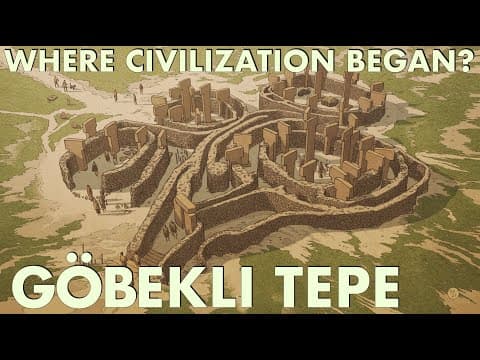
This is a CONFIRMED archaeological breakthrough that turned our understanding of human history upside down. Located in modern-day Turkey, Göbekli Tepe is a massive stone complex built around 11,500 years ago. That makes it older than Stonehenge by over 6,000 years. For decades, historians believed that humans only started building giant stone structures after they settled down and became farmers. Göbekli Tepe proves the opposite. Hunter-gatherers built this masterpiece before agriculture even existed.
Yet, some mysteries remain an OPEN FILE. While the site's creators were once thought to be nomadic wanderers visiting a pure temple, new evidence suggests a different story. Some experts now argue that Göbekli Tepe might have actually been a permanent settlement with houses, not just a lonely place of worship. Whether temple or village, it proves our ancient ancestors were far more advanced than we ever imagined.
“People built massive stone temples at Göbekli Tepe thousands of years before they ever learned how to farm.”
Reflect
If our ancestors could organize huge building projects while still living as wandering hunters, what other achievements have we wrongly assumed require a modern lifestyle?
Research·2 sources·Established confidence·Investigated 2 Aug 2026(1 month ago)·Grounded; verification trace not recorded·Investigation may be outdated
Your next question, in
Evidence
What do we know?
Verified claims with confidence scoring and cited sources.
1 of 3 findings need extra caution. Finding 3 rests on weaker sourcing than the other findings.
Living footnotes
Claims remain in the reading flow. Select a citation number to inspect the source behind it.
01
ObservationalSupported
Göbekli Tepe was built by hunter-gatherers before the invention of agriculture.
For a long time, experts believed people had to start farming before they could build big monuments. Farming meant extra food, which let people settle down and build. But Göbekli Tepe turned this idea upside down. Built between 9600 BCE and 8200 BCE, it is twice as old as Stonehenge. No signs of domesticated crops or animals have been found there. This means wandering hunters built these massive stone circles long before anyone planted the first wheat seed.
02
ObservationalSupported
The site features massive stone pillars carved with geometric precision.
The ruins sit on a mountain ridge in Turkey. They feature huge, T-shaped limestone pillars arranged in circles. The heaviest of these pillars weighs about 50 tons. That is as heavy as a commercial airplane. Moving and carving these stones required hundreds of people working together. Even wilder, researchers used computer models to study the layout. They found that the builders used advanced geometry, like equilateral triangles, to plan the site before they even started digging.
03
ObservationalNot confirmed
Recent excavations show the site was used for daily living, not just rituals.
The original excavator, Klaus Schmidt, thought Göbekli Tepe was only a temple where hunters met for festivals. But archaeology keeps moving. Newer digs have found houses, small buildings, water cisterns, and stone tools. This shows that people did not just visit the site for religious ceremonies. They actually lived there. The site represents a slow, messy transition from wandering to settling down, rather than a sudden change caused by religion alone.
The complete record below preserves every citation, confidence input and recorded limitation.
Read the full evidence record3 findings · citations · limitations
Evidence review3 findings2 openable sources
01
Finding 1 of 3Observational
0/1 verified
Göbekli Tepe was built by hunter-gatherers before the invention of agriculture.
For a long time, experts believed people had to start farming before they could build big monuments. Farming meant extra food, which let people settle down and build. But Göbekli Tepe turned this idea upside down. Built between 9600 BCE and 8200 BCE, it is twice as old as Stonehenge. No signs of domesticated crops or animals have been found there. This means wandering hunters built these massive stone circles long before anyone planted the first wheat seed.
Supportedmodel score 95%
One source, not peer-reviewed. Thinner than the score suggests.
REFERENCE
›View sources and limits— 1 citation, limits
Supporting passage
For a long time, experts believed people had to start farming before they could build big monuments. Farming meant extra food, which let people settle down and build. But Göbekli Tepe turned this idea upside down. Built between 9600 BCE and 8200 BCE, it is twice as old as Stonehenge. No signs of domesticated crops or animals have been found there. This means wandering hunters built these massive stone circles long before anyone planted the first wheat seed.
Rests on a single source. No independent corroboration.
No peer-reviewed source among the citations.
The generator scored this 95%, which would read as “Established”. Its citations reach only “Supported”, so that is what is shown.
02
Finding 2 of 3Observational
0/1 verified
The site features massive stone pillars carved with geometric precision.
The ruins sit on a mountain ridge in Turkey. They feature huge, T-shaped limestone pillars arranged in circles. The heaviest of these pillars weighs about 50 tons. That is as heavy as a commercial airplane. Moving and carving these stones required hundreds of people working together. Even wilder, researchers used computer models to study the layout. They found that the builders used advanced geometry, like equilateral triangles, to plan the site before they even started digging.
Supportedmodel score 90%
One source, not peer-reviewed. Thinner than the score suggests.
REFERENCE
›View sources and limits— 1 citation, limits
Supporting passage
The ruins sit on a mountain ridge in Turkey. They feature huge, T-shaped limestone pillars arranged in circles. The heaviest of these pillars weighs about 50 tons. That is as heavy as a commercial airplane. Moving and carving these stones required hundreds of people working together. Even wilder, researchers used computer models to study the layout. They found that the builders used advanced geometry, like equilateral triangles, to plan the site before they even started digging.
Rests on a single source. No independent corroboration.
No peer-reviewed source among the citations.
The generator scored this 90%, which would read as “Established”. Its citations reach only “Supported”, so that is what is shown.
03
Finding 3 of 3ObservationalNeeds caution
0/0 verified
Recent excavations show the site was used for daily living, not just rituals.
The original excavator, Klaus Schmidt, thought Göbekli Tepe was only a temple where hunters met for festivals. But archaeology keeps moving. Newer digs have found houses, small buildings, water cisterns, and stone tools. This shows that people did not just visit the site for religious ceremonies. They actually lived there. The site represents a slow, messy transition from wandering to settling down, rather than a sudden change caused by religion alone.
Not confirmedmodel score 30%
Scored as if sourced, but every citation failed verification.
NO SURVIVING CITATION
›View sources and limits— limits
Supporting passage
The original excavator, Klaus Schmidt, thought Göbekli Tepe was only a temple where hunters met for festivals. But archaeology keeps moving. Newer digs have found houses, small buildings, water cisterns, and stone tools. This shows that people did not just visit the site for religious ceremonies. They actually lived there. The site represents a slow, messy transition from wandering to settling down, rather than a sudden change caused by religion alone.
Citations (0 of 1 survived verification)
Nothing openable. Every citation was removed by provenance validation.
What limits this
All 1 citation on this claim failed verification and were removed. Nothing openable supports it.
Interactive Exploration
Touch, drag, and discover
These visualizations respond to your curiosity. Interact to go deeper.
timeline
Where Göbekli Tepe Fits in Human History
Loading timeline…
statistics card
Göbekli Tepe by the Numbers
11,500 years
Age of the site
It is twice as old as Stonehenge and the Egyptian pyramids.
50 tons
Weight of largest pillar
Equivalent to the weight of a commercial passenger airplane.
0
Farming tools found
Built entirely by people who lived off hunting and gathering.
Perspectives
How is this interpreted?
Enter a viewpoint. Notice what it reveals, what it leaves out, and whether it changes the question for you.
The EmpiricistScientific viewpointLive tension
Mainstream archaeologists argue that Göbekli Tepe completely flips the story of human progress. We used to think the chain went: farm, settle, build temples. Now, it looks like the desire to gather for rituals came first. Feeding the massive crowds who built these stone circles might have actually forced people to invent farming. It shows that human culture and belief systems drove our technology, not the other way around.
What this lens notices
01Temple construction predates agriculture
02Ritual gatherings created a need for food surplus
03Social coordination began before farming
Application
Why does this matter to you?
Personal reflections and applications for your life.
Thought experimentSelf-Reflection
Do you assume you need a perfect setup before you can start a big project?
Why it changes the question
We often wait for the 'right' conditions to build our dreams. Göbekli Tepe shows us that our ancestors built monuments with almost nothing.
Try this
Choose one big goal you have been putting off and take a small, concrete step toward it today.
Media
QE Smart Glass
Curated media selected for this investigation.
QE Glass
YOUTUBE
The OLDEST temple in the world 🤯 - BBC
BBC
Not just the oldest temple in the world… but the marker of a change in humanity #Human #EllaAlShamahi #GobekliTepe In Turkey ...
QE Glass
YOUTUBE
Humanity’s First Mega-Project: Göbekli Tepe (What Was Their Real Plan?)
Ruhi Cenet Documentaries
Subscribe ▻ https://goo.gl/MKi8tn In southeastern Turkiye lies a secret that is rewriting everything we know about the origins of ...
QE Glass
YOUTUBE
Göbekli Tepe - The First Temple On Earth? 10,000 BC // Ancient History Documentary
History Time
History Time is written, researched and produced by Pete Kelly. Check out my self titled travel/history channel for far flung ...
QE Glass
YOUTUBE
Göbekli Tepe and the Prophecy of Pillar 43 | Apocalypse and the Vulture Stone
The Why Files
Download Opera browser for free! Click here https://opr.as/Opera-browser-TheWhyFiles to upgrade today. Thanks Opera for ...
QE Glass
YOUTUBE
Göbekli Tepe – This Was Built 6,000 Years Before the Pyramids… But Why 10,000 BC | Relaxing History
Relaxing Ancient History and 5 more
Explore the mystery of Göbekli Tepe, the world's oldest known temple, built around 10000 BC—over 6000 years before the ...
QE Glass
YOUTUBE
Göbekli Tepe: The 12,000-Year-Old Temple That Broke History With Its Shocking Secrets | Documentary
Secret Origins
Göbekli Tepe: The 12000-Year-Old Temple That Broke History With Its Shocking Secrets | Documentary Go here ...
QE Glass
YOUTUBE
Göbekli Tepe: The World's First Temple
National Geographic
An in-depth look at the early excavations led by Klaus Schmidt and how they shocked the archaeological world.
QE Glass
PODCAST
Göbekli Tepe: Rewriting Human History
The Ancients
A fascinating discussion with leading experts about the latest discoveries and what they mean for our past.
Keep Going
Where this leads
Questions this investigation opens up — and what QE has already looked into.
No AI help here — no suggestions, no autocomplete, nothing finishing your sentences. That is deliberate. Working out what you think is effortful, and the effort is the part that changes you: reasoning is trained like a muscle, and a muscle that is always carried gets weaker. Let something else do the thinking and you keep the answer but lose the capacity to have reached it.
Write your current position.
Not what the page says. What you think, having read it.0 words · Nothing written yet.
Sign in to leave a mark. Your draft is saved here in the meantime.