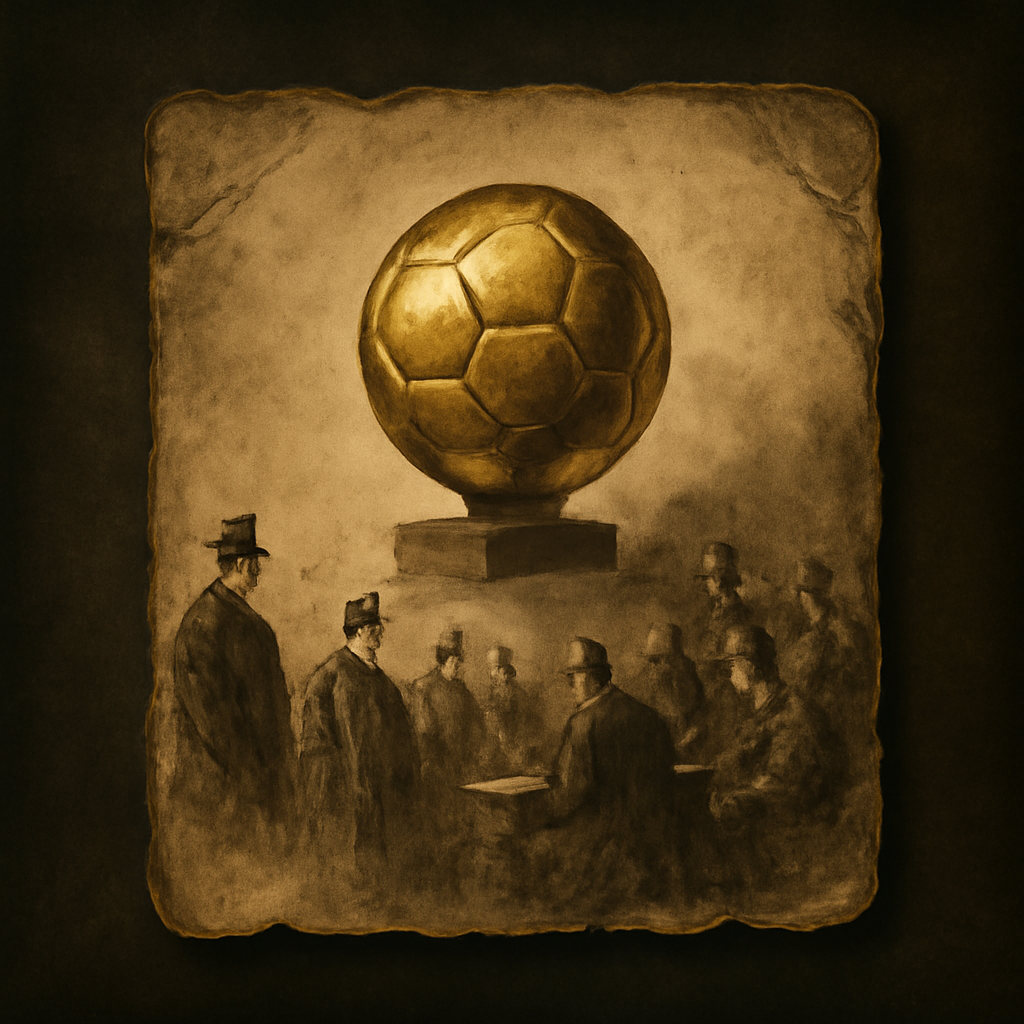
The Golden Ball: Power, Politics, and Prestige of the Ballon d'Or
In 1956, France Football writer Gabriel Hanot wanted to crown Europe’s finest player. The result was the Ballon d’Or. For decades, it was exclusive. Strictly European. This rule famously locked out legends like Pelé and Diego Maradona. Change came slowly. In 1995, the registry opened to any player at a European club, allowing Liberia’s George Weah to claim the prize. By 2007, all geographic barriers dissolved. The golden ball went global.
But defining greatness is a messy science. The voting system has mutated repeatedly. A brief, controversial merger with FIFA invited national coaches and captains to vote, which often turned the award into a simple popularity contest. Today, a curated panel of journalists decides. They weigh three specific criteria: individual brilliance, team trophies, and on-field class. It is a delicate balance. The award tries to solve an impossible puzzle: how to measure a team sport through a single human being.
“For nearly four decades, the world's most prestigious football award was entirely blind to South American legends, meaning Pelé and Diego Maradona never won an official Ballon d'Or during their playing careers.”
Reflect
If individual awards inherently distort our appreciation of collective sports, why does our culture remain so desperate to crown a single, definitive king?
Research·1 source·Developing confidence·Investigated 1 Aug 2026(1 month ago)·Grounded; verification trace not recorded·Investigation may be outdated
Your next question, in
Visual Trail
See The Golden Ball: Power, Politics, and Prestige of the Ballon d'Or
A guided visual explanation assembled from QE artwork and sourced documentary images.
01 / 02
QE visual interpretation
Frame 01
The Golden Ball: Power, Politics, and Prestige of the Ballon d'Or
Established in 1956, the Ballon d'Or has evolved from a restricted European award into football's ultimate, highly debated global individual honor.
Image provenance and limitation
Source: AI-generated visual interpretation
Creator: Question Everything
Limitation: This image explains or evokes the subject. It is not documentary evidence and should not be used to verify a factual claim.
Evidence
What do we know?
Verified claims with confidence scoring and cited sources.
2 of 3 findings need extra caution. Finding 1, Finding 2 rest on weaker sourcing than the other findings.
Living footnotes
Claims remain in the reading flow. Select a citation number to inspect the source behind it.
01
HistoricalNot confirmed
The Ballon d'Or transitioned from a European-exclusive award to a global honor through phased eligibility expansions.
Established in 1956 by Gabriel Hanot and Jacques Ferran, the award initially recognized only European players active in Europe. In 1995, eligibility expanded to include any player at a European club, allowing Liberia's George Weah to win. By 2007, the prize went fully global, opening up to any professional footballer worldwide. This structural evolution reflects soccer's shifting economic and geopolitical landscape over fifty years.
02
ObservationalNot confirmed
The modern voting process is restricted to journalists from the top-ranked FIFA nations evaluating specific season-based criteria.
Since 2022, voting evaluates a standard European season from August to August rather than a calendar year. The jury is restricted to one specialized journalist per nation from the top 100 FIFA-ranked countries for men and top 50 for women. Voters evaluate three strict criteria: individual performance and decisive character, team achievements, and class and fair play, marking a shift away from lifetime achievement bias.
03
AcademicSupported
Voting patterns in the Ballon d'Or reveal an increasing concentration of votes over time, establishing a clear hierarchy in sports celebrity.
Political science analyses of historical voting data indicate that votes have increasingly concentrated on a narrow tier of global superstars. This phenomenon mirrors partisan dynamics in political elections, where fan and voter loyalty mimics political polarization. This trend was exemplified by the decade-long duopoly of Lionel Messi and Cristiano Ronaldo, showcasing how sports eminence is sustained by deep-seated institutional and cultural structures.
The complete record below preserves every citation, confidence input and recorded limitation.
Read the full evidence record3 findings · citations · limitations
Evidence review3 findings1 openable sources
01
Finding 1 of 3HistoricalNeeds caution
0/0 verified
The Ballon d'Or transitioned from a European-exclusive award to a global honor through phased eligibility expansions.
Established in 1956 by Gabriel Hanot and Jacques Ferran, the award initially recognized only European players active in Europe. In 1995, eligibility expanded to include any player at a European club, allowing Liberia's George Weah to win. By 2007, the prize went fully global, opening up to any professional footballer worldwide. This structural evolution reflects soccer's shifting economic and geopolitical landscape over fifty years.
Not confirmedmodel score 30%
Scored as if sourced, but every citation failed verification.
NO SURVIVING CITATION
›View sources and limits— limits
Supporting passage
Established in 1956 by Gabriel Hanot and Jacques Ferran, the award initially recognized only European players active in Europe. In 1995, eligibility expanded to include any player at a European club, allowing Liberia's George Weah to win. By 2007, the prize went fully global, opening up to any professional footballer worldwide. This structural evolution reflects soccer's shifting economic and geopolitical landscape over fifty years.
Citations (0 of 1 survived verification)
Nothing openable. Every citation was removed by provenance validation.
What limits this
All 1 citation on this claim failed verification and were removed. Nothing openable supports it.
02
Finding 2 of 3ObservationalNeeds caution
0/0 verified
The modern voting process is restricted to journalists from the top-ranked FIFA nations evaluating specific season-based criteria.
Since 2022, voting evaluates a standard European season from August to August rather than a calendar year. The jury is restricted to one specialized journalist per nation from the top 100 FIFA-ranked countries for men and top 50 for women. Voters evaluate three strict criteria: individual performance and decisive character, team achievements, and class and fair play, marking a shift away from lifetime achievement bias.
Not confirmedmodel score 30%
Scored as if sourced, but every citation failed verification.
NO SURVIVING CITATION
›View sources and limits— limits
Supporting passage
Since 2022, voting evaluates a standard European season from August to August rather than a calendar year. The jury is restricted to one specialized journalist per nation from the top 100 FIFA-ranked countries for men and top 50 for women. Voters evaluate three strict criteria: individual performance and decisive character, team achievements, and class and fair play, marking a shift away from lifetime achievement bias.
Citations (0 of 1 survived verification)
Nothing openable. Every citation was removed by provenance validation.
What limits this
All 1 citation on this claim failed verification and were removed. Nothing openable supports it.
03
Finding 3 of 3Academic
1
0/1 verified
Voting patterns in the Ballon d'Or reveal an increasing concentration of votes over time, establishing a clear hierarchy in sports celebrity.
Political science analyses of historical voting data indicate that votes have increasingly concentrated on a narrow tier of global superstars. This phenomenon mirrors partisan dynamics in political elections, where fan and voter loyalty mimics political polarization. This trend was exemplified by the decade-long duopoly of Lionel Messi and Cristiano Ronaldo, showcasing how sports eminence is sustained by deep-seated institutional and cultural structures.
Supportedmodel score 95%
A single peer-reviewed source. No independent corroboration.
PRIMARY STUDY
›View sources and limits— 1 citation, limits
Supporting passage
Political science analyses of historical voting data indicate that votes have increasingly concentrated on a narrow tier of global superstars. This phenomenon mirrors partisan dynamics in political elections, where fan and voter loyalty mimics political polarization. This trend was exemplified by the decade-long duopoly of Lionel Messi and Cristiano Ronaldo, showcasing how sports eminence is sustained by deep-seated institutional and cultural structures.
Rests on a single source. No independent corroboration.
The generator scored this 95%, which would read as “Established”. Its citations reach only “Supported”, so that is what is shown.
Interactive Exploration
Touch, drag, and discover
These visualizations respond to your curiosity. Interact to go deeper.
timeline
The Historical Evolution of Eligibility
Loading timeline…
process flow
The Modern Voting and Selection Process
Shortlisting
Jury Selection
Voting Criteria
Tallying & Tie-Breaker
Perspectives
How is this interpreted?
Enter a viewpoint. Notice what it reveals, what it leaves out, and whether it changes the question for you.
The EmpiricistScientific viewpointLive tension
Sports scientists distinguish raw expertise from true eminence, arguing that Ballon d'Or winners possess cognitive and motor skills far exceeding typical elite athletes. Longitudinal studies show these players engage in thousands of hours of highly deliberate, non-linear training. This framework suggests the award does not merely measure luck or media hype, but isolates rare, highly developed neurological and physical adaptations that allow certain athletes to consistently perform at a level of eminence.
02Over 1,000 hours of annual, structured and unstructured training are required.
03Deliberate practice must be paired with high-level scanning and visual exploration.
Application
Why does this matter to you?
Personal reflections and applications for your life.
Thought experimentSelf-Reflection
How do you define individual success in a collaborative environment?
Why it changes the question
We often credit single leaders for team achievements, mimicking the Ballon d'Or's individualist bias. Reflecting on this helps us appreciate the hidden networks of support that make our own successes possible.
Try this
Map out your latest major achievement and identify three people whose uncredited contributions made it possible.
Media
QE Smart Glass
Curated media selected for this investigation.
QE Glass
YOUTUBE
THE HISTORY AND JOURNEY OF BALLOON D'OR AWARD aka GOLDEN BALL
creation sports story
Discover the captivating history of the Ballon d'Or, football's most prestigious individual award! From Gabriel Hanot's visionary ...
QE Glass
YOUTUBE
THE HISTORY AND JOURNEY OF BALLOON D'OR AWARD aka GOLDEN BALL
creation sports story
Discover the captivating history of the Ballon d'Or, football's most prestigious individual award! From Gabriel Hanot's visionary ...
QE Glass
YOUTUBE
Every Individual Award In Football Explained In 9 Minutes
football explained
Want to understand football properly? Get the Football Explained Beginner Starter Pack: ...
QE Glass
YOUTUBE
The Ballon d’Or is not what people think
Tifo Football by The Athletic
Try The Athletic for FREE for 30 days: https://theathletic.com/tifofootball Tifo's new book, "How to Watch Football" is now ...
QE Glass
YOUTUBE
Ballon d'Or: Individual Greatness or Team Success?
amazing golden history
The Ballon d'Or is football's most prestigious individual award—but should it recognize the world's best player regardless of ...
QE Glass
YOUTUBE
Ballon d'Or: Individual Greatness or Team Success?
amazing golden history
The Ballon d'Or is football's most prestigious individual award—but should it recognize the world's best player regardless of ...
QE Glass
YOUTUBE
Ballon d' Or Explained in Hindi || Best Footballer award explained in Hindi || Golden Ball
No AI help here — no suggestions, no autocomplete, nothing finishing your sentences. That is deliberate. Working out what you think is effortful, and the effort is the part that changes you: reasoning is trained like a muscle, and a muscle that is always carried gets weaker. Let something else do the thinking and you keep the answer but lose the capacity to have reached it.
Write your current position.
Not what the page says. What you think, having read it.0 words · Nothing written yet.
Sign in to leave a mark. Your draft is saved here in the meantime.