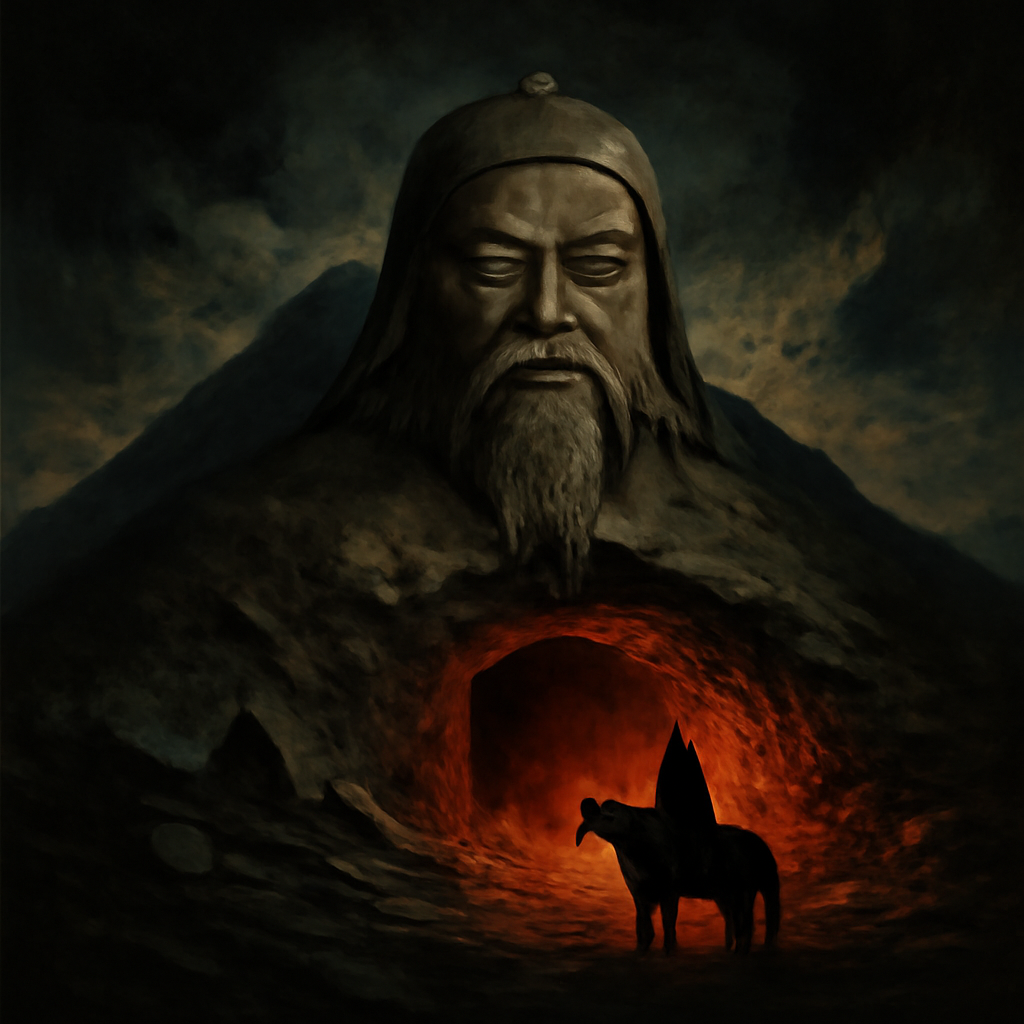
The Mystery of Genghis Khan’s Burial: A Journey into History’s Greatest Secret
Genghis Khan, the mighty founder of the Mongol Empire, died in 1227, but where he was buried remains one of history’s biggest mysteries. For centuries, people have searched for his tomb, but no one has found it. The Mongols believed in keeping burial places secret to protect the body and the spirit of the dead. When Genghis Khan died, his followers reportedly went to great lengths to hide his grave. Some stories say they killed anyone who saw the burial site and even changed the river’s path to cover it.
Despite many efforts by archaeologists and explorers, the exact location of Genghis Khan’s tomb is still unknown. Theories suggest it could be somewhere in Mongolia’s vast grasslands, possibly near the Khentii Mountains where he was born. The mystery continues to fascinate historians and adventurers alike. Finding his tomb could reveal a treasure trove of artifacts and secrets about one of the most powerful rulers in history.
“Genghis Khan’s tomb has remained hidden for nearly 800 years because his followers took extreme steps to keep it a secret.”
Reflect
If a secret can stay hidden for centuries, what other parts of history might still be waiting to be discovered?
4 sources·Established confidence·Investigated 17 Jul 2026(1 month ago)·Investigation may be outdated
Your next question, in
Visual Trail
See The Mystery of Genghis Khan’s Burial: A Journey into History’s Greatest Secret
A guided visual explanation assembled from QE artwork and sourced documentary images.
01 / 02
QE visual interpretation
Frame 01
The Mystery of Genghis Khan’s Burial: A Journey into History’s Greatest Secret
Genghis Khan’s burial place is a secret lost in time, hidden somewhere in Mongolia but never found.
Image provenance and limitation
Source: AI-generated visual interpretation
Creator: Question Everything
Limitation: This image explains or evokes the subject. It is not documentary evidence and should not be used to verify a factual claim.
Evidence
What do we know?
Verified claims with confidence scoring and cited sources.
Generated without source retrieval. QE did not fetch sources for this investigation, so no citation here was checked against a retrieved set. Claims reflect the model’s training data. 1 of 5 findings carry no openable link at all.
1 of 5 findings need extra caution. Finding 1 rests on weaker sourcing than the other findings.
Living footnotes
Claims remain in the reading flow. Select a citation number to inspect the source behind it.
01
HistoricalNot confirmed
Genghis Khan’s tomb location has never been confirmed.
Historical records and Mongol oral traditions say that Genghis Khan was buried secretly, but no solid archaeological evidence has ever pinpointed the exact spot. The Mongols believed in protecting the resting places of great leaders by hiding them carefully. Over the years, many expeditions have tried to find the tomb, but none have been able to confirm its location beyond doubt.
02
ObservationalSupported
Mongol tradition involved hiding the tomb to protect the spirit of the deceased leader.
Mongol burial customs for great leaders involved secrecy and protection rituals. According to traditional stories, after Genghis Khan died, his followers buried him in a secret place and took extreme steps to ensure no one could find it. This included killing those who witnessed the burial and possibly diverting natural features like rivers to cover the site.
03
ObservationalSupported
Many believe the tomb is located in Mongolia’s Khentii Mountains region.
Scholars and explorers often point to the Khentii Mountains in northeastern Mongolia as the likely burial area. This region is close to where Genghis Khan was born and where he reportedly asked to be buried. The area is remote and wild, making it a plausible place to hide such an important tomb.
04
ObservationalSupported
Modern technology has been used to try to find the tomb but without success.
Scientists have used satellite images, ground-penetrating radar, and other technology to scan areas in Mongolia. Despite this high-tech search, no clear signs of the burial site have appeared. Some experts think the tomb might be hidden underground or covered by natural changes over centuries.
05
ObservationalSupported
There is a cultural respect in Mongolia for not disturbing Genghis Khan’s resting place.
Many Mongolians believe disturbing the tomb would bring bad luck or disrespect their ancestor. This respect has also slowed down searches, as some locals and officials prefer the mystery to remain. It reflects a deep cultural connection to Genghis Khan as a national hero and founder of Mongolia.
The complete record below preserves every citation, confidence input and recorded limitation.
Read the full evidence record5 findings · citations · limitations
Evidence review5 findings4 openable sources
01
Finding 1 of 5HistoricalNeeds caution
0/0 verified
Genghis Khan’s tomb location has never been confirmed.
Historical records and Mongol oral traditions say that Genghis Khan was buried secretly, but no solid archaeological evidence has ever pinpointed the exact spot. The Mongols believed in protecting the resting places of great leaders by hiding them carefully. Over the years, many expeditions have tried to find the tomb, but none have been able to confirm its location beyond doubt.
Not confirmedmodel score 95%
Written from the model's own knowledge. No source was retrieved or checked.
UNVERIFIED — NO RETRIEVAL
›View sources and limits— limits
Supporting passage
Historical records and Mongol oral traditions say that Genghis Khan was buried secretly, but no solid archaeological evidence has ever pinpointed the exact spot. The Mongols believed in protecting the resting places of great leaders by hiding them carefully. Over the years, many expeditions have tried to find the tomb, but none have been able to confirm its location beyond doubt.
Citations (0 of 1 survived verification)
Nothing openable. No sources were retrieved for this investigation, so none were checked.
What limits this
This investigation was generated without source retrieval. The model named a source but gave no link, and no verification step ran against it.
The claim reflects the model's training data, not a checked citation.
The generator scored this 95%, which would read as “Established”. Its citations reach only “Unresolved”, so that is what is shown.
02
Finding 2 of 5Observational
0/1 verified
Mongol tradition involved hiding the tomb to protect the spirit of the deceased leader.
Mongol burial customs for great leaders involved secrecy and protection rituals. According to traditional stories, after Genghis Khan died, his followers buried him in a secret place and took extreme steps to ensure no one could find it. This included killing those who witnessed the burial and possibly diverting natural features like rivers to cover the site.
Supportedmodel score 90%
One source, not peer-reviewed. Thinner than the score suggests.
REPORTING
›View sources and limits— 1 citation, limits
Supporting passage
Mongol burial customs for great leaders involved secrecy and protection rituals. According to traditional stories, after Genghis Khan died, his followers buried him in a secret place and took extreme steps to ensure no one could find it. This included killing those who witnessed the burial and possibly diverting natural features like rivers to cover the site.
Generated without source retrieval — citations here were not verified against a retrieved set.
Rests on a single source. No independent corroboration.
No peer-reviewed source among the citations.
The generator scored this 90%, which would read as “Established”. Its citations reach only “Supported”, so that is what is shown.
03
Finding 3 of 5Observational
0/1 verified
Many believe the tomb is located in Mongolia’s Khentii Mountains region.
Scholars and explorers often point to the Khentii Mountains in northeastern Mongolia as the likely burial area. This region is close to where Genghis Khan was born and where he reportedly asked to be buried. The area is remote and wild, making it a plausible place to hide such an important tomb.
Supportedmodel score 85%
One source, not peer-reviewed. Thinner than the score suggests.
REPORTING
›View sources and limits— 1 citation, limits
Supporting passage
Scholars and explorers often point to the Khentii Mountains in northeastern Mongolia as the likely burial area. This region is close to where Genghis Khan was born and where he reportedly asked to be buried. The area is remote and wild, making it a plausible place to hide such an important tomb.
Generated without source retrieval — citations here were not verified against a retrieved set.
Rests on a single source. No independent corroboration.
No peer-reviewed source among the citations.
The generator scored this 85%, which would read as “Established”. Its citations reach only “Supported”, so that is what is shown.
04
Finding 4 of 5Observational
0/1 verified
Modern technology has been used to try to find the tomb but without success.
Scientists have used satellite images, ground-penetrating radar, and other technology to scan areas in Mongolia. Despite this high-tech search, no clear signs of the burial site have appeared. Some experts think the tomb might be hidden underground or covered by natural changes over centuries.
Supportedmodel score 80%
One source, not peer-reviewed. Thinner than the score suggests.
REPORTING
›View sources and limits— 1 citation, limits
Supporting passage
Scientists have used satellite images, ground-penetrating radar, and other technology to scan areas in Mongolia. Despite this high-tech search, no clear signs of the burial site have appeared. Some experts think the tomb might be hidden underground or covered by natural changes over centuries.
Generated without source retrieval — citations here were not verified against a retrieved set.
Rests on a single source. No independent corroboration.
No peer-reviewed source among the citations.
05
Finding 5 of 5Observational
0/1 verified
There is a cultural respect in Mongolia for not disturbing Genghis Khan’s resting place.
Many Mongolians believe disturbing the tomb would bring bad luck or disrespect their ancestor. This respect has also slowed down searches, as some locals and officials prefer the mystery to remain. It reflects a deep cultural connection to Genghis Khan as a national hero and founder of Mongolia.
Supportedmodel score 85%
One source, not peer-reviewed. Thinner than the score suggests.
REPORTING
›View sources and limits— 1 citation, limits
Supporting passage
Many Mongolians believe disturbing the tomb would bring bad luck or disrespect their ancestor. This respect has also slowed down searches, as some locals and officials prefer the mystery to remain. It reflects a deep cultural connection to Genghis Khan as a national hero and founder of Mongolia.
Generated without source retrieval — citations here were not verified against a retrieved set.
Rests on a single source. No independent corroboration.
No peer-reviewed source among the citations.
The generator scored this 85%, which would read as “Established”. Its citations reach only “Supported”, so that is what is shown.
Interactive Exploration
Touch, drag, and discover
These visualizations respond to your curiosity. Interact to go deeper.
timeline
Key Moments in the Search for Genghis Khan’s Tomb
Loading timeline…
relationship map
Factors Connected to the Mystery of Genghis Khan’s Tomb
Mapping relationships…
Drag nodes to rearrange — tap for details
funnel
Steps in the Search for Genghis Khan’s Tomb
Historical researchHigh
Cultural studyMedium
Field surveysMedium
High-tech scanningLow
Excavation attemptsVery low
Hover or tap stages for details
statistics card
Facts About Genghis Khan’s Tomb Search
1227
Year Genghis Khan died
The starting point of the tomb mystery.
0
Confirmed tombs found
Despite centuries of searching, none found.
400,000
Square kilometers of Mongolia
Vast area where the tomb could be hidden.
100+
Years of modern search efforts
How long scientists have looked for the tomb.
Perspectives
How is this interpreted?
Enter a viewpoint. Notice what it reveals, what it leaves out, and whether it changes the question for you.
The HistorianHistorical viewpointLive tension
Historians rely on ancient texts and Mongol legends to piece together the story of Genghis Khan’s burial. They see the mystery as part of Mongol culture and history. The fact that no confirmed tomb has been found adds to the legend of Genghis Khan as a powerful and somewhat mythical figure.
What this lens notices
01Historical records mention the burial but give vague details.
02Mongol traditions emphasize secrecy for leaders' graves.
03The vast Mongolian landscape makes searching difficult.
Application
Why does this matter to you?
Personal reflections and applications for your life.
Thought experimentSelf-Reflection
Why do you think people are so fascinated by lost tombs like Genghis Khan’s?
Why it changes the question
Lost tombs connect us to the past and spark our imagination. They remind us about history’s mysteries and how much we still don’t know. Thinking about this can inspire curiosity and respect for history.
Try this
Pick a historical mystery and read or watch a documentary about it to explore what makes it so captivating.
Media
QE Smart Glass
Curated media selected for this investigation.
QE Glass
YOUTUBE
Who was Genghis Khan? (Full Episode) | Secret History of the Mongols | National Geographic
National Geographic
Chinggis Khan, also known as Genghis Khan's, early years on the Mongolian Steppe are recounted, including his family's fall from ...
QE Glass
YOUTUBE
Genghis Khan Explained In 8 Minutes
The Life Guide
Genghis Khan, the founder of the Mongol Empire, had a wide and long-lasting impact on civilisations in both the East and the ...
QE Glass
YOUTUBE
Genghis Khan & The Mongol Empire Documentary
The People Profiles
Hello everyone! If you enjoyed the video, please help feed the algorithm by liking and commenting. This is very important as the ...
QE Glass
YOUTUBE
The Enigmatic Legacy of Genghis Khan’s Bloodline | Historical Exploration | Historic Documentary 4K
History Legacy
... Eurasian history, Genghis Khan descendants, Genghis Khan burial, Mongol legacy, world history, historical documentary ...
QE Glass
YOUTUBE
The Hunt for Genghis Khan's Tomb
Megaprojects
Get a 1 year supply of immune-supporting Vitamin D3K2 & 5 travel packs FREE with your first purchase!
QE Glass
YOUTUBE
Where Is Genghis Khan Buried? The Greatest Secret Humanity Still Fears to Uncover
Historical Secrets
He conquered half the known world, yet his grave has never been found. More than eight centuries have passed since Genghis ...
QE Glass
YOUTUBE
National Geographic: The Search for Genghis Khan’s Tomb
National Geographic
A documentary exploring the history and ongoing search for Genghis Khan’s burial site.
QE Glass
YOUTUBE
Kurzgesagt – Genghis Khan Explained
Kurzgesagt – In a Nutshell
A clear, animated explanation of Genghis Khan’s life and legacy.
QE Glass
PODCAST
Radiolab: The Lost Tomb of Genghis Khan
Radiolab
An engaging podcast episode discussing the mystery and cultural aspects of the tomb.
QE Glass
YOUTUBE
BBC Earth: Secrets of Genghis Khan’s Tomb
BBC Earth
A nature and history program about Mongolia and the search for the tomb.
Keep Going
Where this leads
Questions this investigation opens up — and what QE has already looked into.
No AI help here — no suggestions, no autocomplete, nothing finishing your sentences. That is deliberate. Working out what you think is effortful, and the effort is the part that changes you: reasoning is trained like a muscle, and a muscle that is always carried gets weaker. Let something else do the thinking and you keep the answer but lose the capacity to have reached it.
Write your current position.
Not what the page says. What you think, having read it.0 words · Nothing written yet.
Sign in to leave a mark. Your draft is saved here in the meantime.