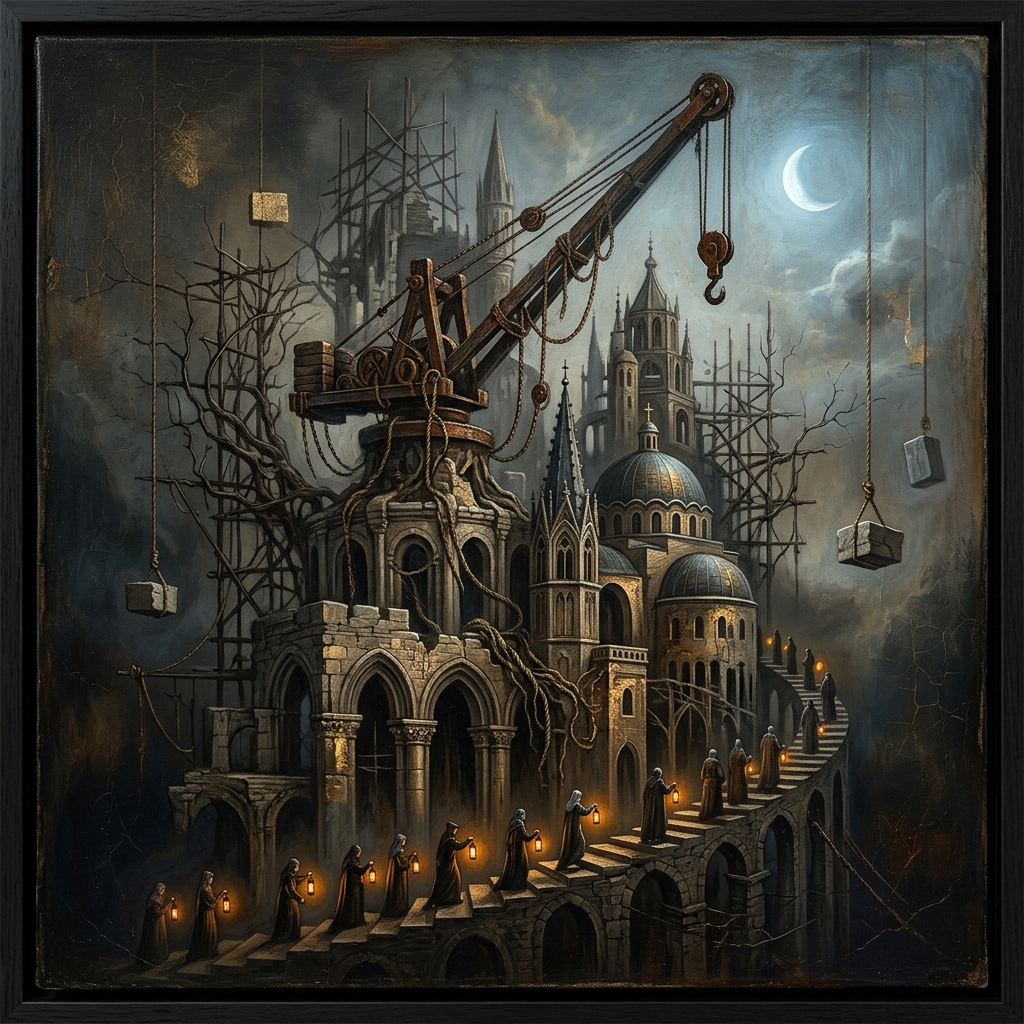
Imagine starting a project today, knowing that your great-great-great-grandchildren still won't see it finished. That was the reality for the builders of some of the world's most famous landmarks. For centuries, communities poured their money, sweat, and lives into giant stone structures. They did this knowing they would die long before the final stone was laid.
We get frustrated when roadworks take a few weeks. But history's longest construction projects lasted for centuries. These giant buildings survived plagues, wars, and the collapse of empires. The people who started them spoke different languages and used different tools than the people who finally finished them.
Let's take a look at the ultimate slow builds. From German cathedrals to Egyptian temples, these projects show what humans can achieve when they plan for the deep future.
✨
Wonder Moment
“Cologne Cathedral took 632 years to build. That is long enough for the language, technology, and country around it to change completely. The people who finished it could not easily understand the language of the people who started it.”
Reflect
If you were asked to start a project today that only your descendants 20 generations from now would see finished, what would you choose to build?
1 source·Established confidence·Investigated 11 Jul 2026(1 month ago)·Investigation may be outdated
Your next question, in
Visual Trail
See The Slowest Builds in Human History
A guided visual explanation assembled from QE artwork and sourced documentary images.
01 / 05
QE visual interpretation
Frame 01
The Slowest Builds in Human History
Cologne Cathedral in Germany took 632 years to finish, while Egypt's Karnak Temple was worked on for nearly 2,000 years.
Image provenance and limitation
Source: AI-generated visual interpretation
Creator: Question Everything
Limitation: This image explains or evokes the subject. It is not documentary evidence and should not be used to verify a factual claim.
Evidence
What do we know?
Verified claims with confidence scoring and cited sources.
Generated without source retrieval. QE did not fetch sources for this investigation, so no citation here was checked against a retrieved set. Claims reflect the model’s training data. 2 of 3 findings carry no openable link at all.
2 of 3 findings need extra caution. Finding 2, Finding 3 rest on weaker sourcing than the other findings.
Living footnotes
Claims remain in the reading flow. Select a citation number to inspect the source behind it.
01
HistoricalSupported
Cologne Cathedral took over 600 years from start to finish
Builders started work on this massive German church in the year 1248. They wanted it to be the grandest house of worship in Europe. But by the late 1400s, the city ran out of money and lost interest. They stopped building entirely in 1473.
For nearly 400 years, a giant wooden crane sat on top of a half-finished tower. It became a famous, messy part of the city skyline. Finally, in 1842, workers went back to work. They used the original medieval plans but added modern iron beams to help hold it up. They finished the church in 1880. That is a total of 632 years.
02
HistoricalNot confirmed
The Karnak Temple Complex in Egypt was built over a span of 2,000 years
Karnak is not just one building, but a massive city of temples. It is the largest religious site ever built. Generation after generation of Egyptian rulers, called Pharaohs, wanted to leave their mark.
Construction began around 2000 BC. Each new pharaoh added their own rooms, giant pillars, and statues. Some rulers even tore down older parts to reuse the stone for their own monuments. The building work only stopped when Rome took over Egypt around 30 BC. By then, the complex had been a work in progress for about 2,000 years.
03
ObservationalNot confirmed
The Sagrada Família in Spain is the longest-running active project today
This famous church in Barcelona was designed by an architect named Antoni Gaudí. Workers laid the first stone in 1882. Gaudí knew he would not live to see it finished. He once joked that his 'client' (God) was in no hurry.
The project has faced many stops and starts. A civil war destroyed Gaudí's original plaster models, and workers had to piece his designs back together like a puzzle. Because the church is funded only by visitor ticket sales and donations, progress has been slow. It has been under construction for over 140 years, which is longer than it took to build the Great Pyramids of Giza.
The complete record below preserves every citation, confidence input and recorded limitation.
Read the full evidence record3 findings · citations · limitations
Evidence review3 findings1 openable sources
01
Finding 1 of 3Historical
1996
1 dated source
Cologne Cathedral took over 600 years from start to finish
Builders started work on this massive German church in the year 1248. They wanted it to be the grandest house of worship in Europe. But by the late 1400s, the city ran out of money and lost interest. They stopped building entirely in 1473.
For nearly 400 years, a giant wooden crane sat on top of a half-finished tower. It became a famous, messy part of the city skyline. Finally, in 1842, workers went back to work. They used the original medieval plans but added modern iron beams to help hold it up. They finished the church in 1880. That is a total of 632 years.
Supportedmodel score 100%
A single peer-reviewed source. No independent corroboration.
PRIMARY STUDY
›View sources and limits— 1 citation, limits
Supporting passage
Builders started work on this massive German church in the year 1248. They wanted it to be the grandest house of worship in Europe. But by the late 1400s, the city ran out of money and lost interest. They stopped building entirely in 1473.
For nearly 400 years, a giant wooden crane sat on top of a half-finished tower. It became a famous, messy part of the city skyline. Finally, in 1842, workers went back to work. They used the original medieval plans but added modern iron beams to help hold it up. They finished the church in 1880. That is a total of 632 years.
Generated without source retrieval — citations here were not verified against a retrieved set.
Rests on a single source. No independent corroboration.
The generator scored this 100%, which would read as “Established”. Its citations reach only “Supported”, so that is what is shown.
02
Finding 2 of 3HistoricalNeeds caution
0/0 verified
The Karnak Temple Complex in Egypt was built over a span of 2,000 years
Karnak is not just one building, but a massive city of temples. It is the largest religious site ever built. Generation after generation of Egyptian rulers, called Pharaohs, wanted to leave their mark.
Construction began around 2000 BC. Each new pharaoh added their own rooms, giant pillars, and statues. Some rulers even tore down older parts to reuse the stone for their own monuments. The building work only stopped when Rome took over Egypt around 30 BC. By then, the complex had been a work in progress for about 2,000 years.
Not confirmedmodel score 95%
Written from the model's own knowledge. No source was retrieved or checked.
UNVERIFIED — NO RETRIEVAL
›View sources and limits— limits
Supporting passage
Karnak is not just one building, but a massive city of temples. It is the largest religious site ever built. Generation after generation of Egyptian rulers, called Pharaohs, wanted to leave their mark.
Construction began around 2000 BC. Each new pharaoh added their own rooms, giant pillars, and statues. Some rulers even tore down older parts to reuse the stone for their own monuments. The building work only stopped when Rome took over Egypt around 30 BC. By then, the complex had been a work in progress for about 2,000 years.
Citations (0 of 1 survived verification)
Nothing openable. No sources were retrieved for this investigation, so none were checked.
What limits this
This investigation was generated without source retrieval. The model named a source but gave no link, and no verification step ran against it.
The claim reflects the model's training data, not a checked citation.
The generator scored this 95%, which would read as “Established”. Its citations reach only “Unresolved”, so that is what is shown.
03
Finding 3 of 3ObservationalNeeds caution
0/0 verified
The Sagrada Família in Spain is the longest-running active project today
This famous church in Barcelona was designed by an architect named Antoni Gaudí. Workers laid the first stone in 1882. Gaudí knew he would not live to see it finished. He once joked that his 'client' (God) was in no hurry.
The project has faced many stops and starts. A civil war destroyed Gaudí's original plaster models, and workers had to piece his designs back together like a puzzle. Because the church is funded only by visitor ticket sales and donations, progress has been slow. It has been under construction for over 140 years, which is longer than it took to build the Great Pyramids of Giza.
Not confirmedmodel score 100%
Written from the model's own knowledge. No source was retrieved or checked.
UNVERIFIED — NO RETRIEVAL
›View sources and limits— limits
Supporting passage
This famous church in Barcelona was designed by an architect named Antoni Gaudí. Workers laid the first stone in 1882. Gaudí knew he would not live to see it finished. He once joked that his 'client' (God) was in no hurry.
The project has faced many stops and starts. A civil war destroyed Gaudí's original plaster models, and workers had to piece his designs back together like a puzzle. Because the church is funded only by visitor ticket sales and donations, progress has been slow. It has been under construction for over 140 years, which is longer than it took to build the Great Pyramids of Giza.
Citations (0 of 1 survived verification)
Nothing openable. No sources were retrieved for this investigation, so none were checked.
What limits this
This investigation was generated without source retrieval. The model named a source but gave no link, and no verification step ran against it.
The claim reflects the model's training data, not a checked citation.
The generator scored this 100%, which would read as “Established”. Its citations reach only “Unresolved”, so that is what is shown.
Interactive Exploration
Touch, drag, and discover
These visualizations respond to your curiosity. Interact to go deeper.
timeline
Timeline of Super-Slow Builds
Loading timeline…
comparison table
How the Giants Compare
Years to Build
Why it Took So Long
Karnak Temple
~2,000 years
Every new Pharaoh wanted to add their own giant rooms and statues.
Cologne Cathedral
632 years
They ran out of money and stopped building for nearly 400 years.
Sagrada Família
140+ years (Ongoing)
Relies entirely on private donations and survived a war.
Great Pyramid
20 years
Built by a highly organized force of tens of thousands of workers.
Tap any row to highlight and compare
statistics card
Cologne Cathedral by the Numbers
632
Years to complete
Longer than the entire history of the United States.
370
Years the project was paused
The giant wooden crane sat untouched on the roof for generations.
157m
Height of the towers
Roughly as tall as a 50-story building, made entirely of stone.
Visual Gallery
Images & artifacts
Historical images, diagrams, and visual knowledge from Wikimedia Commons.
Perspectives
How is this interpreted?
Enter a viewpoint. Notice what it reveals, what it leaves out, and whether it changes the question for you.
The HistorianHistorical viewpointEstablished lens
In the Middle Ages, building a giant church was a community's ultimate goal. It brought jobs, pride, and tourists (called pilgrims) to the city. But these projects were also highly vulnerable. If a plague hit, half the stonemasons died. If a war started, the money went to soldiers instead of stone. This explains why building work often stopped for decades, or even centuries, at a time.
What this lens notices
01Plagues like the Black Death wiped out skilled workers.
02Wars forced cities to spend money on defense instead of decoration.
03Changes in religious fashion made older styles unpopular for a time.
Application
Why does this matter to you?
Personal reflections and applications for your life.
Thought experimentSelf-Reflection
What is your personal 'cathedral'?
Why it changes the question
Most of us focus on what we can get done today, this week, or this year. But the greatest human achievements took lifetimes. Think about a goal that might take decades to finish, like writing a book, planting a forest, or raising a family.
Try this
Write down one goal you have that will take at least ten years to achieve. What is one small step you can take toward it today?
Media
QE Smart Glass
Curated media selected for this investigation.
QE Glass
YOUTUBE
How the world's longest underwater tunnel was built - Alex Gendler
TED-Ed
Discover how the English Channel Tunnel was built and the engineering challenges of building a 200 kilometer long tunnel ...
QE Glass
YOUTUBE
The World's Oldest Construction Project | Sagrada Familia
Real Engineering
Be one of the first 500 people to sign up with this link and get 20% off your subscription with Brilliant.org!
QE Glass
YOUTUBE
How the world’s tallest skyscraper was built - Alex Gendler
TED-Ed
Discover the engineering innovations that made building Burj Khalifa, the world's tallest skyscraper, possible. -- In 2004 ...
QE Glass
YOUTUBE
What makes the Great Wall of China so extraordinary - Megan Campisi and Pen-Pen Chen
TED-Ed
View full lesson: ...
QE Glass
YOUTUBE
How the world's first metro system was built - Christian Wolmar
TED-Ed
Learn more about our student voice program, TED-Ed Clubs: http://bit.ly/2J5g4eS View full lesson: ...
QE Glass
YOUTUBE
How Rome Forged an Epic Empire | Engineering an Empire | Full Episode | History
HISTORY
The Colosseum, a new 8-part premium documentary series, premieres July 17 at 9pm ET/PT on The History Channel. For more ...
QE Glass
YOUTUBE
How the world’s tallest skyscraper was built - Alex Gendler
TED-Ed
Discover the engineering innovations that made building Burj Khalifa, the world's tallest skyscraper, possible. -- In 2004 ...
QE Glass
YOUTUBE
Why Did Cathedrals Take So Long To Build?
TED-Ed
This short cartoon video explains the incredible math, money, and muscle needed to build medieval cathedrals.
QE Glass
PODCAST
How Cathedral Thinking Works
Stuff You Should Know
A fun, friendly chat about why humans build things that outlast their own lives.
Keep Going
Where this leads
Questions this investigation opens up — and what QE has already looked into.
No AI help here — no suggestions, no autocomplete, nothing finishing your sentences. That is deliberate. Working out what you think is effortful, and the effort is the part that changes you: reasoning is trained like a muscle, and a muscle that is always carried gets weaker. Let something else do the thinking and you keep the answer but lose the capacity to have reached it.
Write your current position.
Not what the page says. What you think, having read it.0 words · Nothing written yet.
Sign in to leave a mark. Your draft is saved here in the meantime.