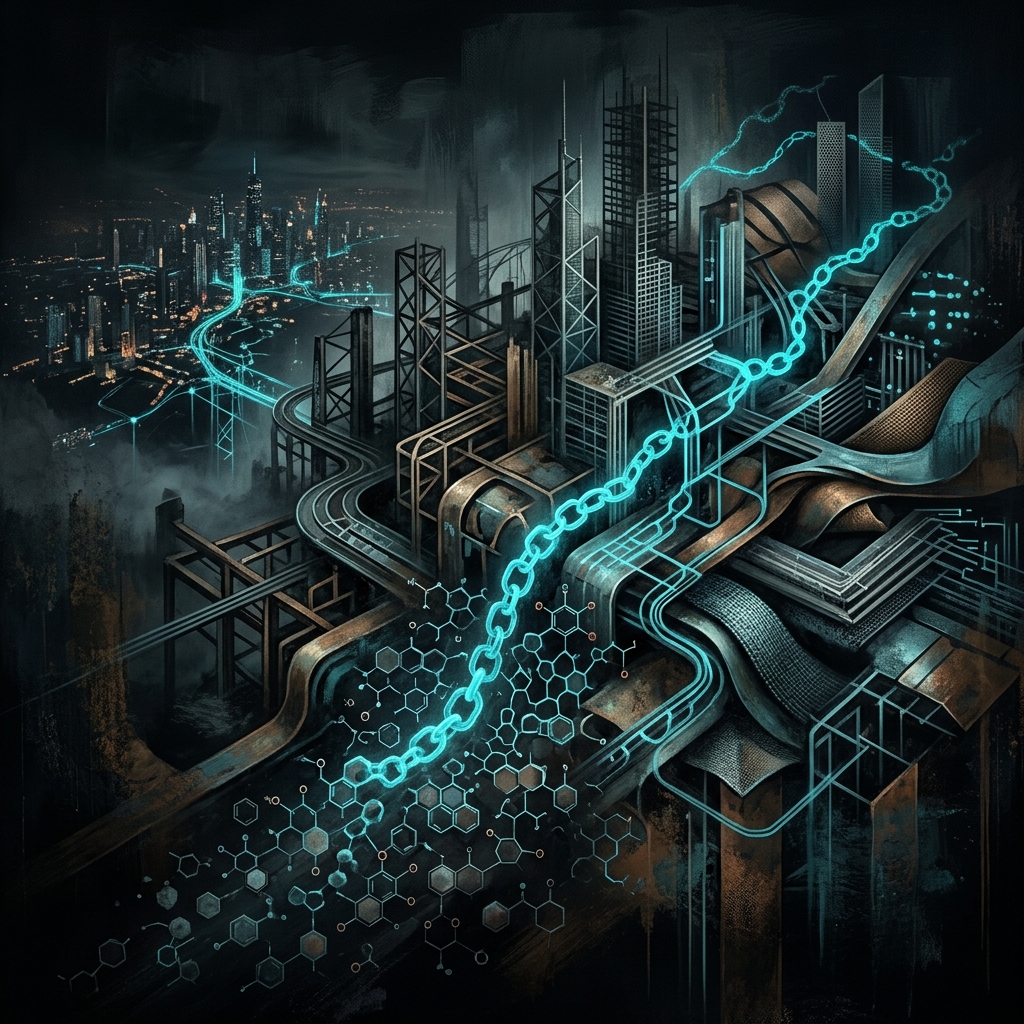
The Chemistry of Connection: How Polymerization Built the Modern World
Look closely at a leaf. Or your own fingernail. Or the synthetic fabric of your shirt. You are looking at the work of nature's ultimate construction crew: polymerization. This is the simple yet profound process of taking tiny, individual molecules and linking them together into endlessly repeating chains. In the natural world, it is the mechanism that builds the cellulose of towering redwoods and the very DNA coiled inside your cells. It is nature’s way of weaving strength out of simplicity.
But humans learned this trick too. In the early twentieth century, we unlocked the secrets of synthetic polymerization. By copying nature's blueprint, we created entirely new materials that never existed before—plastics, rubbers, and nylon. These materials reshaped our homes, our medicine, and our technology. They are lightweight, durable, and incredibly cheap to make.
Yet, this superpower comes with a dark side. The very strength we engineered into these synthetic chains makes them nearly indestructible. They do not rot. They do not break down. Today, we stand at a crossroads, trying to harness this remarkable molecular dance to create new, self-destructing green materials that protect the planet they helped us build.
✨
Wonder Moment
“The plastic bag you used today for five minutes will likely outlive your great-grandchildren because its synthetic polymer chains are a language nature simply does not know how to read or dismantle.”
Reflect
If we can engineer polymer chains that respond to specific environmental triggers—like light, ocean water, or soil microbes—can we build a civilization of self-cleaning convenience that leaves absolutely no trace behind?
2 sources·Established confidence·Investigated 14 Jul 2026(1 month ago)·Investigation may be outdated
Your next question, in
Visual Trail
See The Chemistry of Connection: How Polymerization Built the Modern World
A guided visual explanation assembled from QE artwork and sourced documentary images.
01 / 05
QE visual interpretation
Frame 01
The Chemistry of Connection: How Polymerization Built the Modern World
The molecular process of linking tiny chemical building blocks together to create everything from DNA to plastic.
Image provenance and limitation
Source: AI-generated visual interpretation
Creator: Question Everything
Limitation: This image explains or evokes the subject. It is not documentary evidence and should not be used to verify a factual claim.
Evidence
What do we know?
Verified claims with confidence scoring and cited sources.
Generated without source retrieval. QE did not fetch sources for this investigation, so no citation here was checked against a retrieved set. Claims reflect the model’s training data. 1 of 3 findings carry no openable link at all.
1 of 3 findings need extra caution. Finding 1 rests on weaker sourcing than the other findings.
Living footnotes
Claims remain in the reading flow. Select a citation number to inspect the source behind it.
01
AcademicNot confirmed
Nature is the original and most prolific polymerizer, creating DNA, proteins, and cellulose.
Long before humans synthesized nylon, biological systems perfected the art of the macromolecule. Every protein in your body is a polymer made from amino acid monomers. DNA is a highly complex copolymer, carrying genetic information along a repeating backbone of sugar and phosphate. Cell walls in plants are built from cellulose, a tough polymer of glucose units that gives trees their structural strength.
Without these natural chain-building processes, complex life would be chemically impossible. Nature uses precise enzymatic catalysts to ensure these chains are built without errors, a level of control synthetic chemists still struggle to match.
02
HistoricalSupported
Synthetic polymerization transformed human material culture starting in the early 20th century.
In 1907, Leo Baekeland created Bakelite, the world’s first fully synthetic plastic. He did this by reacting phenol and formaldehyde under heat and pressure, locking them into a rigid, three-dimensional polymer network. This marked a massive shift. Humans were no longer limited to using wood, stone, and metal. We could now design materials from the molecule up.
Following Bakelite, the discovery of nylon, polyethylene, and Teflon changed everything from food preservation to space travel. These synthetic chains gave us cheap, sterile, and virtually indestructible tools, laying the material foundations of modern society.
03
ExperimentalSupported
Polymerization occurs through two distinct chemical pathways: addition and condensation.
Chemists group polymerization reactions into two main families. The first is addition polymerization, where monomers with double bonds simply open up and link together. No atoms are lost. It is clean and direct, like Lego bricks snapping together. This is how we get polyethylene for plastic bags.
The second is condensation polymerization. Here, molecules link up by sharing a handshake that spits out a tiny byproduct—usually a molecule of water or alcohol. Nylon and polyester are made this way. For every link forged in a nylon chain, a molecule of water is cast aside.
The complete record below preserves every citation, confidence input and recorded limitation.
Read the full evidence record3 findings · citations · limitations
Evidence review3 findings2 openable sources
01
Finding 1 of 3AcademicNeeds caution
0
0/0 verified
Nature is the original and most prolific polymerizer, creating DNA, proteins, and cellulose.
Long before humans synthesized nylon, biological systems perfected the art of the macromolecule. Every protein in your body is a polymer made from amino acid monomers. DNA is a highly complex copolymer, carrying genetic information along a repeating backbone of sugar and phosphate. Cell walls in plants are built from cellulose, a tough polymer of glucose units that gives trees their structural strength.
Without these natural chain-building processes, complex life would be chemically impossible. Nature uses precise enzymatic catalysts to ensure these chains are built without errors, a level of control synthetic chemists still struggle to match.
Not confirmedmodel score 100%
Written from the model's own knowledge. No source was retrieved or checked.
UNVERIFIED — NO RETRIEVAL
›View sources and limits— limits
Supporting passage
Long before humans synthesized nylon, biological systems perfected the art of the macromolecule. Every protein in your body is a polymer made from amino acid monomers. DNA is a highly complex copolymer, carrying genetic information along a repeating backbone of sugar and phosphate. Cell walls in plants are built from cellulose, a tough polymer of glucose units that gives trees their structural strength.
Without these natural chain-building processes, complex life would be chemically impossible. Nature uses precise enzymatic catalysts to ensure these chains are built without errors, a level of control synthetic chemists still struggle to match.
Citations (0 of 1 survived verification)
Nothing openable. No sources were retrieved for this investigation, so none were checked.
What limits this
This investigation was generated without source retrieval. The model named a source but gave no link, and no verification step ran against it.
The claim reflects the model's training data, not a checked citation.
The generator scored this 100%, which would read as “Established”. Its citations reach only “Unresolved”, so that is what is shown.
02
Finding 2 of 3Historical
2018
1 dated source
Synthetic polymerization transformed human material culture starting in the early 20th century.
In 1907, Leo Baekeland created Bakelite, the world’s first fully synthetic plastic. He did this by reacting phenol and formaldehyde under heat and pressure, locking them into a rigid, three-dimensional polymer network. This marked a massive shift. Humans were no longer limited to using wood, stone, and metal. We could now design materials from the molecule up.
Following Bakelite, the discovery of nylon, polyethylene, and Teflon changed everything from food preservation to space travel. These synthetic chains gave us cheap, sterile, and virtually indestructible tools, laying the material foundations of modern society.
Supportedmodel score 100%
One source, not peer-reviewed. Thinner than the score suggests.
REFERENCE
›View sources and limits— 1 citation, limits
Supporting passage
In 1907, Leo Baekeland created Bakelite, the world’s first fully synthetic plastic. He did this by reacting phenol and formaldehyde under heat and pressure, locking them into a rigid, three-dimensional polymer network. This marked a massive shift. Humans were no longer limited to using wood, stone, and metal. We could now design materials from the molecule up.
Following Bakelite, the discovery of nylon, polyethylene, and Teflon changed everything from food preservation to space travel. These synthetic chains gave us cheap, sterile, and virtually indestructible tools, laying the material foundations of modern society.
Generated without source retrieval — citations here were not verified against a retrieved set.
Rests on a single source. No independent corroboration.
No peer-reviewed source among the citations.
The generator scored this 100%, which would read as “Established”. Its citations reach only “Supported”, so that is what is shown.
03
Finding 3 of 3Experimental
1
0/1 verified
Polymerization occurs through two distinct chemical pathways: addition and condensation.
Chemists group polymerization reactions into two main families. The first is addition polymerization, where monomers with double bonds simply open up and link together. No atoms are lost. It is clean and direct, like Lego bricks snapping together. This is how we get polyethylene for plastic bags.
The second is condensation polymerization. Here, molecules link up by sharing a handshake that spits out a tiny byproduct—usually a molecule of water or alcohol. Nylon and polyester are made this way. For every link forged in a nylon chain, a molecule of water is cast aside.
Supportedmodel score 100%
A single peer-reviewed source. No independent corroboration.
PRIMARY STUDY
›View sources and limits— 1 citation, limits
Supporting passage
Chemists group polymerization reactions into two main families. The first is addition polymerization, where monomers with double bonds simply open up and link together. No atoms are lost. It is clean and direct, like Lego bricks snapping together. This is how we get polyethylene for plastic bags.
The second is condensation polymerization. Here, molecules link up by sharing a handshake that spits out a tiny byproduct—usually a molecule of water or alcohol. Nylon and polyester are made this way. For every link forged in a nylon chain, a molecule of water is cast aside.
Historical images, diagrams, and visual knowledge from Wikimedia Commons.
Perspectives
How is this interpreted?
Enter a viewpoint. Notice what it reveals, what it leaves out, and whether it changes the question for you.
The EmpiricistScientific viewpointEstablished lens
From a molecular physics and chemistry viewpoint, polymerization is a triumph of thermodynamic control. By using heat, pressure, and clever catalysts—like the Nobel Prize-winning Ziegler-Natta catalysts—we can force chaotic mixtures of small gas molecules like ethylene to pack tightly into dense, ordered solid crystals. The study of these macromolecules has allowed us to tune materials to be ultra-flexible, rock-hard, or incredibly heat-resistant.
What this lens notices
01Catalysts lower the activation energy required to initiate the reaction.
02Controlling chain length and branching directly dictates the material's final physical properties.
03Living polymerization techniques now allow scientists to grow chains to exact target lengths.
Application
Why does this matter to you?
Personal reflections and applications for your life.
Thought experimentSelf-Reflection
How many polymers are you wearing or touching right now?
Why it changes the question
Look at your surroundings. Your keyboard, the soles of your shoes, your phone case, and likely the carpet beneath you are all built from synthetic polymer chains. Understanding this reveals how deeply dependent our daily lives are on materials engineered at the molecular level.
Try this
Check the clothing tags of your favorite outfits. Note how many are made of polyester, nylon, or acrylic (synthetic polymers) versus cotton or wool (natural polymers).
Media
QE Smart Glass
Curated media selected for this investigation.
QE Glass
YOUTUBE
Polymers: Crash Course Chemistry #45
CrashCourse
Did you know that Polymers save the lives of Elephants? Well, now you do! The world of Polymers is so amazingly integrated into ...
QE Glass
YOUTUBE
32. Polymers I (Intro to Solid-State Chemistry)
MIT OpenCourseWare
MIT 3.091 Introduction to Solid-State Chemistry, Fall 2018 Instructor: Jeffrey C. Grossman View the complete course: ...
QE Glass
YOUTUBE
A brief history of plastic
TED-Ed
Join #TeamSeas! Together, we're going to raise $30M to remove 30M pounds of plastic and trash from our ocean, rivers and ...
QE Glass
YOUTUBE
The Surprising Science of Plastics
The Efficient Engineer
Click the link to visit Protolabs and get an instant quote today!
QE Glass
YOUTUBE
GCSE Chemistry - What is a Polymer? Polymers / Monomers / Their Properties Explained (2026/27 exams)
Cognito
Check out our website https://www.cognito.org/ ⭐️ Everything you need to know about polymers! Polymers are large molecules ...
QE Glass
YOUTUBE
Polymer Film Preparation Methods |Film formation using Solution casting, Spin coating, Hot pressing
CASE Chemistry
Film formation typically occurs through mechanisms such as solvent evaporation leading to polymer precipitation, thermal ...
QE Glass
YOUTUBE
The Science Behind Plastic Production | Oil to Polymer Explained 😱🛢️
Tangle Trix
The Science Behind Plastic Production | Oil to Polymer Explained 🛢️ Description: Plastic is one of the most widely used ...
QE Glass
YOUTUBE
The Poisonous History of Plastic
Veritasium
An excellent deep dive into how synthetic polymers were first created to save billiard balls, and how they took over the world.
QE Glass
PODCAST
Ologies: Polymer Science
Ologies with Alie Ward
A fun, accessible interview with a polymer scientist about what makes plastics behave the way they do and the future of materials science.
Connected context
Connected entities
The people, places, concepts, and events that matter here.
Keep Going
Where this leads
Questions this investigation opens up — and what QE has already looked into.
No AI help here — no suggestions, no autocomplete, nothing finishing your sentences. That is deliberate. Working out what you think is effortful, and the effort is the part that changes you: reasoning is trained like a muscle, and a muscle that is always carried gets weaker. Let something else do the thinking and you keep the answer but lose the capacity to have reached it.
Write your current position.
Not what the page says. What you think, having read it.0 words · Nothing written yet.
Sign in to leave a mark. Your draft is saved here in the meantime.