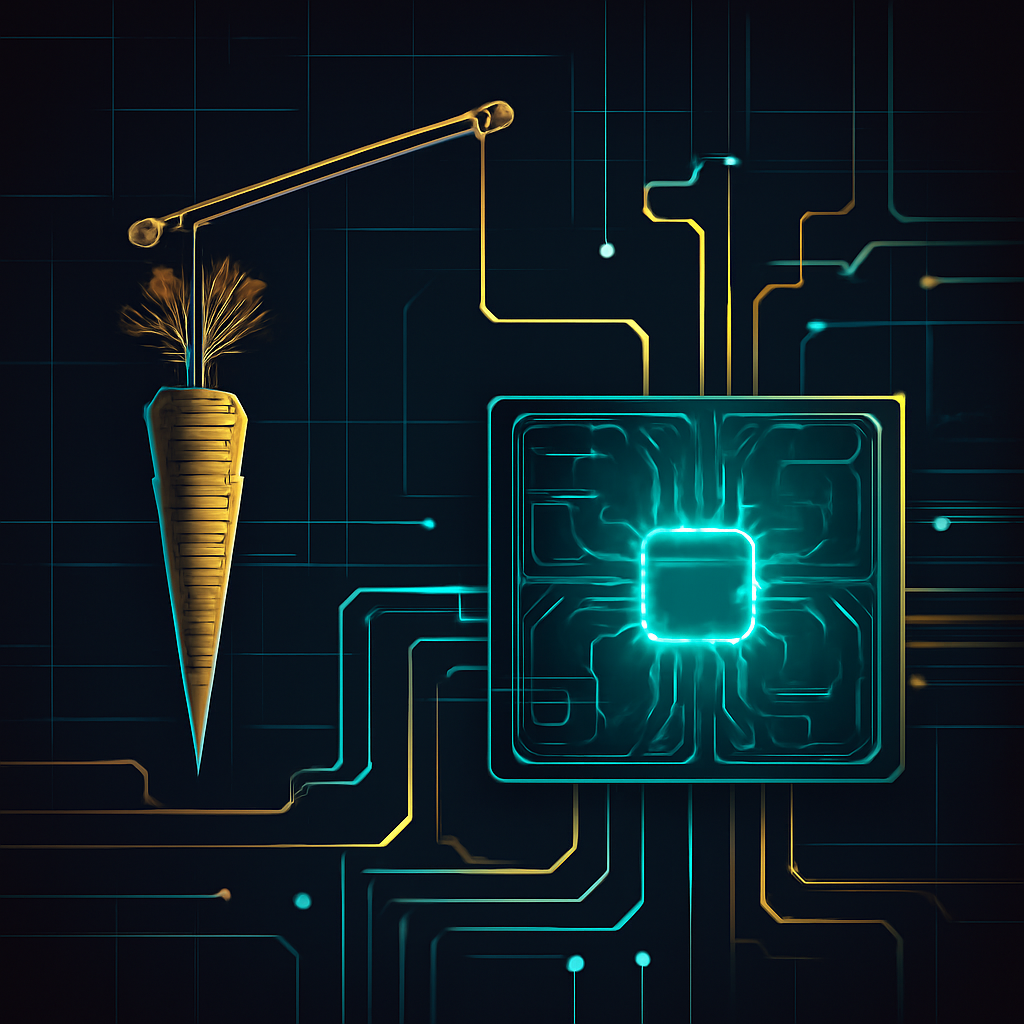
The Carrot and the Stick for Computers: How AI Learns by Doing
Imagine teaching a puppy to sit. You don't hand it a manual. Instead, you wait for it to do what you want, then give it a treat. This is exactly how reinforcement learning works for computers. We place an AI into a digital world and let it play. It makes thousands of mistakes, stumbling around blindly. But every time it gets closer to its goal, we give it a virtual point. If it fails, it gets nothing.
Over millions of quick tries, the AI figures out which moves lead to the biggest jackpot of points. This is how computers learned to drive self-driving cars and beat the world's best gamers. We do not teach the machine the rules. We just let it discover its own path to victory through trial and error. Like us, computers learn best by doing.
“By playing against itself millions of times, a computer can learn complex games like chess from scratch without a single human showing it how to play.”
Reflect
If computers can master complex games by simply trying and failing over and over, what human skills could they learn next just by practicing in virtual worlds?
Research·4 sources·Well-Established confidence·Investigated 2 Aug 2026(1 month ago)·Grounded; verification trace not recorded·Investigation may be outdated
Your next question, in
Visual Trail
See The Carrot and the Stick for Computers: How AI Learns by Doing
A guided visual explanation assembled from QE artwork and sourced documentary images.
01 / 02
QE visual interpretation
Frame 01
The Carrot and the Stick for Computers: How AI Learns by Doing
Reinforcement learning is a way of training AI by giving it virtual rewards for good moves, just like training a puppy with treats.
Image provenance and limitation
Source: AI-generated visual interpretation
Creator: Question Everything
Limitation: This image explains or evokes the subject. It is not documentary evidence and should not be used to verify a factual claim.
Evidence
What do we know?
Verified claims with confidence scoring and cited sources.
Living footnotes
Claims remain in the reading flow. Select a citation number to inspect the source behind it.
01
ObservationalSupported
Reinforcement learning trains computers through a feedback system of rewards and penalties.
Imagine teaching a dog to sit. When they do it, they get a treat. When they don't, they get nothing. This is exactly how reinforcement learning works. A computer program, called an agent, tries different moves in an environment. If a move gets it closer to its goal, it receives a virtual reward. If it makes a mistake, it gets a penalty. Over time, the computer figures out which actions bring the biggest rewards.
02
AcademicSupported
The computer must constantly choose between using moves it already knows work and trying completely new ones.
This is called the exploration-exploitation trade-off. Think of it like deciding where to eat dinner. Do you go to your favorite restaurant because you know the food is great? Or do you try a brand-new place that might be even better, but could also be terrible? The AI faces this exact dilemma at every step. It must balance sticking to safe, known rewards with exploring new paths to find even bigger payoffs.
03
AcademicSupported
Unlike other AI methods, reinforcement learning does not need pre-labeled data to learn.
Most AI models are like students memorizing flashcards with the answers already written on the back. That is called supervised learning. But reinforcement learning is different. It does not use pre-labeled datasets or human guides. Instead, the computer learns entirely from its own experience and trial-and-error. It plays the game or navigates the room, makes mistakes, and learns from the direct feedback of its own actions.
The complete record below preserves every citation, confidence input and recorded limitation.
Read the full evidence record3 findings · citations · limitations
Evidence review3 findings4 openable sources
01
Finding 1 of 3Observational
0/1 verified
Reinforcement learning trains computers through a feedback system of rewards and penalties.
Imagine teaching a dog to sit. When they do it, they get a treat. When they don't, they get nothing. This is exactly how reinforcement learning works. A computer program, called an agent, tries different moves in an environment. If a move gets it closer to its goal, it receives a virtual reward. If it makes a mistake, it gets a penalty. Over time, the computer figures out which actions bring the biggest rewards.
Supportedmodel score 95%
One source, not peer-reviewed. Thinner than the score suggests.
REFERENCE
›View sources and limits— 1 citation, limits
Supporting passage
Imagine teaching a dog to sit. When they do it, they get a treat. When they don't, they get nothing. This is exactly how reinforcement learning works. A computer program, called an agent, tries different moves in an environment. If a move gets it closer to its goal, it receives a virtual reward. If it makes a mistake, it gets a penalty. Over time, the computer figures out which actions bring the biggest rewards.
Rests on a single source. No independent corroboration.
No peer-reviewed source among the citations.
The generator scored this 95%, which would read as “Established”. Its citations reach only “Supported”, so that is what is shown.
02
Finding 2 of 3Academic
1
0/1 verified
The computer must constantly choose between using moves it already knows work and trying completely new ones.
This is called the exploration-exploitation trade-off. Think of it like deciding where to eat dinner. Do you go to your favorite restaurant because you know the food is great? Or do you try a brand-new place that might be even better, but could also be terrible? The AI faces this exact dilemma at every step. It must balance sticking to safe, known rewards with exploring new paths to find even bigger payoffs.
Supportedmodel score 98%
A single peer-reviewed source. No independent corroboration.
PRIMARY STUDY
›View sources and limits— 1 citation, limits
Supporting passage
This is called the exploration-exploitation trade-off. Think of it like deciding where to eat dinner. Do you go to your favorite restaurant because you know the food is great? Or do you try a brand-new place that might be even better, but could also be terrible? The AI faces this exact dilemma at every step. It must balance sticking to safe, known rewards with exploring new paths to find even bigger payoffs.
1 of 2 citations failed verification and are not shown.
Rests on a single source. No independent corroboration.
The generator scored this 98%, which would read as “Established”. Its citations reach only “Supported”, so that is what is shown.
03
Finding 3 of 3Academic
2
0/2 verified
Unlike other AI methods, reinforcement learning does not need pre-labeled data to learn.
Most AI models are like students memorizing flashcards with the answers already written on the back. That is called supervised learning. But reinforcement learning is different. It does not use pre-labeled datasets or human guides. Instead, the computer learns entirely from its own experience and trial-and-error. It plays the game or navigates the room, makes mistakes, and learns from the direct feedback of its own actions.
Supportedmodel score 97%
2 sources agree, none peer-reviewed.
REFERENCE ×2
›View sources and limits— 2 citations, limits
Supporting passage
Most AI models are like students memorizing flashcards with the answers already written on the back. That is called supervised learning. But reinforcement learning is different. It does not use pre-labeled datasets or human guides. Instead, the computer learns entirely from its own experience and trial-and-error. It plays the game or navigates the room, makes mistakes, and learns from the direct feedback of its own actions.
The generator scored this 97%, which would read as “Established”. Its citations reach only “Supported”, so that is what is shown.
Interactive Exploration
Touch, drag, and discover
These visualizations respond to your curiosity. Interact to go deeper.
process flow
The Endless Loop of Learning
Observe
Act
Evaluate
Update
comparison table
Three Ways to Teach a Machine
How It Learns
Best Example
Supervised Learning
Using labeled flashcards
Identifying cats in photos
Unsupervised Learning
Finding hidden patterns alone
Grouping customers by shopping habits
Reinforcement Learning
Trial and error with rewards
Mastering chess or driving a car
Tap any row to highlight and compare
Perspectives
How is this interpreted?
Enter a viewpoint. Notice what it reveals, what it leaves out, and whether it changes the question for you.
The EmpiricistScientific viewpointEstablished lens
Computer scientists view reinforcement learning as a mathematical way to solve decision-making problems. It uses a framework called the Markov Decision Process. This framework breaks down the world into states, actions, and rewards. By mapping these out, scientists can turn the messy process of trial-and-error into clean mathematical equations. This lets the computer systematically calculate the absolute best path to success, even in highly unpredictable environments.
What this lens notices
01Uses Markov Decision Process
02Translates trial-and-error into math
03Finds optimal strategies mathematically
Application
Why does this matter to you?
Personal reflections and applications for your life.
Thought experimentBehavioural
How can you use rewards to build better habits in your own life?
Why it changes the question
Just like an AI agent, your brain is wired to repeat actions that give you a quick reward. By deliberately rewarding yourself after hard tasks, you can train your brain to love good habits.
Try this
Write down one habit you want to build, and choose a small, immediate reward to give yourself every single time you complete it.
Media
QE Smart Glass
Curated media selected for this investigation.
QE Glass
YOUTUBE
Reinforcement Learning - Computerphile
Computerphile
Reinforcement Learning is how robots test the water in the real world. -- Check out Brilliant's courses and start for free at ...
QE Glass
YOUTUBE
The FASTEST introduction to Reinforcement Learning on the internet
Gonkee
Reinforcement learning is a field of machine learning concerned with how an agent should most optimally take actions in an ...
QE Glass
YOUTUBE
Reinforcement Learning: AlphaGo
Graphics in 5 Minutes
How AlphaGo works, based on Reinforcement Learning. Part 2 of RL from scratch series. https://youtu.be/vXtfdGphr3c 0:00 - intro ...
QE Glass
YOUTUBE
The Thinking Game | Full documentary | Tribeca Film Festival official selection
Google DeepMind and 3 more
The inside story of the AI breakthrough that won a Nobel Prize. -- The Thinking Game takes you on a journey into the heart of ...
QE Glass
YOUTUBE
Richard Sutton – Father of RL thinks LLMs are a dead end
Dwarkesh Patel
Richard Sutton is the father of reinforcement learning, winner of the 2024 Turing Award, and author of The Bitter Lesson. And he ...
QE Glass
YOUTUBE
Reinforcement Learning in 5 Minutes (The Truman Show Analogy)
Code sci-fi ( )
Artificial intelligence doesn't just follow rules — it learns from rewards and consequences. In this video we break down ...
QE Glass
YOUTUBE
Multi-Agent Hide and Seek
OpenAI
We've observed agents discovering progressively more complex tool use while playing a simple game of hide-and-seek. Through ...
QE Glass
PODCAST
The Cold War of Go
Radiolab
A thrilling audio story about how a reinforcement learning program defeated the world's best Go player, changing our view of creativity forever.
Keep Going
Where this leads
Questions this investigation opens up — and what QE has already looked into.
No AI help here — no suggestions, no autocomplete, nothing finishing your sentences. That is deliberate. Working out what you think is effortful, and the effort is the part that changes you: reasoning is trained like a muscle, and a muscle that is always carried gets weaker. Let something else do the thinking and you keep the answer but lose the capacity to have reached it.
Write your current position.
Not what the page says. What you think, having read it.0 words · Nothing written yet.
Sign in to leave a mark. Your draft is saved here in the meantime.