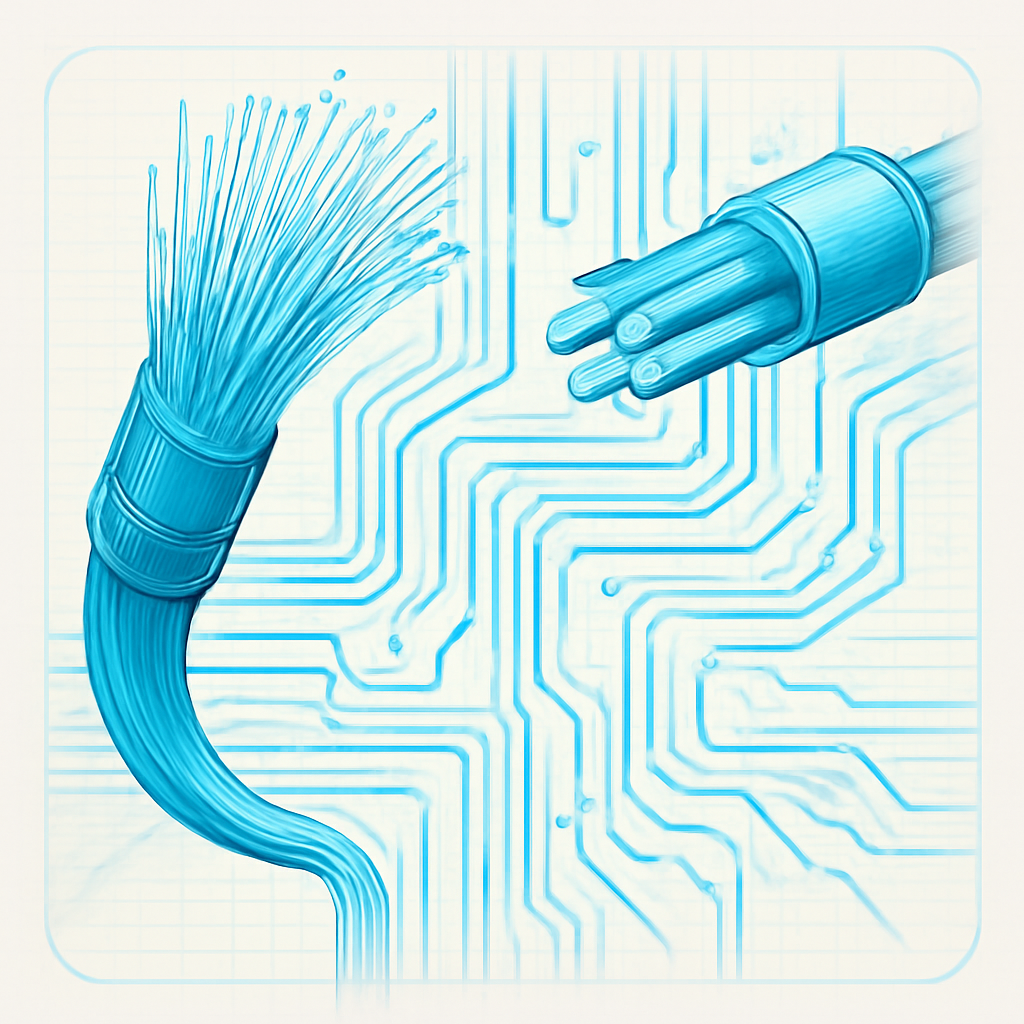
Fibre and Copper Cabling: Foundations of Modern Data Transmission
Fibre optic and copper cabling represent the core physical mediums for telecommunication and data networking, each with distinct physical principles, performance profiles, and deployment considerations. Fibre optic cables utilize pulses of light transmitted through strands of ultra-pure glass or plastic fibers. This enables exceptionally high bandwidths, minimal signal attenuation, and immunity to electromagnetic interference, making fibre indispensable for backbone networks, long-haul communication, and data centers. However, fibre's installation complexity and fragility pose practical constraints.
Conversely, copper cabling, traditionally composed of twisted pairs or coaxial configurations, transmits electrical signals. It offers ease of installation, lower initial costs, and compatibility with established infrastructure. Yet copper suffers from higher signal loss over distance, susceptibility to noise, and limited bandwidth compared to fibre. The nuanced choice between these media depends on context-specific factors including distance, data rates, environmental interference, cost constraints, and future scalability. Modern hybrid infrastructures often combine both, leveraging fibre’s capacity with copper’s flexibility to optimize network performance and cost-effectiveness.
“Fiber optic cables transmit data as pulses of light, enabling speeds and distances that copper cables cannot match due to their reliance on electrical signals.”
Reflect
How might future innovations in material science or quantum communication reshape the fundamental roles of fiber and copper in data transmission?
Research·4 sources·Established confidence·Investigated 3 Sept 2026(15 days ago)·Source-verified·May need refresh
Your next question, in
Visual Trail
See Fibre and Copper Cabling: Foundations of Modern Data Transmission
A guided visual explanation assembled from QE artwork and sourced documentary images.
01 / 02
QE visual interpretation
Frame 01
Fibre and Copper Cabling: Foundations of Modern Data Transmission
Fibre and copper cables are key data transmission mediums, with fibre offering higher speed and distance, copper providing cost-effective flexibility.
Image provenance and limitation
Source: AI-generated visual interpretation
Creator: Question Everything
Limitation: This image explains or evokes the subject. It is not documentary evidence and should not be used to verify a factual claim.
Evidence
What do we know?
Verified claims with confidence scoring and cited sources.
2 of 4 findings need extra caution. Finding 3, Finding 4 rest on weaker sourcing than the other findings.
Living footnotes
Claims remain in the reading flow. Select a citation number to inspect the source behind it.
01
AcademicSupported
Fiber optic cables support vastly higher bandwidth than copper cables, enabling data rates several hundred times greater.
Fiber optics use light pulses to carry data, which allows them to achieve much higher transmission rates than copper cables that rely on electrical signals. This difference makes fiber indispensable for large business campuses, data centers, and ISPs where high throughput is critical. For example, a single fiber link can carry over 50 terabits per second, supporting millions of simultaneous HD video streams, far exceeding copper’s capacity.
02
StatisticalSupported
Copper cabling remains more cost-effective and compatible for short-distance, budget-conscious network installations.
Copper cables are cheaper per foot and easier to install using inexpensive hand tools, making them suitable for small businesses or residential setups. Additionally, copper wiring is compatible with most existing infrastructures, allowing for straightforward upgrades without expensive overhauls. Its ability to carry both data and electrical power simultaneously also reduces the need for additional wiring in setups like security cameras or Wi-Fi access points.
03
ExperimentalMixed evidence
Fiber optic cables exhibit superior immunity to electromagnetic interference and environmental degradation compared to copper cables.
Because fiber optics transmit light rather than electrical signals, they are not susceptible to electromagnetic interference (EMI) from nearby electrical equipment, fluorescent lights, or industrial motors. This makes them more reliable in harsh environments and over long distances, where copper cables suffer signal degradation and noise. Additionally, fiber’s glass composition allows it to endure temperature fluctuations and even submersion in water without loss of performance.
04
StatisticalMixed evidence
The total cost of ownership for fiber optic cabling can be comparable to copper when factoring in performance, maintenance, and future-proofing.
While fiber optic cabling has a higher upfront cost due to specialized installation and materials, its superior longevity, minimal maintenance requirements, and ability to support future bandwidth needs often balance this expense over time. Studies show that when considering the complete network costs—not just the cable price—fiber can be as cost-effective as copper Cat6 cabling, especially in environments demanding high performance and scalability.
The complete record below preserves every citation, confidence input and recorded limitation.
Read the full evidence record4 findings · citations · limitations
Evidence review4 findings6 openable sources
01
Finding 1 of 4Academic
2
0/2 verified
Fiber optic cables support vastly higher bandwidth than copper cables, enabling data rates several hundred times greater.
Fiber optics use light pulses to carry data, which allows them to achieve much higher transmission rates than copper cables that rely on electrical signals. This difference makes fiber indispensable for large business campuses, data centers, and ISPs where high throughput is critical. For example, a single fiber link can carry over 50 terabits per second, supporting millions of simultaneous HD video streams, far exceeding copper’s capacity.
Supportedmodel score 82%
2 sources agree, none peer-reviewed.
REFERENCE ×2
›View sources and limits— 2 citations, limits
Supporting passage
Fiber optics use light pulses to carry data, which allows them to achieve much higher transmission rates than copper cables that rely on electrical signals. This difference makes fiber indispensable for large business campuses, data centers, and ISPs where high throughput is critical. For example, a single fiber link can carry over 50 terabits per second, supporting millions of simultaneous HD video streams, far exceeding copper’s capacity.
Copper cabling remains more cost-effective and compatible for short-distance, budget-conscious network installations.
Copper cables are cheaper per foot and easier to install using inexpensive hand tools, making them suitable for small businesses or residential setups. Additionally, copper wiring is compatible with most existing infrastructures, allowing for straightforward upgrades without expensive overhauls. Its ability to carry both data and electrical power simultaneously also reduces the need for additional wiring in setups like security cameras or Wi-Fi access points.
Supportedmodel score 82%
2 sources agree, none peer-reviewed.
REFERENCE ×2
›View sources and limits— 2 citations, limits
Supporting passage
Copper cables are cheaper per foot and easier to install using inexpensive hand tools, making them suitable for small businesses or residential setups. Additionally, copper wiring is compatible with most existing infrastructures, allowing for straightforward upgrades without expensive overhauls. Its ability to carry both data and electrical power simultaneously also reduces the need for additional wiring in setups like security cameras or Wi-Fi access points.
Fiber optic cables exhibit superior immunity to electromagnetic interference and environmental degradation compared to copper cables.
Because fiber optics transmit light rather than electrical signals, they are not susceptible to electromagnetic interference (EMI) from nearby electrical equipment, fluorescent lights, or industrial motors. This makes them more reliable in harsh environments and over long distances, where copper cables suffer signal degradation and noise. Additionally, fiber’s glass composition allows it to endure temperature fluctuations and even submersion in water without loss of performance.
Mixed evidencemodel score 55%
Verification was mixed across 1 source.
REFERENCE
›View sources and limits— 1 citation, limits
Supporting passage
Because fiber optics transmit light rather than electrical signals, they are not susceptible to electromagnetic interference (EMI) from nearby electrical equipment, fluorescent lights, or industrial motors. This makes them more reliable in harsh environments and over long distances, where copper cables suffer signal degradation and noise. Additionally, fiber’s glass composition allows it to endure temperature fluctuations and even submersion in water without loss of performance.
1 of 2 citations failed verification and are not shown.
Rests on a single source. No independent corroboration.
No peer-reviewed source among the citations.
Verification was mixed — some citations supported the claim and some did not.
04
Finding 4 of 4StatisticalNeeds caution
0/1 verified
The total cost of ownership for fiber optic cabling can be comparable to copper when factoring in performance, maintenance, and future-proofing.
While fiber optic cabling has a higher upfront cost due to specialized installation and materials, its superior longevity, minimal maintenance requirements, and ability to support future bandwidth needs often balance this expense over time. Studies show that when considering the complete network costs—not just the cable price—fiber can be as cost-effective as copper Cat6 cabling, especially in environments demanding high performance and scalability.
Mixed evidencemodel score 55%
Verification was mixed across 1 source.
REFERENCE
›View sources and limits— 1 citation, limits
Supporting passage
While fiber optic cabling has a higher upfront cost due to specialized installation and materials, its superior longevity, minimal maintenance requirements, and ability to support future bandwidth needs often balance this expense over time. Studies show that when considering the complete network costs—not just the cable price—fiber can be as cost-effective as copper Cat6 cabling, especially in environments demanding high performance and scalability.
These visualizations respond to your curiosity. Interact to go deeper.
comparison table
Fiber Optic vs. Copper Cabling: Key Features
Fiber Optic
Copper
Bandwidth Capacity
Up to 50+ Tbps
Up to 10 Gbps (typical)
Maximum Distance
Tens of kilometers
Up to 100 meters
Susceptibility to EMI
Immune
Vulnerable
Installation Cost
Higher upfront
Lower upfront
Maintenance Needs
Minimal
Periodic
Tap any row to highlight and compare
timeline
Evolution of Data Cabling Technologies
Loading timeline…
Contested
This one is genuinely argued over
Both cases are put as strongly as their own supporters would put them, from evidence rather than from who holds the view. Read them and decide for yourself.
The case that it's true
Fiber optic cabling represents the future of data transmission due to its unmatched bandwidth, speed, and resistance to interference. Its capacity to handle enormous data loads over long distances without degradation makes it indispensable for modern networks, from data centers to telecom backbones. The rapid decline in fiber costs and advances in installation ease will continue to erode copper’s foothold, making fiber the default choice for future-proof infrastructure.
What this rests on
Fiber supports data rates over 50 Tbps per single link.
Fiber is immune to electromagnetic interference and environmental damage.
Fiber installation costs are decreasing with technological advances.
The case against
Copper cabling remains highly relevant due to its lower initial cost, ease of installation, and compatibility with existing infrastructure. For many small to medium enterprises, the performance edge of fiber is unnecessary, and copper’s ability to carry power alongside data reduces ancillary costs. Additionally, copper’s physical robustness and familiarity among technicians make it a pragmatic choice in many contexts where budget and ease outweigh peak performance requirements.
What this rests on
Copper is significantly cheaper per foot and easier to install.
Copper can simultaneously transmit power and data, simplifying setups.
Existing infrastructure and equipment are predominantly copper-compatible.
What both sides accept
Both fiber and copper cabling have definitive roles depending on use case and scale. Experts agree that fiber excels in high-bandwidth, long-distance, interference-prone environments, while copper remains viable for short-range, cost-sensitive applications. The technological trend favors fiber as costs fall and demand rises, but copper’s entrenched base and practical advantages ensure it will persist in many networks. Hybrid architectures combining both often deliver balanced solutions.
Documented, and not in dispute
Fiber offers superior bandwidth and distance capabilities.
Copper is more cost-effective and easier to deploy short-term.
Hybrid networks leverage strengths of both cabling types.
Application
Why does this matter to you?
Personal reflections and applications for your life.
Thought experimentPractical
What are your current and future bandwidth needs when choosing cabling for your network?
Why it changes the question
Understanding your network’s demands helps in selecting between copper and fiber. Overestimating your needs may waste budget, while underestimating can cause costly upgrades later.
Try this
Audit your current data traffic and forecast growth over 5-10 years before deciding on cabling infrastructure.
Media
QE Smart Glass
Curated media selected for this investigation.
QE Glass
YOUTUBE
Fiber vs. Copper; What do we really need?
Technology Connections
You can support this channel on Patreon! Link below Fiber optics. A DeLIGHTful technology. Ooh that's a groaner. Well, why don't ...
QE Glass
YOUTUBE
Fibre (Fiber) vs Copper as Fast As Possible
Techquickie
Why is fibre better than copper in an all-out head-to-head showdown? If it's that much better, why don't we use it everywhere?
QE Glass
YOUTUBE
Will Fiber Optics Replace Copper Cables in the Future?
QSFPTEK
Optical fiber is more advanced than copper cableand are in higher demand. In large data centers, the use of optical fiber exceeds ...
QE Glass
YOUTUBE
Copper or Fiber? Future of Communications
Let's Talk Cabling!
Join our expert as we explore the future of the communications industry! We discuss copper-free advancements, the copper vs.
QE Glass
YOUTUBE
Fibre Optics vs. Copper Cabling: Unraveling the Connectivity Debate
Optronics
Welcome to our exciting "Fibre Optics vs. Copper Cabling" series, where we dive deep into the world of cutting-edge technologies ...
QE Glass
YOUTUBE
Fundamentals of Fiber Optic Cabling
Kevin Wallace Training, LLC
Fundamentals of Fiber Optics Get Kevin's Network+ (N10-007) Complete Video Course http://netpluscourse.kevin.live Use ...
QE Glass
YOUTUBE
Copper Cabling - CompTIA Network+ N10-009 - 1.5
Professor Messer
Network+ Training Course Index: https://professormesser.link/n009videos Network+ Course Notes: ...
QE Glass
YOUTUBE
Fiber vs Copper Cable: FACTS
David Bombal
This video is sponsored by @Cisco This video demystifies how ISPs physically connect the world using copper and fiber, ...
QE Glass
PODCAST
The Future of Network Infrastructure: Fiber vs Copper
Ologies with Alie Ward
Explores how emerging technologies and infrastructure choices shape modern networking and what the future holds.
Keep Going
Where this leads
Questions this investigation opens up — and what QE has already looked into.
No AI help here — no suggestions, no autocomplete, nothing finishing your sentences. That is deliberate. Working out what you think is effortful, and the effort is the part that changes you: reasoning is trained like a muscle, and a muscle that is always carried gets weaker. Let something else do the thinking and you keep the answer but lose the capacity to have reached it.
Write your current position.
Not what the page says. What you think, having read it.0 words · Nothing written yet.
Sign in to leave a mark. Your draft is saved here in the meantime.