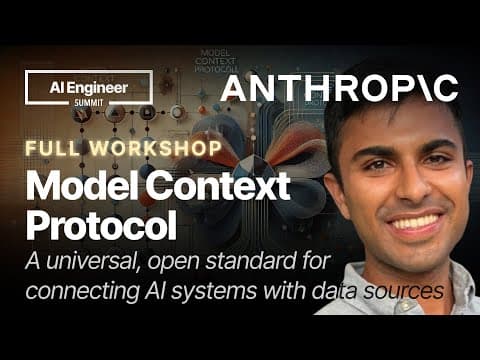
Model Context Protocol (MCP): The Uni… | Question Everything
technology71% confidencepartly supported
26 min deep dive
Complexity
Model Context Protocol (MCP): The Universal Language Connecting AI to the World
Imagine a bustling library where countless AI models seek knowledge scattered across endless shelves—databases, apps, tools—all speaking different languages. The Model Context Protocol, or MCP, is the universal translator that brings order to this chaos. Introduced by Anthropic in late 2024, MCP is an open standard that creates a uniform, secure bridge between AI models and the vast, fragmented world of external data and services. It allows AI systems to access real-time information and perform actions beyond their frozen training data, transforming isolated models into dynamic, context-aware agents.
The problem MCP solves is the explosive complexity of AI integration. Before MCP, every AI model had to build unique adapters for each external tool, creating a tangled web of connections that grew unwieldy as tools and models multiplied. MCP turns this N×M problem into a manageable N+M scenario by standardizing communication protocols. The result is a scalable, interoperable ecosystem where AI can seamlessly discover, retrieve, and act on contextual information—whether querying databases, sending messages, or managing workflows—without bespoke coding for every new connection.
“MCP transforms a tangled web of AI-to-tool integrations into a single, elegant protocol, making AI far more capable and adaptable.”
Reflect
If AI models could speak every tool’s language fluently through one protocol, what new possibilities would that unlock for real-time problem solving?
Research·5 sources·Established confidence·Investigated 13 Oct 2026(21 days ago)·May need refresh
Your next question, in
Evidence
What do we know?
Verified claims with confidence scoring and cited sources.
Generated without source retrieval. QE did not fetch sources for this investigation, so no citation here was checked against a retrieved set. Claims reflect the model’s training data.
2 of 5 findings need extra caution. Finding 4, Finding 5 rest on weaker sourcing than the other findings.
Living footnotes
Claims remain in the reading flow. Select a citation number to inspect the source behind it.
01
AcademicSupported
The Model Context Protocol is an open standard that provides a universal interface for AI models to connect securely to external data sources and tools.
MCP acts like a USB-C port for AI systems, standardizing how AI agents discover and interact with external services like databases, APIs, and applications. This open protocol enables AI applications to make structured requests and receive data or actions through a consistent, secure communication channel without needing custom integrations for each service.
02
AcademicSupported
MCP solves the complex N×M integration problem by reducing the number of custom connections needed between AI models and external tools from N times M to N plus M.
Before MCP, each AI model had to build unique adapters for every external tool, creating a multiplication of integration points that quickly became unmanageable. MCP standardizes the interface so any AI client can interact with any MCP-compatible server, dramatically simplifying development and maintenance and enabling faster innovation.
03
AcademicSupported
MCP enables AI models to access real-time, external data and perform actions, overcoming the limitation of static knowledge frozen at training time.
Large language models alone cannot access up-to-date information or execute tasks in external systems. MCP bridges this gap by allowing models to securely query live data sources and invoke external tools, making AI assistants more accurate, interactive, and useful in dynamic environments.
04
AcademicMixed evidence
MCP uses a client-server architecture where AI applications act as clients making requests to MCP servers that expose tools, data, and prompts in a standardized way.
In MCP’s design, AI-powered applications connect as clients that discover and invoke resources provided by MCP servers. This stateful communication allows efficient management of sessions and context, enabling complex interactions such as querying databases or triggering workflows while maintaining security and consistency.
05
AcademicMixed evidence
MCP incorporates strong security and tenancy boundary controls to prevent data leakage and unauthorized access in multi-tenant AI and cloud environments.
Because AI systems often share infrastructure across multiple users or organizations, MCP enforces strict isolation of contextual data. Techniques like local encryption, dynamic policy enforcement, and tenant-aware context tagging help contain sensitive information, ensuring privacy and compliance within shared AI workflows.
The complete record below preserves every citation, confidence input and recorded limitation.
Read the full evidence record5 findings · citations · limitations
Evidence review5 findings8 openable sources
01
Finding 1 of 5Academic
2
2/2 verified
The Model Context Protocol is an open standard that provides a universal interface for AI models to connect securely to external data sources and tools.
MCP acts like a USB-C port for AI systems, standardizing how AI agents discover and interact with external services like databases, APIs, and applications. This open protocol enables AI applications to make structured requests and receive data or actions through a consistent, secure communication channel without needing custom integrations for each service.
Supportedmodel score 82%
2 sources agree, none peer-reviewed.
REFERENCE ×2
›View sources and limits— 2 citations, limits
Supporting passage
MCP acts like a USB-C port for AI systems, standardizing how AI agents discover and interact with external services like databases, APIs, and applications. This open protocol enables AI applications to make structured requests and receive data or actions through a consistent, secure communication channel without needing custom integrations for each service.
QE used this source because its retrieved passage directly addresses the claim. It appeared in 2 complementary searches.
“# What is the Model Context Protocol (MCP)? Enable AI models to securely access external data sources and tools through a standardized integration framework by Databricks Staff ## Introduction: Understanding the Model Context Protocol The Model Context Protocol (MCP) is an open standard that enables AI applications to…”
QE used this source because its retrieved passage directly addresses the claim.
“## What is Model Context Protocol (MCP)? MCP link-icon (Model Context Protocol) is an open and evolving JSON-RPC-based standard that lets any AI application discover tools, reusable prompts, resources, and other context from remote MCP servers, then invoke them through a stateful session rather than ad-hoc REST API ca…”
This passage was checked against the claim.
Retrieved 13/10/2026
What limits this
Generated without source retrieval — citations here were not verified against a retrieved set.
No peer-reviewed source among the citations.
02
Finding 2 of 5Academic
2
2/2 verified
MCP solves the complex N×M integration problem by reducing the number of custom connections needed between AI models and external tools from N times M to N plus M.
Before MCP, each AI model had to build unique adapters for every external tool, creating a multiplication of integration points that quickly became unmanageable. MCP standardizes the interface so any AI client can interact with any MCP-compatible server, dramatically simplifying development and maintenance and enabling faster innovation.
Supportedmodel score 82%
2 sources agree, none peer-reviewed.
REFERENCE ×2
›View sources and limits— 2 citations, limits
Supporting passage
Before MCP, each AI model had to build unique adapters for every external tool, creating a multiplication of integration points that quickly became unmanageable. MCP standardizes the interface so any AI client can interact with any MCP-compatible server, dramatically simplifying development and maintenance and enabling faster innovation.
QE used this source because its retrieved passage directly addresses the claim.
“If each tool vendor exposes its functionalities through an MCP server, any MCP-aware model front-end can seamlessly interact with these tools without the need for additional custom code. This approach transforms the N × M problem into a more manageable N + M scenario, significantly reducing the complexity and maintena…”
QE used this source because its retrieved passage directly addresses the claim. It appeared in 2 complementary searches.
“ate directly with every external service, creating N×M separate integrations where N represents the number of tools and M represents the number of clients. This approach quickly becomes impossible to scale. The Model Context Protocol MCP solves this by requiring each client and each MCP server to implement the protoco…”
This passage was checked against the claim.
Retrieved 13/10/2026
What limits this
Generated without source retrieval — citations here were not verified against a retrieved set.
No peer-reviewed source among the citations.
03
Finding 3 of 5Academic
2
2/2 verified
MCP enables AI models to access real-time, external data and perform actions, overcoming the limitation of static knowledge frozen at training time.
Large language models alone cannot access up-to-date information or execute tasks in external systems. MCP bridges this gap by allowing models to securely query live data sources and invoke external tools, making AI assistants more accurate, interactive, and useful in dynamic environments.
Supportedmodel score 82%
2 sources agree, none peer-reviewed.
REFERENCE ×2
›View sources and limits— 2 citations, limits
Supporting passage
Large language models alone cannot access up-to-date information or execute tasks in external systems. MCP bridges this gap by allowing models to securely query live data sources and invoke external tools, making AI assistants more accurate, interactive, and useful in dynamic environments.
QE used this source because its retrieved passage directly addresses the claim.
“# What is the MCP and how does it work? Large language models (LLMs) are powerful, but they have two major limitations: their knowledge is frozen at the time of their training, and they can't interact with the outside world. This means they can't access real-time data or perform actions like booking a meeting or updat…”
QE used this source because its retrieved passage directly addresses the claim. It appeared in 3 complementary searches.
“the Linux Foundation formed the Agentic AI Foundation (AAIF) with MCP as one of its founding projects, giving the protocol neutral, open governance. Large language models (LLMs) like Claude, ChatGPT, Gemini, and Llama can write, research, and solve increasingly complex problems. On their own, though, they're isolated…”
This passage was checked against the claim.
Retrieved 13/10/2026
What limits this
Generated without source retrieval — citations here were not verified against a retrieved set.
No peer-reviewed source among the citations.
04
Finding 4 of 5AcademicNeeds caution
1
1/1 verified
MCP uses a client-server architecture where AI applications act as clients making requests to MCP servers that expose tools, data, and prompts in a standardized way.
In MCP’s design, AI-powered applications connect as clients that discover and invoke resources provided by MCP servers. This stateful communication allows efficient management of sessions and context, enabling complex interactions such as querying databases or triggering workflows while maintaining security and consistency.
Mixed evidencemodel score 55%
Verification was mixed across 1 source.
REFERENCE
›View sources and limits— 1 citation, limits
Supporting passage
In MCP’s design, AI-powered applications connect as clients that discover and invoke resources provided by MCP servers. This stateful communication allows efficient management of sessions and context, enabling complex interactions such as querying databases or triggering workflows while maintaining security and consistency.
QE used this source because its retrieved passage directly addresses the claim. It appeared in 3 complementary searches.
“Summarize the post with your preferred LLM here instead. The Model Context Protocol (MCP) is an open standard that defines how AI applications connect to external tools, data sources, and services. MCP clients inside AI apps send requests to MCP servers, which expose tools, resources, and prompts through one consisten…”
This passage was checked against the claim.
Retrieved 13/10/2026
What limits this
Generated without source retrieval — citations here were not verified against a retrieved set.
1 of 2 citations failed verification and are not shown.
Rests on a single source. No independent corroboration.
No peer-reviewed source among the citations.
Verification was mixed — some citations supported the claim and some did not.
05
Finding 5 of 5AcademicNeeds caution
1
1/1 verified
MCP incorporates strong security and tenancy boundary controls to prevent data leakage and unauthorized access in multi-tenant AI and cloud environments.
Because AI systems often share infrastructure across multiple users or organizations, MCP enforces strict isolation of contextual data. Techniques like local encryption, dynamic policy enforcement, and tenant-aware context tagging help contain sensitive information, ensuring privacy and compliance within shared AI workflows.
Mixed evidencemodel score 55%
Verification was mixed across 1 source.
PRIMARY STUDY
›View sources and limits— 1 citation, limits
Supporting passage
Because AI systems often share infrastructure across multiple users or organizations, MCP enforces strict isolation of contextual data. Techniques like local encryption, dynamic policy enforcement, and tenant-aware context tagging help contain sensitive information, ensuring privacy and compliance within shared AI workflows.
QE used this research source for direct evidence relevant to the claim.
“Nevertheless, keeping contextual cues tenant-confined so as not to allow data leakage, inference crossover, and unauthorized model memory persistence necessitates very strong and strict boundary control. Establishing clear tenancy boundaries goes a long way in protecting sensitive metadata, prompts, and dynamic sessio…”
This passage was checked against the claim.
Retrieved 13/10/2026
What limits this
Generated without source retrieval — citations here were not verified against a retrieved set.
1 of 2 citations failed verification and are not shown.
Rests on a single source. No independent corroboration.
Verification was mixed — some citations supported the claim and some did not.
Interactive Exploration
Touch, drag, and discover
These visualizations respond to your curiosity. Interact to go deeper.
process flow
How MCP Connects AI Models to External Tools
AI Client Initialization
Discovery
Invocation
Response and Context Update
Session Management
statistics card
MCP Impact on AI Integration Complexity
N×M
Custom integrations before MCP
Number of unique adapters needed for N tools and M AI models
N+M
Integrations with MCP
Number of adapters needed after MCP, drastically reducing complexity
Hundreds
MCP servers created since launch
Demonstrates rapid adoption and ecosystem growth
Contested
This one is genuinely argued over
Both cases are put as strongly as their own supporters would put them, from evidence rather than from who holds the view. Read them and decide for yourself.
The case that it's true
MCP is a breakthrough that solves a critical bottleneck in AI integration, enabling models to become genuinely useful agents rather than isolated predictors. By standardizing communication, MCP reduces development effort, encourages interoperability, and unlocks new capabilities like real-time data access and action execution. This opens the door to AI systems that can work across diverse domains and tools seamlessly.
What this rests on
Eliminates the need for bespoke integration code per model-tool pair
Enables secure, real-time access to external data sources
Supports complex, stateful interactions through a standardized protocol
The case against
While MCP promises great benefits, its success depends on widespread adoption and robust security implementation. The protocol alone does not guarantee governance or compliance, and without careful oversight, risks such as data leakage, unauthorized access, or misuse remain. Moreover, integrating legacy systems and ensuring consistent performance across many vendors pose practical challenges that could slow adoption.
What this rests on
Requires all tool providers and AI clients to implement MCP consistently
Security and tenancy boundaries need continual enforcement and auditing
Governance beyond protocol (authorization, compliance) is not inherently solved
What both sides accept
Both supporters and critics agree MCP is a crucial step toward scalable AI integration and that its open, standardized approach offers clear advantages over bespoke solutions. There is consensus that MCP improves interoperability and reduces complexity, but also that additional layers of security, governance, and ecosystem maturity are needed to fully realize its potential in enterprise and regulated environments.
Documented, and not in dispute
MCP reduces integration complexity significantly
Security and tenancy are core concerns in multi-tenant AI systems
Governance frameworks must build on MCP to ensure regulated compliance
Application
Why does this matter to you?
Personal reflections and applications for your life.
Thought experimentSelf-Reflection
How might standardized protocols like MCP change the way you interact with AI-powered tools in daily life?
Why it changes the question
Understanding MCP helps you see how AI could soon access your calendars, emails, and apps seamlessly, making interactions more natural and productive.
Try this
Try exploring AI tools that integrate multiple services and notice how seamless or fragmented the experience feels.
Media
QE Smart Glass
Curated media selected for this investigation.
QE Glass
YOUTUBE
What is MCP? Integrate AI Agents with Databases & APIs
IBM Technology
Ready to become a certified Architect on Cloud Pak? Register now and use code IBMTechYT20 for 20% off of your exam ...
QE Glass
YOUTUBE
Model Context Protocol Clearly Explained | MCP Beyond the Hype
codebasics
This video contains a very simple explanation of MCP, also known as Model Context Protocol. We will first understand what ...
QE Glass
YOUTUBE
MCP vs API: Simplifying AI Agent Integration with External Data
IBM Technology
Ready to become a certified Solution Implementer? Register now and use code IBMTechYT20 for 20% off of your exam ...
QE Glass
YOUTUBE
MCP Explained in 2 Minutes (Model Context Protocol)
9x
FREE AI & AUTOMATION TUTORIALS: https://go9x.me/vawa8q FREE CRASH COURSE: https://go9x.me/7h75a4 We train ...
QE Glass
YOUTUBE
How Model Context Protocol (MCP) actually works
Google Cloud Tech
Google MCPs → https://goo.gle/3PYkjky Build an ADK agent with Google MCPs → https://goo.gle/4o6h8DP Connect an MCP ...
QE Glass
YOUTUBE
Model Context Protocol (MCP) Explained for Beginners: AI Flight Booking Demo!
KodeKloud
Try MCP Lab for Free: https://kode.wiki/3IxxdBG Curious about how AI agents function and their impact on technology? ✨ In this ...
Keep Going
Where this leads
Questions this investigation opens up — and what QE has already looked into.
No AI help here — no suggestions, no autocomplete, nothing finishing your sentences. That is deliberate. Working out what you think is effortful, and the effort is the part that changes you: reasoning is trained like a muscle, and a muscle that is always carried gets weaker. Let something else do the thinking and you keep the answer but lose the capacity to have reached it.
Write your current position.
Not what the page says. What you think, having read it.0 words · Nothing written yet.
Sign in to leave a mark. Your draft is saved here in the meantime.