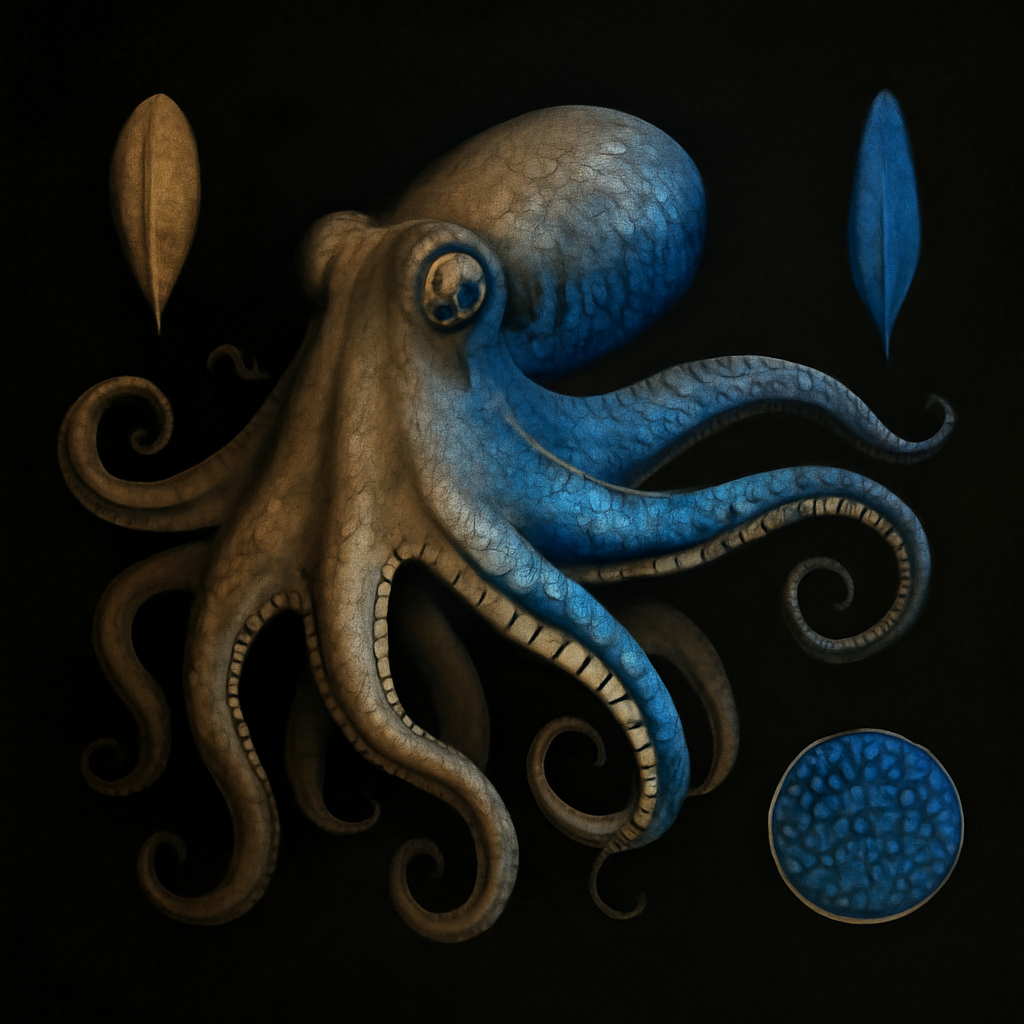
How Octopuses Change Color: The Ocean's Living Screen
Imagine having skin made of millions of tiny, colorful balloons. That is exactly how an octopus lives. By squeezing and stretching these tiny pockets of color, they can rewrite their entire appearance in less than a second. It is the ultimate game of hide-and-seek.
This trick is not just for hiding. Octopuses use their shifting skin to talk, scare off threats, and even mimic other deadly sea creatures. They are the closest thing we have to living, breathing television screens.
“An octopus can change its entire body pattern in less than a second, faster than the blink of a human eye.”
Reflect
If our skin could display our thoughts and emotions in real-time color, how would human society change?
Research·3 sources·Well-Established confidence·Investigated 4 Aug 2026(1 month ago)·Grounded; verification trace not recorded·Investigation may be outdated
Your next question, in
Visual Trail
See How Octopuses Change Color: The Ocean's Living Screen
A guided visual explanation assembled from QE artwork and sourced documentary images.
01 / 05
QE visual interpretation
Frame 01
How Octopuses Change Color: The Ocean's Living Screen
Octopuses change color using millions of tiny, muscle-controlled color sacs in their skin that stretch and shrink in a split second.
Image provenance and limitation
Source: AI-generated visual interpretation
Creator: Question Everything
Limitation: This image explains or evokes the subject. It is not documentary evidence and should not be used to verify a factual claim.
Evidence
What do we know?
Verified claims with confidence scoring and cited sources.
Living footnotes
Claims remain in the reading flow. Select a citation number to inspect the source behind it.
01
ObservationalSupported
Tiny muscle-controlled color sacs called chromatophores expand and shrink to change the octopus's skin color.
The top layer of octopus skin has millions of these tiny sacs. Each sac is like a tiny water balloon filled with paint. Special muscles pull the balloon wide to show the color, or let it shrink to a tiny dot to hide it. These sacs come in yellow, red, and brown. By mixing them, the octopus creates different patterns.
02
ExperimentalSupported
Octopus skin can sense light directly without using the eyes or brain.
Scientists discovered that octopus skin has the same light-sensing proteins found in their eyes. In tests, blue light shining on patches of octopus skin made the color spots expand automatically. This means their skin can feel and react to light all on its own, helping them blend in even faster.
03
ObservationalSupported
Special reflective cells beneath the color sacs create shiny, metallic colors like blue and green.
Because pigments can only make dark colors like brown or red, the octopus uses a second layer of cells called iridophores. These act like tiny mirrors. They reflect and bend the light, creating bright, shiny metallic blues, greens, and golds. A third layer called leucophores scatters light to create solid white.
The complete record below preserves every citation, confidence input and recorded limitation.
Read the full evidence record3 findings · citations · limitations
Evidence review3 findings3 openable sources
01
Finding 1 of 3Observational
0/1 verified
Tiny muscle-controlled color sacs called chromatophores expand and shrink to change the octopus's skin color.
The top layer of octopus skin has millions of these tiny sacs. Each sac is like a tiny water balloon filled with paint. Special muscles pull the balloon wide to show the color, or let it shrink to a tiny dot to hide it. These sacs come in yellow, red, and brown. By mixing them, the octopus creates different patterns.
Supportedmodel score 95%
One source, not peer-reviewed. Thinner than the score suggests.
REFERENCE
›View sources and limits— 1 citation, limits
Supporting passage
The top layer of octopus skin has millions of these tiny sacs. Each sac is like a tiny water balloon filled with paint. Special muscles pull the balloon wide to show the color, or let it shrink to a tiny dot to hide it. These sacs come in yellow, red, and brown. By mixing them, the octopus creates different patterns.
Rests on a single source. No independent corroboration.
No peer-reviewed source among the citations.
The generator scored this 95%, which would read as “Established”. Its citations reach only “Supported”, so that is what is shown.
02
Finding 2 of 3Experimental
1
0/1 verified
Octopus skin can sense light directly without using the eyes or brain.
Scientists discovered that octopus skin has the same light-sensing proteins found in their eyes. In tests, blue light shining on patches of octopus skin made the color spots expand automatically. This means their skin can feel and react to light all on its own, helping them blend in even faster.
Supportedmodel score 98%
A single peer-reviewed source. No independent corroboration.
PRIMARY STUDY
›View sources and limits— 1 citation, limits
Supporting passage
Scientists discovered that octopus skin has the same light-sensing proteins found in their eyes. In tests, blue light shining on patches of octopus skin made the color spots expand automatically. This means their skin can feel and react to light all on its own, helping them blend in even faster.
Rests on a single source. No independent corroboration.
The generator scored this 98%, which would read as “Established”. Its citations reach only “Supported”, so that is what is shown.
03
Finding 3 of 3Observational
0/1 verified
Special reflective cells beneath the color sacs create shiny, metallic colors like blue and green.
Because pigments can only make dark colors like brown or red, the octopus uses a second layer of cells called iridophores. These act like tiny mirrors. They reflect and bend the light, creating bright, shiny metallic blues, greens, and golds. A third layer called leucophores scatters light to create solid white.
Supportedmodel score 95%
One source, not peer-reviewed. Thinner than the score suggests.
REFERENCE
›View sources and limits— 1 citation, limits
Supporting passage
Because pigments can only make dark colors like brown or red, the octopus uses a second layer of cells called iridophores. These act like tiny mirrors. They reflect and bend the light, creating bright, shiny metallic blues, greens, and golds. A third layer called leucophores scatters light to create solid white.
Rests on a single source. No independent corroboration.
No peer-reviewed source among the citations.
The generator scored this 95%, which would read as “Established”. Its citations reach only “Supported”, so that is what is shown.
Interactive Exploration
Touch, drag, and discover
These visualizations respond to your curiosity. Interact to go deeper.
comparison table
The Three Layers of Octopus Skin Cells
How it Works
Colors Created
Chromatophores
Stretchy pigment sacs controlled by muscles
Yellow, Red, Brown
Iridophores
Reflective plates that bend light
Metallic Blue, Green, Gold
Leucophores
Scattering plates that reflect ambient light
Bright White
Tap any row to highlight and compare
process flow
The Chain Reaction of Color Change
Spotting the Threat
Brain Signal
Muscle Squeeze
Color Reveal
Visual Gallery
Images & artifacts
Historical images, diagrams, and visual knowledge from Wikimedia Commons.
Perspectives
How is this interpreted?
Enter a viewpoint. Notice what it reveals, what it leaves out, and whether it changes the question for you.
The EmpiricistScientific viewpointEstablished lens
Biologists study these color changes as a miracle of neuroscience. Unlike chameleons, which rely on slow hormones, octopuses use their brain and nerves to control their skin directly. This makes their color change almost instant. It is like having your brain wired directly to a TV screen.
What this lens notices
01Nerves connect directly to each color sac
02The brain bypasses chemical delays
03Visual information is processed instantly into physical action
Application
Why does this matter to you?
Personal reflections and applications for your life.
Thought experimentSelf-Reflection
How much of your communication is non-verbal?
Why it changes the question
An octopus uses its skin to show emotions like fear or anger instantly. Try paying attention to how your body language speaks for you before you say a single word.
Try this
Spend a day noticing how others react to your posture and expression rather than your words.
Media
QE Smart Glass
Curated media selected for this investigation.
QE Glass
YOUTUBE
Masterminds: Secrets of the Octopus (Full Episode) | National Geographic
National Geographic
Octopuses break all the rules on animal intelligence. Born into the world as orphans, they are self-taught masterminds; capable of ...
QE Glass
YOUTUBE
Shapeshifters: Octopus Superpowers (Full Episode) | Secrets of the Octopus
National Geographic
Octopuses break all the rules on animal intelligence. Born into the world as orphans, they are self-taught masterminds; capable of ...
QE Glass
YOUTUBE
Octopuses HAVE 3 HEARTS and BLUE BLOOD! | Wild Bites | BBC Earth Kids
BBC Earth Kids
3 hearts and blue blood? Nope, it's not an alien - meet the octopus! Octopuses have developed incredible adaptations to life ...
QE Glass
YOUTUBE
Amazing Octopus changing colour transformations - BBC
BBC
Subscribe and to the BBC https://bit.ly/BBCYouTubeSub Watch the BBC first on iPlayer https://bbc.in/iPlayer-Home You ...
QE Glass
YOUTUBE
The Insane Biology of: The Octopus
Real Science
Watch this video ad-free on Nebula: https://nebula.tv/videos/real-science-the-insane-biology-of-the-octopus New streaming ...
QE Glass
YOUTUBE
Amazing Octopus Color Transformation | National Geographic
National Geographic
Ever wish you could change shape and color the way the Cyanea octopus can? ➡ Subscribe: http://bit.ly/NatGeoSubscribe About ...
QE Glass
YOUTUBE
Octopuses Are Stranger Than We Ever Imagined
Boring Planet
Octopuses are stranger than we ever imagined. They can change color in an instant, solve complex puzzles, escape impossible ...
QE Glass
YOUTUBE
OCTOPUS Camouflage | Changes color, texture and shape
Dive&Discover
Octopus changes color, texture and shape. This cool octopus camouflage was seen in Zanzibar 2016. The Octopus is absolutely ...
QE Glass
YOUTUBE
How Do Octopuses Change Colour? - Fun Fact Friday
One World
Octopuses are truly amazing at camouflaging themselves, but how do they do this? This video explores how they can produce the ...
QE Glass
YOUTUBE
Camouflaged Octopus Makes Marine Biologist Scream Bloody Murder
Discover Magazine
Bet you can't spot the octopus in this video. When marine biologist Roger Hanlon caught this creature on camera, he said he ...
QE Glass
YOUTUBE
The Amazing Color-Changing Octopus
Science Friday
A close-up look at how chromatophores work under a microscope and in the wild.
QE Glass
PODCAST
Teuthology (SQUIDS & OCTOPUSES) with Sarah McAnulty
Ologies with Alie Ward
An incredibly fun and friendly interview with a cephalopod expert explaining the weird secrets of octopus biology.
Keep Going
Where this leads
Questions this investigation opens up — and what QE has already looked into.
No AI help here — no suggestions, no autocomplete, nothing finishing your sentences. That is deliberate. Working out what you think is effortful, and the effort is the part that changes you: reasoning is trained like a muscle, and a muscle that is always carried gets weaker. Let something else do the thinking and you keep the answer but lose the capacity to have reached it.
Write your current position.
Not what the page says. What you think, having read it.0 words · Nothing written yet.
Sign in to leave a mark. Your draft is saved here in the meantime.