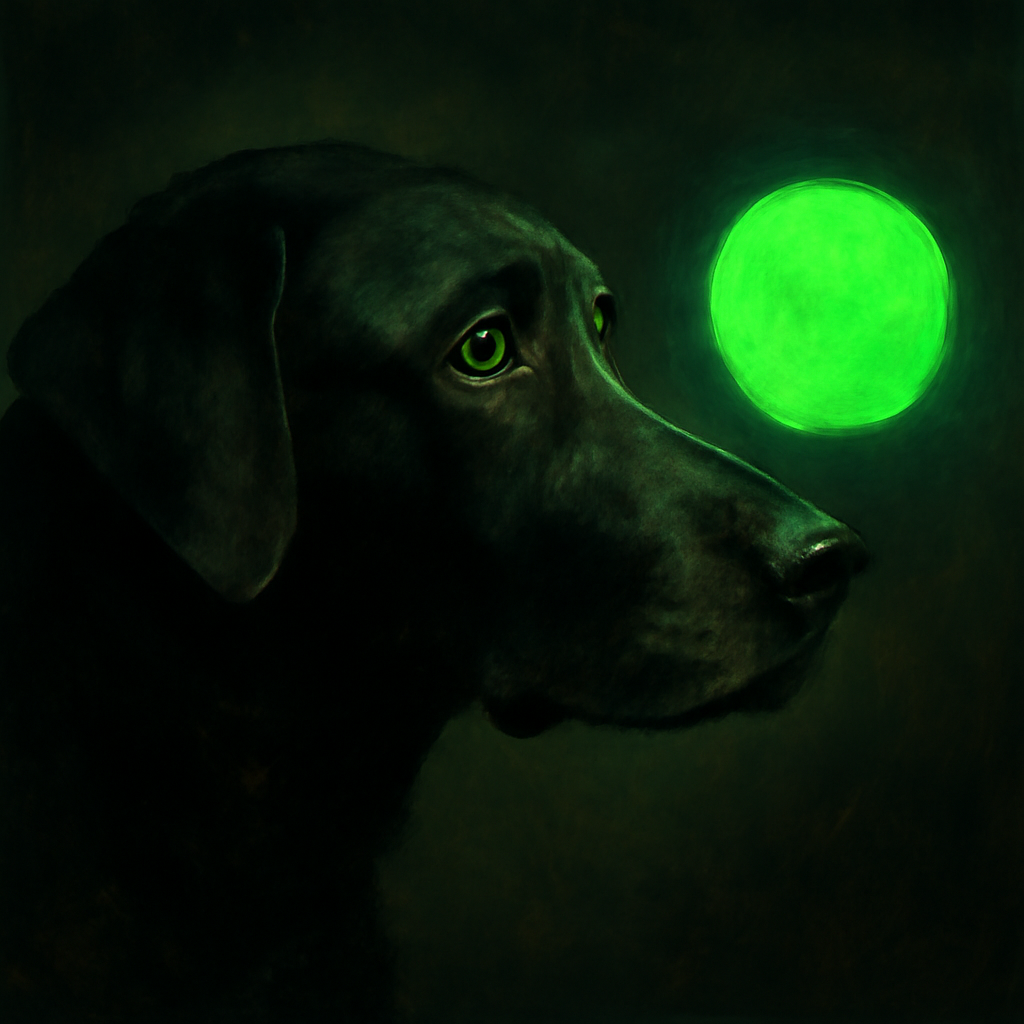
Can Dogs See the Color Green? Exploring Canine Color Vision
Imagine seeing the world through your dog's eyes. Dogs rely heavily on their keen senses, but their vision is quite different from ours. Unlike humans, dogs do not see the full spectrum of colors. Their eyes are tuned to a more limited range, primarily shades of blue and yellow. But what about green? This color, so common in nature, holds a unique place in canine vision.
Dogs have two types of color receptors called cones, while humans have three. This difference means dogs experience a form of color vision known as dichromacy. In this system, green does not appear as a distinct color the way it does to us. Instead, it likely blends into a range of yellows and blues, making green more of a muted or grayish tone for them.
Yet, this doesn't mean dogs live in a dull world. Their vision is adapted to detect motion and contrasts, which is vital for their survival and hunting instincts. Understanding how dogs see colors like green helps us appreciate their unique perspective and deepens the bond we share with our loyal companions.
“Dogs do not see the color green as we do; to them, it often looks like a muted yellow or gray shade.”
Reflect
What other everyday things might look completely different if we saw the world through another species’ eyes?
4 sources·Established confidence·Investigated 17 Jul 2026(1 month ago)·Investigation may be outdated
Your next question, in
Visual Trail
See Can Dogs See the Color Green? Exploring Canine Color Vision
A guided visual explanation assembled from QE artwork and sourced documentary images.
01 / 05
QE visual interpretation
Frame 01
Can Dogs See the Color Green? Exploring Canine Color Vision
Dogs see green as a muted shade, blending it with yellows and blues due to their different color vision.
Image provenance and limitation
Source: AI-generated visual interpretation
Creator: Question Everything
Limitation: This image explains or evokes the subject. It is not documentary evidence and should not be used to verify a factual claim.
Evidence
What do we know?
Verified claims with confidence scoring and cited sources.
Generated without source retrieval. QE did not fetch sources for this investigation, so no citation here was checked against a retrieved set. Claims reflect the model’s training data.
Living footnotes
Claims remain in the reading flow. Select a citation number to inspect the source behind it.
01
AcademicSupported
Dogs have dichromatic vision, meaning they have two types of color receptors.
Humans have three types of cones in their eyes, allowing us to see a full range of colors. Dogs, however, possess only two types of cones, which limits their ability to distinguish between some colors. This is why dogs see the world differently, especially in terms of color perception. Their vision is similar to a human with red-green color blindness, where reds and greens are harder to tell apart.
02
ExperimentalSupported
Dogs cannot see the color green as humans do; it appears as a shade of yellow or gray to them.
Because dogs lack the cone that detects green wavelengths, green colors do not stand out distinctly in their vision. Instead, greens are perceived as muted yellows or grays depending on lighting and surrounding colors. This means that a lush green lawn looks quite different to a dog, more like a neutral or yellowish surface than a vivid green patch.
03
AcademicSupported
Dogs rely more on motion and contrast than color to interpret their environment.
While color vision is limited, dogs excel in detecting movement and differences in brightness. This ability helps them hunt, track, and recognize objects in their surroundings. Their eyes have more rod cells, which are sensitive to light and movement but less so to color, making dogs better at seeing in dim light and spotting motion.
04
ExperimentalSupported
Studies using behavioral tests show dogs distinguish blues and yellows better than reds and greens.
Behavioral experiments involving colored targets have demonstrated that dogs can reliably differentiate between blue and yellow hues. However, when red and green targets are presented, dogs have difficulty telling them apart. This supports the anatomical evidence of their dichromatic vision and explains why green is not a distinct color for them.
The complete record below preserves every citation, confidence input and recorded limitation.
Read the full evidence record4 findings · citations · limitations
Evidence review4 findings4 openable sources
01
Finding 1 of 4Academic
1
0/1 verified
Dogs have dichromatic vision, meaning they have two types of color receptors.
Humans have three types of cones in their eyes, allowing us to see a full range of colors. Dogs, however, possess only two types of cones, which limits their ability to distinguish between some colors. This is why dogs see the world differently, especially in terms of color perception. Their vision is similar to a human with red-green color blindness, where reds and greens are harder to tell apart.
Supportedmodel score 98%
One source, not peer-reviewed. Thinner than the score suggests.
REPORTING
›View sources and limits— 1 citation, limits
Supporting passage
Humans have three types of cones in their eyes, allowing us to see a full range of colors. Dogs, however, possess only two types of cones, which limits their ability to distinguish between some colors. This is why dogs see the world differently, especially in terms of color perception. Their vision is similar to a human with red-green color blindness, where reds and greens are harder to tell apart.
Citations
REPORTINGColor Vision in Dogs, University of California, Davis Veterinary Medicine (2018)
What limits this
Generated without source retrieval — citations here were not verified against a retrieved set.
Rests on a single source. No independent corroboration.
No peer-reviewed source among the citations.
The generator scored this 98%, which would read as “Established”. Its citations reach only “Supported”, so that is what is shown.
02
Finding 2 of 4Experimental
1
0/1 verified
Dogs cannot see the color green as humans do; it appears as a shade of yellow or gray to them.
Because dogs lack the cone that detects green wavelengths, green colors do not stand out distinctly in their vision. Instead, greens are perceived as muted yellows or grays depending on lighting and surrounding colors. This means that a lush green lawn looks quite different to a dog, more like a neutral or yellowish surface than a vivid green patch.
Supportedmodel score 93%
A single peer-reviewed source. No independent corroboration.
PRIMARY STUDY
›View sources and limits— 1 citation, limits
Supporting passage
Because dogs lack the cone that detects green wavelengths, green colors do not stand out distinctly in their vision. Instead, greens are perceived as muted yellows or grays depending on lighting and surrounding colors. This means that a lush green lawn looks quite different to a dog, more like a neutral or yellowish surface than a vivid green patch.
Generated without source retrieval — citations here were not verified against a retrieved set.
Rests on a single source. No independent corroboration.
The generator scored this 93%, which would read as “Established”. Its citations reach only “Supported”, so that is what is shown.
03
Finding 3 of 4Academic
1
0/1 verified
Dogs rely more on motion and contrast than color to interpret their environment.
While color vision is limited, dogs excel in detecting movement and differences in brightness. This ability helps them hunt, track, and recognize objects in their surroundings. Their eyes have more rod cells, which are sensitive to light and movement but less so to color, making dogs better at seeing in dim light and spotting motion.
Supportedmodel score 95%
One source, not peer-reviewed. Thinner than the score suggests.
REPORTING
›View sources and limits— 1 citation, limits
Supporting passage
While color vision is limited, dogs excel in detecting movement and differences in brightness. This ability helps them hunt, track, and recognize objects in their surroundings. Their eyes have more rod cells, which are sensitive to light and movement but less so to color, making dogs better at seeing in dim light and spotting motion.
Generated without source retrieval — citations here were not verified against a retrieved set.
Rests on a single source. No independent corroboration.
No peer-reviewed source among the citations.
The generator scored this 95%, which would read as “Established”. Its citations reach only “Supported”, so that is what is shown.
04
Finding 4 of 4Experimental
1
0/1 verified
Studies using behavioral tests show dogs distinguish blues and yellows better than reds and greens.
Behavioral experiments involving colored targets have demonstrated that dogs can reliably differentiate between blue and yellow hues. However, when red and green targets are presented, dogs have difficulty telling them apart. This supports the anatomical evidence of their dichromatic vision and explains why green is not a distinct color for them.
Supportedmodel score 92%
A single peer-reviewed source. No independent corroboration.
PRIMARY STUDY
›View sources and limits— 1 citation, limits
Supporting passage
Behavioral experiments involving colored targets have demonstrated that dogs can reliably differentiate between blue and yellow hues. However, when red and green targets are presented, dogs have difficulty telling them apart. This supports the anatomical evidence of their dichromatic vision and explains why green is not a distinct color for them.
Generated without source retrieval — citations here were not verified against a retrieved set.
Rests on a single source. No independent corroboration.
The generator scored this 92%, which would read as “Established”. Its citations reach only “Supported”, so that is what is shown.
Interactive Exploration
Touch, drag, and discover
These visualizations respond to your curiosity. Interact to go deeper.
hierarchy
Hierarchy of Color Vision in Mammals
Building hierarchy…
Tap nodes to explore the hierarchy
spectrum
Canine Color Perception Spectrum
BlueYellow
5%
Blue
50%
Green
95%
Yellow
55%
Red
statistics card
Canine Vision Facts
2
Types of color cones
Dogs have two cones; humans have three.
~20%
Human color spectrum visible to dogs
Dogs see about 20% of the colors humans see.
More rods
Rod cells in dog eyes
Enhances night vision and motion detection.
process flow
How Dogs Perceive Color
Light enters the eye
Photoreceptors activate
Signal processing
Brain interprets vision
Visual Gallery
Images & artifacts
Historical images, diagrams, and visual knowledge from Wikimedia Commons.
Perspectives
How is this interpreted?
Enter a viewpoint. Notice what it reveals, what it leaves out, and whether it changes the question for you.
The EmpiricistScientific viewpointEstablished lens
The scientific view is clear: dogs see the world through a different lens than humans. Their eyes have two types of cones, limiting their color perception primarily to blues and yellows. This dichromatic vision means colors like green and red blend into less distinct shades. Evolutionarily, this suits dogs well. Their vision is optimized for detecting movement and contrasts, particularly in low light. This helps with hunting and survival rather than distinguishing colorful details.
What this lens notices
01Anatomical studies show dogs have fewer cone types than humans.
02Behavioral tests confirm dogs see blues and yellows better than reds and greens.
03Dogs’ rod cells enhance motion detection and night vision over color perception.
Application
Why does this matter to you?
Personal reflections and applications for your life.
Thought experimentSelf-Reflection
How might understanding a dog's vision change the way you interact with them?
Why it changes the question
Recognizing that dogs see colors differently helps us empathize with their experience. It can improve how we choose toys, training tools, and even the environments where they play. This awareness deepens our connection, showing respect for their unique way of perceiving the world.
Try this
Try observing your dog’s reaction to different colored objects and notice which colors they respond to best.
Media
QE Smart Glass
Curated media selected for this investigation.
QE Glass
YOUTUBE
Which animal has the best eyesight? - Thomas W. Cronin
TED-Ed
Explore the incredible diversity of eyes and vision in the animal kingdom, and find out which creature has the best eyesight.
QE Glass
YOUTUBE
Why do cats have vertical pupils? - Emma Bryce
TED-Ed
Dive into the incredible diversity of animal pupils, and how the different shapes indicate the animal's role in an ecosystem.
QE Glass
YOUTUBE
David Attenborough encounters the most DANGEROUS plant in the desert! 😲🌵 The Green Planet 🌱BBC
BBC
Subscribe and to the BBC https://bit.ly/BBCYouTubeSub Watch the BBC first on iPlayer https://bbc.in/iPlayer-Home Did ...
QE Glass
YOUTUBE
The Weirdest Things We've Done to Fruit Flies | Compilation
SciShow
Visit https://brilliant.org/scishow/ to get started learning STEM for free, and the first 200 people will get 20% off their annual ...
QE Glass
YOUTUBE
Dog vision, explained
Howtown
Apps claim to show you the colors dogs see – but where does that information come from? To keep independent science ...
QE Glass
YOUTUBE
The World Through the Eyes of Animals
BRIGHT SIDE
Did you know that animals see the world differently from us? Pigeons actually have better vision than humans. Cows can't see the ...
QE Glass
YOUTUBE
The World Through the Eyes of Animals
BRIGHT SIDE
Did you know that animals see the world differently from us? Pigeons actually have better vision than humans. Cows can't see the ...
QE Glass
YOUTUBE
How Dogs See Color - Explained
Kurzgesagt – In a Nutshell
A clear and animated explanation of canine color vision and how it differs from humans.
QE Glass
YOUTUBE
What Colors Do Dogs See?
AnimalWised
A detailed video exploring the science behind dog color perception and its effects.
QE Glass
PODCAST
The Science of Dog Senses
Ologies with Alie Ward
An engaging podcast episode that covers how dogs use their senses, including vision.
Keep Going
Where this leads
Questions this investigation opens up — and what QE has already looked into.
No AI help here — no suggestions, no autocomplete, nothing finishing your sentences. That is deliberate. Working out what you think is effortful, and the effort is the part that changes you: reasoning is trained like a muscle, and a muscle that is always carried gets weaker. Let something else do the thinking and you keep the answer but lose the capacity to have reached it.
Write your current position.
Not what the page says. What you think, having read it.0 words · Nothing written yet.
Sign in to leave a mark. Your draft is saved here in the meantime.