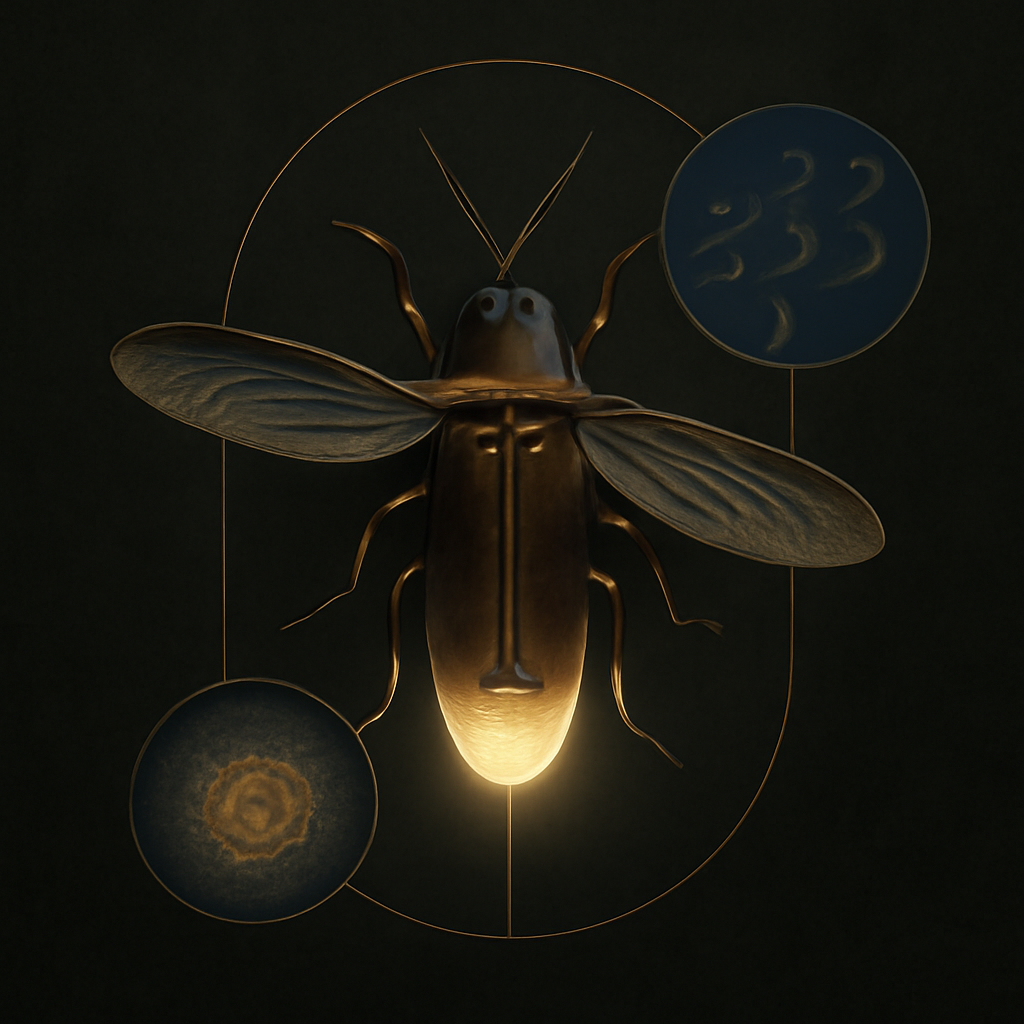
How Fireflies Light Up: The Science of Living Lanterns
Imagine sitting on a porch on a warm summer night. Suddenly, the grass comes alive with tiny, drifting sparks of green and yellow light. These aren't sparks of fire, but living beetles communicating in the dark. For centuries, people wondered how such tiny creatures could shine so brightly without burning themselves.
The secret lies in a beautiful bit of natural chemistry. By mixing a few simple ingredients inside their bodies, fireflies create a pure, heat-free light that puts our best technology to shame. They use this glowing language to talk to each other, find love, and warn off hungry predators in the dark.
“Firefly light is nearly one hundred percent efficient, meaning they lose almost zero energy as heat to create their beautiful glow.”
Reflect
If humans could replicate the firefly's heat-free chemical reaction, how might we redesign our cities, lighting up our homes and streets without using electricity?
Research·2 sources·Established confidence·Investigated 4 Aug 2026(1 month ago)·Grounded; verification trace not recorded·Investigation may be outdated
Your next question, in
Visual Trail
See How Fireflies Light Up: The Science of Living Lanterns
A guided visual explanation assembled from QE artwork and sourced documentary images.
01 / 02
QE visual interpretation
Frame 01
How Fireflies Light Up: The Science of Living Lanterns
Fireflies produce light inside their bellies by mixing a chemical called luciferin with oxygen, using a helper enzyme to trigger a heat-free glow.
Image provenance and limitation
Source: AI-generated visual interpretation
Creator: Question Everything
Limitation: This image explains or evokes the subject. It is not documentary evidence and should not be used to verify a factual claim.
Evidence
What do we know?
Verified claims with confidence scoring and cited sources.
1 of 3 findings need extra caution. Finding 2 rests on weaker sourcing than the other findings.
Living footnotes
Claims remain in the reading flow. Select a citation number to inspect the source behind it.
01
ObservationalSupported
Fireflies produce light by mixing a chemical called luciferin, oxygen, and a helper enzyme called luciferase.
Think of it like a natural glow stick. Inside a firefly's belly, a chemical called luciferin reacts with oxygen. A helper protein called luciferase speeds up this reaction. This process releases energy as a soft, colorful glow. It all happens inside special light-making organs in the beetle's abdomen. Because the reaction does not need high energy, it is extremely efficient and safe.
02
ExperimentalNot confirmed
Fireflies use nitric oxide gas to turn their biological lights on and off.
For a long time, scientists did not know how fireflies flashed so quickly. It turns out they use nitric oxide gas. Normally, tiny cellular power plants called mitochondria keep oxygen away from the light organ. When the firefly wants to flash, it releases nitric oxide. This gas tells the power plants to let go of the oxygen, which rushes into the light organ and triggers the chemical flash.
03
ExperimentalSupported
Scientists use the firefly's light-making gene to track transplanted organs in living rats.
The firefly's glow is so useful that scientists have copied its genetic code. Researchers created 'Firefly Rats' by adding the luciferase gene to their DNA. Because these rats glow under special cameras, doctors can track transplanted tissues and organs in real-time. It helps them see if a transplant is working without having to perform invasive surgery.
The complete record below preserves every citation, confidence input and recorded limitation.
Read the full evidence record3 findings · citations · limitations
Evidence review3 findings2 openable sources
01
Finding 1 of 3Observational
0/1 verified
Fireflies produce light by mixing a chemical called luciferin, oxygen, and a helper enzyme called luciferase.
Think of it like a natural glow stick. Inside a firefly's belly, a chemical called luciferin reacts with oxygen. A helper protein called luciferase speeds up this reaction. This process releases energy as a soft, colorful glow. It all happens inside special light-making organs in the beetle's abdomen. Because the reaction does not need high energy, it is extremely efficient and safe.
Supportedmodel score 100%
One source, not peer-reviewed. Thinner than the score suggests.
REFERENCE
›View sources and limits— 1 citation, limits
Supporting passage
Think of it like a natural glow stick. Inside a firefly's belly, a chemical called luciferin reacts with oxygen. A helper protein called luciferase speeds up this reaction. This process releases energy as a soft, colorful glow. It all happens inside special light-making organs in the beetle's abdomen. Because the reaction does not need high energy, it is extremely efficient and safe.
Rests on a single source. No independent corroboration.
No peer-reviewed source among the citations.
The generator scored this 100%, which would read as “Established”. Its citations reach only “Supported”, so that is what is shown.
02
Finding 2 of 3ExperimentalNeeds caution
0
0/0 verified
Fireflies use nitric oxide gas to turn their biological lights on and off.
For a long time, scientists did not know how fireflies flashed so quickly. It turns out they use nitric oxide gas. Normally, tiny cellular power plants called mitochondria keep oxygen away from the light organ. When the firefly wants to flash, it releases nitric oxide. This gas tells the power plants to let go of the oxygen, which rushes into the light organ and triggers the chemical flash.
Not confirmedmodel score 30%
Scored as if sourced, but every citation failed verification.
NO SURVIVING CITATION
›View sources and limits— limits
Supporting passage
For a long time, scientists did not know how fireflies flashed so quickly. It turns out they use nitric oxide gas. Normally, tiny cellular power plants called mitochondria keep oxygen away from the light organ. When the firefly wants to flash, it releases nitric oxide. This gas tells the power plants to let go of the oxygen, which rushes into the light organ and triggers the chemical flash.
Citations (0 of 1 survived verification)
Nothing openable. Every citation was removed by provenance validation.
What limits this
All 1 citation on this claim failed verification and were removed. Nothing openable supports it.
03
Finding 3 of 3Experimental
1
0/1 verified
Scientists use the firefly's light-making gene to track transplanted organs in living rats.
The firefly's glow is so useful that scientists have copied its genetic code. Researchers created 'Firefly Rats' by adding the luciferase gene to their DNA. Because these rats glow under special cameras, doctors can track transplanted tissues and organs in real-time. It helps them see if a transplant is working without having to perform invasive surgery.
Supportedmodel score 100%
A single peer-reviewed source. No independent corroboration.
PRIMARY STUDY
›View sources and limits— 1 citation, limits
Supporting passage
The firefly's glow is so useful that scientists have copied its genetic code. Researchers created 'Firefly Rats' by adding the luciferase gene to their DNA. Because these rats glow under special cameras, doctors can track transplanted tissues and organs in real-time. It helps them see if a transplant is working without having to perform invasive surgery.
Rests on a single source. No independent corroboration.
The generator scored this 100%, which would read as “Established”. Its citations reach only “Supported”, so that is what is shown.
Interactive Exploration
Touch, drag, and discover
These visualizations respond to your curiosity. Interact to go deeper.
process flow
The Four Steps to a Firefly Flash
Oxygen Enters
The Gas Switch
The Chemical Mix
The Cold Light
statistics card
Efficiency: Nature vs. Humans
95%
Firefly Light Efficiency
Almost all energy in the firefly's chemical reaction is turned into pure, cold light.
10%
Old Light Bulb Efficiency
Traditional bulbs wasted 90% of their electricity as useless heat.
Perspectives
How is this interpreted?
Enter a viewpoint. Notice what it reveals, what it leaves out, and whether it changes the question for you.
The EmpiricistScientific viewpointEstablished lens
From a biological perspective, the firefly's light is a masterclass in organic chemistry and cellular control. The ability to switch oxygen delivery on and off using nitric oxide gas allows for highly precise, rapid communication that consumes very little metabolic energy.
What this lens notices
01Nitric oxide acts as a fast-acting gas switch
02The reaction is highly efficient with minimal heat loss
03Luciferase enzymes are perfect natural catalysts
Application
Why does this matter to you?
Personal reflections and applications for your life.
Thought experimentPractical
Can you speak the language of fireflies?
Why it changes the question
Different firefly species have unique rhythms. Some flash in short bursts, while others make a long, lazy glow.
Try this
Next time you see fireflies, bring a small flashlight outside. Try copying their flash patterns with your light and see if any real fireflies flash back to you.
Media
QE Smart Glass
Curated media selected for this investigation.
QE Glass
YOUTUBE
Fireflies: Nature's Baffling Blinkers | Animal Science for Kids
SciShow Kids
Have you ever wondered how fireflies twinkle and blink on lovely summer nights? Join Jessi and Squeaks at the fort to learn their ...
QE Glass
YOUTUBE
What's Behind The Firefly's Glow | What's Inside?
Insider Science
The firefly is probably the Earth's most famous bioluminescent species, with over 2000 individual species. And the secret to its ...
QE Glass
YOUTUBE
Fireflies: The Quiet Science of Nature’s Living Lanterns
Science for Sleep
Tonight's video explores the quiet science of fireflies, from the chemistry of luciferin and luciferase to the soft yellow-green flashes ...
QE Glass
YOUTUBE
David Attenborough Shines a Light on Glowing Animals | 4K Nature Documentary
Terra Mater
This nature documentary, guided by Sir David Attenborough, reveals a hidden world that has existed all around us completely ...
QE Glass
YOUTUBE
True Facts: Where Have All The Fireflies Gone!
Ze Frank
Donate here: https://xerces.org/savefireflies The Xerces Society Website: https://xerces.org/ Firefly Atlas: ...
QE Glass
YOUTUBE
Glow of Love: The Secret Language Fireflies Use to Find Mates
PBS Terra
On summer evenings in the U.S., the night comes alive with the blinking code of fireflies. Each species of firefly has its own light ...
QE Glass
YOUTUBE
Fireflies | Firefly Facts for Kids | Why Do Fireflies Glow ?
Hey! Guess What
Fireflies | Firefly Facts for Kids | Why Do Fireflies Glow ? is an educational video for kids that will teach them all about fireflies Here ...
QE Glass
PODCAST
Coleopterology (BEETLES) with Dr. Marc Branham
Ologies with Alie Ward
A fun, friendly interview with an insect expert who explains why fireflies glow and how they live.
Keep Going
Where this leads
Questions this investigation opens up — and what QE has already looked into.
No AI help here — no suggestions, no autocomplete, nothing finishing your sentences. That is deliberate. Working out what you think is effortful, and the effort is the part that changes you: reasoning is trained like a muscle, and a muscle that is always carried gets weaker. Let something else do the thinking and you keep the answer but lose the capacity to have reached it.
Write your current position.
Not what the page says. What you think, having read it.0 words · Nothing written yet.
Sign in to leave a mark. Your draft is saved here in the meantime.