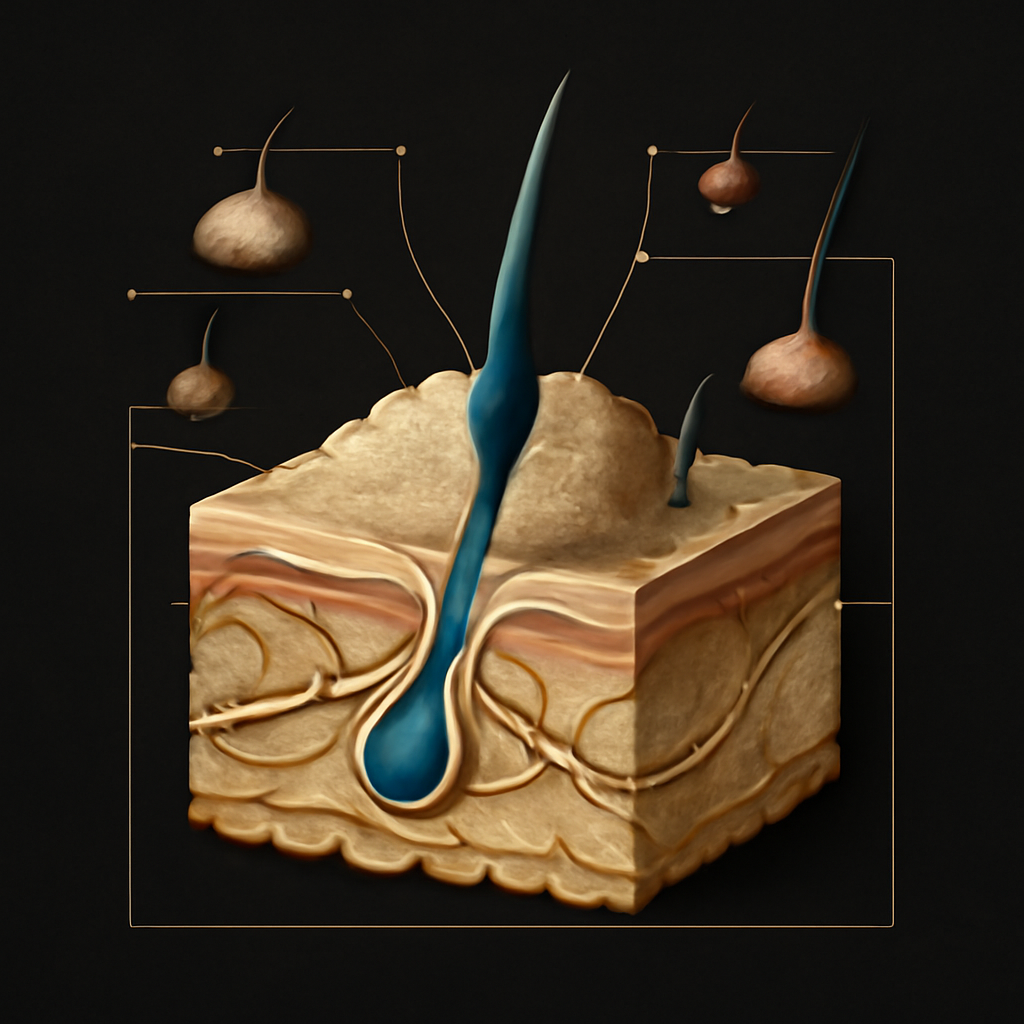
Why Your Skin Puffs Up: The Secret Behind Goosebumps
Have you ever wondered why your skin breaks out in tiny bumps when you step into a chilly room? It is actually a leftover trick from our ancient ancestors. Back when humans were covered in thick hair, tiny muscles under the skin would tighten, pulling each hair straight up. This puffed-up hair trapped a layer of warm air right next to the body. Think of it as nature's original puffer jacket.
But why do they appear when you are scared or hearing a beautiful song? That is down to adrenaline, your body’s emergency hormone. When you feel a sudden rush of fear or awe, your brain prepares you to fight or run. It releases adrenaline, which instantly triggers those same tiny skin muscles to pinch shut. It is the exact same reflex that makes a cat puff up its tail when it is startled, trying to look bigger to its enemies.
“Even though humans shed their thick coats of body hair over a million years ago, our brains still try to fluff up our invisible fur every time we get cold or scared.”
Reflect
If our bodies still hold onto useless survival traits from millions of years ago, what modern behaviors are actually just ancient evolutionary ghosts?
Research·3 sources·Well-Established confidence·Investigated 1 Aug 2026(1 month ago)·Grounded; verification trace not recorded·Investigation may be outdated
Your next question, in
Visual Trail
See Why Your Skin Puffs Up: The Secret Behind Goosebumps
A guided visual explanation assembled from QE artwork and sourced documentary images.
01 / 02
QE visual interpretation
Frame 01
Why Your Skin Puffs Up: The Secret Behind Goosebumps
Goosebumps are a leftover trick from our hairy ancestors, acting like a built-in puffer jacket when cold, or a defense reflex when scared.
Image provenance and limitation
Source: AI-generated visual interpretation
Creator: Question Everything
Limitation: This image explains or evokes the subject. It is not documentary evidence and should not be used to verify a factual claim.
Evidence
What do we know?
Verified claims with confidence scoring and cited sources.
Living footnotes
Claims remain in the reading flow. Select a citation number to inspect the source behind it.
01
ObservationalSupported
Goosebumps are caused by a stress hormone called adrenaline that triggers tiny skin muscles to contract.
When you get cold or scared, your body releases a hormone called adrenaline from small glands above your kidneys. This hormone acts like an emergency alarm. It instantly tells the tiny muscles at the base of your body hairs to tighten up. When these microscopic muscles squeeze, they pull your hair straight up and pinch the skin around them. This is what creates those little bumps you see on your arms.
02
HistoricalSupported
Goosebumps served as a vital survival tool for our hairy ancestors to trap heat and scare off predators.
Millions of years ago, our ancestors were covered in thick hair. When they got cold, goosebumps fluffed up their fur to trap a warm layer of air next to their skin. It worked just like a cozy winter jacket. If a wild animal threatened them, the standing hair made them look much bigger and scarier to attackers. Today, we still have the same reaction, even though we no longer have the thick fur to make it useful.
03
ObservationalSupported
Powerful emotional experiences like music or movies can trigger goosebumps by activating the brain's reward system.
You do not just get goosebumps from physical cold or fear. Beautiful music, moving speeches, or epic movie scenes can trigger them too. Scientists call these "aesthetic chills." When you experience something deeply moving, your brain releases chemicals along its reward pathways. This emotional spike tricks your nervous system into triggering the exact same physical response as a sudden chill, proving that our feelings are deeply wired into our physical bodies.
The complete record below preserves every citation, confidence input and recorded limitation.
Read the full evidence record3 findings · citations · limitations
Evidence review3 findings3 openable sources
01
Finding 1 of 3Observational
0/1 verified
Goosebumps are caused by a stress hormone called adrenaline that triggers tiny skin muscles to contract.
When you get cold or scared, your body releases a hormone called adrenaline from small glands above your kidneys. This hormone acts like an emergency alarm. It instantly tells the tiny muscles at the base of your body hairs to tighten up. When these microscopic muscles squeeze, they pull your hair straight up and pinch the skin around them. This is what creates those little bumps you see on your arms.
Supportedmodel score 95%
One source, not peer-reviewed. Thinner than the score suggests.
REFERENCE
›View sources and limits— 1 citation, limits
Supporting passage
When you get cold or scared, your body releases a hormone called adrenaline from small glands above your kidneys. This hormone acts like an emergency alarm. It instantly tells the tiny muscles at the base of your body hairs to tighten up. When these microscopic muscles squeeze, they pull your hair straight up and pinch the skin around them. This is what creates those little bumps you see on your arms.
Rests on a single source. No independent corroboration.
No peer-reviewed source among the citations.
The generator scored this 95%, which would read as “Established”. Its citations reach only “Supported”, so that is what is shown.
02
Finding 2 of 3Historical
2015
1 dated source
Goosebumps served as a vital survival tool for our hairy ancestors to trap heat and scare off predators.
Millions of years ago, our ancestors were covered in thick hair. When they got cold, goosebumps fluffed up their fur to trap a warm layer of air next to their skin. It worked just like a cozy winter jacket. If a wild animal threatened them, the standing hair made them look much bigger and scarier to attackers. Today, we still have the same reaction, even though we no longer have the thick fur to make it useful.
Supportedmodel score 90%
One source, not peer-reviewed. Thinner than the score suggests.
REFERENCE
›View sources and limits— 1 citation, limits
Supporting passage
Millions of years ago, our ancestors were covered in thick hair. When they got cold, goosebumps fluffed up their fur to trap a warm layer of air next to their skin. It worked just like a cozy winter jacket. If a wild animal threatened them, the standing hair made them look much bigger and scarier to attackers. Today, we still have the same reaction, even though we no longer have the thick fur to make it useful.
Rests on a single source. No independent corroboration.
No peer-reviewed source among the citations.
The generator scored this 90%, which would read as “Established”. Its citations reach only “Supported”, so that is what is shown.
03
Finding 3 of 3Observational
0/1 verified
Powerful emotional experiences like music or movies can trigger goosebumps by activating the brain's reward system.
You do not just get goosebumps from physical cold or fear. Beautiful music, moving speeches, or epic movie scenes can trigger them too. Scientists call these "aesthetic chills." When you experience something deeply moving, your brain releases chemicals along its reward pathways. This emotional spike tricks your nervous system into triggering the exact same physical response as a sudden chill, proving that our feelings are deeply wired into our physical bodies.
Supportedmodel score 88%
One source, not peer-reviewed. Thinner than the score suggests.
REFERENCE
›View sources and limits— 1 citation, limits
Supporting passage
You do not just get goosebumps from physical cold or fear. Beautiful music, moving speeches, or epic movie scenes can trigger them too. Scientists call these "aesthetic chills." When you experience something deeply moving, your brain releases chemicals along its reward pathways. This emotional spike tricks your nervous system into triggering the exact same physical response as a sudden chill, proving that our feelings are deeply wired into our physical bodies.
Rests on a single source. No independent corroboration.
No peer-reviewed source among the citations.
The generator scored this 88%, which would read as “Established”. Its citations reach only “Supported”, so that is what is shown.
Interactive Exploration
Touch, drag, and discover
These visualizations respond to your curiosity. Interact to go deeper.
process flow
The Goosebump Reflex
The Trigger
The Alarm
The Squeeze
The Rise
statistics card
Human vs. Ancestor Hair Stats
5 million
Human body hairs
We have the same number of hairs as chimpanzees, but ours are too thin to keep us warm.
1 million+
Years since hair loss
When our ancestors began losing thick fur, goosebumps lost their main survival purpose.
98.6°F
Core temperature trigger
If your body heat dips below this normal level, your skin sounds the goosebump alarm.
Perspectives
How is this interpreted?
Enter a viewpoint. Notice what it reveals, what it leaves out, and whether it changes the question for you.
The EmpiricistScientific viewpointEstablished lens
From an evolutionary view, goosebumps are a classic example of a vestigial trait. This means they are a leftover habit from our ancient past that no longer serves a real purpose. Since we shed our thick coats of fur over a million years ago, raising our tiny, fine body hairs does not keep us warm or scare off predators anymore. It is simply a harmless glitch in our biology, like a piece of old software still running on a modern computer.
What this lens notices
01We have the same number of hairs as chimps but they are too fine to trap heat.
02The reflex is controlled by the automatic nervous system we cannot easily control.
03Other mammals still actively use this reflex for warmth and defense.
Application
Why does this matter to you?
Personal reflections and applications for your life.
Thought experimentSelf-Reflection
When was the last time a song or a story gave you goosebumps?
Why it changes the question
Paying attention to what triggers your goosebumps can show you what you truly value. It is a direct, honest signal from your subconscious about what moves you.
Try this
Keep a mental note of the exact moments you get 'the chills' this week to discover your true emotional triggers.
Media
QE Smart Glass
Curated media selected for this investigation.
QE Glass
YOUTUBE
Why Do We Get Goosebumps When We’re Scared or Cold?
WebWeaver Education
Why do goosebumps even exist? One minute you're cold. The next minute you're crying over a song—and your arms go full ...
QE Glass
YOUTUBE
Why Do We Get Goosebumps? | The Dr. Binocs Show | Best Learning Videos For Kids | Peekaboo Kidz
Peekaboo Kidz
Hi Friends, welcome to the Dr. Binocs show. in this video Dr. Binocs will explain what causes Goosebumps. Make sure you watch ...
QE Glass
YOUTUBE
Why Do We Get Goosebumps? The Fascinating Science Behind This Body Reaction
BioPulse Health
Goosebumps..... Why do we get goosebumps? 🌡️ are they, and why do we get them? Whether it's the chill of cold air, a thrilling ...
QE Glass
YOUTUBE
Why Do We Get Goosebumps? (Cold, Fear, and Music Explained)
Toggle Mind
Cold weather, a scary movie, and your favorite song can all give you the exact same reaction: goosebumps. In this video, we ...
QE Glass
YOUTUBE
Why Do We Get Goosebumps
The Mental Scientist
Have you ever wondered why your skin suddenly forms tiny bumps when you're cold, scared, or even moved by music?
QE Glass
YOUTUBE
Why Do We Get Goosebumps? The Amazing Science Behind Your Skin
GS Untold Lives
Why Do We Get Goosebumps? The Amazing Science Behind Your Skin Have you ever wondered why you get goosebumps ...
QE Glass
YOUTUBE
Why Do We Get Goosebumps? 🧬 The "Scary" Biological Secret
Swift Shift
Have you ever wondered why your skin bumps up when you're cold or scared? In this video, we break down the "Pilomotor ...
QE Glass
YOUTUBE
The Hair-Raising Science Of Goose Bumps
NPR Skunk Bear
A fun, short animated video explaining the evolutionary history and biology of goosebumps.
QE Glass
PODCAST
Ologies with Alie Ward
Ologies
An entertaining podcast episode exploring why humans kept strange, useless evolutionary traits like goosebumps.
Keep Going
Where this leads
Questions this investigation opens up — and what QE has already looked into.
No AI help here — no suggestions, no autocomplete, nothing finishing your sentences. That is deliberate. Working out what you think is effortful, and the effort is the part that changes you: reasoning is trained like a muscle, and a muscle that is always carried gets weaker. Let something else do the thinking and you keep the answer but lose the capacity to have reached it.
Write your current position.
Not what the page says. What you think, having read it.0 words · Nothing written yet.
Sign in to leave a mark. Your draft is saved here in the meantime.