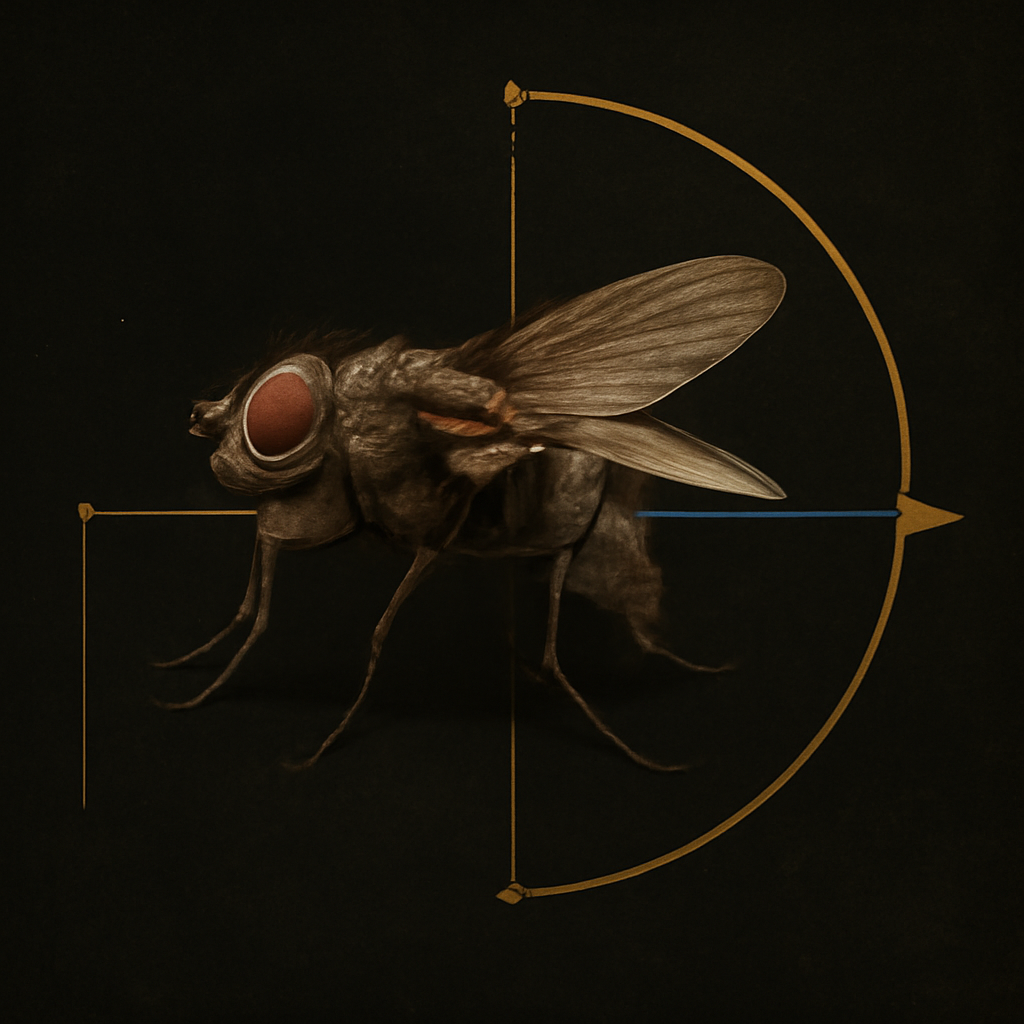
A housefly may look like a tiny blur, but its top speed is surprisingly modest: about 7 kilometres per hour, or 4 miles per hour. That is roughly the pace of a gentle jog. Its real advantage is not raw speed. A fly can change direction almost instantly, hover briefly, and take off in a fraction of a second. Its two wings beat around 200 times each second, giving it remarkable control in tight spaces.
Other flies can be faster. Horseflies are powerful fliers, and some species may reach around 30 kilometres per hour in short bursts, though exact measurements vary. The fastest insects overall are not flies, but certain dragonflies and moths. For a housefly, survival depends less on winning a race than on making escape unpredictable. It sees movement across a wide field of view, senses air currents, and launches backward or sideways before a swatter arrives. Small body. Lightning reactions.
✨
Wonder Moment
“A house fly travels at about 7 km/h, yet its rapid vision and instant manoeuvres make a human hand seem almost frozen.”
Reflect
If speed is not just distance per second, but also reaction time and control, which animals experience the world as slow motion?
1 source·Developing confidence·Investigated 15 Aug 2026(12 days ago)·Source-verified·May need refresh
Your next question, in
Visual Trail
See How Fast Can Flies Fly?
A guided visual explanation assembled from QE artwork and sourced documentary images.
01 / 05
QE visual interpretation
Frame 01
How Fast Can Flies Fly?
A typical housefly flies about 7 km/h, but its rapid takeoffs and sharp turns make it seem much faster.
Image provenance and limitation
Source: AI-generated visual interpretation
Creator: Question Everything
Limitation: This image explains or evokes the subject. It is not documentary evidence and should not be used to verify a factual claim.
Evidence
What do we know?
Verified claims with confidence scoring and cited sources.
2 of 3 findings need extra caution. Finding 2, Finding 3 rest on weaker sourcing than the other findings.
Living footnotes
Claims remain in the reading flow. Select a citation number to inspect the source behind it.
01
ObservationalSupported
House flies can fly at about 7 km/h.
That is roughly the pace of a brisk walk, not the speed of a miniature fighter jet. The house fly’s reputation comes from what it does with that modest speed: it launches quickly, changes direction sharply and slips through complicated indoor spaces. Its flight speed also varies with conditions and behaviour, so 7 km/h is a useful estimate rather than a universal maximum.
02
ExperimentalNot confirmed
House flies approach vertical walls at 0.1–0.55 m/s before landing.
High-speed camera experiments reveal that landing is a carefully controlled manoeuvre, not a simple crash. Researchers filmed house flies at up to 3,000 frames per second and found that many decelerated before touching a vertical wall, while others extended their legs without clear deceleration. The flies were managing speed, distance and leg position in the final moments before contact.
03
ExperimentalNot confirmed
Common green bottle fly males are attracted to wing flashes at about 178 Hz.
For some flies, flight is also a visual language. In experiments filmed at 15,000 frames per second, moving wings produced flashes of reflected light. Male common green bottle flies strongly preferred flashes at 178 Hz, a frequency linked with young females, over frequencies associated with males or older females. Their fast visual system helps turn wingbeats into a signal used during mate recognition.
The complete record below preserves every citation, confidence input and recorded limitation.
Read the full evidence record3 findings · citations · limitations
Evidence review3 findings1 openable sources
01
Finding 1 of 3Observational
0/1 verified
House flies can fly at about 7 km/h.
That is roughly the pace of a brisk walk, not the speed of a miniature fighter jet. The house fly’s reputation comes from what it does with that modest speed: it launches quickly, changes direction sharply and slips through complicated indoor spaces. Its flight speed also varies with conditions and behaviour, so 7 km/h is a useful estimate rather than a universal maximum.
Supportedmodel score 90%
One source, not peer-reviewed. Thinner than the score suggests.
REFERENCE
›View sources and limits— 1 citation, limits
Supporting passage
That is roughly the pace of a brisk walk, not the speed of a miniature fighter jet. The house fly’s reputation comes from what it does with that modest speed: it launches quickly, changes direction sharply and slips through complicated indoor spaces. Its flight speed also varies with conditions and behaviour, so 7 km/h is a useful estimate rather than a universal maximum.
Rests on a single source. No independent corroboration.
No peer-reviewed source among the citations.
The generator scored this 90%, which would read as “Established”. Its citations reach only “Supported”, so that is what is shown.
02
Finding 2 of 3ExperimentalNeeds caution
0
0/0 verified
House flies approach vertical walls at 0.1–0.55 m/s before landing.
High-speed camera experiments reveal that landing is a carefully controlled manoeuvre, not a simple crash. Researchers filmed house flies at up to 3,000 frames per second and found that many decelerated before touching a vertical wall, while others extended their legs without clear deceleration. The flies were managing speed, distance and leg position in the final moments before contact.
Not confirmedmodel score 30%
Scored as if sourced, but every citation failed verification.
NO SURVIVING CITATION
›View sources and limits— limits
Supporting passage
High-speed camera experiments reveal that landing is a carefully controlled manoeuvre, not a simple crash. Researchers filmed house flies at up to 3,000 frames per second and found that many decelerated before touching a vertical wall, while others extended their legs without clear deceleration. The flies were managing speed, distance and leg position in the final moments before contact.
Citations (0 of 1 survived verification)
Nothing openable. Every citation was removed by provenance validation.
What limits this
All 1 citation on this claim failed verification and were removed. Nothing openable supports it.
03
Finding 3 of 3ExperimentalNeeds caution
0
0/0 verified
Common green bottle fly males are attracted to wing flashes at about 178 Hz.
For some flies, flight is also a visual language. In experiments filmed at 15,000 frames per second, moving wings produced flashes of reflected light. Male common green bottle flies strongly preferred flashes at 178 Hz, a frequency linked with young females, over frequencies associated with males or older females. Their fast visual system helps turn wingbeats into a signal used during mate recognition.
Not confirmedmodel score 30%
Scored as if sourced, but every citation failed verification.
NO SURVIVING CITATION
›View sources and limits— limits
Supporting passage
For some flies, flight is also a visual language. In experiments filmed at 15,000 frames per second, moving wings produced flashes of reflected light. Male common green bottle flies strongly preferred flashes at 178 Hz, a frequency linked with young females, over frequencies associated with males or older females. Their fast visual system helps turn wingbeats into a signal used during mate recognition.
Citations (0 of 1 survived verification)
Nothing openable. Every citation was removed by provenance validation.
What limits this
All 1 citation on this claim failed verification and were removed. Nothing openable supports it.
Interactive Exploration
Touch, drag, and discover
These visualizations respond to your curiosity. Interact to go deeper.
comparison table
Speed Is Only One Part of Flight
House fly
What it reveals
Cruising speed
About 7 km/h
Moderate forward travel
Wall approach
0.1–0.55 m/s
Controlled landing
Wing-flash signal
About 178 Hz
Mate recognition
Tap any row to highlight and compare
statistics card
The Fly in Numbers
7 km/h
Approximate house-fly speed
About the pace of a brisk walk.
3,000 fps
Camera speed used for wall-landing study
It exposes movements too fast for human eyes.
178 Hz
Preferred wing-flash frequency
A visual cue used by male bottle flies.
Visual Gallery
Images & artifacts
Historical images, diagrams, and visual knowledge from Wikimedia Commons.
Perspectives
How is this interpreted?
Enter a viewpoint. Notice what it reveals, what it leaves out, and whether it changes the question for you.
The EmpiricistScientific viewpointEstablished lens
The most useful answer depends on what “fast” means. A house fly’s forward speed is ordinary by human standards, but its acceleration, visual processing and turning ability are exceptional at its scale. Flight is a package deal: speed, stability, sensing and control. The fly wins the contest against a swatter less by crossing a room quickly than by detecting movement, lifting off and redirecting its body before the blow arrives.
What this lens notices
01Flight speed is different from acceleration and manoeuvrability.
03Wing movement can carry information about sex and age.
Application
Why does this matter to you?
Personal reflections and applications for your life.
Thought experimentSelf-Reflection
When judging performance, are you measuring the result or the hidden skills that make it possible?
Why it changes the question
A fly’s modest cruising speed hides extraordinary timing and control. The same mistake can make human abilities look simple when the real work lies in reaction, balance and adjustment.
Try this
Choose one skill you admire and list three invisible abilities it depends on.
Media
QE Smart Glass
Curated media selected for this investigation.
QE Glass
YOUTUBE
Why Is It so Hard to Swat a Fly?
SciShow
SciShow is supported by Brilliant.org. Go to https://Brilliant.org/SciShow to get 20% off of an annual Premium subscription. Flies ...
QE Glass
YOUTUBE
Why Flies Die When They See Dead Flies
SciShow
Head to https://linode.com/scishow to get a $100 60-day credit on a new Linode account. Linode offers simple, affordable, and ...
QE Glass
YOUTUBE
Fly Life Cycle and Lifespan | How Long Do Flies Live? | How to Control Flies in Your Home
Fresh Home 24
Flies are more than just annoying pests. Understanding the flies life cycle is key to managing them effectively. In this video, we ...
QE Glass
YOUTUBE
Complete Life Cycle of the Fruit Fly
Insects Limited
Insects Limited entomologist, Patrick Kelley, takes a detailed look into the complete life cycle of fruit flies that can help us ...
QE Glass
YOUTUBE
1,000 Flies vs. Venus Fly Trap
TerraGreen
NEW Plushies : https://terragreenstore.com/ In this video, I hatched 1000 flies, and put them in the same container as 50 ...
QE Glass
YOUTUBE
The Life Cycle Of A Common House Fly
Animalium
This was worth making. Here's a video on the life cycle of a common house fly! If you liked this video, please share, and subscribe ...
QE Glass
YOUTUBE
Why are Flies so Hard to Swat? + more videos | #aumsum #kids #science #education #children
It's AumSum Time
Buy AumSum Merchandise: http://bit.ly/3srNDiG Website: https://www.aumsum.com When we see the world, our eyes send ...
QE Glass
YOUTUBE
Insect Flight: How Flies Control the Air
Smithsonian Institution
An authoritative introduction to insect flight, wing mechanics and manoeuvrability.
Keep Going
Where this leads
Questions this investigation opens up — and what QE has already looked into.
No AI help here — no suggestions, no autocomplete, nothing finishing your sentences. That is deliberate. Working out what you think is effortful, and the effort is the part that changes you: reasoning is trained like a muscle, and a muscle that is always carried gets weaker. Let something else do the thinking and you keep the answer but lose the capacity to have reached it.
Write your current position.
Not what the page says. What you think, having read it.0 words · Nothing written yet.
Sign in to leave a mark. Your draft is saved here in the meantime.