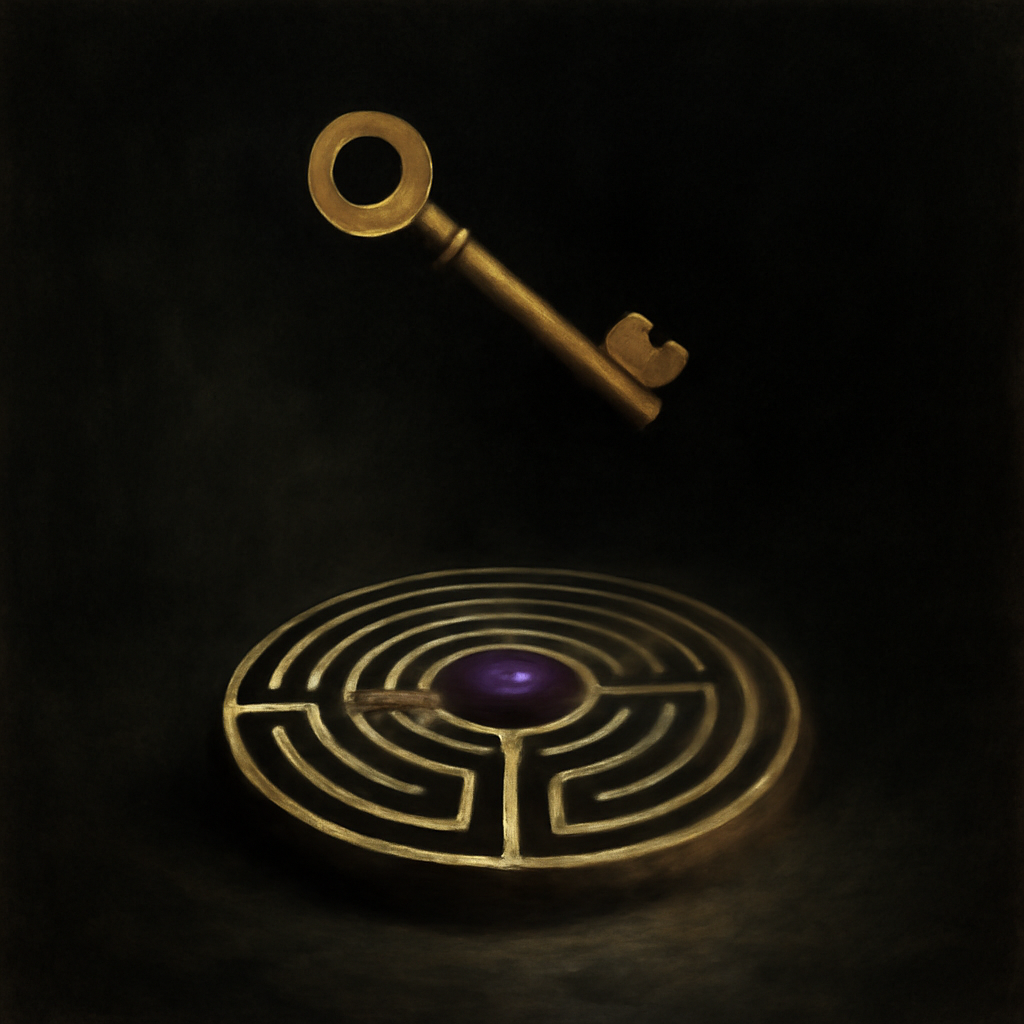
Look around you. Almost everything you think you know is built on a silent foundation. We navigate our daily lives trusting our senses, our memories, and the words of strangers. But how do we actually prove that any of it is real?
This is where epistemology steps in. It is the quiet curator of the mind, asking three deceptively simple questions: What is knowledge? How do we get it? And how can we be absolutely sure we are not mistaken? By examining the boundary between what we merely believe and what is genuinely true, this ancient branch of philosophy acts as the ultimate filter for human understanding.
✨
Wonder Moment
“For centuries, philosophers defined knowledge as 'justified true belief,' yet a three-page paper in 1963 shattered this definition by proving you can have a justified true belief that is still correct only by complete coincidence.”
Reflect
If our senses can be easily fooled by simple illusions, on what foundation can we build any absolute truth?
1 source·Developing confidence·Investigated 19 Jun 2026(2 months ago)·Source-verified·Investigation may be outdated
Your next question, in
Visual Trail
See Epistemology: The Rules of Knowing
A guided visual explanation assembled from QE artwork and sourced documentary images.
01 / 05
QE visual interpretation
Frame 01
Epistemology: The Rules of Knowing
Epistemology is the branch of philosophy that explores what knowledge is, how we acquire it, and how we distinguish true facts from mere beliefs.
Image provenance and limitation
Source: AI-generated visual interpretation
Creator: Question Everything
Limitation: This image explains or evokes the subject. It is not documentary evidence and should not be used to verify a factual claim.
Evidence
What do we know?
Verified claims with confidence scoring and cited sources.
2 of 3 findings need extra caution. Finding 2, Finding 3 rest on weaker sourcing than the other findings.
Living footnotes
Claims remain in the reading flow. Select a citation number to inspect the source behind it.
01
HistoricalSupported
Traditional epistemology defines knowledge as 'justified true belief,' requiring three distinct criteria: truth, belief, and evidence.
For centuries, thinkers traced this definition back to Plato. To know something, you must believe it, it must actually be true, and you must have good evidence or justification for holding that belief. Without justification, a correct guess is just lucky, not true knowledge.
02
AcademicNot confirmed
Edmund Gettier proved that a person can have a justified true belief without actually possessing knowledge.
In a brief 1963 paper, Gettier presented scenarios where someone's belief was both justified and true, yet only by sheer luck. For instance, if you look at a broken clock that happens to show the correct time, your belief about the time is true and justified by the clock, but you do not actually 'know' the time. This simple revelation forced philosophers to rethink the very definition of knowing.
03
ObservationalNot confirmed
Epistemological justification is divided between foundationalism, which relies on basic self-evident beliefs, and coherentism, which holds that beliefs are justified by fitting together.
Foundationalists argue that our knowledge rests on a base of self-evident truths that need no further proof. Coherentists disagree, comparing knowledge to a web where beliefs support each other. If a new belief fits neatly with everything else we believe, it is justified.
The complete record below preserves every citation, confidence input and recorded limitation.
Read the full evidence record3 findings · citations · limitations
Evidence review3 findings1 openable sources
01
Finding 1 of 3Historical
2019
1 dated source
Traditional epistemology defines knowledge as 'justified true belief,' requiring three distinct criteria: truth, belief, and evidence.
For centuries, thinkers traced this definition back to Plato. To know something, you must believe it, it must actually be true, and you must have good evidence or justification for holding that belief. Without justification, a correct guess is just lucky, not true knowledge.
Supportedmodel score 100%
One source, not peer-reviewed. Thinner than the score suggests.
REFERENCE
›View sources and limits— 1 citation, limits
Supporting passage
For centuries, thinkers traced this definition back to Plato. To know something, you must believe it, it must actually be true, and you must have good evidence or justification for holding that belief. Without justification, a correct guess is just lucky, not true knowledge.
Rests on a single source. No independent corroboration.
No peer-reviewed source among the citations.
The generator scored this 100%, which would read as “Established”. Its citations reach only “Supported”, so that is what is shown.
02
Finding 2 of 3AcademicNeeds caution
0
0/0 verified
Edmund Gettier proved that a person can have a justified true belief without actually possessing knowledge.
In a brief 1963 paper, Gettier presented scenarios where someone's belief was both justified and true, yet only by sheer luck. For instance, if you look at a broken clock that happens to show the correct time, your belief about the time is true and justified by the clock, but you do not actually 'know' the time. This simple revelation forced philosophers to rethink the very definition of knowing.
Not confirmedmodel score 30%
Scored as if sourced, but every citation failed verification.
NO SURVIVING CITATION
›View sources and limits— limits
Supporting passage
In a brief 1963 paper, Gettier presented scenarios where someone's belief was both justified and true, yet only by sheer luck. For instance, if you look at a broken clock that happens to show the correct time, your belief about the time is true and justified by the clock, but you do not actually 'know' the time. This simple revelation forced philosophers to rethink the very definition of knowing.
Citations (0 of 1 survived verification)
Nothing openable. Every citation was removed by provenance validation.
What limits this
All 1 citation on this claim failed verification and were removed. Nothing openable supports it.
03
Finding 3 of 3ObservationalNeeds caution
0/0 verified
Epistemological justification is divided between foundationalism, which relies on basic self-evident beliefs, and coherentism, which holds that beliefs are justified by fitting together.
Foundationalists argue that our knowledge rests on a base of self-evident truths that need no further proof. Coherentists disagree, comparing knowledge to a web where beliefs support each other. If a new belief fits neatly with everything else we believe, it is justified.
Not confirmedmodel score 30%
Scored as if sourced, but every citation failed verification.
NO SURVIVING CITATION
›View sources and limits— limits
Supporting passage
Foundationalists argue that our knowledge rests on a base of self-evident truths that need no further proof. Coherentists disagree, comparing knowledge to a web where beliefs support each other. If a new belief fits neatly with everything else we believe, it is justified.
Citations (0 of 1 survived verification)
Nothing openable. Every citation was removed by provenance validation.
What limits this
All 1 citation on this claim failed verification and were removed. Nothing openable supports it.
Interactive Exploration
Touch, drag, and discover
These visualizations respond to your curiosity. Interact to go deeper.
spectrum
The Spectrum of Belief and Observation
Pure Reason (A Priori)Pure Observation (A Posteriori)
10%
Mathematics
30%
Philosophical Logic
50%
Theoretical Physics
80%
Biology and Chemistry
95%
Sensory Experience
comparison table
Two Paths to Justification
Foundationalism
Coherentism
Core Metaphor
A building with a solid concrete foundation
A spiderweb where threads support each other
Source of Justification
Self-evident, basic beliefs that need no external proof
The overall consistency and fit within a system of beliefs
Main Vulnerability
Hard to prove which beliefs are truly self-evident
Can lead to circular reasoning where false ideas support each other
Tap any row to highlight and compare
Visual Gallery
Images & artifacts
Historical images, diagrams, and visual knowledge from Wikimedia Commons.
Perspectives
How is this interpreted?
Enter a viewpoint. Notice what it reveals, what it leaves out, and whether it changes the question for you.
The EmpiricistScientific viewpointLive tension
Science approaches knowledge through physical observation and measurement. From this perspective, our senses are the primary gateway to truth. We formulate hypotheses, test them against physical reality, and gather hard empirical evidence to build our understanding of the universe.
What this lens notices
01Sensory data is the ultimate test of reality
02Repeated experimental testing minimizes human bias
03Physical measurements provide objective, shared facts
Application
Why does this matter to you?
Personal reflections and applications for your life.
Thought experimentSelf-Reflection
How much of what you 'know' is based on your own experience versus the testimony of others?
Why it changes the question
Most of our knowledge about the world—from the existence of atoms to distant countries—comes from trusting other people. Epistemology helps us evaluate when it is reasonable to trust these external sources.
Try this
Write down three facts you believe to be true, and track down exactly where you first learned them to test their reliability.
Media
QE Smart Glass
Curated media selected for this investigation.
QE Glass
YOUTUBE
Understanding Epistemology The Study of Knowledge
ElevatedMinds
Embark on an enlightening journey through the world of epistemology—the study of knowledge, belief, and truth.
QE Glass
YOUTUBE
PHILOSOPHY - Epistemology: Introduction to Theory of Knowledge [HD]
Wireless Philosophy
In this Wireless Philosophy video, Jennifer Nagel (University of Toronto) launches our Theory of Knowledge series. We look at the ...
QE Glass
YOUTUBE
Epistemology: How Do I Know? | Episode 1807 | Closer To Truth
Closer To Truth
Donate to Closer To Truth and help us keep our content free and without paywalls: https://shorturl.at/OnyRq Epistemology is the ...
QE Glass
YOUTUBE
Epistemology | The Complete Philosophy of Knowledge
SleepNomad
A comprehensive deep-dive into epistemology: the philosophy of knowledge. This video explores what knowledge is, where it ...
QE Glass
YOUTUBE
David Hume Documentary to Fall Asleep To
Mind Palace
Today we explore the complete life of David Hume, the influential Scottish philosopher and historian known for his ...
QE Glass
YOUTUBE
Robert Audi - Epistemology: How Do We Know What We Know?
Closer To Truth
What do we know and how do we know it? What is knowledge? What is belief? How is belief justified? What justifies us in ...
QE Glass
YOUTUBE
What is Philosophy?: Crash Course Philosophy #1
CrashCourse
Today Hank begins to teach you about Philosophy by discussing the historical origins of philosophy in ancient Greece, and its ...
QE Glass
YOUTUBE
PHILOSOPHY - Epistemology: Analyzing Knowledge #1 (The Gettier Problem) [HD]
Wireless Philosophy
Is knowledge the same as justified true belief? In this Wireless Philosophy video, Jennifer Nagel (University of Toronto) discusses ...
QE Glass
PODCAST
What Do We Know, and How Do We Know It? (Ep. 136)
The Partially Examined Life
A group of philosophers discuss key texts and concepts related to epistemology in a less formal, conversational style.
QE Glass
YOUTUBE
How do you know what's true? - Matt Ewbank
TED-Ed
A concise and visually appealing animated exploration of how we distinguish truth from falsehood, touching on epistemological questions.
Connected context
Connected entities
The people, places, concepts, and events that matter here.
Keep Going
Where this leads
Questions this investigation opens up — and what QE has already looked into.
No AI help here — no suggestions, no autocomplete, nothing finishing your sentences. That is deliberate. Working out what you think is effortful, and the effort is the part that changes you: reasoning is trained like a muscle, and a muscle that is always carried gets weaker. Let something else do the thinking and you keep the answer but lose the capacity to have reached it.
Write your current position.
Not what the page says. What you think, having read it.0 words · Nothing written yet.
Sign in to leave a mark. Your draft is saved here in the meantime.