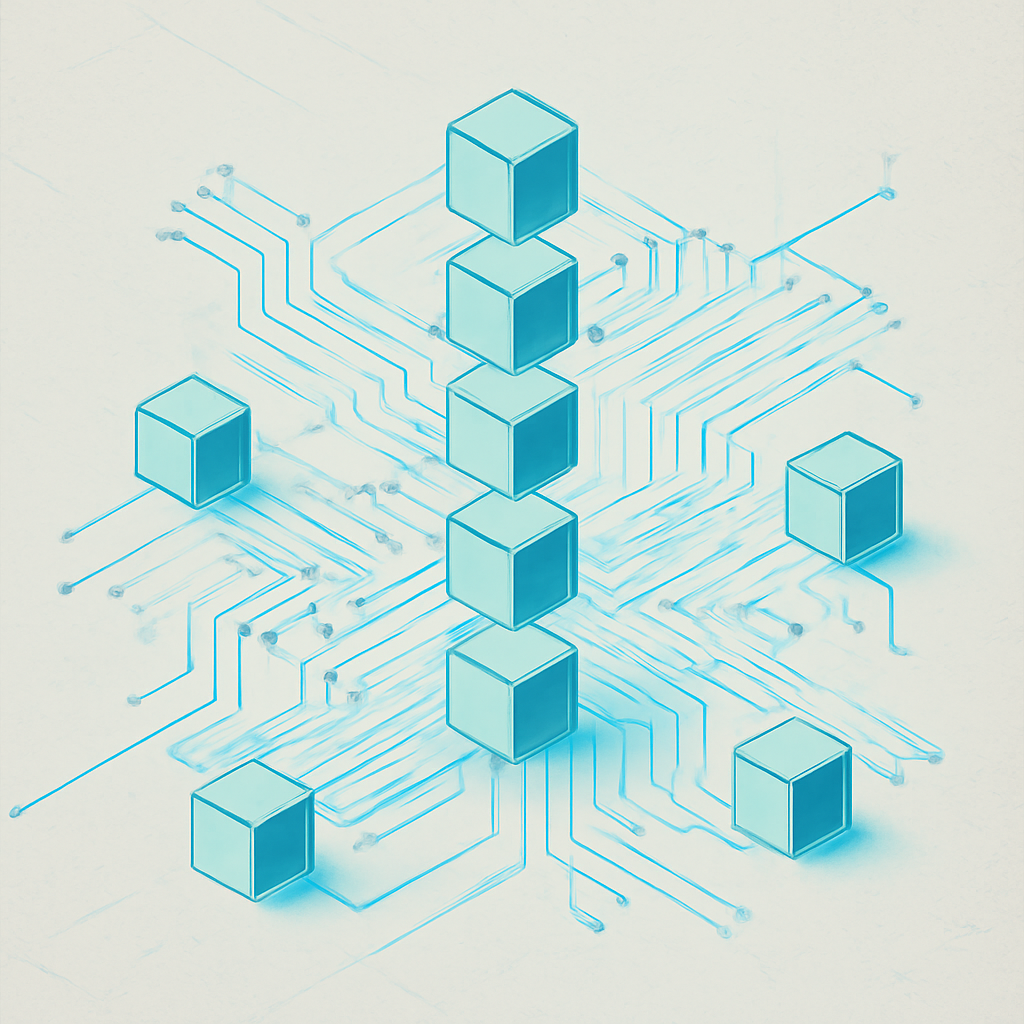
The Trust Machine: How Blockchain Rules Without Rulers
Imagine a book. But not just any book. A ledger of transactions, copied thousands of times across a vast global network of computers. Every time a page is written, every single computer must agree on its contents. Once written, the ink is permanent. It cannot be erased, rewritten, or torn out. This is the blockchain.
By removing the need for a central authority—like a bank or a government—this technology does something once thought impossible. It creates trust between total strangers. Here, math and consensus replace traditional institutions. Let us look closer at how this digital ecosystem keeps itself alive, secure, and perfectly synchronized.
✨
Wonder Moment
“By copying the exact same ledger to thousands of independent computers, blockchain creates a system of absolute trust where no single computer is in charge.”
Reflect
If we can trust transactions without needing a bank, what other major institutions in our society could be replaced by shared, open-source code?
4 sources·Established confidence·Investigated 8 Aug 2026(19 days ago)·May need refresh
Your next question, in
Visual Trail
See The Trust Machine: How Blockchain Rules Without Rulers
A guided visual explanation assembled from QE artwork and sourced documentary images.
01 / 05
QE visual interpretation
Frame 01
The Trust Machine: How Blockchain Rules Without Rulers
Blockchain is a shared, unchangeable digital ledger that lets strangers safely trade assets without needing a bank.
Image provenance and limitation
Source: AI-generated visual interpretation
Creator: Question Everything
Limitation: This image explains or evokes the subject. It is not documentary evidence and should not be used to verify a factual claim.
Evidence
What do we know?
Verified claims with confidence scoring and cited sources.
Generated without source retrieval. QE did not fetch sources for this investigation, so no citation here was checked against a retrieved set. Claims reflect the model’s training data. 1 of 3 findings carry no openable link at all.
1 of 3 findings need extra caution. Finding 1 rests on weaker sourcing than the other findings.
Living footnotes
Claims remain in the reading flow. Select a citation number to inspect the source behind it.
01
ObservationalNot confirmed
Blockchain data is stored in linked chronological blocks that cannot be altered without network consensus.
When data enters a blockchain, it is grouped into blocks and chained together chronologically. Once a block is added, it is permanent. To change any part of this history, the majority of the network must agree. This consensus mechanism keeps the shared ledger consistent and secure from unauthorized tampering, removing the vulnerability of a single point of failure.
02
ObservationalSupported
Blockchain eliminates the need for trusted third parties by using a decentralized peer-to-peer network.
Traditional systems rely on central institutions like banks to verify transactions. Blockchain shifts this responsibility to a distributed network of computers, known as nodes. Each node holds a copy of the ledger. They work together to validate transactions directly, allowing secure peer-to-peer exchanges without an expensive intermediary.
03
ExperimentalSupported
Smart contracts on a blockchain can automate agreements and access control without human intervention.
Blockchains do more than track money. By implementing smart contracts, the network can act as an automated access-control manager. These programs run directly on the blockchain, automatically executing agreements or granting data access when specific conditions are met, entirely independent of third-party enforcement.
The complete record below preserves every citation, confidence input and recorded limitation.
Read the full evidence record3 findings · citations · limitations
Evidence review3 findings4 openable sources
01
Finding 1 of 3ObservationalNeeds caution
0/0 verified
Blockchain data is stored in linked chronological blocks that cannot be altered without network consensus.
When data enters a blockchain, it is grouped into blocks and chained together chronologically. Once a block is added, it is permanent. To change any part of this history, the majority of the network must agree. This consensus mechanism keeps the shared ledger consistent and secure from unauthorized tampering, removing the vulnerability of a single point of failure.
Not confirmedmodel score 30%
Written from the model's own knowledge. No source was retrieved or checked.
UNVERIFIED — NO RETRIEVAL
›View sources and limits— limits
Supporting passage
When data enters a blockchain, it is grouped into blocks and chained together chronologically. Once a block is added, it is permanent. To change any part of this history, the majority of the network must agree. This consensus mechanism keeps the shared ledger consistent and secure from unauthorized tampering, removing the vulnerability of a single point of failure.
Citations (0 of 1 survived verification)
Nothing openable. No sources were retrieved for this investigation, so none were checked.
What limits this
This investigation was generated without source retrieval. The model named a source but gave no link, and no verification step ran against it.
The claim reflects the model's training data, not a checked citation.
02
Finding 2 of 3Observational
0/2 verified
Blockchain eliminates the need for trusted third parties by using a decentralized peer-to-peer network.
Traditional systems rely on central institutions like banks to verify transactions. Blockchain shifts this responsibility to a distributed network of computers, known as nodes. Each node holds a copy of the ledger. They work together to validate transactions directly, allowing secure peer-to-peer exchanges without an expensive intermediary.
Supportedmodel score 100%
2 sources agree, none peer-reviewed.
REFERENCE ×2
›View sources and limits— 2 citations, limits
Supporting passage
Traditional systems rely on central institutions like banks to verify transactions. Blockchain shifts this responsibility to a distributed network of computers, known as nodes. Each node holds a copy of the ledger. They work together to validate transactions directly, allowing secure peer-to-peer exchanges without an expensive intermediary.
Generated without source retrieval — citations here were not verified against a retrieved set.
No peer-reviewed source among the citations.
The generator scored this 100%, which would read as “Established”. Its citations reach only “Supported”, so that is what is shown.
03
Finding 3 of 3Experimental
2
0/2 verified
Smart contracts on a blockchain can automate agreements and access control without human intervention.
Blockchains do more than track money. By implementing smart contracts, the network can act as an automated access-control manager. These programs run directly on the blockchain, automatically executing agreements or granting data access when specific conditions are met, entirely independent of third-party enforcement.
Supportedmodel score 100%
2 sources agree, 2 peer-reviewed.
PRIMARY STUDY ×2
›View sources and limits— 2 citations, limits
Supporting passage
Blockchains do more than track money. By implementing smart contracts, the network can act as an automated access-control manager. These programs run directly on the blockchain, automatically executing agreements or granting data access when specific conditions are met, entirely independent of third-party enforcement.
Generated without source retrieval — citations here were not verified against a retrieved set.
The generator scored this 100%, which would read as “Established”. Its citations reach only “Supported”, so that is what is shown.
Interactive Exploration
Touch, drag, and discover
These visualizations respond to your curiosity. Interact to go deeper.
process flow
The Journey of a Blockchain Transaction
Transaction Requested
Broadcast to Network
Validation
Block Creation
Chaining
Completion
comparison table
Ledger Comparison
Centralized Database
Blockchain Ledger
Control
Owned and managed by a single central authority
Distributed across a public or private peer-to-peer network
Data Integrity
Can be edited, deleted, or overwritten by administrators
Immutable; once written, blocks cannot be modified or deleted
Speed & Cost
Extremely fast processing with minimal overhead cost
Slower processing due to network consensus mechanisms
Trust Model
Requires trust in the central party keeping the records
Built on cryptographic validation and consensus math
Tap any row to highlight and compare
Visual Gallery
Images & artifacts
Historical images, diagrams, and visual knowledge from Wikimedia Commons.
Perspectives
How is this interpreted?
Enter a viewpoint. Notice what it reveals, what it leaves out, and whether it changes the question for you.
The EmpiricistScientific viewpointLive tension
Computer scientists view blockchain as a major breakthrough in distributed computing. It solves the Byzantine Generals Problem—how to coordinate consensus in a network where some players might be malicious. By combining cryptography with game theory, blockchain keeps thousands of independent nodes aligned, though it faces ongoing challenges with transaction speed, latency, and energy use.
What this lens notices
01Solves coordination without a central coordinator
02Uses cryptographic hashing for absolute data integrity
03Balances security and decentralization against speed scales
Application
Why does this matter to you?
Personal reflections and applications for your life.
Thought experimentPhilosophical
Where do you place your trust in your daily life?
Why it changes the question
We trust banks with our money and social networks with our data. Blockchain asks us to imagine a world where we don't have to trust anyone's good intentions, only the cold logic of open-source math.
Try this
Write down three organizations you trust with your personal data, and think about how your relationship with them would change if they used a decentralized ledger.
Media
QE Smart Glass
Curated media selected for this investigation.
QE Glass
YOUTUBE
Blockchain In 7 Minutes | What Is Blockchain | Blockchain Explained|How Blockchain Works|Simplilearn
Simplilearn
AI Accelerator Program - From Prompts to Agentic Workflows ...
QE Glass
YOUTUBE
Blockchain Technology Simply Explained
AI Uncovered
Blockchain Technology Simply Explained Keep Your Digital Life Private and Be Safe Online: https://nordvpn.com/safetyfirst ...
QE Glass
YOUTUBE
Blockchain Technology Explained (2 Hour Course)
Coding Tech
Blockchain Technology Course will cover: - Technology overview - Blockchain evolution - Decentralized web - Distributed ...
QE Glass
YOUTUBE
Blockchain Explained: The Technology Behind Bitcoin and the Future of Money
Rise & Beyond
Blockchain Explained: The Technology Behind Bitcoin and the Future of Money Blockchain is one of the most revolutionary ...
QE Glass
YOUTUBE
What is Blockchain? Blockchain Technology Explained Simply
99Bitcoins
Start trading Bitcoin and cryptocurrency here: http://bit.ly/3uk1YyL Blockchain technology is a way of managing a ledger of records ...
QE Glass
YOUTUBE
The History of Blockchain Explained in 5mins
EatTheBlocks
FREE MASTERCLASS "Get Into Web3 In a Bear Market" Link: https://eattheblocks.com/masterclass Full roadmap to learn ...
Keep Going
Where this leads
Questions this investigation opens up — and what QE has already looked into.
No AI help here — no suggestions, no autocomplete, nothing finishing your sentences. That is deliberate. Working out what you think is effortful, and the effort is the part that changes you: reasoning is trained like a muscle, and a muscle that is always carried gets weaker. Let something else do the thinking and you keep the answer but lose the capacity to have reached it.
Write your current position.
Not what the page says. What you think, having read it.0 words · Nothing written yet.
Sign in to leave a mark. Your draft is saved here in the meantime.