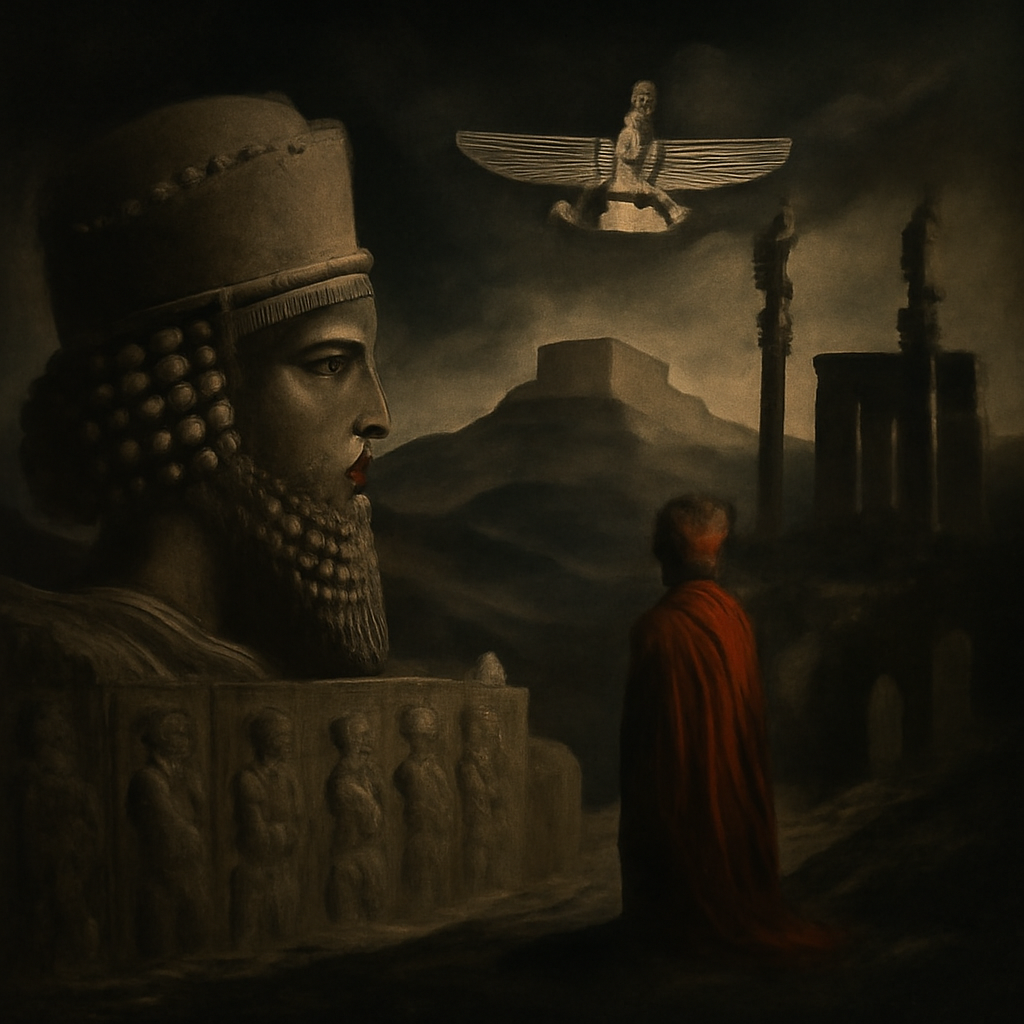
Ancient Iran: The Land of Empires and Endless Stories
Ancient Iran, once called Persia by the Greeks, was a vast and rich land full of powerful empires, stunning art, and deep culture. It stretched across deserts, mountains, and fertile lands, making it a crossroads for many peoples and ideas. From the early days of village life to mighty empires like the Achaemenids, it shaped much of the ancient world.
Imagine huge palaces in cities like Persepolis, where kings ruled with great power but also respected many different peoples and cultures. Ancient Iranians were skilled builders, artists, and thinkers. They created impressive roads, introduced early human rights ideas, and worshipped gods tied to nature and truth. Their stories and inventions still influence us today.
“The Persian Empire was so vast it connected lands from today’s Europe all the way to India, shaping cultures across continents.”
Reflect
What parts of today’s world do you think will be remembered thousands of years from now, and why?
5 sources·Established confidence·Investigated 16 Jul 2026(1 month ago)·Investigation may be outdated
Your next question, in
Visual Trail
See Ancient Iran: The Land of Empires and Endless Stories
A guided visual explanation assembled from QE artwork and sourced documentary images.
01 / 05
QE visual interpretation
Frame 01
Ancient Iran: The Land of Empires and Endless Stories
Ancient Iran was a vast empire known for its rich culture, powerful kings, and lasting influence.
Image provenance and limitation
Source: AI-generated visual interpretation
Creator: Question Everything
Limitation: This image explains or evokes the subject. It is not documentary evidence and should not be used to verify a factual claim.
Evidence
What do we know?
Verified claims with confidence scoring and cited sources.
Generated without source retrieval. QE did not fetch sources for this investigation, so no citation here was checked against a retrieved set. Claims reflect the model’s training data.
Living footnotes
Claims remain in the reading flow. Select a citation number to inspect the source behind it.
01
HistoricalSupported
The Achaemenid Empire was one of the largest empires in ancient history.
Founded by Cyrus the Great around 550 BCE, the Achaemenid Empire stretched from the Balkans and Eastern Europe to the Indus Valley. This made it the largest empire the world had seen at the time. It united many different cultures under one rule and created systems like roads and postal services to connect its vast lands. The empire was known for respecting the customs and religions of the people it ruled, which was unusual for that era.
02
ObservationalSupported
Persepolis was a grand capital city built as a symbol of Achaemenid power.
Persepolis was built around 515 BCE and served as a ceremonial capital. It featured stunning palaces, huge staircases, and detailed carvings showing scenes of kings and diplomats from across the empire. The city's design showed the empire’s wealth and the king’s power, but also its respect for the diverse peoples under Persian rule. Sadly, it was destroyed by Alexander the Great in 330 BCE.
03
HistoricalSupported
Zoroastrianism was the main religion in ancient Iran before Islam.
Zoroastrianism is one of the world’s oldest known religions. It was founded by the prophet Zoroaster and focuses on the struggle between truth and lies, good and evil. Fire played a special role in its worship, symbolizing purity. This religion greatly influenced later beliefs and was the official faith during the Achaemenid and Sassanian empires.
04
HistoricalSupported
Ancient Iranians built an early network of roads, including the Royal Road.
The Royal Road was built to connect the vast Achaemenid Empire. It stretched about 2,700 kilometers (almost 1,700 miles) from Sardis in the west to Susa in the east. This road helped messengers, traders, and soldiers travel quickly across the empire. It was one of the earliest examples of a long, built road system, showing the empire's advanced organization.
05
ObservationalSupported
Ancient Iran was home to early cities and cultures dating back to 4000 BCE.
Before the great empires, ancient Iran had many early farming villages and towns. The Jiroft culture is one example, known for its unique pottery and early writing. These early societies laid the groundwork for later powerful empires by developing agriculture, crafts, and trade.
The complete record below preserves every citation, confidence input and recorded limitation.
Read the full evidence record5 findings · citations · limitations
Evidence review5 findings5 openable sources
01
Finding 1 of 5Historical
2020
1 dated source
The Achaemenid Empire was one of the largest empires in ancient history.
Founded by Cyrus the Great around 550 BCE, the Achaemenid Empire stretched from the Balkans and Eastern Europe to the Indus Valley. This made it the largest empire the world had seen at the time. It united many different cultures under one rule and created systems like roads and postal services to connect its vast lands. The empire was known for respecting the customs and religions of the people it ruled, which was unusual for that era.
Supportedmodel score 98%
One source, not peer-reviewed. Thinner than the score suggests.
REPORTING
›View sources and limits— 1 citation, limits
Supporting passage
Founded by Cyrus the Great around 550 BCE, the Achaemenid Empire stretched from the Balkans and Eastern Europe to the Indus Valley. This made it the largest empire the world had seen at the time. It united many different cultures under one rule and created systems like roads and postal services to connect its vast lands. The empire was known for respecting the customs and religions of the people it ruled, which was unusual for that era.
Generated without source retrieval — citations here were not verified against a retrieved set.
Rests on a single source. No independent corroboration.
No peer-reviewed source among the citations.
The generator scored this 98%, which would read as “Established”. Its citations reach only “Supported”, so that is what is shown.
02
Finding 2 of 5Observational
0/1 verified
Persepolis was a grand capital city built as a symbol of Achaemenid power.
Persepolis was built around 515 BCE and served as a ceremonial capital. It featured stunning palaces, huge staircases, and detailed carvings showing scenes of kings and diplomats from across the empire. The city's design showed the empire’s wealth and the king’s power, but also its respect for the diverse peoples under Persian rule. Sadly, it was destroyed by Alexander the Great in 330 BCE.
Supportedmodel score 95%
One source, not peer-reviewed. Thinner than the score suggests.
REFERENCE
›View sources and limits— 1 citation, limits
Supporting passage
Persepolis was built around 515 BCE and served as a ceremonial capital. It featured stunning palaces, huge staircases, and detailed carvings showing scenes of kings and diplomats from across the empire. The city's design showed the empire’s wealth and the king’s power, but also its respect for the diverse peoples under Persian rule. Sadly, it was destroyed by Alexander the Great in 330 BCE.
Generated without source retrieval — citations here were not verified against a retrieved set.
Rests on a single source. No independent corroboration.
No peer-reviewed source among the citations.
The generator scored this 95%, which would read as “Established”. Its citations reach only “Supported”, so that is what is shown.
03
Finding 3 of 5Historical
2023
1 dated source
Zoroastrianism was the main religion in ancient Iran before Islam.
Zoroastrianism is one of the world’s oldest known religions. It was founded by the prophet Zoroaster and focuses on the struggle between truth and lies, good and evil. Fire played a special role in its worship, symbolizing purity. This religion greatly influenced later beliefs and was the official faith during the Achaemenid and Sassanian empires.
Supportedmodel score 90%
One source, not peer-reviewed. Thinner than the score suggests.
REPORTING
›View sources and limits— 1 citation, limits
Supporting passage
Zoroastrianism is one of the world’s oldest known religions. It was founded by the prophet Zoroaster and focuses on the struggle between truth and lies, good and evil. Fire played a special role in its worship, symbolizing purity. This religion greatly influenced later beliefs and was the official faith during the Achaemenid and Sassanian empires.
Generated without source retrieval — citations here were not verified against a retrieved set.
Rests on a single source. No independent corroboration.
No peer-reviewed source among the citations.
The generator scored this 90%, which would read as “Established”. Its citations reach only “Supported”, so that is what is shown.
04
Finding 4 of 5Historical
2018
1 dated source
Ancient Iranians built an early network of roads, including the Royal Road.
The Royal Road was built to connect the vast Achaemenid Empire. It stretched about 2,700 kilometers (almost 1,700 miles) from Sardis in the west to Susa in the east. This road helped messengers, traders, and soldiers travel quickly across the empire. It was one of the earliest examples of a long, built road system, showing the empire's advanced organization.
Supportedmodel score 92%
One source, not peer-reviewed. Thinner than the score suggests.
REPORTING
›View sources and limits— 1 citation, limits
Supporting passage
The Royal Road was built to connect the vast Achaemenid Empire. It stretched about 2,700 kilometers (almost 1,700 miles) from Sardis in the west to Susa in the east. This road helped messengers, traders, and soldiers travel quickly across the empire. It was one of the earliest examples of a long, built road system, showing the empire's advanced organization.
Generated without source retrieval — citations here were not verified against a retrieved set.
Rests on a single source. No independent corroboration.
No peer-reviewed source among the citations.
The generator scored this 92%, which would read as “Established”. Its citations reach only “Supported”, so that is what is shown.
05
Finding 5 of 5Observational
0/1 verified
Ancient Iran was home to early cities and cultures dating back to 4000 BCE.
Before the great empires, ancient Iran had many early farming villages and towns. The Jiroft culture is one example, known for its unique pottery and early writing. These early societies laid the groundwork for later powerful empires by developing agriculture, crafts, and trade.
Supportedmodel score 85%
One source, not peer-reviewed. Thinner than the score suggests.
REPORTING
›View sources and limits— 1 citation, limits
Supporting passage
Before the great empires, ancient Iran had many early farming villages and towns. The Jiroft culture is one example, known for its unique pottery and early writing. These early societies laid the groundwork for later powerful empires by developing agriculture, crafts, and trade.
Generated without source retrieval — citations here were not verified against a retrieved set.
Rests on a single source. No independent corroboration.
No peer-reviewed source among the citations.
The generator scored this 85%, which would read as “Established”. Its citations reach only “Supported”, so that is what is shown.
Interactive Exploration
Touch, drag, and discover
These visualizations respond to your curiosity. Interact to go deeper.
timeline
Key Events in Ancient Iran
Loading timeline…
relationship map
Connections of Ancient Iran
Mapping relationships…
Drag nodes to rearrange — tap for details
statistics card
Facts About Ancient Iran
2,700 km
Length of the Royal Road
Connected east and west of the empire
6 million km²
Approximate size of Achaemenid Empire
One of the largest empires in ancient times
330 BCE
Year Alexander the Great conquered Persia
Marked the fall of the Achaemenid Empire
c. 550 BCE
Founding year of Achaemenid Empire
Started by Cyrus the Great
spectrum
Religious Influence in Ancient Iran
Polytheism and local godsMonotheism and ethical religion
20%
Early Iranian beliefs
80%
Zoroastrianism
Visual Gallery
Images & artifacts
Historical images, diagrams, and visual knowledge from Wikimedia Commons.
Perspectives
How is this interpreted?
Enter a viewpoint. Notice what it reveals, what it leaves out, and whether it changes the question for you.
The EmpiricistScientific viewpointEstablished lens
Scientists and archaeologists study ancient Iran by digging up cities, artifacts, and ancient texts. Their work helps us understand how these people lived, worked, and ruled. They use carbon dating to find out how old things are and analyze ancient writing to learn about laws, religion, and daily life. These findings show a complex society with advanced technology for the time.
What this lens notices
01Excavations at Persepolis reveal detailed art and architecture.
02Ancient texts like the Behistun Inscription help decode Persian history.
03Artifacts show advanced metalwork and trade connections.
Application
Why does this matter to you?
Personal reflections and applications for your life.
Thought experimentSelf-Reflection
How do you think respecting different cultures can help in today's world?
Why it changes the question
Ancient Iran taught us that ruling a diverse group of people works better when you respect their traditions and beliefs. This helps keep peace and encourages cooperation, lessons we can use in our own communities.
Try this
Try learning about a culture different from your own and share what you find with friends or family.
Media
QE Smart Glass
Curated media selected for this investigation.
QE Glass
YOUTUBE
The Persian Empire: CrashCourse World History
CrashCourse
A fast-paced, engaging overview of the Persian Empire's rise and impact.
QE Glass
YOUTUBE
Persepolis: The Lost Capital of the Persian Empire
Smithsonian Channel
A visual journey through the ruins and history of Persepolis.
QE Glass
PODCAST
Radiolab: Empires of the Past - Persia
Radiolab
A curious exploration of Persian history and culture.
Connected context
Connected entities
The people, places, concepts, and events that matter here.
Keep Going
Where this leads
Questions this investigation opens up — and what QE has already looked into.
No AI help here — no suggestions, no autocomplete, nothing finishing your sentences. That is deliberate. Working out what you think is effortful, and the effort is the part that changes you: reasoning is trained like a muscle, and a muscle that is always carried gets weaker. Let something else do the thinking and you keep the answer but lose the capacity to have reached it.
Write your current position.
Not what the page says. What you think, having read it.0 words · Nothing written yet.
Sign in to leave a mark. Your draft is saved here in the meantime.