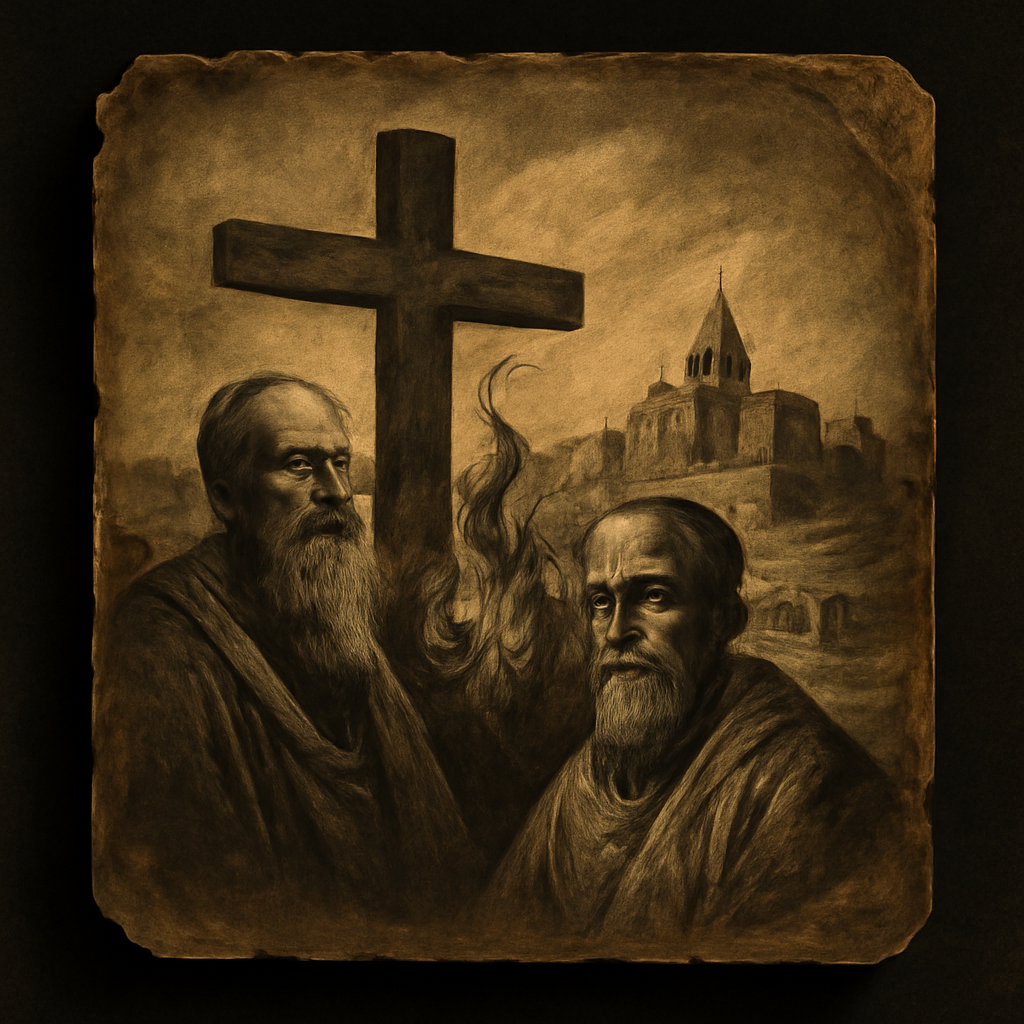
The Orthodoxy Crucible: Irenaeus, Polycarp, and the Invention of Heresy
In the second-century Mediterranean, Christianity was a chaotic ecosystem of competing cosmologies. Gnostics claimed secret, esoteric knowledge (*gnosis*), severing the creator God from the supreme Father of Jesus. Marcion of Sinope rejected the Hebrew Bible entirely, creating his own radical canon. Amid this fragmentation, Polycarp of Smyrna stood as a living bridge. He had studied under the Apostle John. His disciple, Irenaeus of Lyons, weaponized this lineage to construct the concept of orthodoxy, transforming loose house churches into an institutionalized global network.
His treatise, *Against Heresies*, dismantled Gnostic systems like Valentinianism. Irenaeus championed apostolic succession and the "rule of faith." He argued that true doctrine was public and historically traceable, not whispered in secret. By asserting a fourfold gospel canon and the continuity of both Testaments, Irenaeus did not just defend the faith. He synthesized it. His work established the theological scaffolding of Christian identity. Orthodoxy was forged in the heat of polemical combat.
“The entire structural defense of early Christian orthodoxy rested on a single living chain of custody: Polycarp of Smyrna, who was appointed by the Apostle John and later trained Irenaeus of Lyons.”
Reflect
If the preservation of historical truth depends entirely on personal succession, how do we distinguish an authentic chain of custody from a brilliantly constructed myth?
Research·4 sources·Well-Established confidence·Investigated 3 Aug 2026(1 month ago)·Grounded; verification trace not recorded·Investigation may be outdated
Your next question, in
Visual Trail
See The Orthodoxy Crucible: Irenaeus, Polycarp, and the Invention of Heresy
A guided visual explanation assembled from QE artwork and sourced documentary images.
01 / 02
QE visual interpretation
Frame 01
The Orthodoxy Crucible: Irenaeus, Polycarp, and the Invention of Heresy
Irenaeus and Polycarp countered early Christian diversity by establishing apostolic succession, a fourfold gospel canon, and the concept of orthodoxy.
Image provenance and limitation
Source: AI-generated visual interpretation
Creator: Question Everything
Limitation: This image explains or evokes the subject. It is not documentary evidence and should not be used to verify a factual claim.
Evidence
What do we know?
Verified claims with confidence scoring and cited sources.
Living footnotes
Claims remain in the reading flow. Select a citation number to inspect the source behind it.
01
HistoricalSupported
Irenaeus formulated a four-gospel canon and an early list of authoritative New Testament books to counter Gnostic claims of secret knowledge.
To counter Gnostic teachers like Valentinus and Marcion, who claimed secret spiritual insights, Irenaeus of Lyons established a formal, public rule of faith. In his landmark work Against Heresies, he argued for the unique authority of exactly four Gospels. By anchoring Christian truth in public apostolic succession and a defined set of scriptural texts rather than private revelations, he laid the structural foundations for what would become the orthodox New Testament canon.
02
HistoricalSupported
Polycarp of Smyrna served as the vital, direct link between the original Apostles and second-century theologians like Irenaeus.
Polycarp of Smyrna occupied a unique transitional space in early church history. Born in the late first century, he was appointed bishop of Smyrna by the Apostle John. Later, a young Irenaeus sat under Polycarp's teaching, absorbing firsthand accounts of those who had physically seen Jesus. This direct, two-step connection allowed Irenaeus to claim an unbroken, public pedigree of doctrine that bypassed the speculative, unwritten traditions of Gnostic rivals.
03
HistoricalSupported
The early church faced deep internal liturgical divisions, such as the second-century controversy over the correct date to celebrate Easter.
Even among those claiming apostolic ties, unity was fragile. Around AD 150, Polycarp traveled to Rome to debate Pope Anicetus over the timing of Easter. Eastern churches under Polycarp followed the Jewish lunar calendar, celebrating on the fourteenth of Nisan, while Rome insisted on the following Sunday. Though they disagreed, they maintained communion, demonstrating that the early drive for orthodoxy had to navigate deep, localized cultural differences before achieving rigid institutional uniformity.
The complete record below preserves every citation, confidence input and recorded limitation.
Read the full evidence record3 findings · citations · limitations
Evidence review3 findings4 openable sources
01
Finding 1 of 3Historical
0/1 verified
Irenaeus formulated a four-gospel canon and an early list of authoritative New Testament books to counter Gnostic claims of secret knowledge.
To counter Gnostic teachers like Valentinus and Marcion, who claimed secret spiritual insights, Irenaeus of Lyons established a formal, public rule of faith. In his landmark work Against Heresies, he argued for the unique authority of exactly four Gospels. By anchoring Christian truth in public apostolic succession and a defined set of scriptural texts rather than private revelations, he laid the structural foundations for what would become the orthodox New Testament canon.
Supportedmodel score 95%
One source, not peer-reviewed. Thinner than the score suggests.
REFERENCE
›View sources and limits— 1 citation, limits
Supporting passage
To counter Gnostic teachers like Valentinus and Marcion, who claimed secret spiritual insights, Irenaeus of Lyons established a formal, public rule of faith. In his landmark work Against Heresies, he argued for the unique authority of exactly four Gospels. By anchoring Christian truth in public apostolic succession and a defined set of scriptural texts rather than private revelations, he laid the structural foundations for what would become the orthodox New Testament canon.
1 of 2 citations failed verification and are not shown.
Rests on a single source. No independent corroboration.
No peer-reviewed source among the citations.
The generator scored this 95%, which would read as “Established”. Its citations reach only “Supported”, so that is what is shown.
02
Finding 2 of 3Historical
2021
1 dated source
Polycarp of Smyrna served as the vital, direct link between the original Apostles and second-century theologians like Irenaeus.
Polycarp of Smyrna occupied a unique transitional space in early church history. Born in the late first century, he was appointed bishop of Smyrna by the Apostle John. Later, a young Irenaeus sat under Polycarp's teaching, absorbing firsthand accounts of those who had physically seen Jesus. This direct, two-step connection allowed Irenaeus to claim an unbroken, public pedigree of doctrine that bypassed the speculative, unwritten traditions of Gnostic rivals.
Supportedmodel score 90%
2 sources agree, none peer-reviewed.
REFERENCE ×2
›View sources and limits— 2 citations, limits
Supporting passage
Polycarp of Smyrna occupied a unique transitional space in early church history. Born in the late first century, he was appointed bishop of Smyrna by the Apostle John. Later, a young Irenaeus sat under Polycarp's teaching, absorbing firsthand accounts of those who had physically seen Jesus. This direct, two-step connection allowed Irenaeus to claim an unbroken, public pedigree of doctrine that bypassed the speculative, unwritten traditions of Gnostic rivals.
The generator scored this 90%, which would read as “Established”. Its citations reach only “Supported”, so that is what is shown.
03
Finding 3 of 3Historical
2018
1 dated source
The early church faced deep internal liturgical divisions, such as the second-century controversy over the correct date to celebrate Easter.
Even among those claiming apostolic ties, unity was fragile. Around AD 150, Polycarp traveled to Rome to debate Pope Anicetus over the timing of Easter. Eastern churches under Polycarp followed the Jewish lunar calendar, celebrating on the fourteenth of Nisan, while Rome insisted on the following Sunday. Though they disagreed, they maintained communion, demonstrating that the early drive for orthodoxy had to navigate deep, localized cultural differences before achieving rigid institutional uniformity.
Supportedmodel score 85%
One source, not peer-reviewed. Thinner than the score suggests.
REFERENCE
›View sources and limits— 1 citation, limits
Supporting passage
Even among those claiming apostolic ties, unity was fragile. Around AD 150, Polycarp traveled to Rome to debate Pope Anicetus over the timing of Easter. Eastern churches under Polycarp followed the Jewish lunar calendar, celebrating on the fourteenth of Nisan, while Rome insisted on the following Sunday. Though they disagreed, they maintained communion, demonstrating that the early drive for orthodoxy had to navigate deep, localized cultural differences before achieving rigid institutional uniformity.
Rests on a single source. No independent corroboration.
No peer-reviewed source among the citations.
The generator scored this 85%, which would read as “Established”. Its citations reach only “Supported”, so that is what is shown.
Interactive Exploration
Touch, drag, and discover
These visualizations respond to your curiosity. Interact to go deeper.
timeline
The Succession Line and Early Church Milestones
Loading timeline…
relationship map
The Second-Century Network of Orthodoxy and Heterodoxy
Mapping relationships…
Drag nodes to rearrange — tap for details
Perspectives
How is this interpreted?
Enter a viewpoint. Notice what it reveals, what it leaves out, and whether it changes the question for you.
The HistorianHistorical viewpointLive tension
Early Christian writers framed their struggle as a defense of original truth against recent innovations. By emphasizing apostolic succession, bishops like Irenaeus built an institutional fortress. They argued that truth is public, historical, and preserved through a visible line of bishops. This strategy transformed a loose network of diverse, charismatic house churches into a highly structured, global institution capable of surviving intense imperial persecution and internal philosophical schisms.
What this lens notices
01Apostolic succession creates a verifiable chain of custody.
03Institutional structure ensures survival under Roman persecution.
Application
Why does this matter to you?
Personal reflections and applications for your life.
Thought experimentbehavioral
How do you verify the integrity of the information chains you trust today?
Why it changes the question
Irenaeus relied on a physical, personal chain of custody to verify his beliefs in a sea of competing claims. In our digital age, we face a similar flood of conflicting narratives with obscure origins.
Try this
Map out the primary sources of your most deeply held beliefs to see if they rely on verified evidence or unexamined echo chambers.
Media
QE Smart Glass
Curated media selected for this investigation.
QE Glass
YOUTUBE
Gnosticism - Irenaeus and his Against Heresies - Catholic Orthodoxy vs the Valentinian Gnostics
ESOTERICA
Gnosticism came upon powerful and sustained assault beginning in the 2nd century, most famously by Irenaeus and in Five Book ...
QE Glass
PODCAST
Episode 82: Secret Knowledge (Gnosticism)
Literature and History
A deep, beautifully produced exploration of Gnostic philosophy, its origins, and its clash with early orthodox Church Fathers.
Connected context
Connected entities
The people, places, concepts, and events that matter here.
Keep Going
Where this leads
Questions this investigation opens up — and what QE has already looked into.
No AI help here — no suggestions, no autocomplete, nothing finishing your sentences. That is deliberate. Working out what you think is effortful, and the effort is the part that changes you: reasoning is trained like a muscle, and a muscle that is always carried gets weaker. Let something else do the thinking and you keep the answer but lose the capacity to have reached it.
Write your current position.
Not what the page says. What you think, having read it.0 words · Nothing written yet.
Sign in to leave a mark. Your draft is saved here in the meantime.