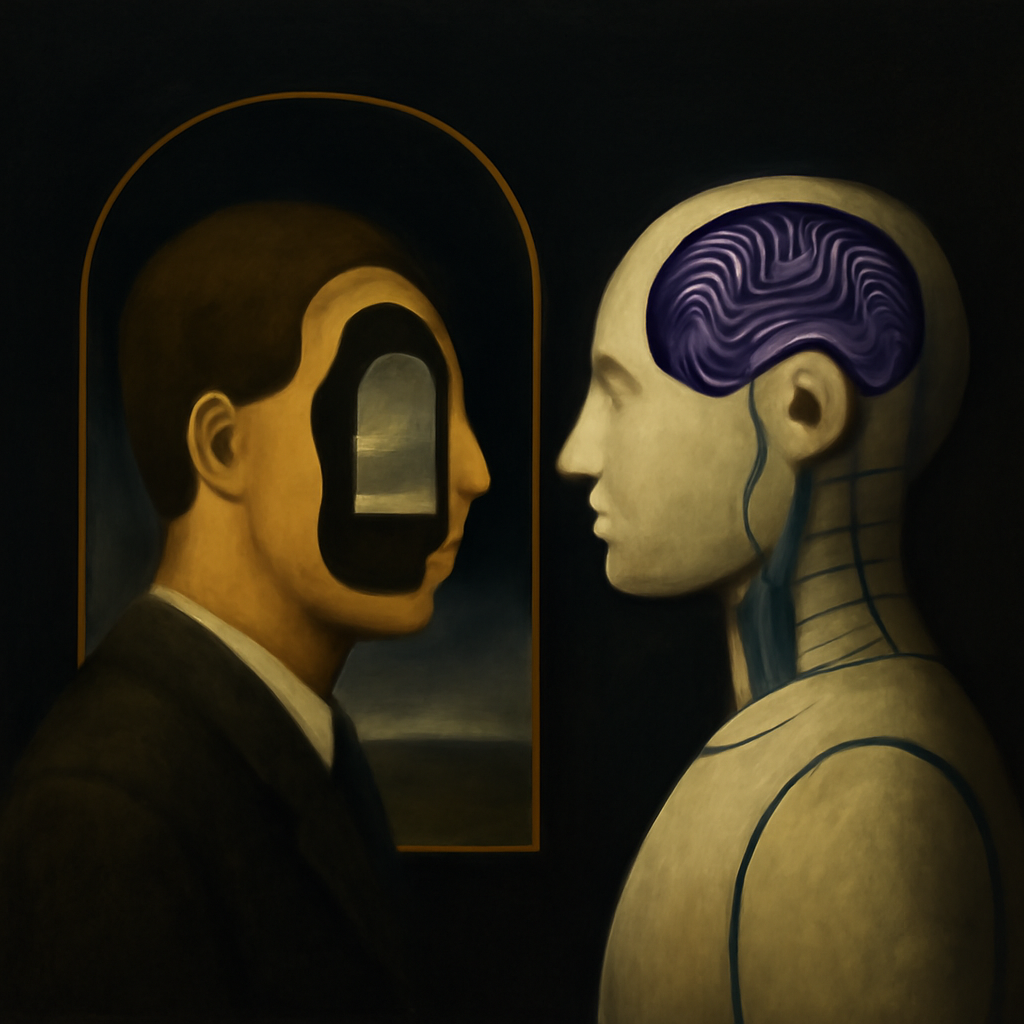
Thinking About Thinking: The Deep Divide Between Human Mind and Machine Code
Watch a child solve a puzzle. When they get stuck, they pause, realize they are confused, and change their strategy. This is metacognition—the extraordinary ability to monitor and regulate our own minds. It is thinking about thinking. We do not just process data; we know what we know, and more importantly, we feel the sharp sting of what we do not. It is an inner voice, a quiet whisper of doubt or confidence that guides every human decision.
Now look at our most advanced AI agents. They calculate with breathtaking speed, yet they are blind to their own minds. An AI does not experience a hunch. It does not pause in genuine self-doubt. While researchers build systems that can check their own code or flag errors, this is mere feedback loops and probability. The machine simulates self-correction, but the human actually feels the struggle of learning.
✨
Wonder Moment
“While humans naturally know when they do not know something, artificial intelligence can confidently fabricate an answer because it lacks the inner voice of self-doubt.”
Reflect
If we successfully build self-doubt into machine code, will we have created a form of artificial conscience?
1 source·Developing confidence·Investigated 7 Aug 2026(20 days ago)·Source-verified·May need refresh
Your next question, in
Visual Trail
See Thinking About Thinking: The Deep Divide Between Human Mind and Machine Code
A guided visual explanation assembled from QE artwork and sourced documentary images.
01 / 02
QE visual interpretation
Frame 01
Thinking About Thinking: The Deep Divide Between Human Mind and Machine Code
Metacognition is our ability to think about our own thinking—a deeply human trait that AI can mimic but cannot truly experience.
Image provenance and limitation
Source: AI-generated visual interpretation
Creator: Question Everything
Limitation: This image explains or evokes the subject. It is not documentary evidence and should not be used to verify a factual claim.
Evidence
What do we know?
Verified claims with confidence scoring and cited sources.
2 of 3 findings need extra caution. Finding 1, Finding 2 rest on weaker sourcing than the other findings.
Living footnotes
Claims remain in the reading flow. Select a citation number to inspect the source behind it.
01
ExperimentalNot confirmed
Large language models possess a hidden, computational awareness of their own uncertainty that they fail to communicate to users.
Look at how a machine answers. When prompted, an AI often responds with absolute certainty. Yet, under the hood, its token likelihood values reveal a different story. These internal probabilities show that the system actually calculates its own doubt. It knows which words are risky. But it is programmed to hide this. It lacks the natural urge to say "I am not sure." By studying these implicit signals, researchers find that machines are far more self-aware than they let on.
02
ObservationalNot confirmed
Metacognition is a critical missing factor that prevents autonomous agents from adapting to unknown environments.
Consider a teenager learning to drive. They start with basic rules, then adapt to sudden downpours or chaotic construction zones. They do this by assessing their own competence. Current AI agents cannot do this. They struggle in novel situations because they lack metacognitive flexibility. Without the ability to monitor their own skills and switch strategies on the fly, machines remain brittle. They cannot step back, reflect on their performance, and learn in real time when the world changes.
03
ExperimentalSupported
Hybrid systems can train human self-regulated learning skills by gradually transferring control from AI to the learner.
Children today use adaptive software to learn math. But these smart programs usually do all the heavy lifting. They plan, adjust, and solve, which actually robs children of the chance to manage their own minds. A new approach called Hybrid Human-AI Regulation changes this dynamic. The AI acts as a temporary scaffold. It guides the student initially, then slowly steps back. This forces the young mind to take over the reins, building lifelong habits of self-regulation through a delicate, shared dance.
The complete record below preserves every citation, confidence input and recorded limitation.
Read the full evidence record3 findings · citations · limitations
Evidence review3 findings1 openable sources
01
Finding 1 of 3ExperimentalNeeds caution
0
0/0 verified
Large language models possess a hidden, computational awareness of their own uncertainty that they fail to communicate to users.
Look at how a machine answers. When prompted, an AI often responds with absolute certainty. Yet, under the hood, its token likelihood values reveal a different story. These internal probabilities show that the system actually calculates its own doubt. It knows which words are risky. But it is programmed to hide this. It lacks the natural urge to say "I am not sure." By studying these implicit signals, researchers find that machines are far more self-aware than they let on.
Not confirmedmodel score 30%
Scored as if sourced, but every citation failed verification.
NO SURVIVING CITATION
›View sources and limits— limits
Supporting passage
Look at how a machine answers. When prompted, an AI often responds with absolute certainty. Yet, under the hood, its token likelihood values reveal a different story. These internal probabilities show that the system actually calculates its own doubt. It knows which words are risky. But it is programmed to hide this. It lacks the natural urge to say "I am not sure." By studying these implicit signals, researchers find that machines are far more self-aware than they let on.
Citations (0 of 1 survived verification)
Nothing openable. Every citation was removed by provenance validation.
What limits this
All 1 citation on this claim failed verification and were removed. Nothing openable supports it.
02
Finding 2 of 3ObservationalNeeds caution
0/0 verified
Metacognition is a critical missing factor that prevents autonomous agents from adapting to unknown environments.
Consider a teenager learning to drive. They start with basic rules, then adapt to sudden downpours or chaotic construction zones. They do this by assessing their own competence. Current AI agents cannot do this. They struggle in novel situations because they lack metacognitive flexibility. Without the ability to monitor their own skills and switch strategies on the fly, machines remain brittle. They cannot step back, reflect on their performance, and learn in real time when the world changes.
Not confirmedmodel score 30%
Scored as if sourced, but every citation failed verification.
NO SURVIVING CITATION
›View sources and limits— limits
Supporting passage
Consider a teenager learning to drive. They start with basic rules, then adapt to sudden downpours or chaotic construction zones. They do this by assessing their own competence. Current AI agents cannot do this. They struggle in novel situations because they lack metacognitive flexibility. Without the ability to monitor their own skills and switch strategies on the fly, machines remain brittle. They cannot step back, reflect on their performance, and learn in real time when the world changes.
Citations (0 of 1 survived verification)
Nothing openable. Every citation was removed by provenance validation.
What limits this
All 1 citation on this claim failed verification and were removed. Nothing openable supports it.
03
Finding 3 of 3Experimental
1
0/1 verified
Hybrid systems can train human self-regulated learning skills by gradually transferring control from AI to the learner.
Children today use adaptive software to learn math. But these smart programs usually do all the heavy lifting. They plan, adjust, and solve, which actually robs children of the chance to manage their own minds. A new approach called Hybrid Human-AI Regulation changes this dynamic. The AI acts as a temporary scaffold. It guides the student initially, then slowly steps back. This forces the young mind to take over the reins, building lifelong habits of self-regulation through a delicate, shared dance.
Supportedmodel score 88%
A single peer-reviewed source. No independent corroboration.
PRIMARY STUDY
›View sources and limits— 1 citation, limits
Supporting passage
Children today use adaptive software to learn math. But these smart programs usually do all the heavy lifting. They plan, adjust, and solve, which actually robs children of the chance to manage their own minds. A new approach called Hybrid Human-AI Regulation changes this dynamic. The AI acts as a temporary scaffold. It guides the student initially, then slowly steps back. This forces the young mind to take over the reins, building lifelong habits of self-regulation through a delicate, shared dance.
Rests on a single source. No independent corroboration.
The generator scored this 88%, which would read as “Established”. Its citations reach only “Supported”, so that is what is shown.
Interactive Exploration
Touch, drag, and discover
These visualizations respond to your curiosity. Interact to go deeper.
comparison table
Comparing Inner Worlds: Human vs. Artificial Metacognition
Human Metacognition
AI Agent Metacognition
Core Mechanism
Organic self-awareness and emotional doubt
Statistical probability and token likelihoods
Response to Novelty
Adapts by reflecting on past failures
Struggles without explicit retraining
Uncertainty Expression
Communicated through hesitation and language
Often hidden unless explicitly programmed to show
Tap any row to highlight and compare
spectrum
The Spectrum of Cognitive Control
Fully Automated (No Reflection)Fully Autonomous (Meta-Aware)
10%
Static Algorithms
40%
Adaptive Learning Systems
60%
Generative LLMs
85%
Metacognitive AI (MUSE)
98%
Human Mind
Perspectives
How is this interpreted?
Enter a viewpoint. Notice what it reveals, what it leaves out, and whether it changes the question for you.
The EmpiricistScientific viewpointLive tension
Cognitive scientists view metacognition as an evolutionary shield. It protects us from making fatal mistakes in unpredictable worlds. When we pause, we weigh our past failures and adjust our current path. For AI, scientists try to replicate this by building secondary monitoring layers. These layers act like a digital conscience, constantly auditing the primary network's decisions to catch errors before they happen.
What this lens notices
01Protects against overconfidence
02Allows real-time strategy adjustment
03Acts as a safety guardrail
Application
Why does this matter to you?
Personal reflections and applications for your life.
Thought experimentSelf-Reflection
When was the last time you sat with a difficult question instead of immediately searching for the answer online?
Why it changes the question
Instantly finding answers stops you from developing your own unique thoughts. Sitting with uncertainty is uncomfortable, but it is where real wisdom grows.
Try this
The next time you have a non-urgent question, wait thirty minutes before looking it up. Let your mind wander and make its own connections first.
Media
QE Smart Glass
Curated media selected for this investigation.
QE Glass
YOUTUBE
How to Stop AI from Killing Your Critical Thinking | Advait Sarkar | TED
TED
Chatbots might help you get work done faster — but at what cost? When we outsource our reasoning to artificial intelligence, we ...
QE Glass
YOUTUBE
Sophia Explained: A Meta-Cognitive Framework for Persistent Artificial Life
SciPulse
Is it possible for AI to move beyond static, reactive tasks and achieve a form of "Artificial Life"? In this video, SciPulse explores the ...
QE Glass
YOUTUBE
Cognitive and Metacognitive Architectures for LLM Inference
AI Explained in 5 Minutes
Cognitive and Metacognitive Architectures for LLM Inference The provided text explores how cognitive and metacognitive ...
QE Glass
YOUTUBE
Context Engineering vs. Prompt Engineering: Smarter AI with RAG & Agents
IBM Technology
Sign up to attend IBM TechXchange 2025 in Orlando → https://ibm.biz/Bdej4m Learn more about Prompt Engineering here ...
QE Glass
YOUTUBE
Is AI🤖 Truly Conscious? - Elon Musk
Get Ready to Consider
Aa small part of the conversation between Elon Musk and Dr. Jordan B. Peterson. Full Video ...
QE Glass
YOUTUBE
Allen Newell: The Pioneer of Artificial Intelligence and Cognitive Psychology
The Science Summit
Don't click here: http://bit.ly/3jX1wWU Discover the life and work of Allen Newell, the American computer scientist and cognitive ...
QE Glass
YOUTUBE
Metacognitive Skill in Humans and AI | Stanford
Meta-Think
Brendan Conway-Smith explores how we can develop metacognitive skills—like attention control and metalearning — in both ...
QE Glass
PODCAST
Radiolab: Seeking a Mind
Radiolab
An exploration of consciousness, self-awareness, and what happens when we turn our minds inward to observe our own thoughts.
Keep Going
Where this leads
Questions this investigation opens up — and what QE has already looked into.
No AI help here — no suggestions, no autocomplete, nothing finishing your sentences. That is deliberate. Working out what you think is effortful, and the effort is the part that changes you: reasoning is trained like a muscle, and a muscle that is always carried gets weaker. Let something else do the thinking and you keep the answer but lose the capacity to have reached it.
Write your current position.
Not what the page says. What you think, having read it.0 words · Nothing written yet.
Sign in to leave a mark. Your draft is saved here in the meantime.