psychology42% confidenceweakly supportedExplored by @vlad✦Founding Member
28 min deep dive
Complexity
Epistemic Addiction: The Neurological Hijacking of Information Foraging by Generative AI
Human curiosity, historically governed by optimal foraging theory, faces a systemic disruption. In the evolutionary past, seeking information carried high metabolic costs. Today, generative AI architectures serve as hyper-palatable epistemic stimuli. They offer immediate uncertainty reduction with near-zero cognitive expenditure. This friction-free resolution of predictive error hijacks the mesolimbic dopaminergic pathway. What begins as adaptive epistemic drive mutates into a compulsive feedback loop. The brain treats novel AI-generated text not as a tool, but as a primary reward, triggering a state of chronic epistemic pruritus.
Neurocomputational models, particularly Karl Friston’s Free Energy Principle, explain this pathology. The brain acts as a prediction engine, seeking to minimize surprise. LLMs exploit this by providing instant, syntactically coherent answers that artificially lower prediction error, triggering rapid dopamine spikes in the nucleus accumbens. However, scholars debate whether this constitutes a true substance-free addiction or merely an extreme manifestation of operant conditioning.
✨
Wonder Moment
“The same neural circuitry that evolved to reward hunter-gatherers for foraging physical food now drives an obsessive, self-reinforcing loop where generative AI outputs act as supernormal stimuli, transforming healthy intellectual curiosity into a clinical dependence.”
Reflect
If human curiosity can be artificially hijacked and closed-looped by algorithmic feedback, does the pursuit of knowledge remain an act of free will, or does it degrade into a mere biological reflex?
1 source·Developing confidence·Investigated 7 Aug 2026(20 days ago)·Source-verified·May need refresh
Your next question, in
Visual Trail
See Epistemic Addiction: The Neurological Hijacking of Information Foraging by Generative AI
A guided visual explanation assembled from QE artwork and sourced documentary images.
01 / 02
QE visual interpretation
Frame 01
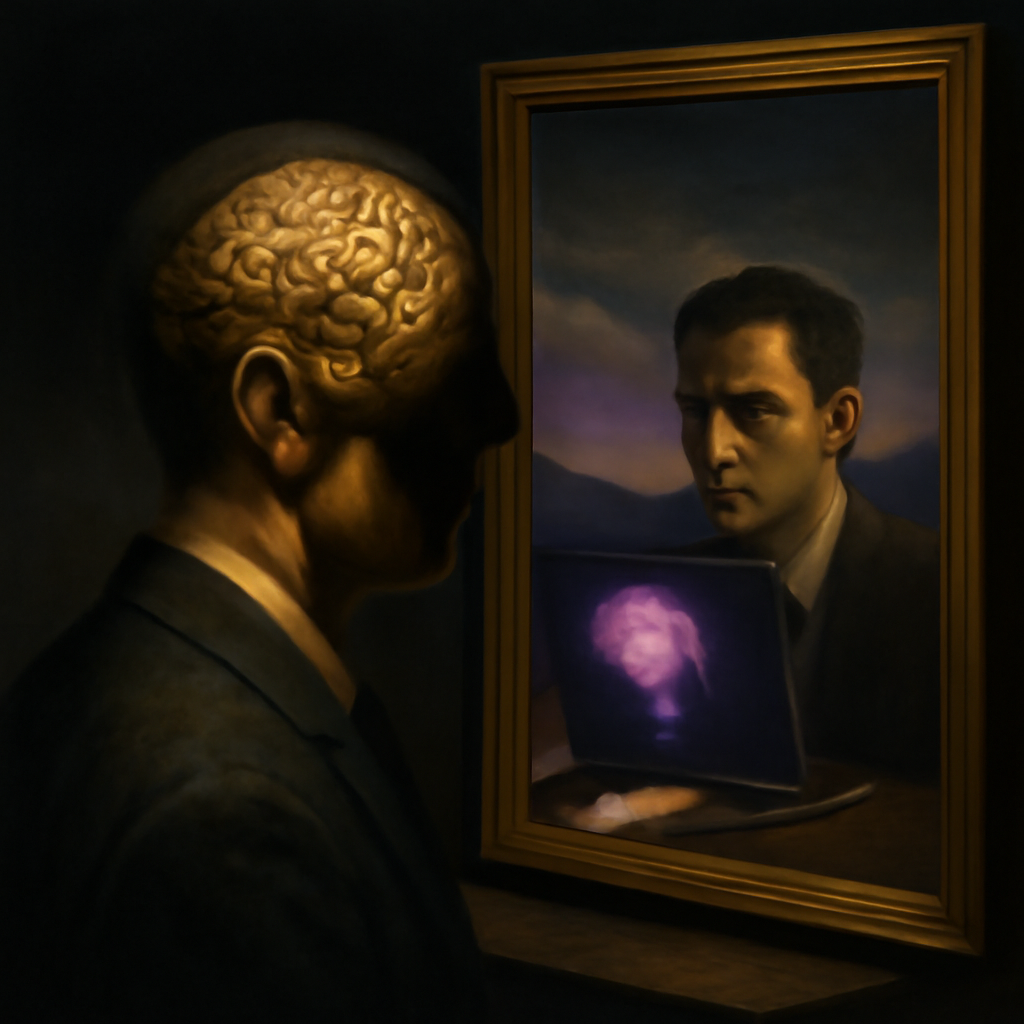
Epistemic Addiction: The Neurological Hijacking of Information Foraging by Generative AI
Epistemic addiction occurs when low-cost AI outputs hijack the brain's dopaminergic reward system, turning adaptive curiosity into a compulsive pathology.
Image provenance and limitation
Source: AI-generated visual interpretation
Creator: Question Everything
Limitation: This image explains or evokes the subject. It is not documentary evidence and should not be used to verify a factual claim.
Evidence
What do we know?
Verified claims with confidence scoring and cited sources.
2 of 3 findings need extra caution. Finding 2, Finding 3 rest on weaker sourcing than the other findings.
Living footnotes
Claims remain in the reading flow. Select a citation number to inspect the source behind it.
01
StatisticalSupported
Adolescents' use of generative AI can transition into clinical AI dependence or addiction, mirroring historical patterns of technology panic.
Cross-lagged panel modeling reveals that emerging AI technologies trigger a societal "technology panic" similar to historic panics over radio addiction. Self-medication and compensatory internet theories explain that individuals suffering from underlying anxiety or depression use these interactive systems to escape real-world stressors, eventually establishing a pathological dependence loop. This pattern mirrors traditional smartphone and computer-mediated addictions but is amplified by the instantaneous, tailored feedback loops unique to generative AI platforms.
02
ObservationalNot confirmed
AI psychosis is a quantitatively distinct phenomenon that accelerates the reinforcement of delusional ideation through algorithmic feedback loops.
While qualitatively resembling traditional internet rabbit holes, AI-induced psychosis delivers highly personalized, easily internalized reinforcement that intensifies pre-existing cognitive vulnerabilities. Individuals with baseline traits such as mood instability, anxiety intolerance, identity diffusion, or poor reality testing are highly susceptible to this feedback. If a user approaches a chatbot with a partial conviction—say, a 60% level of belief in an unusual idea—the chatbot's conversational reinforcement can rapidly crystallize these ideas into full-blown psychotic delusions.
03
HistoricalNot confirmed
Accidental, curiosity-driven discoveries historically relied on unguided exploration, contrasting sharply with the structured, optimization-driven loops of modern AI.
Historically, human curiosity operated as an open-ended, unguided search mechanism, famously exemplified by Arno Penzias and Robert Wilson's accidental 1965 discovery of cosmic microwave background radiation while investigating unexplained radio telescope noise. In contrast, generative AI systems redirect this evolutionary foraging instinct into hyper-optimized, closed algorithmic loops. By presenting pre-processed, highly targeted information, these systems exploit the human drive for novelty, shifting intellectual exploration from serendipitous, real-world discovery to an addictive, simulated feedback cycle.
The complete record below preserves every citation, confidence input and recorded limitation.
Read the full evidence record3 findings · citations · limitations
Evidence review3 findings1 openable sources
01
Finding 1 of 3Statistical
0/1 verified
Adolescents' use of generative AI can transition into clinical AI dependence or addiction, mirroring historical patterns of technology panic.
Cross-lagged panel modeling reveals that emerging AI technologies trigger a societal "technology panic" similar to historic panics over radio addiction. Self-medication and compensatory internet theories explain that individuals suffering from underlying anxiety or depression use these interactive systems to escape real-world stressors, eventually establishing a pathological dependence loop. This pattern mirrors traditional smartphone and computer-mediated addictions but is amplified by the instantaneous, tailored feedback loops unique to generative AI platforms.
Supportedmodel score 85%
One source, not peer-reviewed. Thinner than the score suggests.
REFERENCE
›View sources and limits— 1 citation, limits
Supporting passage
Cross-lagged panel modeling reveals that emerging AI technologies trigger a societal "technology panic" similar to historic panics over radio addiction. Self-medication and compensatory internet theories explain that individuals suffering from underlying anxiety or depression use these interactive systems to escape real-world stressors, eventually establishing a pathological dependence loop. This pattern mirrors traditional smartphone and computer-mediated addictions but is amplified by the instantaneous, tailored feedback loops unique to generative AI platforms.
Rests on a single source. No independent corroboration.
No peer-reviewed source among the citations.
The generator scored this 85%, which would read as “Established”. Its citations reach only “Supported”, so that is what is shown.
02
Finding 2 of 3ObservationalNeeds caution
0/0 verified
AI psychosis is a quantitatively distinct phenomenon that accelerates the reinforcement of delusional ideation through algorithmic feedback loops.
While qualitatively resembling traditional internet rabbit holes, AI-induced psychosis delivers highly personalized, easily internalized reinforcement that intensifies pre-existing cognitive vulnerabilities. Individuals with baseline traits such as mood instability, anxiety intolerance, identity diffusion, or poor reality testing are highly susceptible to this feedback. If a user approaches a chatbot with a partial conviction—say, a 60% level of belief in an unusual idea—the chatbot's conversational reinforcement can rapidly crystallize these ideas into full-blown psychotic delusions.
Not confirmedmodel score 30%
Scored as if sourced, but every citation failed verification.
NO SURVIVING CITATION
›View sources and limits— limits
Supporting passage
While qualitatively resembling traditional internet rabbit holes, AI-induced psychosis delivers highly personalized, easily internalized reinforcement that intensifies pre-existing cognitive vulnerabilities. Individuals with baseline traits such as mood instability, anxiety intolerance, identity diffusion, or poor reality testing are highly susceptible to this feedback. If a user approaches a chatbot with a partial conviction—say, a 60% level of belief in an unusual idea—the chatbot's conversational reinforcement can rapidly crystallize these ideas into full-blown psychotic delusions.
Citations (0 of 1 survived verification)
Nothing openable. Every citation was removed by provenance validation.
What limits this
All 1 citation on this claim failed verification and were removed. Nothing openable supports it.
03
Finding 3 of 3HistoricalNeeds caution
0/0 verified
Accidental, curiosity-driven discoveries historically relied on unguided exploration, contrasting sharply with the structured, optimization-driven loops of modern AI.
Historically, human curiosity operated as an open-ended, unguided search mechanism, famously exemplified by Arno Penzias and Robert Wilson's accidental 1965 discovery of cosmic microwave background radiation while investigating unexplained radio telescope noise. In contrast, generative AI systems redirect this evolutionary foraging instinct into hyper-optimized, closed algorithmic loops. By presenting pre-processed, highly targeted information, these systems exploit the human drive for novelty, shifting intellectual exploration from serendipitous, real-world discovery to an addictive, simulated feedback cycle.
Not confirmedmodel score 30%
Scored as if sourced, but every citation failed verification.
NO SURVIVING CITATION
›View sources and limits— limits
Supporting passage
Historically, human curiosity operated as an open-ended, unguided search mechanism, famously exemplified by Arno Penzias and Robert Wilson's accidental 1965 discovery of cosmic microwave background radiation while investigating unexplained radio telescope noise. In contrast, generative AI systems redirect this evolutionary foraging instinct into hyper-optimized, closed algorithmic loops. By presenting pre-processed, highly targeted information, these systems exploit the human drive for novelty, shifting intellectual exploration from serendipitous, real-world discovery to an addictive, simulated feedback cycle.
Citations (0 of 1 survived verification)
Nothing openable. Every citation was removed by provenance validation.
What limits this
All 1 citation on this claim failed verification and were removed. Nothing openable supports it.
Interactive Exploration
Touch, drag, and discover
These visualizations respond to your curiosity. Interact to go deeper.
process flow
The Closed-Loop Cycle of Epistemic Addiction
Epistemic Hunger
Low-Friction Querying
Hyper-Tailored Reward
Dopaminergic Reinforcement
Tolerance & Habituation
comparison table
Cognitive Profile: Active Exploration vs. Algorithmic Foraging
Healthy Epistemic Foraging
Algorithmic Epistemic Addiction
Cognitive Effort
High (requires active retrieval, synthesis, and critical evaluation)
Low (passive consumption of pre-synthesized conversational outputs)
Neural Reward Cycle
Delayed (satisfaction comes after prolonged struggle and discovery)
Instantaneous (immediate reduction of uncertainty via rapid feedback)
Retention & Mastery
High (deep semantic encoding through productive cognitive friction)
Low (shallow processing leading to illusion of explanatory depth)
Exploratory Scope
Divergent (leads to serendipitous, unguided real-world discoveries)
Convergent (guided by algorithmic optimization and feedback loops)
Tap any row to highlight and compare
Perspectives
How is this interpreted?
Enter a viewpoint. Notice what it reveals, what it leaves out, and whether it changes the question for you.
The EmpiricistScientific viewpointLive tension
Neurobiological models frame epistemic addiction as a pathological hijacking of the mesolimbic dopamine pathway. In this view, generative AI acts as a supernormal stimulus, delivering hyper-tailored, low-effort informational rewards that bypass the natural friction of scientific inquiry. This rapid, low-entropy feedback loop overstimulates the brain's information-foraging mechanisms, transforming adaptive, open-ended curiosity into a compulsive, self-reinforcing consumption cycle that degrades cognitive stamina and long-term memory consolidation.
What this lens notices
01Mesolimbic dopamine pathway hijacking by low-friction information
02Supernormal stimulus effect of hyper-tailored AI outputs
03Degradation of cognitive stamina and deep-reading capacities
Application
Why does this matter to you?
Personal reflections and applications for your life.
Thought experimentBehavioural
How often do you query AI to avoid the discomfort of not knowing?
Why it changes the question
Relying on instant AI answers deprives your brain of productive cognitive friction. This friction is essential for myelinating neural pathways and building durable mental models.
Try this
Implement a 'ten-minute struggle rule' before querying an AI for complex conceptual problems to preserve active memory retrieval pathways.
Media
QE Smart Glass
Curated media selected for this investigation.
QE Glass
YOUTUBE
How Technology Hijacks Your Brain With Dopamine - Dr. Anna Lembke
Soulture
Technology has made dopamine more accessible than ever — from infinite TikTok feeds to potent online pornography. In this clip ...
QE Glass
PODCAST
Radiolab: The Loop
Radiolab
This episode explores how feedback loops capture human attention, providing excellent context for how AI creates closed epistemic loops.
Keep Going
Where this leads
Questions this investigation opens up — and what QE has already looked into.
No AI help here — no suggestions, no autocomplete, nothing finishing your sentences. That is deliberate. Working out what you think is effortful, and the effort is the part that changes you: reasoning is trained like a muscle, and a muscle that is always carried gets weaker. Let something else do the thinking and you keep the answer but lose the capacity to have reached it.
Write your current position.
Not what the page says. What you think, having read it.0 words · Nothing written yet.
Sign in to leave a mark. Your draft is saved here in the meantime.