a large group of trees with very large roots
Photo by Andrey Volk on Unsplash
biology95% confidence
18 min deep dive

The Wood Wide Web: How Trees Talk Underground

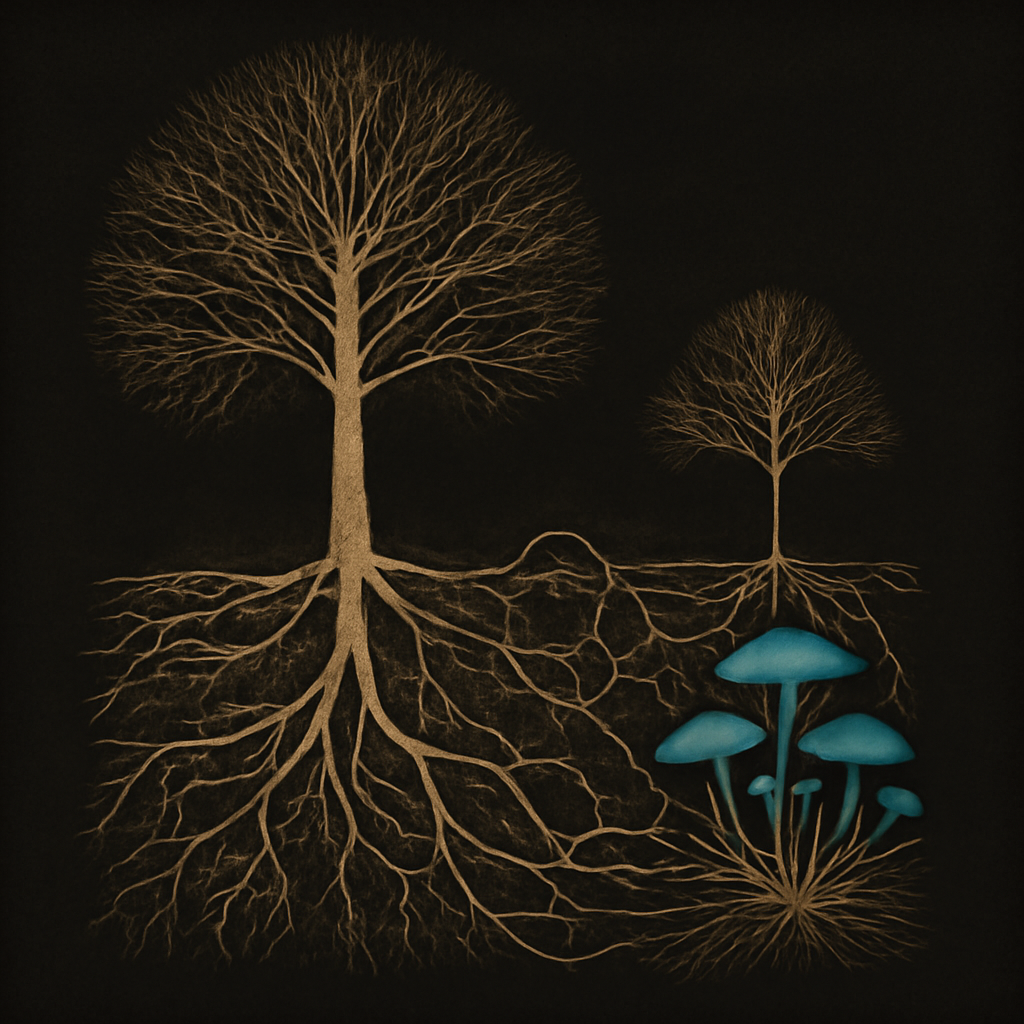
Imagine a hidden internet made of tiny threads, running right beneath your feet in the woods. This is a mycorrhizal network. It is built by fungi, but not just the mushrooms you see on the surface. Under the dirt, vast webs of ultra-thin threads connect the roots of different plants and trees. They form a massive, living sharing system. Through this underground web, trees do something amazing. They trade resources like water and sugar. They even send warning signals when pests attack. It is a giant cooperative community. But it is not always a perfect partnership. Sometimes, plants and fungi bargain, cheat, or take more than they give. It is a bustling, hidden marketplace that keeps our forests alive.

Wonder Moment

If you stretched out all the underground fungal threads in just the top ten centimeters of Earth's soil, they would reach halfway across our entire galaxy.

Reflect

If trees can share food and warnings with their neighbors, does a forest act more like a single, giant living organism than a group of individual plants?

Creating Your Artwork

Your question is generating a unique piece of art...

2 sources·Well-Established confidence·Investigated 4 Aug 2026 (yesterday)·Source-verified

Evidence

What do we know?

Verified claims with confidence scoring and cited sources.

Observational

Underground fungal networks connect different plants together so they can share resources.

Under the forest floor, tiny fungal threads plug into plant roots. This links multiple plants in a shared network. Once connected, they can pass nutrients back and forth. For example, a tall tree with plenty of sunlight can send food to a young sapling struggling in the shade. It is a lifesaver for young trees.

90%
Experimental

Underground networks allow plants to send chemical warning signals to their neighbors during insect attacks.

The network does not just carry food. It also carries news. In a famous study, a Douglas fir tree was damaged by pests. It sent warning chemicals through the fungal threads to a nearby pine tree. The pine tree received the message and quickly built up its own chemical defenses before the bugs could arrive.

30%
ReferenceMycorrhizal network (2023)
Experimental

Fungi and plants do not always share resources equally.

Scientists tested this trade using flax and sorghum plants connected by a fungal network. They found a wild imbalance. The flax plant gave very little carbon to the fungus but took almost all the nitrogen and phosphorus. Meanwhile, the sorghum plant invested a massive amount of food but got almost nothing back from the trade.

95%

Go deeper

Another way to see this

Scientists view this network as a highly complex trading market. It is not pure kindness. Both plants and fungi negotiate for resources they need to survive....

You might be wrong about this

The philosophical view challenges this

This system challenges our old ideas about nature. For a long time, we thought of the forest as a brutal battleground...

Interactive Exploration

Touch, drag, and discover

These visualizations respond to your curiosity. Interact to go deeper.

relationship map

Who Connects to Who in the Forest?

Mapping relationships…

Drag nodes to rearrange — tap for details

statistics card

The Mind-Boggling Scale of the Underground Web

450,000,000,000,000,000 km

Total fungal length in Earth's topsoil

This is roughly half the width of our entire galaxy, packed under our feet.

90 meters

Fungal threads in one gram of soil

A tiny pinch of healthy dirt contains enough fungal threads to stretch almost the length of a football field.

80% to 90%

Plants using the network

Nearly all land plants rely on these fungal partnerships to survive.

Perspectives

How is this interpreted?

Diverse viewpoints across worldviews and disciplines.

Scientific View

Controversy

Scientists view this network as a highly complex trading market. It is not pure kindness. Both plants and fungi negotiate for resources they need to survive. Fungi want carbon from photosynthesis, which they cannot make themselves. Plants want minerals from deep in the soil. It is a biological marketplace driven by supply and demand, where partners can reward cooperative behavior or penalize bad traders.

Key Arguments

  • Plants choose which fungi to feed based on nutrient return
  • Fungi allocate nutrients to the plants that give them the most carbon
  • The relationship can slide from helpful cooperation to parasitism depending on environmental conditions

Go deeper

Deep Dive Media

Explore further

Curated videos and media on QE Smart Glass.

QE Glass
YOUTUBE

The Earth's Internet: How Fungi Help Plants Communicate

SciShow

Plants have their own interconnected networks that allow them to communicate with each other, sometimes over considerable ...

QE Glass
YOUTUBE

Mycorrhizal Fungi Animation

PrimroseTV

How do Mycorrhizal Fungi help your plants to grow? This video will tell you everything you need to know about this remarkable ...

QE Glass
YOUTUBE

Mycorrhizal Fungi: The Roots of Life on Land

SPUN

A new animation discussing the evolution of mycorrhizal fungal relationships from SPUN and @FFungi made by the amazing May ...

QE Glass
YOUTUBE

Fungi’s Resilience and Intelligence

Show Me the World

Fungi, ancient colonizers of land, form a vast kingdom distinct from plants and animals. They survived extreme conditions by ...

QE Glass
YOUTUBE

The life of the forest. Fungi

Forest Film Studio

A forest is a place where thousands of different organisms meet, creating the most complex network of connections that can exist ...

QE Glass
YOUTUBE

The Secret Language of Trees

Real Science

Use code REALSCIENCE12 for up to 12 FREE MEALS across your first 4 HelloFresh boxes, including free shipping on your first ...

QE Glass
YOUTUBE

How Trees Talk to Each Other

TED

Suzanne Simard's famous TED Talk explaining how she discovered that trees communicate and share resources.

QE Glass
PODCAST

From Tree to Shining Tree

Radiolab

An incredibly immersive audio journey into the discovery and mechanics of the forest's fungal internet.

Think about this

Think like a forest

Knowledge Graph

Connected entities

People, places, concepts, and events related to this topic — powered by Wikidata.

Rabbit Holes

Follow the threads

Connected ideas waiting to be explored.

The key insight

If you stretched out all the underground fungal threads in just the top ten centimeters of Earth's soil, they would reach halfway across our entire galaxy.

Application

Why does this matter to you?

Personal reflections and applications for your life.

Practical

Think like a forest

Our modern world pushes us to compete, but the forest thrives on sharing. You can look for ways to build your own mutual support network in your neighborhood or school.

Try this

Start a small sharing tool-library or community garden with your neighbors.

Self-Reflection

Rethinking your garden

When you dig up your garden soil, you might be ripping apart ancient networks that keep your plants healthy. Leaving soil undisturbed preserves these lifelines.

Try this

Try 'no-dig' gardening this season to let the underground fungal networks do the work for you.

Founder's Note

One thing my grandmother first taught me and still reminds me of till this day is that “Knowledge Is Power” and those words stayed with me ever since. I believe they sparked this creation.

To understand anything, you must Question Everything.

D

Darren

Founder of QE