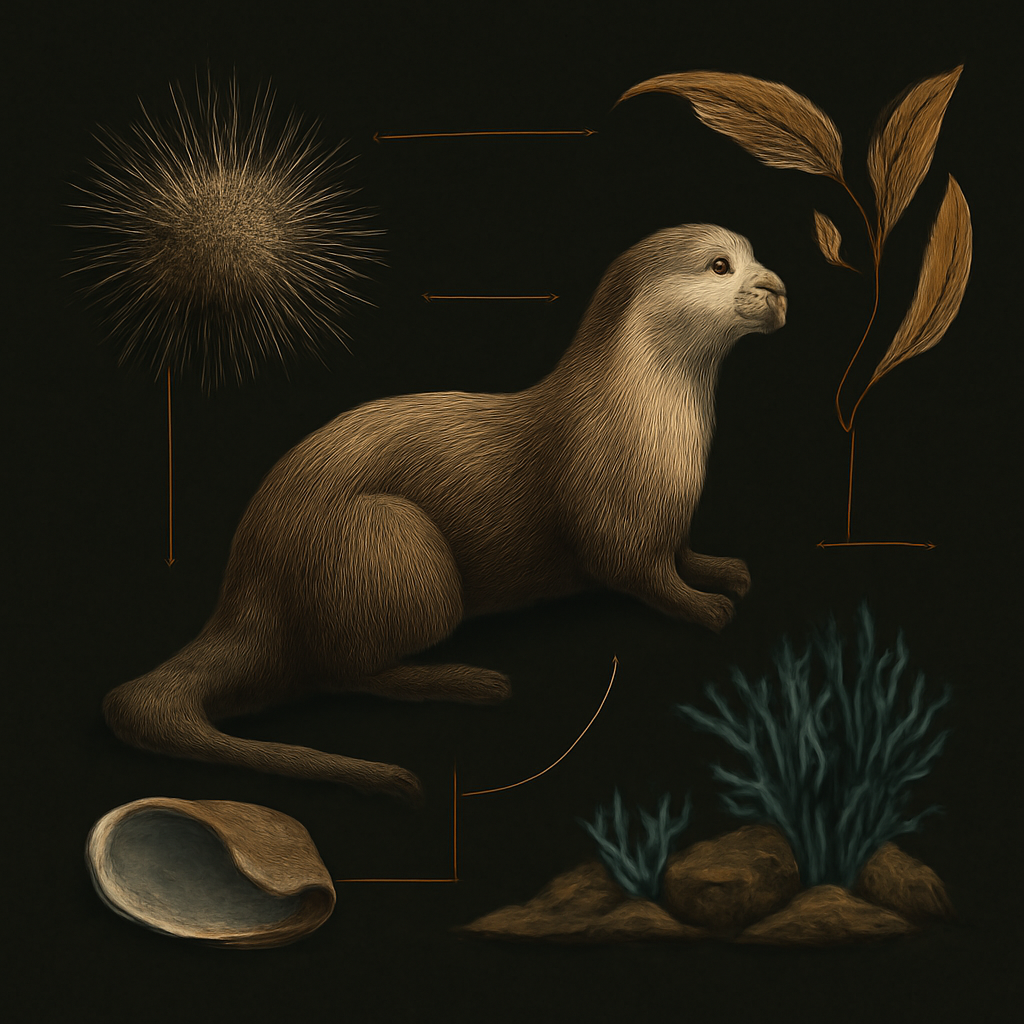
Otters are more than playful swimmers; they are vital architects of nearshore ecosystems. By hunting sea urchins, they keep kelp forests from turning into barren rocky plains, allowing those underwater forests to flourish. Those kelp forests, in turn, absorb vast amounts of carbon dioxide, offering a natural buffer against climate change. Beyond their ecological engineering, otters showcase remarkable intelligence—using rocks as tools to crack open shellfish and storing those tools in loose skin pouches under their armpits. Their dense fur, the thickest of any mammal, keeps them warm in icy waters without a layer of blubber. This combination of ecological impact, ingenuity, and adaptation makes otters a living example of how a single species can shape the health of an entire coastline.
“A single sea otter can help protect a kelp forest that stores enough carbon to offset the annual emissions of dozens of cars.”
Reflect
If a small, furry predator can have such an outsized impact on planetary health, what other overlooked species might be silently stabilizing the ecosystems we depend on?
Research·4 sources·Well-Established confidence·Investigated 24 Jul 2026(1 month ago)·Grounded; verification trace not recorded·Investigation may be outdated
Your next question, in
Visual Trail
See Otters: Keystone Engineers of Coastal Waters
A guided visual explanation assembled from QE artwork and sourced documentary images.
01 / 05
QE visual interpretation
Frame 01
Otters: Keystone Engineers of Coastal Waters
Otters are keystone predators that protect kelp forests, store carbon, and use tools to survive.
Image provenance and limitation
Source: AI-generated visual interpretation
Creator: Question Everything
Limitation: This image explains or evokes the subject. It is not documentary evidence and should not be used to verify a factual claim.
Evidence
What do we know?
Verified claims with confidence scoring and cited sources.
Living footnotes
Claims remain in the reading flow. Select a citation number to inspect the source behind it.
01
ObservationalSupported
Sea otters are a keystone species that maintain kelp forest health by preying on sea urchins.
Sea otters hunt sea urchins, which are voracious grazers of kelp. When otter populations decline, urchin numbers explode and they can devour entire kelp forests, leaving behind urchin barrens that support far less biodiversity. With otters present, urchin populations stay low, allowing kelp to grow dense and complex. These kelp forests provide habitat, food, and nursery grounds for countless fish, invertebrates, and marine mammals, dramatically increasing coastal productivity and resilience.
Kelp forests capture carbon dioxide from the atmosphere through photosynthesis, storing it in their biomass and in the deep ocean when kelp detritus sinks. This process, known as carbon sequestration, can remove significant amounts of CO2, a major greenhouse gas. When sea otters keep urchin populations in check, kelp forests thrive and continue this carbon drawdown. Research shows that healthy kelp beds supported by otters can contribute to the ocean's carbon storage, making otters an indirect but important ally in climate regulation.
03
ObservationalSupported
Sea otters use rocks as tools to break open shelled prey, storing them in loose skin pouches under their armpits.
When foraging for prey like clams, mussels, or sea urchins, a sea otter will often dive to the seafloor, pick up a rock, and return to the surface. Floating on its back, the otter places the rock on its chest and smashes the prey against it until the shell breaks open. After use, the otter tucks the rock into a loose patch of skin under its foreleg, creating an improvised pocket. This behavior demonstrates foresight and tool maintenance, traits once thought rare outside primates, and highlights the otter's problem-solving abilities.
04
ObservationalSupported
Otters possess the densest fur of any mammal, with up to a million hairs per square inch, providing insulation without blubber.
Unlike whales or seals that rely on a thick layer of blubber for warmth, otters depend on their extraordinarily dense fur to trap air and stay buoyant and warm in cold water. Each square inch of otter fur can contain as many as a million individual hairs, creating a waterproof, insulating layer that must be meticulously groomed to maintain its effectiveness. This adaptation allows otters to thrive in frigid Pacific waters while remaining agile hunters, a trait that sets them apart from most other marine mammals.
The complete record below preserves every citation, confidence input and recorded limitation.
Read the full evidence record4 findings · citations · limitations
Evidence review4 findings4 openable sources
01
Finding 1 of 4Observational
0/1 verified
Sea otters are a keystone species that maintain kelp forest health by preying on sea urchins.
Sea otters hunt sea urchins, which are voracious grazers of kelp. When otter populations decline, urchin numbers explode and they can devour entire kelp forests, leaving behind urchin barrens that support far less biodiversity. With otters present, urchin populations stay low, allowing kelp to grow dense and complex. These kelp forests provide habitat, food, and nursery grounds for countless fish, invertebrates, and marine mammals, dramatically increasing coastal productivity and resilience.
Supportedmodel score 96%
One source, not peer-reviewed. Thinner than the score suggests.
REFERENCE
›View sources and limits— 1 citation, limits
Supporting passage
Sea otters hunt sea urchins, which are voracious grazers of kelp. When otter populations decline, urchin numbers explode and they can devour entire kelp forests, leaving behind urchin barrens that support far less biodiversity. With otters present, urchin populations stay low, allowing kelp to grow dense and complex. These kelp forests provide habitat, food, and nursery grounds for countless fish, invertebrates, and marine mammals, dramatically increasing coastal productivity and resilience.
Kelp forests capture carbon dioxide from the atmosphere through photosynthesis, storing it in their biomass and in the deep ocean when kelp detritus sinks. This process, known as carbon sequestration, can remove significant amounts of CO2, a major greenhouse gas. When sea otters keep urchin populations in check, kelp forests thrive and continue this carbon drawdown. Research shows that healthy kelp beds supported by otters can contribute to the ocean's carbon storage, making otters an indirect but important ally in climate regulation.
Supportedmodel score 94%
One source, not peer-reviewed. Thinner than the score suggests.
REFERENCE
›View sources and limits— 1 citation, limits
Supporting passage
Kelp forests capture carbon dioxide from the atmosphere through photosynthesis, storing it in their biomass and in the deep ocean when kelp detritus sinks. This process, known as carbon sequestration, can remove significant amounts of CO2, a major greenhouse gas. When sea otters keep urchin populations in check, kelp forests thrive and continue this carbon drawdown. Research shows that healthy kelp beds supported by otters can contribute to the ocean's carbon storage, making otters an indirect but important ally in climate regulation.
2 of 3 citations failed verification and are not shown.
Rests on a single source. No independent corroboration.
No peer-reviewed source among the citations.
The generator scored this 94%, which would read as “Established”. Its citations reach only “Supported”, so that is what is shown.
03
Finding 3 of 4Observational
0/1 verified
Sea otters use rocks as tools to break open shelled prey, storing them in loose skin pouches under their armpits.
When foraging for prey like clams, mussels, or sea urchins, a sea otter will often dive to the seafloor, pick up a rock, and return to the surface. Floating on its back, the otter places the rock on its chest and smashes the prey against it until the shell breaks open. After use, the otter tucks the rock into a loose patch of skin under its foreleg, creating an improvised pocket. This behavior demonstrates foresight and tool maintenance, traits once thought rare outside primates, and highlights the otter's problem-solving abilities.
Supportedmodel score 93%
One source, not peer-reviewed. Thinner than the score suggests.
REFERENCE
›View sources and limits— 1 citation, limits
Supporting passage
When foraging for prey like clams, mussels, or sea urchins, a sea otter will often dive to the seafloor, pick up a rock, and return to the surface. Floating on its back, the otter places the rock on its chest and smashes the prey against it until the shell breaks open. After use, the otter tucks the rock into a loose patch of skin under its foreleg, creating an improvised pocket. This behavior demonstrates foresight and tool maintenance, traits once thought rare outside primates, and highlights the otter's problem-solving abilities.
2 of 3 citations failed verification and are not shown.
Rests on a single source. No independent corroboration.
No peer-reviewed source among the citations.
The generator scored this 93%, which would read as “Established”. Its citations reach only “Supported”, so that is what is shown.
04
Finding 4 of 4Observational
0/1 verified
Otters possess the densest fur of any mammal, with up to a million hairs per square inch, providing insulation without blubber.
Unlike whales or seals that rely on a thick layer of blubber for warmth, otters depend on their extraordinarily dense fur to trap air and stay buoyant and warm in cold water. Each square inch of otter fur can contain as many as a million individual hairs, creating a waterproof, insulating layer that must be meticulously groomed to maintain its effectiveness. This adaptation allows otters to thrive in frigid Pacific waters while remaining agile hunters, a trait that sets them apart from most other marine mammals.
Supportedmodel score 95%
One source, not peer-reviewed. Thinner than the score suggests.
REFERENCE
›View sources and limits— 1 citation, limits
Supporting passage
Unlike whales or seals that rely on a thick layer of blubber for warmth, otters depend on their extraordinarily dense fur to trap air and stay buoyant and warm in cold water. Each square inch of otter fur can contain as many as a million individual hairs, creating a waterproof, insulating layer that must be meticulously groomed to maintain its effectiveness. This adaptation allows otters to thrive in frigid Pacific waters while remaining agile hunters, a trait that sets them apart from most other marine mammals.
Historical images, diagrams, and visual knowledge from Wikimedia Commons.
Perspectives
How is this interpreted?
Enter a viewpoint. Notice what it reveals, what it leaves out, and whether it changes the question for you.
The EmpiricistScientific viewpointEstablished lens
From an ecological standpoint, otters exemplify a keystone species whose influence ripples through trophic levels. Their predation on sea urchins prevents overgrazing of kelp, which in turn supports complex food webs, enhances biodiversity, and stabilizes shorelines against erosion. Studies show that kelp forests with healthy otter populations have higher fish biomass and greater resilience to storm events. This top-down control illustrates how predator presence can shape entire ecosystems, a concept central to modern conservation biology.
What this lens notices
01Otters reduce sea urchin densities, allowing kelp forests to recover and expand.
02Kelp forests provide nursery habitats for commercially important fish species.
03The presence of otters correlates with increased carbon storage in coastal waters.
Application
Why does this matter to you?
Personal reflections and applications for your life.
Thought experimentSelf-Reflection
When you think about your own role in the ecosystems you inhabit, what small actions could you take to protect keystone species like otters?
Why it changes the question
Recognizing that our daily choices—such as the seafood we eat, the products we buy, and how we dispose of waste—can ripple out to affect distant habitats encourages a sense of stewardship. By supporting sustainable fisheries, reducing plastic use, and advocating for coastal protections, we help maintain the balance that allows otters and the kelp forests they guard to flourish.
Try this
Research one sustainable seafood guide and choose your next meal from a recommended option.
Media
QE Smart Glass
Curated media selected for this investigation.
QE Glass
YOUTUBE
Otters for Kids | Learn all about these semi-aquatic mammals
Learn Bright
Did you know that otters hold hands? This video for kids will teach you all kinds of fun tidbits of information about these cute ...
QE Glass
YOUTUBE
How Otters Are Saving Earth’s Underwater Forests
PBS Terra
Hidden beneath the surface of our coastal seas are towering forests - of kelp. These underwater ecosystems are as crucial to our ...
QE Glass
YOUTUBE
North American River Otter Facts: the NORTHERN OTTER 🦦
Animal Fact Files
The North American river otter is also known the as northern otter. Learn more about them with this Animal Fact Files Video!
QE Glass
YOUTUBE
Otters The Untold Story #wildlife #knowledgejourney
Planet Earth
Discover the world with us! Journey through 'History,' 'World,' 'Biology,' 'Technology,' and 'AI.' Unearth stories, explore our ...
QE Glass
YOUTUBE
The Incredible Life Cycle of the Sea Otter | From Birth to Adulthood
Wild Origins Studio
Discover the incredible life cycle of the Sea Otter, one of the ocean's most intelligent and fascinating marine mammals. Journey ...
QE Glass
YOUTUBE
Your Earth is Blue: Sea Otters
Alaska Extreme
Recommended Resources • Sea Otter Rescue: The Aftermath of an Oil Spill http://amzn.to/2Bpkeh8 • In Search of The Kushtaka, ...
QE Glass
YOUTUBE
Sea otters: Keystone species with a big appetite | Word of the Bay
Monterey Bay Aquarium
Sea otters have a superpower — an insatiable appetite! These adorable yet ravenous creatures play a massive role in keeping ...
QE Glass
YOUTUBE
Otters' Ingenious Adaptation: The Mystery of Armpit Pockets ~カワウソの巧妙な適応:脇の下のポケットの謎~
動物たちの魔法の瞬間 magical moments of animals
Unlocking Nature's Secrets: Otters and their Armpit Pockets Welcome to a world where animals utilize tools just like humans.
QE Glass
PODCAST
Ologies: Sea Otters with Alissa Rubin
Ologies
An engaging interview with a sea otter biologist covering ecology, conservation, and the surprising ways otters shape coastal ecosystems.
Keep Going
Where this leads
Questions this investigation opens up — and what QE has already looked into.
No AI help here — no suggestions, no autocomplete, nothing finishing your sentences. That is deliberate. Working out what you think is effortful, and the effort is the part that changes you: reasoning is trained like a muscle, and a muscle that is always carried gets weaker. Let something else do the thinking and you keep the answer but lose the capacity to have reached it.
Write your current position.
Not what the page says. What you think, having read it.0 words · Nothing written yet.
Sign in to leave a mark. Your draft is saved here in the meantime.