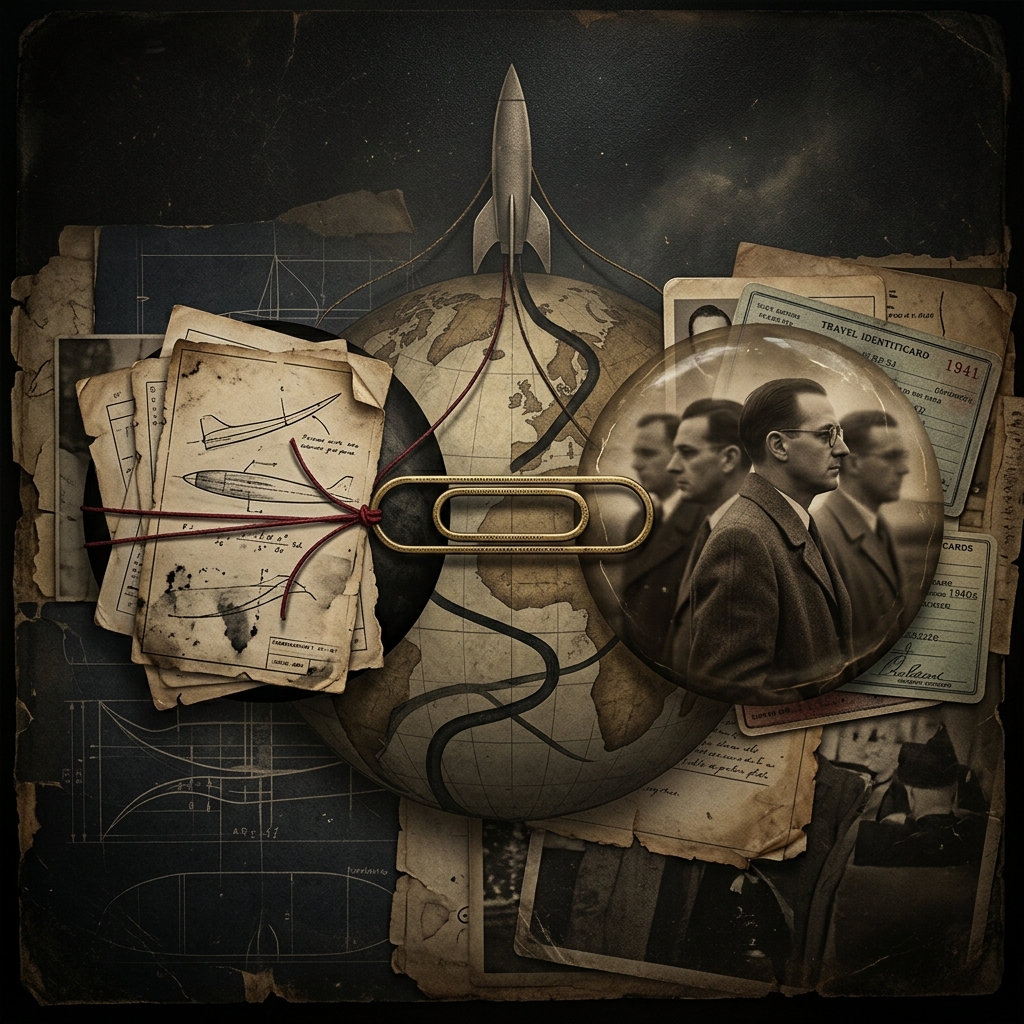
This is a CONFIRMED historical operation. Right after World War Two, the US government secretly brought over 1,600 German scientists, engineers, and technicians to America. Many were former Nazi Party members, and some were even linked to war crimes. The US military literally clipped paperclips to the files of the scientists they wanted to smuggle out of Europe, bypassing laws that banned Nazi collaborators from entering the country.
The goal was simple: win the Cold War. The US desperately wanted Germany's advanced rocket technology before the Soviet Union could grab it. Men like Wernher von Braun, who helped build the deadly V-2 rockets using slave labor, became American heroes. He even helped put Neil Armstrong on the moon. While some argue these scientists were just doing their jobs, critics point out that justice was traded for technology, leaving a dark moral stain on the space race.
“The secret program got its name because US officials used simple paperclips to mark the files of Nazi scientists they wanted to smuggle into America.”
Reflect
If a nation must choose between its moral values and winning a global race for technology, which one should it sacrifice?
Research·1 source·Developing confidence·Investigated 2 Aug 2026(1 month ago)·Grounded; verification trace not recorded·Investigation may be outdated
Your next question, in
Visual Trail
See Operation Paperclip: The Secret Pact
A guided visual explanation assembled from QE artwork and sourced documentary images.
01 / 05
QE visual interpretation
Frame 01
Operation Paperclip: The Secret Pact
The US secretly smuggled over 1,600 Nazi scientists to America after WWII to build rockets and win the Cold War.
Image provenance and limitation
Source: AI-generated visual interpretation
Creator: Question Everything
Limitation: This image explains or evokes the subject. It is not documentary evidence and should not be used to verify a factual claim.
Evidence
What do we know?
Verified claims with confidence scoring and cited sources.
2 of 3 findings need extra caution. Finding 2, Finding 3 rest on weaker sourcing than the other findings.
Living footnotes
Claims remain in the reading flow. Select a citation number to inspect the source behind it.
01
HistoricalSupported
The United States government secretly brought over 1,600 German scientists and engineers to America after World War II.
After defeating Germany in 1945, the US wanted to grab the best scientific minds before the Soviet Union could. Under a secret program called Operation Paperclip, the military brought more than 1,600 German experts to America. Many were dedicated members of the Nazi party, and some even served in dangerous groups like the SS. Instead of facing trials for war crimes, they were given comfortable jobs working for the US government.
02
HistoricalNot confirmed
German rocket scientists from the program became key leaders in America's space agency, NASA.
The US military wanted to master rocket technology, which Germany had used to build terrifying weapons like the V-2 missile. German specialists, including famous rocket designer Wernher von Braun, were sent to work on American space projects. They helped develop early space medicine, studied weightlessness, and built the massive rockets that eventually sent American astronauts to the moon. Their research laid the foundation for modern space exploration.
03
HistoricalNot confirmed
US military and intelligence agencies deliberately covered up the Nazi records of scientists they wanted to recruit.
President Harry Truman officially approved the program, but he ordered that active Nazis should not be recruited. To bypass this rule, US military intelligence officers altered the security files of valuable scientists. They removed evidence of war crimes and Nazi party membership, attaching paperclips to the clean files instead. This allowed people who should have faced trial to live quietly in American neighborhoods as respected citizens.
The complete record below preserves every citation, confidence input and recorded limitation.
Read the full evidence record3 findings · citations · limitations
Evidence review3 findings1 openable sources
01
Finding 1 of 3Historical
2024
1 dated source
The United States government secretly brought over 1,600 German scientists and engineers to America after World War II.
After defeating Germany in 1945, the US wanted to grab the best scientific minds before the Soviet Union could. Under a secret program called Operation Paperclip, the military brought more than 1,600 German experts to America. Many were dedicated members of the Nazi party, and some even served in dangerous groups like the SS. Instead of facing trials for war crimes, they were given comfortable jobs working for the US government.
Supportedmodel score 95%
One source, not peer-reviewed. Thinner than the score suggests.
REFERENCE
›View sources and limits— 1 citation, limits
Supporting passage
After defeating Germany in 1945, the US wanted to grab the best scientific minds before the Soviet Union could. Under a secret program called Operation Paperclip, the military brought more than 1,600 German experts to America. Many were dedicated members of the Nazi party, and some even served in dangerous groups like the SS. Instead of facing trials for war crimes, they were given comfortable jobs working for the US government.
Rests on a single source. No independent corroboration.
No peer-reviewed source among the citations.
The generator scored this 95%, which would read as “Established”. Its citations reach only “Supported”, so that is what is shown.
02
Finding 2 of 3HistoricalNeeds caution
0/0 verified
German rocket scientists from the program became key leaders in America's space agency, NASA.
The US military wanted to master rocket technology, which Germany had used to build terrifying weapons like the V-2 missile. German specialists, including famous rocket designer Wernher von Braun, were sent to work on American space projects. They helped develop early space medicine, studied weightlessness, and built the massive rockets that eventually sent American astronauts to the moon. Their research laid the foundation for modern space exploration.
Not confirmedmodel score 30%
Scored as if sourced, but every citation failed verification.
NO SURVIVING CITATION
›View sources and limits— limits
Supporting passage
The US military wanted to master rocket technology, which Germany had used to build terrifying weapons like the V-2 missile. German specialists, including famous rocket designer Wernher von Braun, were sent to work on American space projects. They helped develop early space medicine, studied weightlessness, and built the massive rockets that eventually sent American astronauts to the moon. Their research laid the foundation for modern space exploration.
Citations (0 of 1 survived verification)
Nothing openable. Every citation was removed by provenance validation.
What limits this
All 1 citation on this claim failed verification and were removed. Nothing openable supports it.
03
Finding 3 of 3HistoricalNeeds caution
0/0 verified
US military and intelligence agencies deliberately covered up the Nazi records of scientists they wanted to recruit.
President Harry Truman officially approved the program, but he ordered that active Nazis should not be recruited. To bypass this rule, US military intelligence officers altered the security files of valuable scientists. They removed evidence of war crimes and Nazi party membership, attaching paperclips to the clean files instead. This allowed people who should have faced trial to live quietly in American neighborhoods as respected citizens.
Not confirmedmodel score 30%
Scored as if sourced, but every citation failed verification.
NO SURVIVING CITATION
›View sources and limits— limits
Supporting passage
President Harry Truman officially approved the program, but he ordered that active Nazis should not be recruited. To bypass this rule, US military intelligence officers altered the security files of valuable scientists. They removed evidence of war crimes and Nazi party membership, attaching paperclips to the clean files instead. This allowed people who should have faced trial to live quietly in American neighborhoods as respected citizens.
Citations (0 of 1 survived verification)
Nothing openable. Every citation was removed by provenance validation.
What limits this
All 1 citation on this claim failed verification and were removed. Nothing openable supports it.
Interactive Exploration
Touch, drag, and discover
These visualizations respond to your curiosity. Interact to go deeper.
timeline
The Path of Operation Paperclip
Loading timeline…
statistics card
The Scale of Post-War Recruitment
1,600+
German Scientists in the US
The number of engineers, doctors, and technicians brought to America under the program.
2,200
German Specialists in the USSR
The Soviet Union recruited an even larger number of skilled German minds during the same period.
15% to 20%
Von Braun's Rocket Team
The famous Huntsville rocket group made up only a small fraction of the total Paperclip intake.
Visual Gallery
Images & artifacts
Historical images, diagrams, and visual knowledge from Wikimedia Commons.
Perspectives
How is this interpreted?
Enter a viewpoint. Notice what it reveals, what it leaves out, and whether it changes the question for you.
The EmpiricistScientific viewpointLive tension
This view focuses on the massive jump in technology that the German scientists brought to America. Without their advanced knowledge of aerodynamics, supersonic flight, and rocket engines, America's space program might have lagged behind for decades. They solved complex engineering problems that saved lives in early space missions, making their arrival a massive win for human scientific progress.
What this lens notices
01Accelerated the development of US space flight
02Provided critical data on high-speed aerodynamics
03Helped design the Saturn V rocket that went to the moon
Application
Why does this matter to you?
Personal reflections and applications for your life.
Thought experimentSelf-Reflection
How do you decide when a good result justifies a questionable choice?
Why it changes the question
Operation Paperclip forced leaders to choose between safety and morality. In our own lives, we often face smaller versions of this trade-off when trying to succeed.
Try this
Write down a recent difficult decision you made and identify if you prioritized the final outcome or the moral method of getting there.
Media
QE Smart Glass
Curated media selected for this investigation.
QE Glass
YOUTUBE
The Nazis recruited to win the Cold War - Brian Crim
TED-Ed
Dig into Operation Paperclip, a secret intelligence program which brought scientists from Nazi Germany to the US after WWII.
QE Glass
YOUTUBE
Operation Paperclip
Untold History
Operation Paperclip saw around 1600 Nazi scientists recruited by U.S. intelligence to aid American innovation. As a result, none ...
QE Glass
YOUTUBE
Annie Jacobsen, "Operation Paperclip"
Politics and Prose
http://politics-prose.com Author Annie Jacobsen presents a fascinating topic from her new book, Operation Paperclip, and takes ...
QE Glass
YOUTUBE
Operation Paperclip: How Nazi Scientists Built America’s Future
Proven Conspiracies
Operation Paperclip: How Nazi Scientists Built America's Future reveals the hidden story of how the U.S. brought over 1600 former ...
QE Glass
YOUTUBE
Alabama’s Biggest Secret - Operation Paperclip 🇺🇸
Peter Santenello
In the north of Alabama is the city of Huntsville. It's here where German scientists built NASA in secrecy after World War II.
QE Glass
YOUTUBE
The Nazi Scientists Who Built America's Future: Operation Paperclip
The Mysteria Archive
What if America's greatest scientific triumph began with a secret Nazi recruitment program? The true story of Operation Paperclip ...
QE Glass
YOUTUBE
How Nazi Scientists Secretly Built America’s Space Program || Full Documentary Video
Uncovered History
What if the men who helped America reach the Moon… once helped build weapons for Adolf Hitler? This is the hidden story the ...
QE Glass
PODCAST
Paperclip: America's Nazi Scientists
Paperclip (Spotify Studios)
An audio series exploring the lives, secrets, and ethical dilemmas of the German scientists who moved next door.
Connected context
Connected entities
The people, places, concepts, and events that matter here.
Keep Going
Where this leads
Questions this investigation opens up — and what QE has already looked into.
No AI help here — no suggestions, no autocomplete, nothing finishing your sentences. That is deliberate. Working out what you think is effortful, and the effort is the part that changes you: reasoning is trained like a muscle, and a muscle that is always carried gets weaker. Let something else do the thinking and you keep the answer but lose the capacity to have reached it.
Write your current position.
Not what the page says. What you think, having read it.0 words · Nothing written yet.
Sign in to leave a mark. Your draft is saved here in the meantime.