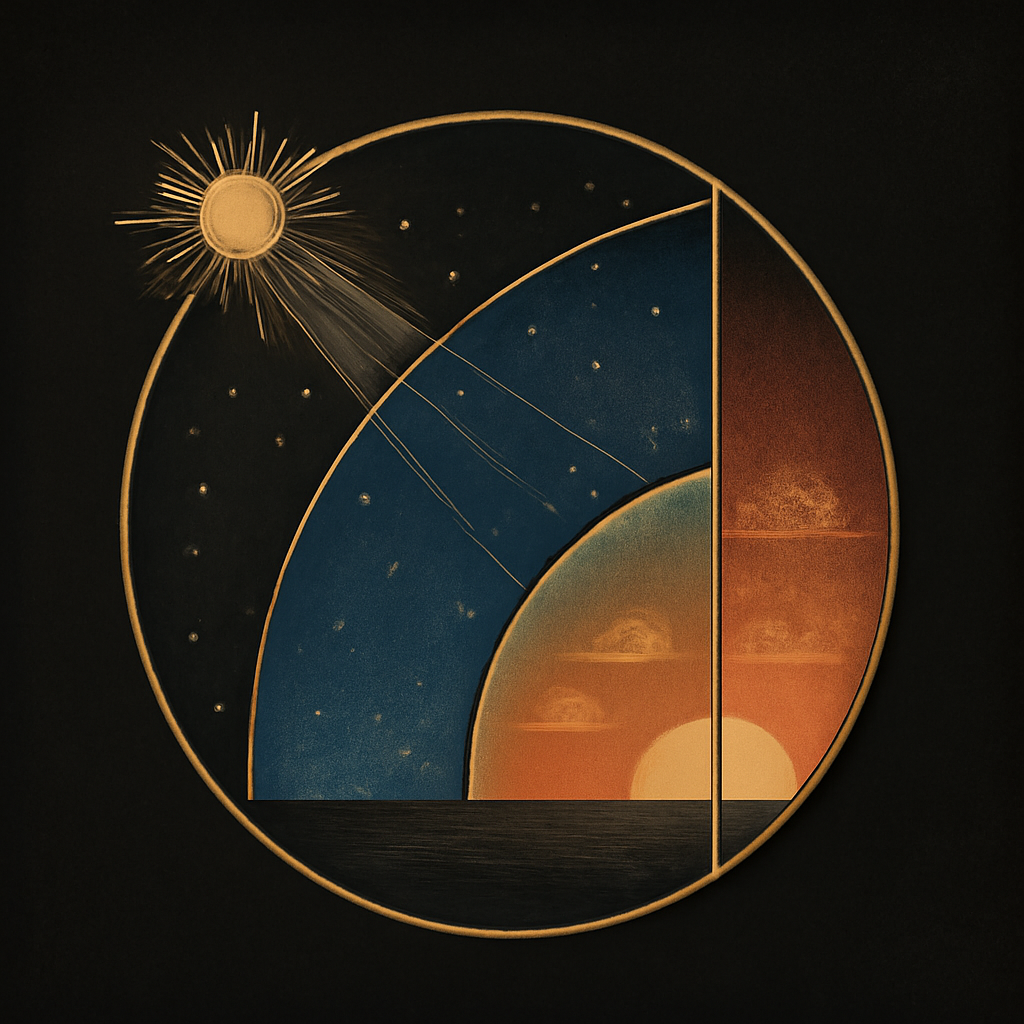
The Color-Shifting Canopy: Why the Sky Changes from Blue to Red
Imagine sunlight as a giant bundle of colored ribbons. All together, they look like plain white light. But they are actually a hidden rainbow. When this light hits the air around Earth, it runs into tiny gas molecules. The blue ribbons are short and bouncy. They get knocked around easily and scatter all over the sky. This is why the sky looks blue at noon.
But at sunset, everything changes. The sun sinks low. Now, the sunlight has to travel through a much thicker wall of air to reach you. The blue light gets scattered so many times it gets lost. Only the long, strong red ribbons can make the long journey to your eyes. That is why the sunset blazes with deep reds and oranges.
“If Earth had no atmosphere, the sky would be completely black even in the middle of the day.”
Reflect
How would our daily lives, our art, and our moods change if we spent our days under a pitch-black sky with a glaring white sun?
Research·1 source·Developing confidence·Investigated 4 Aug 2026(1 month ago)·Grounded; verification trace not recorded·Investigation may be outdated
Your next question, in
Visual Trail
See The Color-Shifting Canopy: Why the Sky Changes from Blue to Red
A guided visual explanation assembled from QE artwork and sourced documentary images.
01 / 03
QE visual interpretation
Frame 01
The Color-Shifting Canopy: Why the Sky Changes from Blue to Red
Earth's air scatters short blue light waves at noon, but at sunset, only the long red waves can travel through the thick air to reach us.
Image provenance and limitation
Source: AI-generated visual interpretation
Creator: Question Everything
Limitation: This image explains or evokes the subject. It is not documentary evidence and should not be used to verify a factual claim.
Evidence
What do we know?
Verified claims with confidence scoring and cited sources.
2 of 3 findings need extra caution. Finding 2, Finding 3 rest on weaker sourcing than the other findings.
Living footnotes
Claims remain in the reading flow. Select a citation number to inspect the source behind it.
01
ObservationalSupported
Air molecules scatter short blue light waves in all directions, making the daytime sky look blue.
Sunlight looks white, but it holds every color of the rainbow. These colors travel in waves of different sizes. Blue light travels in short, choppy waves. Red light travels in long, lazy waves. The tiny gas molecules in our air are mostly nitrogen and oxygen. They are the perfect size to bounce the short blue waves around. This bouncing is called scattering. Because blue bounces everywhere, that is the color we see when we look up.
02
ObservationalNot confirmed
At sunset, sunlight must travel through a thicker layer of atmosphere to reach our eyes.
When the sun goes down, it sits low on the horizon. Because of this sharp angle, the sunlight has to travel a much longer path through the air to reach you. It is like swimming through a thick pool. By the time the light gets to your eyes, almost all the short blue waves have been scattered away and lost. Only the long, tough red and orange waves can make it through the thick air.
03
ObservationalNot confirmed
Tiny particles of dust and pollution scatter additional light, making sunsets look more intensely red.
It is not just gas molecules that scatter light. Dust, smoke, and pollution also float in our air. These larger particles scatter even more blue and green light out of the way. This leaves behind a much deeper, richer red and orange glow. For example, when a volcano erupts, it throws massive clouds of dust into the air. This creates incredibly colorful sunsets all over the world for months.
The complete record below preserves every citation, confidence input and recorded limitation.
Read the full evidence record3 findings · citations · limitations
Evidence review3 findings1 openable sources
01
Finding 1 of 3Observational
0/1 verified
Air molecules scatter short blue light waves in all directions, making the daytime sky look blue.
Sunlight looks white, but it holds every color of the rainbow. These colors travel in waves of different sizes. Blue light travels in short, choppy waves. Red light travels in long, lazy waves. The tiny gas molecules in our air are mostly nitrogen and oxygen. They are the perfect size to bounce the short blue waves around. This bouncing is called scattering. Because blue bounces everywhere, that is the color we see when we look up.
Supportedmodel score 100%
One source, not peer-reviewed. Thinner than the score suggests.
REFERENCE
›View sources and limits— 1 citation, limits
Supporting passage
Sunlight looks white, but it holds every color of the rainbow. These colors travel in waves of different sizes. Blue light travels in short, choppy waves. Red light travels in long, lazy waves. The tiny gas molecules in our air are mostly nitrogen and oxygen. They are the perfect size to bounce the short blue waves around. This bouncing is called scattering. Because blue bounces everywhere, that is the color we see when we look up.
Rests on a single source. No independent corroboration.
No peer-reviewed source among the citations.
The generator scored this 100%, which would read as “Established”. Its citations reach only “Supported”, so that is what is shown.
02
Finding 2 of 3ObservationalNeeds caution
0/0 verified
At sunset, sunlight must travel through a thicker layer of atmosphere to reach our eyes.
When the sun goes down, it sits low on the horizon. Because of this sharp angle, the sunlight has to travel a much longer path through the air to reach you. It is like swimming through a thick pool. By the time the light gets to your eyes, almost all the short blue waves have been scattered away and lost. Only the long, tough red and orange waves can make it through the thick air.
Not confirmedmodel score 30%
Scored as if sourced, but every citation failed verification.
NO SURVIVING CITATION
›View sources and limits— limits
Supporting passage
When the sun goes down, it sits low on the horizon. Because of this sharp angle, the sunlight has to travel a much longer path through the air to reach you. It is like swimming through a thick pool. By the time the light gets to your eyes, almost all the short blue waves have been scattered away and lost. Only the long, tough red and orange waves can make it through the thick air.
Citations (0 of 1 survived verification)
Nothing openable. Every citation was removed by provenance validation.
What limits this
All 1 citation on this claim failed verification and were removed. Nothing openable supports it.
03
Finding 3 of 3ObservationalNeeds caution
0/0 verified
Tiny particles of dust and pollution scatter additional light, making sunsets look more intensely red.
It is not just gas molecules that scatter light. Dust, smoke, and pollution also float in our air. These larger particles scatter even more blue and green light out of the way. This leaves behind a much deeper, richer red and orange glow. For example, when a volcano erupts, it throws massive clouds of dust into the air. This creates incredibly colorful sunsets all over the world for months.
Not confirmedmodel score 30%
Scored as if sourced, but every citation failed verification.
NO SURVIVING CITATION
›View sources and limits— limits
Supporting passage
It is not just gas molecules that scatter light. Dust, smoke, and pollution also float in our air. These larger particles scatter even more blue and green light out of the way. This leaves behind a much deeper, richer red and orange glow. For example, when a volcano erupts, it throws massive clouds of dust into the air. This creates incredibly colorful sunsets all over the world for months.
Citations (0 of 1 survived verification)
Nothing openable. Every citation was removed by provenance validation.
What limits this
All 1 citation on this claim failed verification and were removed. Nothing openable supports it.
Interactive Exploration
Touch, drag, and discover
These visualizations respond to your curiosity. Interact to go deeper.
process flow
How Light Changes Color Through the Sky
Sunlight Enters
Noon Transit
Sunset Transit
Only Red Remains
comparison table
Blue Light vs. Red Light
Blue Light
Red Light
Wavelength
Short and choppy
Long and lazy
Scattering Level
Very high
Very low
When it Dominates
Noon (mid-day)
Sunset and sunrise
Behavior in Thick Air
Gets scattered away and lost
Passes straight through to your eyes
Tap any row to highlight and compare
Visual Gallery
Images & artifacts
Historical images, diagrams, and visual knowledge from Wikimedia Commons.
Perspectives
How is this interpreted?
Enter a viewpoint. Notice what it reveals, what it leaves out, and whether it changes the question for you.
The EmpiricistScientific viewpointEstablished lens
Scientists explain this color shift using a process called Rayleigh scattering. They use math to show how light waves interact with particles smaller than the light's wavelength. Because blue light has a short wavelength, it scatters much more easily than red light. At sunset, the path through the air is so long that the blue light is completely scattered away before it can reach our eyes, leaving only the red light behind.
What this lens notices
01Light travels in waves of different lengths
02Smaller particles scatter shorter wavelengths more
03The angle of the sun changes how much air the light passes through
Application
Why does this matter to you?
Personal reflections and applications for your life.
Thought experimentCreative
Can you paint with the sky's palette?
Why it changes the question
Observing the sky helps you notice fine details in nature. It trains your eyes to see subtle shifts in color.
Try this
Go outside at sunset. Try to count how many distinct shades of orange, pink, and red you can spot before the light fades.
Media
QE Smart Glass
Curated media selected for this investigation.
QE Glass
YOUTUBE
Beautiful Science - Why does the sky change color at sunset?
Beautiful Science
Blue to red, why does this happen? NAME OUR BLACK CAT IN THE COMMENTS. Instagram ...
QE Glass
YOUTUBE
If The Sky's Blue...why are Sunsets Red?
Science Workshop
Blue light is scattered (bounces off) Oxygen more than red light. Learn how this simple fact explains the sky's colour.
QE Glass
YOUTUBE
Why are sunsets red? | #aumsum #kids #science #education #children
It's AumSum Time
Buy AumSum Merchandise: http://bit.ly/3srNDiG Website: https://www.aumsum.com It is basically because of scattering of light in ...
QE Glass
YOUTUBE
Rayleigh Scattering Explained in Simple Words for Beginners
Science ABC
Why is the sky blue? In this video, we explain Rayleigh scattering in simple words — from why shorter wavelengths (blue and ...
QE Glass
YOUTUBE
Neil deGrasse Tyson Explains Why The Sky Is Blue
StarTalk
Have you ever wondered why the sky is blue? Neil deGrasse Tyson is here to help you answer that question alongside comic ...
QE Glass
YOUTUBE
Why Is the Sky Blue?
NASA Space Place
Why is the sky blue and not purple, green or orange? It's all because of how the Sun's light reaches Earth! Comprehension ...
QE Glass
PODCAST
Why is the sky blue and sunsets red?
Brains On! Science podcast for kids
An easy-to-follow audio journey into the science of light, perfect for curious minds of all ages.
Connected context
Connected entities
The people, places, concepts, and events that matter here.
Keep Going
Where this leads
Questions this investigation opens up — and what QE has already looked into.
No AI help here — no suggestions, no autocomplete, nothing finishing your sentences. That is deliberate. Working out what you think is effortful, and the effort is the part that changes you: reasoning is trained like a muscle, and a muscle that is always carried gets weaker. Let something else do the thinking and you keep the answer but lose the capacity to have reached it.
Write your current position.
Not what the page says. What you think, having read it.0 words · Nothing written yet.
Sign in to leave a mark. Your draft is saved here in the meantime.