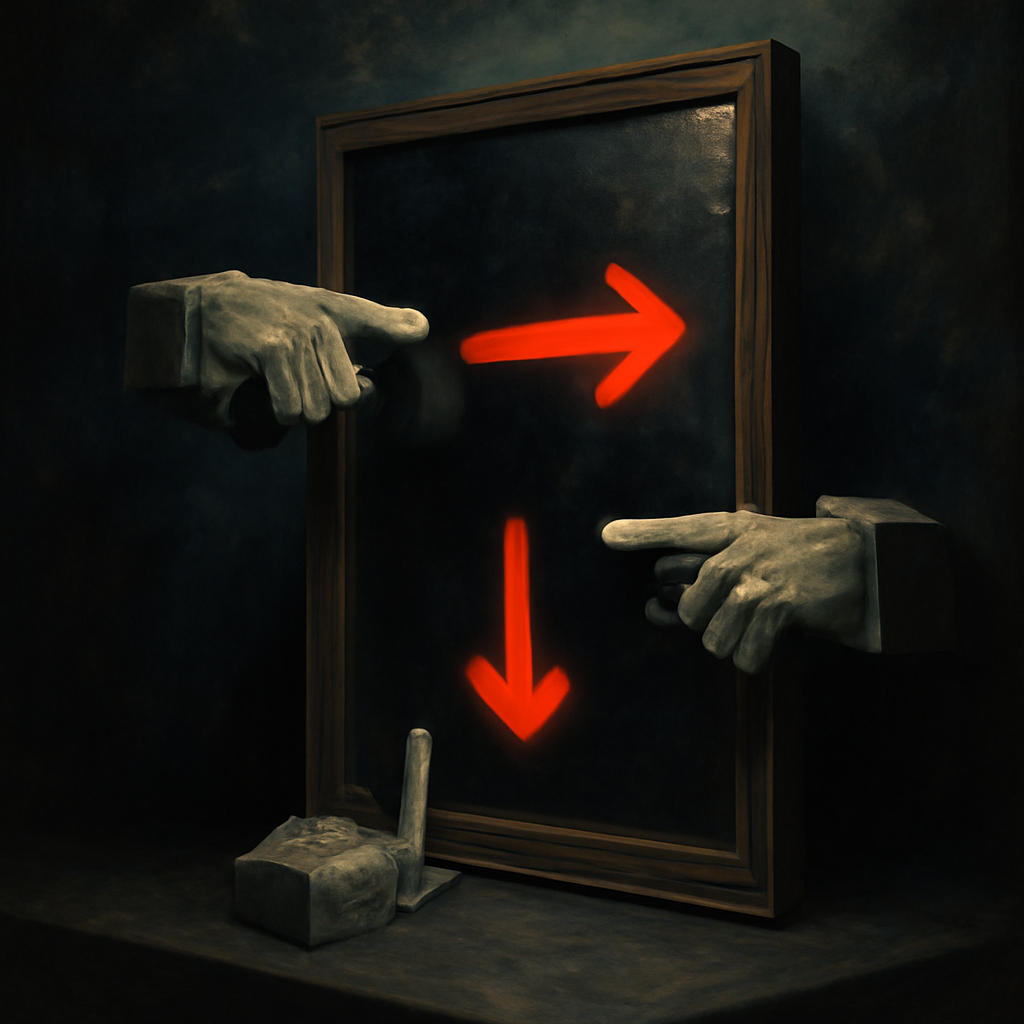
Why Mirrors Flip Left and Right but Not Up and Down
Have you ever looked in a mirror and wondered why your reflection seems to swap left and right sides, but your head stays on top and your feet stay below? It feels like the mirror is playing a trick on us, flipping us sideways but not upside down. Surprisingly, mirrors don’t actually reverse left and right. Instead, they flip front and back. This means the mirror swaps the direction going into the mirror with the direction coming out, but it doesn't change what's left or right or up or down.
This illusion happens because our bodies are mostly symmetrical left to right, but not front to back. When you face a mirror, you expect your reflection to be like another person standing opposite you, turned around to face you. That imagined person would have their right hand where you have your left, so it looks like left and right get swapped. But in reality, the mirror only flips the front side of your body to the back side and vice versa. Your left and right sides stay exactly where they are. The way we interpret the mirror flip depends on how we naturally think about facing another person, not on what the mirror actually does.
“Mirrors don’t actually swap your left and right — they flip front and back, and your brain does the rest.”
Reflect
If mirrors flipped left and right, what would happen if you lay down facing one? How would your reflection look then?
Research·4 sources·Well-Established confidence·Investigated 18 Jul 2026(2 months ago)·Grounded; verification trace not recorded·Investigation may be outdated
Your next question, in
Visual Trail
See Why Mirrors Flip Left and Right but Not Up and Down
A guided visual explanation assembled from QE artwork and sourced documentary images.
01 / 05
QE visual interpretation
Frame 01
Why Mirrors Flip Left and Right but Not Up and Down
Mirrors flip front and back, not left and right, which makes it look like left and right are reversed but up and down stay the same.
Image provenance and limitation
Source: AI-generated visual interpretation
Creator: Question Everything
Limitation: This image explains or evokes the subject. It is not documentary evidence and should not be used to verify a factual claim.
Evidence
What do we know?
Verified claims with confidence scoring and cited sources.
Living footnotes
Claims remain in the reading flow. Select a citation number to inspect the source behind it.
01
AcademicSupported
Mirrors flip the front-back direction, not left-right or up-down.
When you stand in front of a mirror, the image you see is reversed along the direction perpendicular to the mirror surface — that is, front and back are swapped. Everything on your left side stays on the left side, and everything on your right stays on the right side in the reflection. The mirror does not perform any left-right or up-down reversal on its own. This flipping in the front-back dimension is the only reversal that occurs because the reflection happens across the mirror's flat surface.
02
AcademicSupported
The feeling that mirrors reverse left and right comes from how humans imagine reflections as rotated people.
We tend to think of the mirror image as another person standing opposite us, facing us after turning around. When a person turns 180 degrees, their left and right sides switch places compared to us. But a mirror doesn't actually rotate the image; it just flips front to back. Our brains interpret the mirror image as if it had been rotated, which causes the illusion that left and right are swapped. The symmetry of the human body — which looks very similar left to right but different front to back — adds to this confusion.
03
AcademicSupported
Mirror images do not flip upside down because the vertical axis is not reversed.
If mirrors flipped up and down, your head would appear at the bottom and your feet at the top in the reflection, which does not happen. The mirror keeps the vertical axis the same because it only reverses the depth axis — the direction going into and out of the mirror. This means the mirror image stays right side up, preserving the top and bottom orientation.
04
ObservationalSupported
The mirror reflection is a type of symmetry called reflection symmetry across the mirror plane.
Reflection symmetry means one half is a mirror image of the other across a line or plane. In the case of a flat mirror, the plane of symmetry is the mirror surface itself. The mirror creates an image where every point is flipped across this plane, which swaps front and back. Left and right, or up and down, are preserved unless you turn your body or the mirror, because the mirror has no way to distinguish left from right or up from down.
The complete record below preserves every citation, confidence input and recorded limitation.
Read the full evidence record4 findings · citations · limitations
Evidence review4 findings4 openable sources
01
Finding 1 of 4Academic
1
0/1 verified
Mirrors flip the front-back direction, not left-right or up-down.
When you stand in front of a mirror, the image you see is reversed along the direction perpendicular to the mirror surface — that is, front and back are swapped. Everything on your left side stays on the left side, and everything on your right stays on the right side in the reflection. The mirror does not perform any left-right or up-down reversal on its own. This flipping in the front-back dimension is the only reversal that occurs because the reflection happens across the mirror's flat surface.
Supportedmodel score 100%
A single peer-reviewed source. No independent corroboration.
PRIMARY STUDY
›View sources and limits— 1 citation, limits
Supporting passage
When you stand in front of a mirror, the image you see is reversed along the direction perpendicular to the mirror surface — that is, front and back are swapped. Everything on your left side stays on the left side, and everything on your right stays on the right side in the reflection. The mirror does not perform any left-right or up-down reversal on its own. This flipping in the front-back dimension is the only reversal that occurs because the reflection happens across the mirror's flat surface.
Rests on a single source. No independent corroboration.
The generator scored this 100%, which would read as “Established”. Its citations reach only “Supported”, so that is what is shown.
02
Finding 2 of 4Academic
1
0/1 verified
The feeling that mirrors reverse left and right comes from how humans imagine reflections as rotated people.
We tend to think of the mirror image as another person standing opposite us, facing us after turning around. When a person turns 180 degrees, their left and right sides switch places compared to us. But a mirror doesn't actually rotate the image; it just flips front to back. Our brains interpret the mirror image as if it had been rotated, which causes the illusion that left and right are swapped. The symmetry of the human body — which looks very similar left to right but different front to back — adds to this confusion.
Supportedmodel score 90%
One source, not peer-reviewed. Thinner than the score suggests.
REFERENCE
›View sources and limits— 1 citation, limits
Supporting passage
We tend to think of the mirror image as another person standing opposite us, facing us after turning around. When a person turns 180 degrees, their left and right sides switch places compared to us. But a mirror doesn't actually rotate the image; it just flips front to back. Our brains interpret the mirror image as if it had been rotated, which causes the illusion that left and right are swapped. The symmetry of the human body — which looks very similar left to right but different front to back — adds to this confusion.
Rests on a single source. No independent corroboration.
No peer-reviewed source among the citations.
The generator scored this 90%, which would read as “Established”. Its citations reach only “Supported”, so that is what is shown.
03
Finding 3 of 4Academic
1
0/1 verified
Mirror images do not flip upside down because the vertical axis is not reversed.
If mirrors flipped up and down, your head would appear at the bottom and your feet at the top in the reflection, which does not happen. The mirror keeps the vertical axis the same because it only reverses the depth axis — the direction going into and out of the mirror. This means the mirror image stays right side up, preserving the top and bottom orientation.
Supportedmodel score 95%
One source, not peer-reviewed. Thinner than the score suggests.
REFERENCE
›View sources and limits— 1 citation, limits
Supporting passage
If mirrors flipped up and down, your head would appear at the bottom and your feet at the top in the reflection, which does not happen. The mirror keeps the vertical axis the same because it only reverses the depth axis — the direction going into and out of the mirror. This means the mirror image stays right side up, preserving the top and bottom orientation.
Rests on a single source. No independent corroboration.
No peer-reviewed source among the citations.
The generator scored this 95%, which would read as “Established”. Its citations reach only “Supported”, so that is what is shown.
04
Finding 4 of 4Observational
0/1 verified
The mirror reflection is a type of symmetry called reflection symmetry across the mirror plane.
Reflection symmetry means one half is a mirror image of the other across a line or plane. In the case of a flat mirror, the plane of symmetry is the mirror surface itself. The mirror creates an image where every point is flipped across this plane, which swaps front and back. Left and right, or up and down, are preserved unless you turn your body or the mirror, because the mirror has no way to distinguish left from right or up from down.
Supportedmodel score 90%
One source, not peer-reviewed. Thinner than the score suggests.
REFERENCE
›View sources and limits— 1 citation, limits
Supporting passage
Reflection symmetry means one half is a mirror image of the other across a line or plane. In the case of a flat mirror, the plane of symmetry is the mirror surface itself. The mirror creates an image where every point is flipped across this plane, which swaps front and back. Left and right, or up and down, are preserved unless you turn your body or the mirror, because the mirror has no way to distinguish left from right or up from down.
Rests on a single source. No independent corroboration.
No peer-reviewed source among the citations.
The generator scored this 90%, which would read as “Established”. Its citations reach only “Supported”, so that is what is shown.
Interactive Exploration
Touch, drag, and discover
These visualizations respond to your curiosity. Interact to go deeper.
process flow
How Mirrors Create Reflections
Light hits the mirror
Reflection at equal angle
Image appears behind the mirror
Front and back flipped
relationship map
Mirror Reflection and Human Perception
Mapping relationships…
Drag nodes to rearrange — tap for details
comparison table
What Mirrors Flip vs What They Don’t
Flipped by Mirrors
Not Flipped by Mirrors
Direction
Front and back (depth)
Left and right
Vertical Orientation
No
Up and down
Text Appearance
Reversed front-back, looks mirrored horizontally
Not upside down
Tap any row to highlight and compare
statistics card
Key Facts About Mirror Reflection
1
Plane of symmetry in a flat mirror
The mirror surface is the only axis where reflection happens.
0
Number of left-right or up-down reversals by mirrors themselves
Mirrors do not flip these directions; the effect is perceptual.
180 degrees
Rotation people imagine the reflection has
Our brain sees the mirror image as a person turned around.
Visual Gallery
Images & artifacts
Historical images, diagrams, and visual knowledge from Wikimedia Commons.
Perspectives
How is this interpreted?
Enter a viewpoint. Notice what it reveals, what it leaves out, and whether it changes the question for you.
The EmpiricistScientific viewpointEstablished lens
Scientists explain mirror reversal as a geometric reflection across a plane. The key is that a mirror swaps the direction perpendicular to its surface (front-back), but leaves the other directions (left-right and up-down) unchanged. Our brain interprets the mirror image by imagining it as another person facing us, which creates the illusion of left-right reversal. This understanding is backed by physics and optics, and helps explain why text appears reversed in a mirror but not upside down.
What this lens notices
01Mirrors reverse depth (front-back) but not lateral (left-right) or vertical (up-down) directions.
02Human body symmetry causes us to interpret the reflection as rotated, leading to left-right confusion.
03Physical laws of light reflection confirm this type of reversal.
Application
Why does this matter to you?
Personal reflections and applications for your life.
Thought experimentSelf-Reflection
How do your own assumptions shape what you see in a mirror?
Why it changes the question
Understanding that mirrors don’t really flip left and right helps us realize how our brain fills in gaps based on expectations. This awareness can make us more mindful of how perception works in daily life.
Try this
Try looking at a word in the mirror and then write it backwards yourself. Notice how the mirror reverses the front-back direction, not left-right.
Media
QE Smart Glass
Curated media selected for this investigation.
QE Glass
YOUTUBE
Why Do Mirrors Flip Left & Right (but not up & down)?
minutephysics
Go to https://nebula.tv/minutephysics to get access to Nebula (where you can watch MinuteBody) plus you'll get a 20% discount ...
QE Glass
YOUTUBE
Brian Cox explains quantum mechanics in 60 seconds - BBC News
BBC News
Subscribe to BBC News www.youtube.com/bbcnews British physicist Brian Cox is challenged by the presenter of Radio 4's 'Life ...
QE Glass
YOUTUBE
The Backwards Brain Bicycle - Smarter Every Day 133
SmarterEveryDay
Get your own here ⇒ http://bit.ly/BuyBackwardsBike ⇐ Shirt: https://goo.gl/doOG3G I give talks: ...
QE Glass
YOUTUBE
What They (Probably) Don't Teach You About Rainbows At School
Veritasium
You probably don't understand how a rainbow really works. Get a little smarter every day with Brilliant.
QE Glass
YOUTUBE
Your Brain Is Wrong About Mirrors – The Left/Right Flip Explained
The Daily Object
Ever wondered why mirrors seem to flip left and right, but never up and down? In this video, we break down the mind-bending ...
QE Glass
YOUTUBE
How do Mirrors Work? + more videos | #aumsum #kids #science #education #children
It's AumSum Time
Buy AumSum Merchandise: https://www.aumsum.com How do Mirrors Work? See, when light hits an apple, it absorbs all the ...
QE Glass
YOUTUBE
Why Do Mirrors Flip Left & Right (but not up & down)?
minutephysics
Go to https://nebula.tv/minutephysics to get access to Nebula (where you can watch MinuteBody) plus you'll get a 20% discount ...
QE Glass
YOUTUBE
Reflection Symmetry - What is Mirror Symmetry?
Cuemath
An easy-to-understand video about the concept of reflection symmetry using visual examples.
QE Glass
PODCAST
How Our Brain Tricks Us with Optical Illusions
Science Vs
A podcast episode that discusses why our brain sometimes misinterprets what we see, including mirror illusions.
Keep Going
Where this leads
Questions this investigation opens up — and what QE has already looked into.
No AI help here — no suggestions, no autocomplete, nothing finishing your sentences. That is deliberate. Working out what you think is effortful, and the effort is the part that changes you: reasoning is trained like a muscle, and a muscle that is always carried gets weaker. Let something else do the thinking and you keep the answer but lose the capacity to have reached it.
Write your current position.
Not what the page says. What you think, having read it.0 words · Nothing written yet.
Sign in to leave a mark. Your draft is saved here in the meantime.