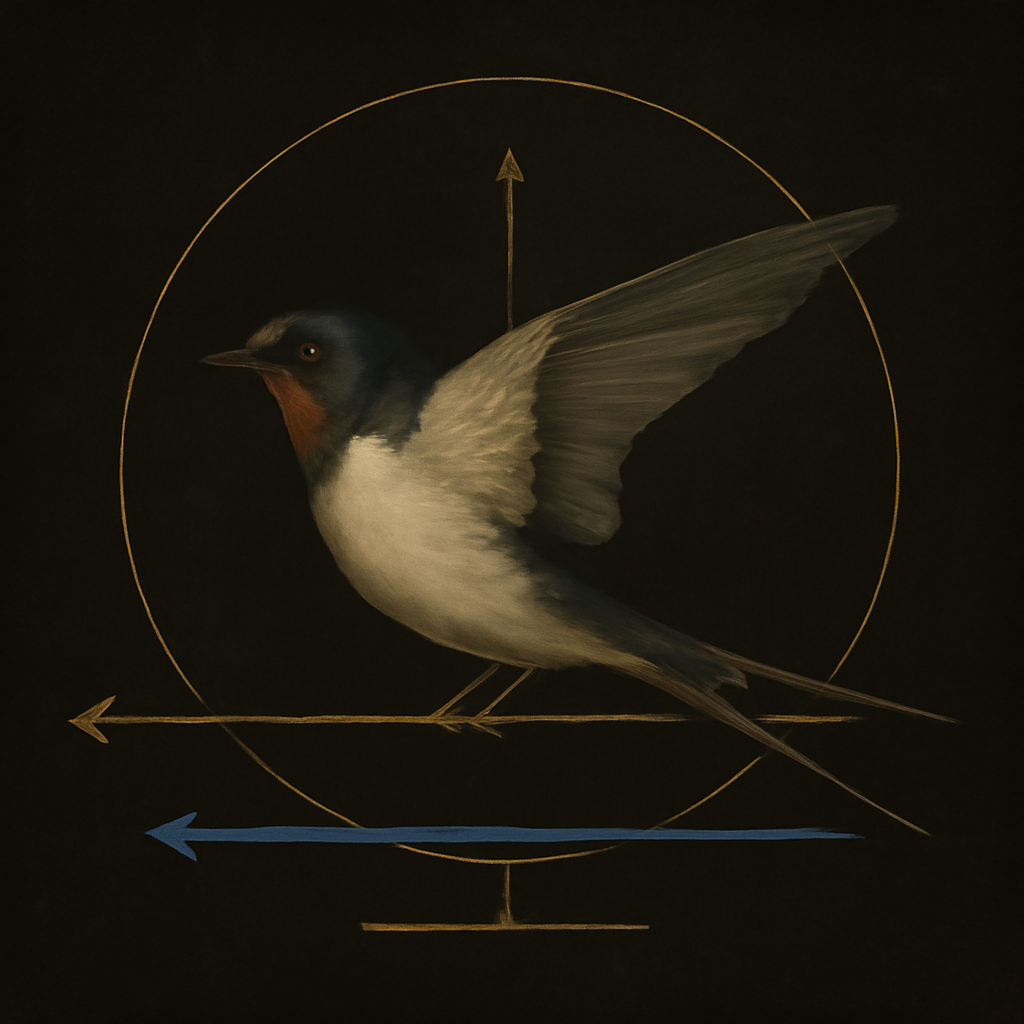
It started as a silly throwaway joke in a 1975 comedy film. King Arthur is stopped at a bridge and asked a simple question: 'What is the airspeed velocity of an unladen swallow?' His failure to answer correctly gets him tossed into the Gorge of Eternal Peril. But behind this classic movie moment lies some surprisingly real, and very fun, science.
To answer the question, scientists and bird lovers actually did the math. They studied how real swallows flap their wings in wind tunnels. They compared different species of swallows. What they found is a beautiful look at how nature solves the problem of flight, proving that even the silliest questions can lead to wonderful scientific truths.
“A real European swallow actually flies at about 24 miles per hour, which is just fast enough to outrun a professional human sprinter.”
Reflect
If a simple joke from a movie can lead to real, published scientific papers, what other silly questions in your life might have fascinating answers?
Research·2 sources·Developing confidence·Investigated 4 Aug 2026(1 month ago)·Grounded; verification trace not recorded·Investigation may be outdated
Your next question, in
Visual Trail
See The Airspeed of an Unladen Swallow
A guided visual explanation assembled from QE artwork and sourced documentary images.
01 / 02
QE visual interpretation
Frame 01
The Airspeed of an Unladen Swallow
An unladen European swallow flies at about 24 miles per hour, while an African one can reach roughly 40 miles per hour.
Image provenance and limitation
Source: AI-generated visual interpretation
Creator: Question Everything
Limitation: This image explains or evokes the subject. It is not documentary evidence and should not be used to verify a factual claim.
Evidence
What do we know?
Verified claims with confidence scoring and cited sources.
2 of 3 findings need extra caution. Finding 2, Finding 3 rest on weaker sourcing than the other findings.
Living footnotes
Claims remain in the reading flow. Select a citation number to inspect the source behind it.
01
ObservationalSupported
A European swallow flies at a normal cruising speed of about 24 miles per hour.
Scientists figured this out by studying how birds fly in special wind tunnels. They looked at how fast the birds flap and how far they move with each flap. It turns out a normal, empty European swallow moves at around 11 meters per second. That is about 24 miles per hour.
02
ObservationalNot confirmed
A European swallow beats its wings about 18 times every second.
In the movie Monty Python, a character guesses that the swallow flaps its wings 43 times a second. That is way too high. Real biology shows they flap their wings about 18 times a second. Each flap moves their wings about 18 centimeters. This keeps them steady and fast in the air.
03
ObservationalNot confirmed
The African Mosque swallow is estimated to fly at about 40 miles per hour.
To answer the movie's trick question, we have to look at African swallows too. The Mosque swallow is a common African species. It is much bigger than the European swallow—about twice as large. Because of its size, scientists estimate its cruising speed is around 40 miles per hour. That is fast enough to keep up with a car driving through town.
The complete record below preserves every citation, confidence input and recorded limitation.
Read the full evidence record3 findings · citations · limitations
Evidence review3 findings2 openable sources
01
Finding 1 of 3Observational
0/2 verified
A European swallow flies at a normal cruising speed of about 24 miles per hour.
Scientists figured this out by studying how birds fly in special wind tunnels. They looked at how fast the birds flap and how far they move with each flap. It turns out a normal, empty European swallow moves at around 11 meters per second. That is about 24 miles per hour.
Supportedmodel score 95%
2 sources agree, none peer-reviewed.
REFERENCE ×2
›View sources and limits— 2 citations, limits
Supporting passage
Scientists figured this out by studying how birds fly in special wind tunnels. They looked at how fast the birds flap and how far they move with each flap. It turns out a normal, empty European swallow moves at around 11 meters per second. That is about 24 miles per hour.
The generator scored this 95%, which would read as “Established”. Its citations reach only “Supported”, so that is what is shown.
02
Finding 2 of 3ObservationalNeeds caution
0/0 verified
A European swallow beats its wings about 18 times every second.
In the movie Monty Python, a character guesses that the swallow flaps its wings 43 times a second. That is way too high. Real biology shows they flap their wings about 18 times a second. Each flap moves their wings about 18 centimeters. This keeps them steady and fast in the air.
Not confirmedmodel score 30%
Scored as if sourced, but every citation failed verification.
NO SURVIVING CITATION
›View sources and limits— limits
Supporting passage
In the movie Monty Python, a character guesses that the swallow flaps its wings 43 times a second. That is way too high. Real biology shows they flap their wings about 18 times a second. Each flap moves their wings about 18 centimeters. This keeps them steady and fast in the air.
Citations (0 of 1 survived verification)
Nothing openable. Every citation was removed by provenance validation.
What limits this
All 1 citation on this claim failed verification and were removed. Nothing openable supports it.
03
Finding 3 of 3ObservationalNeeds caution
0/0 verified
The African Mosque swallow is estimated to fly at about 40 miles per hour.
To answer the movie's trick question, we have to look at African swallows too. The Mosque swallow is a common African species. It is much bigger than the European swallow—about twice as large. Because of its size, scientists estimate its cruising speed is around 40 miles per hour. That is fast enough to keep up with a car driving through town.
Not confirmedmodel score 30%
Scored as if sourced, but every citation failed verification.
NO SURVIVING CITATION
›View sources and limits— limits
Supporting passage
To answer the movie's trick question, we have to look at African swallows too. The Mosque swallow is a common African species. It is much bigger than the European swallow—about twice as large. Because of its size, scientists estimate its cruising speed is around 40 miles per hour. That is fast enough to keep up with a car driving through town.
Citations (0 of 1 survived verification)
Nothing openable. Every citation was removed by provenance validation.
What limits this
All 1 citation on this claim failed verification and were removed. Nothing openable supports it.
Interactive Exploration
Touch, drag, and discover
These visualizations respond to your curiosity. Interact to go deeper.
comparison table
European vs. African Swallow
European Barn Swallow
African Mosque Swallow
Cruising Speed
24 mph (11 m/s)
40 mph (18 m/s)
Relative Body Size
Smaller (Standard)
About 2.2 times larger
Wing Flap Speed
18 beats per second
Slower (estimated)
Tap any row to highlight and compare
statistics card
Flight Stats of the European Swallow
24 mph
Cruising Speed
Calculated by real scientists using wind tunnel data.
18
Flaps Per Second
How fast they actually beat their wings, much slower than the movie's guess of 43.
Perspectives
How is this interpreted?
Enter a viewpoint. Notice what it reveals, what it leaves out, and whether it changes the question for you.
The EmpiricistScientific viewpointEstablished lens
Biologists use strict math to study flight. By looking at a bird's weight, wing shape, and how fast it flaps, they can calculate its speed. This helps us design better drones and understand how animals travel thousands of miles during migration.
What this lens notices
01Uses wind tunnel data to confirm theories
02Applies the Strouhal ratio to estimate bird speeds
03Helps us map out animal migration routes
Application
Why does this matter to you?
Personal reflections and applications for your life.
Thought experimentSelf-Reflection
Are you asking the right questions?
Why it changes the question
Just like King Arthur, we sometimes fail because we do not ask for more details. Taking a second to clarify a problem can save us a lot of trouble.
Try this
The next time someone asks you a vague or tricky question at work or school, ask them to define their terms before you try to answer.
Media
QE Smart Glass
Curated media selected for this investigation.
QE Glass
YOUTUBE
Monty Python and the Holy Grail - The Bridge of Death
FDUK200K
King Arther and his Knights of the round table arrive at the Bridge of Death.
QE Glass
PODCAST
The Physics of Bird Flight
The Science of Birds
A friendly podcast episode that explains the amazing science behind how birds stay in the air.
Keep Going
Where this leads
Questions this investigation opens up — and what QE has already looked into.
No AI help here — no suggestions, no autocomplete, nothing finishing your sentences. That is deliberate. Working out what you think is effortful, and the effort is the part that changes you: reasoning is trained like a muscle, and a muscle that is always carried gets weaker. Let something else do the thinking and you keep the answer but lose the capacity to have reached it.
Write your current position.
Not what the page says. What you think, having read it.0 words · Nothing written yet.
Sign in to leave a mark. Your draft is saved here in the meantime.