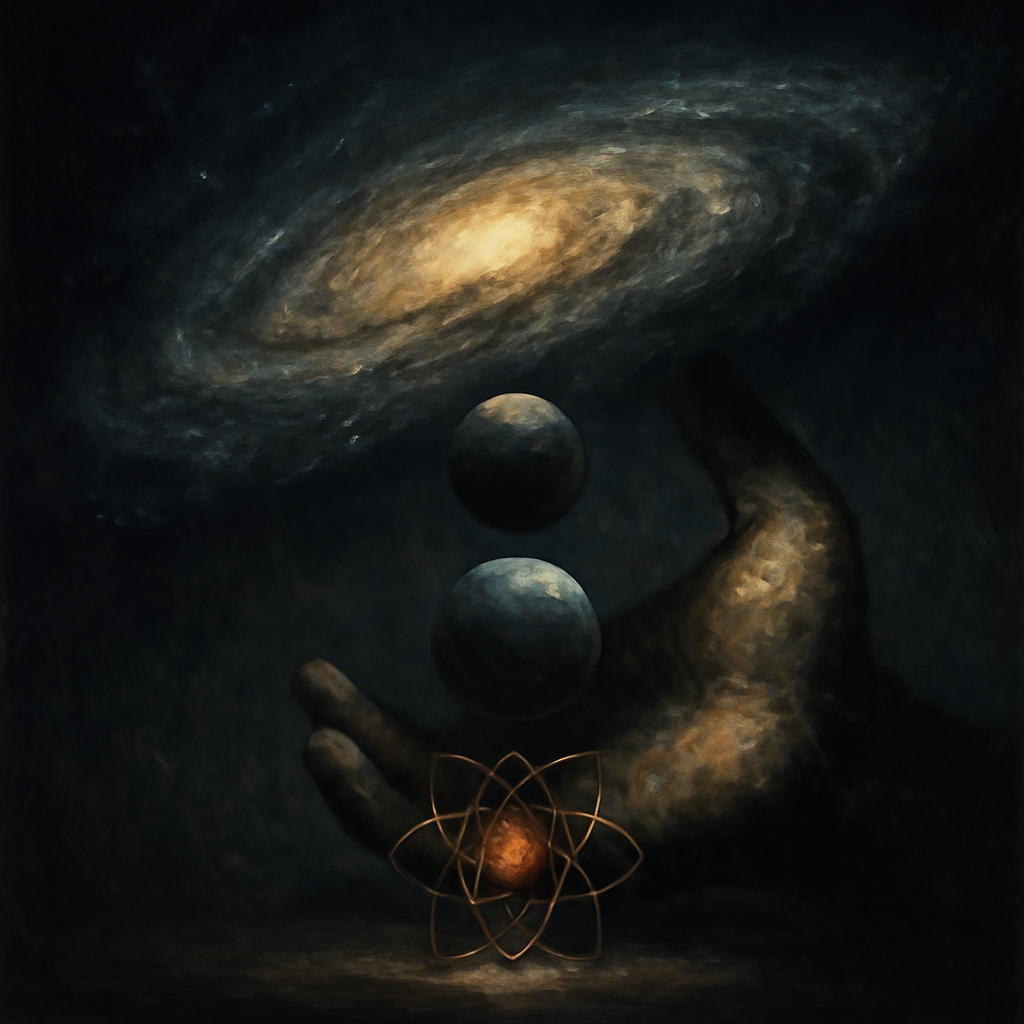
How Big Is Big? Exploring Size from Atoms to Galaxies
Big is a tricky word because it means different things depending on what you’re talking about. Imagine an ant. That ant is big to a tiny microbe living on it, but small compared to a human. Now think about Earth — huge to us ants, but tiny compared to the Sun. And the Sun itself? Just a small star in a vast galaxy filled with billions of other stars.
When we ask "how big is big?" we’re really asking about scale. Size can be measured in many ways — length, volume, weight — and things get surprising when we zoom in or out. Some things are so small we can’t see them without special tools. Others are so large they stretch across space for billions of kilometers. Understanding how big things can be helps us appreciate the world and universe around us, from the tiniest particles to the endless cosmos.
“The universe is so big that light takes 93 billion years just to cross the part we can see.”
Reflect
If the universe is this huge, what ‘big’ things might exist that we can’t even imagine yet?
4 sources·Established confidence·Investigated 17 Jul 2026(1 month ago)·Investigation may be outdated
Your next question, in
Visual Trail
See How Big Is Big? Exploring Size from Atoms to Galaxies
A guided visual explanation assembled from QE artwork and sourced documentary images.
01 / 05
QE visual interpretation
Frame 01
How Big Is Big? Exploring Size from Atoms to Galaxies
Big means different things depending on what you're measuring, from tiny atoms to huge galaxies.
Image provenance and limitation
Source: AI-generated visual interpretation
Creator: Question Everything
Limitation: This image explains or evokes the subject. It is not documentary evidence and should not be used to verify a factual claim.
Evidence
What do we know?
Verified claims with confidence scoring and cited sources.
Generated without source retrieval. QE did not fetch sources for this investigation, so no citation here was checked against a retrieved set. Claims reflect the model’s training data. 1 of 5 findings carry no openable link at all.
1 of 5 findings need extra caution. Finding 5 rests on weaker sourcing than the other findings.
Living footnotes
Claims remain in the reading flow. Select a citation number to inspect the source behind it.
01
ExperimentalSupported
Atoms are incredibly small, about one ten-billionth of a meter across.
Atoms form the basic building blocks of everything around us. They are so tiny that a human hair is about one million atoms wide! Scientists measure atoms using special microscopes and experiments based on how atoms scatter light or electrons. This tiny scale is hard to imagine but is the starting point for understanding size from the very small side.
02
ObservationalSupported
The Earth is about 12,742 kilometers (7,918 miles) wide.
Earth’s size is easy to grasp because we live on it. Its diameter measures roughly 12,742 kilometers, which is about the distance you’d travel flying from London to New York and back again. This size makes Earth a medium-sized planet in our solar system, bigger than Mars but smaller than Jupiter. Knowing Earth’s size helps us understand distances, travel times, and the scale of life on our planet.
03
ObservationalSupported
The Milky Way galaxy is about 100,000 light-years across.
Our galaxy, the Milky Way, is enormous compared to Earth. It stretches about 100,000 light-years, meaning light takes 100,000 years to travel from one side to the other. Since light travels about 300,000 kilometers every second, this distance is almost impossible to picture. The galaxy contains billions of stars, planets, and other objects, making it one huge cosmic city.
04
ObservationalSupported
The observable universe is about 93 billion light-years wide.
When we look out into space, we see the observable universe — the part we can detect with telescopes. It spans about 93 billion light-years across. That means the light from the farthest objects has traveled for billions of years to reach us. This vastness is so huge it’s almost beyond human understanding, showing just how big “big” can get.
05
ObservationalNot confirmed
Size can be subjective; what’s big for one scale may be small on another.
The idea of 'big' depends on what you compare it to. A human is huge compared to a virus, but tiny compared to a mountain. A mountain is massive to us but just a small bump on Earth’s surface. This shows that 'big' isn’t a fixed number but a relative idea. Understanding this helps us think clearly about size and scale in everyday life and science.
The complete record below preserves every citation, confidence input and recorded limitation.
Read the full evidence record5 findings · citations · limitations
Evidence review5 findings4 openable sources
01
Finding 1 of 5Experimental
1
0/1 verified
Atoms are incredibly small, about one ten-billionth of a meter across.
Atoms form the basic building blocks of everything around us. They are so tiny that a human hair is about one million atoms wide! Scientists measure atoms using special microscopes and experiments based on how atoms scatter light or electrons. This tiny scale is hard to imagine but is the starting point for understanding size from the very small side.
Supportedmodel score 98%
One source, not peer-reviewed. Thinner than the score suggests.
REPORTING
›View sources and limits— 1 citation, limits
Supporting passage
Atoms form the basic building blocks of everything around us. They are so tiny that a human hair is about one million atoms wide! Scientists measure atoms using special microscopes and experiments based on how atoms scatter light or electrons. This tiny scale is hard to imagine but is the starting point for understanding size from the very small side.
Citations
REPORTINGAtomic Scale Explained, National Institute of Standards and Technology (NIST) (2020)
What limits this
Generated without source retrieval — citations here were not verified against a retrieved set.
Rests on a single source. No independent corroboration.
No peer-reviewed source among the citations.
The generator scored this 98%, which would read as “Established”. Its citations reach only “Supported”, so that is what is shown.
02
Finding 2 of 5Observational
0/1 verified
The Earth is about 12,742 kilometers (7,918 miles) wide.
Earth’s size is easy to grasp because we live on it. Its diameter measures roughly 12,742 kilometers, which is about the distance you’d travel flying from London to New York and back again. This size makes Earth a medium-sized planet in our solar system, bigger than Mars but smaller than Jupiter. Knowing Earth’s size helps us understand distances, travel times, and the scale of life on our planet.
Supportedmodel score 99%
One source, not peer-reviewed. Thinner than the score suggests.
REPORTING
›View sources and limits— 1 citation, limits
Supporting passage
Earth’s size is easy to grasp because we live on it. Its diameter measures roughly 12,742 kilometers, which is about the distance you’d travel flying from London to New York and back again. This size makes Earth a medium-sized planet in our solar system, bigger than Mars but smaller than Jupiter. Knowing Earth’s size helps us understand distances, travel times, and the scale of life on our planet.
Generated without source retrieval — citations here were not verified against a retrieved set.
Rests on a single source. No independent corroboration.
No peer-reviewed source among the citations.
The generator scored this 99%, which would read as “Established”. Its citations reach only “Supported”, so that is what is shown.
03
Finding 3 of 5Observational
0/1 verified
The Milky Way galaxy is about 100,000 light-years across.
Our galaxy, the Milky Way, is enormous compared to Earth. It stretches about 100,000 light-years, meaning light takes 100,000 years to travel from one side to the other. Since light travels about 300,000 kilometers every second, this distance is almost impossible to picture. The galaxy contains billions of stars, planets, and other objects, making it one huge cosmic city.
Supportedmodel score 95%
One source, not peer-reviewed. Thinner than the score suggests.
REPORTING
›View sources and limits— 1 citation, limits
Supporting passage
Our galaxy, the Milky Way, is enormous compared to Earth. It stretches about 100,000 light-years, meaning light takes 100,000 years to travel from one side to the other. Since light travels about 300,000 kilometers every second, this distance is almost impossible to picture. The galaxy contains billions of stars, planets, and other objects, making it one huge cosmic city.
Generated without source retrieval — citations here were not verified against a retrieved set.
Rests on a single source. No independent corroboration.
No peer-reviewed source among the citations.
The generator scored this 95%, which would read as “Established”. Its citations reach only “Supported”, so that is what is shown.
04
Finding 4 of 5Observational
0/1 verified
The observable universe is about 93 billion light-years wide.
When we look out into space, we see the observable universe — the part we can detect with telescopes. It spans about 93 billion light-years across. That means the light from the farthest objects has traveled for billions of years to reach us. This vastness is so huge it’s almost beyond human understanding, showing just how big “big” can get.
Supportedmodel score 90%
One source, not peer-reviewed. Thinner than the score suggests.
REPORTING
›View sources and limits— 1 citation, limits
Supporting passage
When we look out into space, we see the observable universe — the part we can detect with telescopes. It spans about 93 billion light-years across. That means the light from the farthest objects has traveled for billions of years to reach us. This vastness is so huge it’s almost beyond human understanding, showing just how big “big” can get.
Generated without source retrieval — citations here were not verified against a retrieved set.
Rests on a single source. No independent corroboration.
No peer-reviewed source among the citations.
The generator scored this 90%, which would read as “Established”. Its citations reach only “Supported”, so that is what is shown.
05
Finding 5 of 5ObservationalNeeds caution
0/0 verified
Size can be subjective; what’s big for one scale may be small on another.
The idea of 'big' depends on what you compare it to. A human is huge compared to a virus, but tiny compared to a mountain. A mountain is massive to us but just a small bump on Earth’s surface. This shows that 'big' isn’t a fixed number but a relative idea. Understanding this helps us think clearly about size and scale in everyday life and science.
Not confirmedmodel score 85%
Written from the model's own knowledge. No source was retrieved or checked.
UNVERIFIED — NO RETRIEVAL
›View sources and limits— limits
Supporting passage
The idea of 'big' depends on what you compare it to. A human is huge compared to a virus, but tiny compared to a mountain. A mountain is massive to us but just a small bump on Earth’s surface. This shows that 'big' isn’t a fixed number but a relative idea. Understanding this helps us think clearly about size and scale in everyday life and science.
Citations (0 of 1 survived verification)
Nothing openable. No sources were retrieved for this investigation, so none were checked.
What limits this
This investigation was generated without source retrieval. The model named a source but gave no link, and no verification step ran against it.
The claim reflects the model's training data, not a checked citation.
The generator scored this 85%, which would read as “Established”. Its citations reach only “Unresolved”, so that is what is shown.
Interactive Exploration
Touch, drag, and discover
These visualizations respond to your curiosity. Interact to go deeper.
spectrum
Size Spectrum: From Atoms to the Universe
Tiny (Atoms)Huge (Observable Universe)
0%
Atom
25%
Human
50%
Earth
75%
Sun
90%
Milky Way Galaxy
100%
Observable Universe
timeline
History of Understanding Size
Loading timeline…
comparison table
Comparing Sizes: Everyday Objects vs Cosmic Giants
Size
Comparison
Atom
0.1 nanometers
1 million atoms fit across a human hair
Human
1.7 meters
About the height of an average adult
Earth
12,742 kilometers
Distance from London to New York and back
Sun
1.4 million kilometers
About 109 times Earth’s diameter
Milky Way
100,000 light-years
Light takes 100,000 years to cross it
Observable Universe
93 billion light-years
All the space we can see with telescopes
Tap any row to highlight and compare
statistics card
Key Size Facts
0.0000000001 meters
Size of an atom
Basic unit of matter
12,742 km
Diameter of Earth
Our home planet’s width
1.4 million km
Diameter of the Sun
Our star’s width
100,000 light-years
Size of the Milky Way
Our galaxy’s span
93 billion light-years
Observable universe width
All visible space
Visual Gallery
Images & artifacts
Historical images, diagrams, and visual knowledge from Wikimedia Commons.
Perspectives
How is this interpreted?
Enter a viewpoint. Notice what it reveals, what it leaves out, and whether it changes the question for you.
The EmpiricistScientific viewpointEstablished lens
Scientists measure 'big' by using numbers and units like meters, kilometers, or light-years. They use tools like microscopes to see tiny things and telescopes to explore huge distances. Their goal is to understand the universe by breaking it into scales, from the smallest particles to the largest galaxies. This scientific approach helps us grasp how the world fits together.
What this lens notices
01Precise measurements give us clear comparisons.
02Different tools reveal different size scales.
03Scale helps explain how things behave at different sizes.
Application
Why does this matter to you?
Personal reflections and applications for your life.
Thought experimentSelf-Reflection
How does your idea of 'big' change when you think about different things?
Why it changes the question
Thinking about size in different ways helps you see the world with fresh eyes. It can show how your experiences shape what you consider big or small.
Try this
Look around and pick three objects. Try to guess their size, then check online or measure them to see how accurate you were.
Media
QE Smart Glass
Curated media selected for this investigation.
QE Glass
YOUTUBE
Decoding the Universe: Quantum | Full Documentary | NOVA | PBS
NOVA PBS Official
Dive into the universe at the tiniest – and weirdest – of scales. Official Website: https://to.pbs.org/3CkDYDR | #novapbs When we ...
QE Glass
YOUTUBE
Brian Cox explains quantum mechanics in 60 seconds - BBC News
BBC News
Subscribe to BBC News www.youtube.com/bbcnews British physicist Brian Cox is challenged by the presenter of Radio 4's 'Life ...
QE Glass
YOUTUBE
The Beginning of Everything -- The Big Bang
Kurzgesagt – In a Nutshell
How did everything get started? Has the universe a beginning or was it here since forever? Well, evidence suggests that there ...
QE Glass
YOUTUBE
The Biggest Misconception in Physics
Veritasium
Why does energy disappear in General Relativity? Use code VERITASIUM to get 50% off your first monthly KiwiCo Crate!
QE Glass
YOUTUBE
The Most Misunderstood Concept in Physics
Veritasium
One of the most important, yet least understood, concepts in all of physics. Head to https://brilliant.org/veritasium to start your free ...
QE Glass
YOUTUBE
Physicist Brian Cox explains quantum physics in 22 minutes
Big Think and Big Think Clips
Become a Big Think member to unlock expert classes, premium print issues, exclusive events and more: ...
QE Glass
YOUTUBE
Black Hole Apocalypse: What's Inside a Black Hole? | Full Documentary | NOVA | PBS
NOVA PBS Official
Take a mind-blowing voyage to the most powerful and mysterious objects in the universe. (Aired January 10, 2018) Official ...
QE Glass
YOUTUBE
How Big is the Universe? – Kurzgesagt
Kurzgesagt – In a Nutshell
A visually stunning explanation of the size of the universe and how it compares to smaller scales.
QE Glass
YOUTUBE
The Scale of the Universe – CrashCourse Astronomy
CrashCourse
Easy to follow video that zooms from atoms to galaxies to show size differences.
QE Glass
PODCAST
Radiolab: Size and Scale
Radiolab
A podcast episode exploring how we understand size and scale in nature and science.
QE Glass
YOUTUBE
Measuring the Universe - NASA Visualization
NASA Goddard
NASA’s video showing how scientists measure huge distances in space.
Connected context
Connected entities
The people, places, concepts, and events that matter here.
Keep Going
Where this leads
Questions this investigation opens up — and what QE has already looked into.
No AI help here — no suggestions, no autocomplete, nothing finishing your sentences. That is deliberate. Working out what you think is effortful, and the effort is the part that changes you: reasoning is trained like a muscle, and a muscle that is always carried gets weaker. Let something else do the thinking and you keep the answer but lose the capacity to have reached it.
Write your current position.
Not what the page says. What you think, having read it.0 words · Nothing written yet.
Sign in to leave a mark. Your draft is saved here in the meantime.