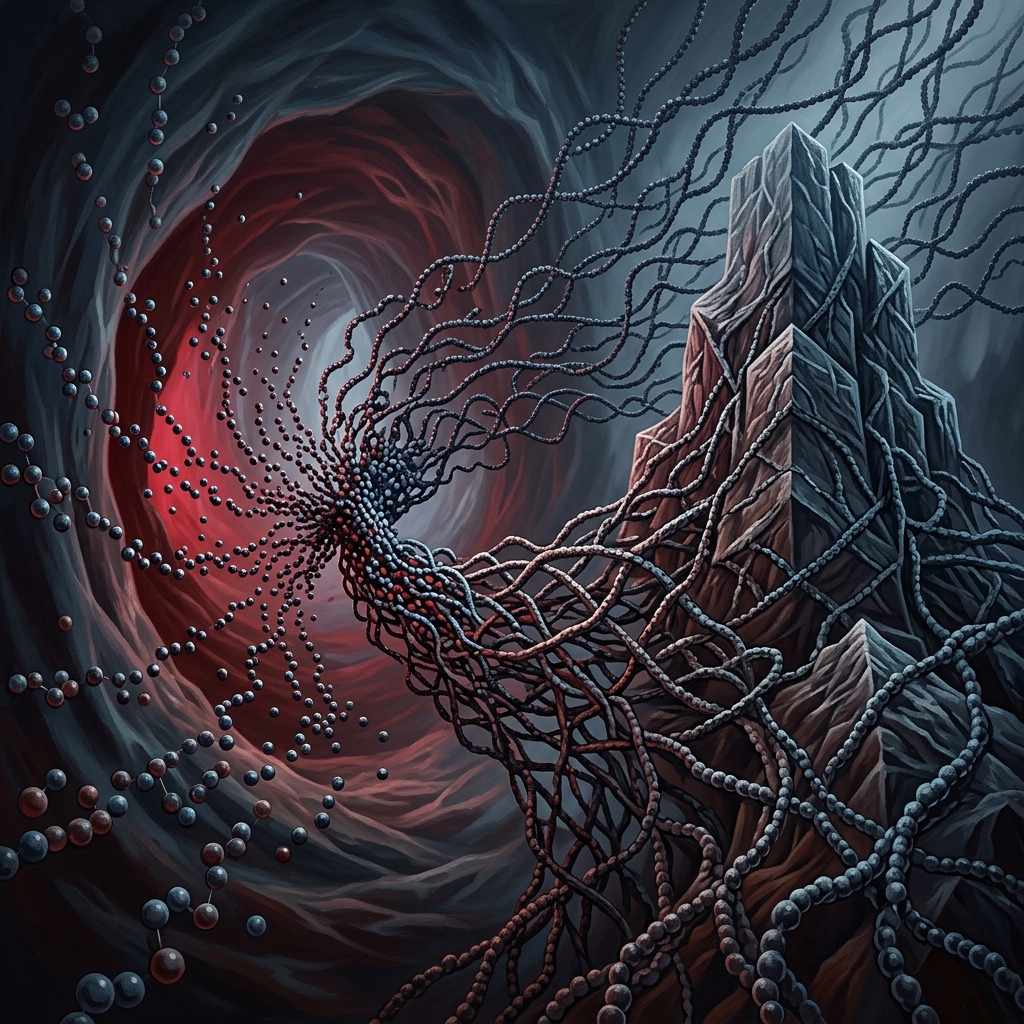
The Infinite Chain: How Tiny Molecules Link to Build Our Solid World
Look closely at a plastic bottle, a rubber band, or even your own skin. They seem completely still, solid, and simple. Yet beneath their surfaces lies a chaotic and beautiful world of giant, snake-like molecules. These are polymers. Their story is one of the great magic tricks of nature: taking tiny, identical chemical units and linking them into chains that stretch on forever.
Unlike simple substances like water or salt, polymers do not form neat, perfect crystals when they freeze. Instead, they transform into solids through a struggle of geometry. As they cool, these massive molecular chains twist, turn, and thrash. Some get hopelessly tangled like dry spaghetti, freezing into a glass-like state. Others fold neatly back and forth, packing tightly into tough, crystalline zones.
This microscopic dance dictates everything about how our world feels. It is why a rubber band stretches, why a plastic cup bends, and why Kevlar can stop a speeding bullet. By understanding how these giant chains lock together, we have learned to sculpt the physical world to our every whim.
✨
Wonder Moment
“If you scaled a single polyethylene chain from your plastic shopping bag up to the thickness of a piece of sewing thread, it would stretch for over half a mile. Your plastic bag is not a solid sheet; it is a giant, microscopic fishing net woven from these unimaginably long strings.”
Reflect
If natural biology took billions of years to evolve enzymes to break down natural polymers like wood, how long will it take for nature to evolve a way to digest our synthetic plastics?
2 sources·Established confidence·Investigated 11 Jul 2026(1 month ago)·Investigation may be outdated
Your next question, in
Visual Trail
See The Infinite Chain: How Tiny Molecules Link to Build Our Solid World
A guided visual explanation assembled from QE artwork and sourced documentary images.
01 / 05
QE visual interpretation
Frame 01
The Infinite Chain: How Tiny Molecules Link to Build Our Solid World
Polymers are giant molecular chains that tangle and pack together to transform from flowing liquids into the tough solids of our daily lives.
Image provenance and limitation
Source: AI-generated visual interpretation
Creator: Question Everything
Limitation: This image explains or evokes the subject. It is not documentary evidence and should not be used to verify a factual claim.
Evidence
What do we know?
Verified claims with confidence scoring and cited sources.
Generated without source retrieval. QE did not fetch sources for this investigation, so no citation here was checked against a retrieved set. Claims reflect the model’s training data. 1 of 3 findings carry no openable link at all.
1 of 3 findings need extra caution. Finding 2 rests on weaker sourcing than the other findings.
Living footnotes
Claims remain in the reading flow. Select a citation number to inspect the source behind it.
01
ExperimentalSupported
Polymers form through covalent polymerization, connecting small monomer units into macromolecular chains.
At the heart of every polymer is a simple chemical reaction. Small, active molecules called monomers collide and hook together. They share electrons to form incredibly strong covalent bonds. This process repeats thousands of times, creating a single molecule of immense length. It is like snapping together plastic toy bricks, but on an atomic scale.
These chains can be completely straight, or they can sprout branches like trees. The length of these chains is staggering. While a water molecule contains just three atoms, a single polymer chain can easily contain hundreds of thousands. This vast size gives them physical properties that smaller molecules can never achieve.
02
ObservationalNot confirmed
Amorphous polymers solidify through molecular entanglement and glass transition rather than neat crystallization.
When liquid water cools, its molecules quickly line up in perfect rows to form ice. Many polymers cannot do this. Their chains are too long, bulky, and awkward to arrange themselves quickly. Instead, as they lose heat, their motion slows down. The chains simply drape over one another, tangling hopelessly.
This messy state is called amorphous. As temperature drops further, the polymer crosses a vital line called the glass transition temperature. Below this point, there is not enough thermal energy for the chains to slide past each other. They lock in place, turning a soft, gummy liquid into a hard, rigid solid.
03
AcademicSupported
Semicrystalline polymers achieve rigidity by folding into highly ordered microscopic lamellae.
Some polymer chains are highly regular and symmetrical. This simplicity allows them to do something remarkable as they cool: they fold. The chains bend back and forth on themselves, creating flat, neat sheets called lamellae. These folded regions are highly ordered, acting like tiny, tough crystals inside the material.
However, because these chains are so long, a single molecule might have one end trapped in a neat fold and the other end lost in a tangled, amorphous mess. No synthetic polymer is entirely crystalline. They are always semicrystalline, combining the flexibility of the tangled zones with the strength of the folded crystals.
The complete record below preserves every citation, confidence input and recorded limitation.
Read the full evidence record3 findings · citations · limitations
Evidence review3 findings2 openable sources
01
Finding 1 of 3Experimental
1
0/1 verified
Polymers form through covalent polymerization, connecting small monomer units into macromolecular chains.
At the heart of every polymer is a simple chemical reaction. Small, active molecules called monomers collide and hook together. They share electrons to form incredibly strong covalent bonds. This process repeats thousands of times, creating a single molecule of immense length. It is like snapping together plastic toy bricks, but on an atomic scale.
These chains can be completely straight, or they can sprout branches like trees. The length of these chains is staggering. While a water molecule contains just three atoms, a single polymer chain can easily contain hundreds of thousands. This vast size gives them physical properties that smaller molecules can never achieve.
Supportedmodel score 99%
A single peer-reviewed source. No independent corroboration.
PRIMARY STUDY
›View sources and limits— 1 citation, limits
Supporting passage
At the heart of every polymer is a simple chemical reaction. Small, active molecules called monomers collide and hook together. They share electrons to form incredibly strong covalent bonds. This process repeats thousands of times, creating a single molecule of immense length. It is like snapping together plastic toy bricks, but on an atomic scale.
These chains can be completely straight, or they can sprout branches like trees. The length of these chains is staggering. While a water molecule contains just three atoms, a single polymer chain can easily contain hundreds of thousands. This vast size gives them physical properties that smaller molecules can never achieve.
Generated without source retrieval — citations here were not verified against a retrieved set.
Rests on a single source. No independent corroboration.
The generator scored this 99%, which would read as “Established”. Its citations reach only “Supported”, so that is what is shown.
02
Finding 2 of 3ObservationalNeeds caution
0/0 verified
Amorphous polymers solidify through molecular entanglement and glass transition rather than neat crystallization.
When liquid water cools, its molecules quickly line up in perfect rows to form ice. Many polymers cannot do this. Their chains are too long, bulky, and awkward to arrange themselves quickly. Instead, as they lose heat, their motion slows down. The chains simply drape over one another, tangling hopelessly.
This messy state is called amorphous. As temperature drops further, the polymer crosses a vital line called the glass transition temperature. Below this point, there is not enough thermal energy for the chains to slide past each other. They lock in place, turning a soft, gummy liquid into a hard, rigid solid.
Not confirmedmodel score 97%
Written from the model's own knowledge. No source was retrieved or checked.
UNVERIFIED — NO RETRIEVAL
›View sources and limits— limits
Supporting passage
When liquid water cools, its molecules quickly line up in perfect rows to form ice. Many polymers cannot do this. Their chains are too long, bulky, and awkward to arrange themselves quickly. Instead, as they lose heat, their motion slows down. The chains simply drape over one another, tangling hopelessly.
This messy state is called amorphous. As temperature drops further, the polymer crosses a vital line called the glass transition temperature. Below this point, there is not enough thermal energy for the chains to slide past each other. They lock in place, turning a soft, gummy liquid into a hard, rigid solid.
Citations (0 of 1 survived verification)
Nothing openable. No sources were retrieved for this investigation, so none were checked.
What limits this
This investigation was generated without source retrieval. The model named a source but gave no link, and no verification step ran against it.
The claim reflects the model's training data, not a checked citation.
The generator scored this 97%, which would read as “Established”. Its citations reach only “Unresolved”, so that is what is shown.
03
Finding 3 of 3Academic
1
0/1 verified
Semicrystalline polymers achieve rigidity by folding into highly ordered microscopic lamellae.
Some polymer chains are highly regular and symmetrical. This simplicity allows them to do something remarkable as they cool: they fold. The chains bend back and forth on themselves, creating flat, neat sheets called lamellae. These folded regions are highly ordered, acting like tiny, tough crystals inside the material.
However, because these chains are so long, a single molecule might have one end trapped in a neat fold and the other end lost in a tangled, amorphous mess. No synthetic polymer is entirely crystalline. They are always semicrystalline, combining the flexibility of the tangled zones with the strength of the folded crystals.
Supportedmodel score 98%
A single peer-reviewed source. No independent corroboration.
PRIMARY STUDY
›View sources and limits— 1 citation, limits
Supporting passage
Some polymer chains are highly regular and symmetrical. This simplicity allows them to do something remarkable as they cool: they fold. The chains bend back and forth on themselves, creating flat, neat sheets called lamellae. These folded regions are highly ordered, acting like tiny, tough crystals inside the material.
However, because these chains are so long, a single molecule might have one end trapped in a neat fold and the other end lost in a tangled, amorphous mess. No synthetic polymer is entirely crystalline. They are always semicrystalline, combining the flexibility of the tangled zones with the strength of the folded crystals.
Historical images, diagrams, and visual knowledge from Wikimedia Commons.
Perspectives
How is this interpreted?
Enter a viewpoint. Notice what it reveals, what it leaves out, and whether it changes the question for you.
The EmpiricistScientific viewpointEstablished lens
From a thermodynamic view, the solidifying of polymers is a battle between entropy and enthalpy. Monomers naturally prefer chaos and high entropy. Forcing them into long, ordered chains requires energy and specific conditions. Once formed, their massive molecular weight limits how they can move. They form solids because their sheer physical length makes cooperative movement impossible without a lot of heat. This unique state of matter blurs the line between traditional liquids and crystalline solids.
What this lens notices
01High molecular weight reduces the entropic drive to mix or flow.
02Glass transition is a kinetic slowdown, not a classic thermodynamic phase change.
03Semicrystalline states balance the energy of ordering with the chaos of entanglement.
Application
Why does this matter to you?
Personal reflections and applications for your life.
Thought experimentPractical
Why does a plastic container turn white when you bend it?
Why it changes the question
When you bend certain plastics, you are physically pulling and forcing the tangled polymer chains to align in one direction. This force causes tiny crystalline zones to slide past one another and creates micro-voids that scatter light. This scattering makes the stressed area look cloudy or white, warning you that the chains are reaching their breaking point.
Try this
Take a plastic milk jug or yogurt lid and bend it back and forth. Watch the crease turn white as the internal polymer structure deforms and reorganizes.
Media
QE Smart Glass
Curated media selected for this investigation.
QE Glass
YOUTUBE
Polymers: Crash Course Chemistry #45
CrashCourse
Did you know that Polymers save the lives of Elephants? Well, now you do! The world of Polymers is so amazingly integrated into ...
QE Glass
YOUTUBE
Magical metals, how shape memory alloys work - Ainissa Ramirez
TED-Ed
View full lesson here: http://ed.ted.com/lessons/ainissa-ramirez-magical-metals-how-shape-memory-alloys-work From robots to ...
QE Glass
YOUTUBE
How Small Is An Atom? Spoiler: Very Small.
Kurzgesagt – In a Nutshell
Atoms are very weird. Wrapping your head around exactly how weird, is close to impossible – how can you describe something ...
QE Glass
YOUTUBE
How Small Is An Atom? Spoiler: Very Small.
Kurzgesagt – In a Nutshell
Atoms are very weird. Wrapping your head around exactly how weird, is close to impossible – how can you describe something ...
QE Glass
YOUTUBE
The Surprising Science of Plastics
The Efficient Engineer
Click the link to visit Protolabs and get an instant quote today!
QE Glass
YOUTUBE
The Surprising Science of Plastics
The Efficient Engineer
Click the link to visit Protolabs and get an instant quote today!
QE Glass
YOUTUBE
GCSE Chemistry - What is a Polymer? Polymers / Monomers / Their Properties Explained (2026/27 exams)
Cognito
Check out our website https://www.cognito.org/ ⭐️ Everything you need to know about polymers! Polymers are large molecules ...
QE Glass
YOUTUBE
GCSE Chemistry - What is a Polymer? Polymers / Monomers / Their Properties Explained (2026/27 exams)
Cognito
Check out our website https://www.cognito.org/ ⭐️ Everything you need to know about polymers! Polymers are large molecules ...
QE Glass
YOUTUBE
Understanding Metals
The Efficient Engineer
The bundle with CuriosityStream is no longer available - sign up directly for Nebula with this link to get the 40% discount!
QE Glass
YOUTUBE
Understanding Metals
The Efficient Engineer
The bundle with CuriosityStream is no longer available - sign up directly for Nebula with this link to get the 40% discount!
QE Glass
YOUTUBE
Crystalline and Amorphous Solids
Najam Academy
This lecture is about crystalline and amorphous solids in chemistry class 12. Also, you will learn difference between them. To learn ...
QE Glass
YOUTUBE
The Miracle of Plastics
Veritasium
An excellent exploration of how the discovery of synthetic polymers changed our physical world and the science of how they behave.
QE Glass
YOUTUBE
Polymers: Crash Course Chemistry #45
CrashCourse
A fast, highly visual breakdown of polymer chemistry, explaining how monomers link and why their structures create different properties.
Connected context
Connected entities
The people, places, concepts, and events that matter here.
Keep Going
Where this leads
Questions this investigation opens up — and what QE has already looked into.
No AI help here — no suggestions, no autocomplete, nothing finishing your sentences. That is deliberate. Working out what you think is effortful, and the effort is the part that changes you: reasoning is trained like a muscle, and a muscle that is always carried gets weaker. Let something else do the thinking and you keep the answer but lose the capacity to have reached it.
Write your current position.
Not what the page says. What you think, having read it.0 words · Nothing written yet.
Sign in to leave a mark. Your draft is saved here in the meantime.