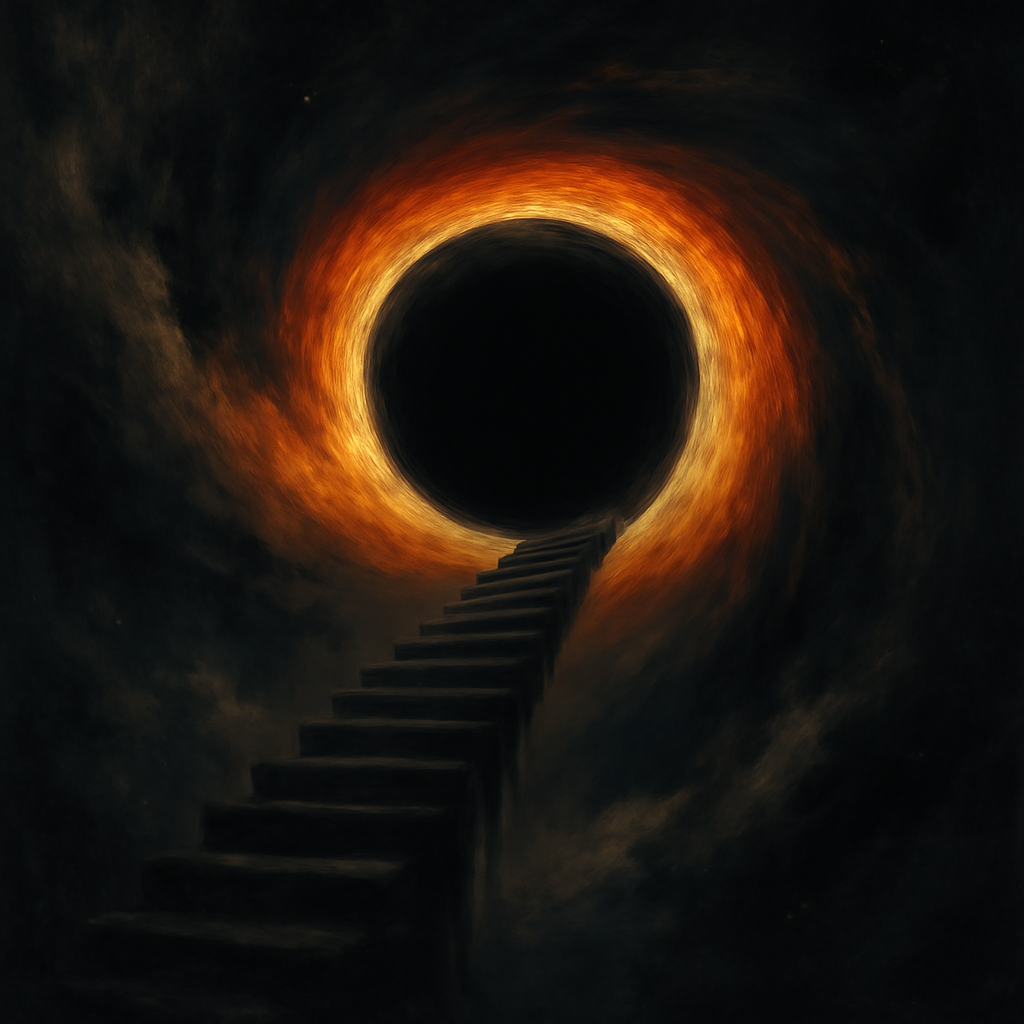
The Event Horizon: The Mysterious Boundary of Black Holes
Imagine a cosmic boundary so extreme that nothing, not even light, can escape its grasp. This boundary is known as the event horizon, the defining edge of a black hole. It is not a physical surface but an invisible frontier in space and time, marking the point of no return. Once an object crosses this threshold, it is forever lost to the outside universe, swallowed by the black hole’s immense gravity. This boundary captures the imagination because it confronts us with the limits of what we can observe and understand about the cosmos.
The event horizon is shaped by the black hole’s mass and spin, forming a spherical or sometimes distorted surface surrounding the singularity—the infinitely dense heart of the black hole. It represents the escape velocity equal to the speed of light. Because nothing can travel faster than light, nothing can escape. Modern observations, such as those by the Event Horizon Telescope, have even imaged the glowing ring of material swirling around the event horizon of supermassive black holes, providing stunning confirmation of Einstein’s theory of general relativity. The event horizon stands as both a scientific frontier and a symbol of the universe’s deepest mysteries.
“The event horizon is not a wall or a surface, but a boundary defined by light’s ultimate speed limit—cross it, and escape becomes impossible.”
Reflect
If the event horizon hides everything inside a black hole, what secrets of the universe might forever lie beyond our reach?
3 sources·Established confidence·Investigated 17 Jul 2026(1 month ago)·Source-verified·Investigation may be outdated
Your next question, in
Visual Trail
See The Event Horizon: The Mysterious Boundary of Black Holes
A guided visual explanation assembled from QE artwork and sourced documentary images.
01 / 05
QE visual interpretation
Frame 01
The Event Horizon: The Mysterious Boundary of Black Holes
The event horizon is the black hole’s point of no return, beyond which nothing, not even light, can escape.
Image provenance and limitation
Source: AI-generated visual interpretation
Creator: Question Everything
Limitation: This image explains or evokes the subject. It is not documentary evidence and should not be used to verify a factual claim.
Evidence
What do we know?
Verified claims with confidence scoring and cited sources.
1 of 4 findings need extra caution. Finding 3 rests on weaker sourcing than the other findings.
Living footnotes
Claims remain in the reading flow. Select a citation number to inspect the source behind it.
01
AcademicSupported
The event horizon is the boundary around a black hole where the escape velocity equals the speed of light.
The event horizon is not a physical surface but a mathematical boundary. At this radius, the pull of gravity is so strong that the speed needed to escape exceeds the speed of light, which nothing can surpass. This means anything crossing this threshold cannot return or send signals back, making it a one-way barrier. The size of the event horizon depends on the black hole’s mass and varies from one black hole to another. For non-rotating black holes, this boundary is spherical and defined by the Schwarzschild radius.
02
ObservationalWell supported
The Event Horizon Telescope has directly imaged the shadow of the event horizon around supermassive black holes.
In 2019, astronomers using the Event Horizon Telescope (EHT) captured the first-ever image of the dark shadow cast by the event horizon of the supermassive black hole in the galaxy M87. This shadow appears as a bright asymmetric ring of glowing plasma surrounding the dark silhouette where the event horizon blocks light. These observations confirm predictions from Einstein’s general relativity and provide direct evidence of the event horizon’s existence. Similar observations of Sagittarius A*, the black hole at the center of our Milky Way, also show a ring-like structure consistent with an event horizon.
03
AcademicNot confirmed
Inside the event horizon lies the singularity, where gravity crushes matter to infinite density.
The event horizon conceals the singularity, a point where the known laws of physics break down. Here, matter is compressed infinitely, and space-time itself curves without limit. Because the event horizon hides this singularity from view, it prevents the singularity’s extreme effects from disturbing the observable universe. This shield makes the event horizon a vital concept in black hole physics, preserving cosmic order despite the singularity’s mysterious nature.
04
AcademicSupported
The event horizon’s size depends on the black hole’s mass and spin, affecting its shape and properties.
A non-rotating black hole has a spherical event horizon defined by its Schwarzschild radius. However, rotating black holes, or Kerr black holes, have distorted, oblate event horizons due to their spin. The rotation drags spacetime around with it, altering the shape and size of the horizon and influencing nearby matter’s behavior. This spin can even affect how matter spirals into the black hole and the energy emitted from the vicinity of the event horizon.
The complete record below preserves every citation, confidence input and recorded limitation.
Read the full evidence record4 findings · citations · limitations
Evidence review4 findings4 openable sources
01
Finding 1 of 4Academic
1
0/1 verified
The event horizon is the boundary around a black hole where the escape velocity equals the speed of light.
The event horizon is not a physical surface but a mathematical boundary. At this radius, the pull of gravity is so strong that the speed needed to escape exceeds the speed of light, which nothing can surpass. This means anything crossing this threshold cannot return or send signals back, making it a one-way barrier. The size of the event horizon depends on the black hole’s mass and varies from one black hole to another. For non-rotating black holes, this boundary is spherical and defined by the Schwarzschild radius.
Supportedmodel score 98%
One source, not peer-reviewed. Thinner than the score suggests.
REFERENCE
›View sources and limits— 1 citation, limits
Supporting passage
The event horizon is not a physical surface but a mathematical boundary. At this radius, the pull of gravity is so strong that the speed needed to escape exceeds the speed of light, which nothing can surpass. This means anything crossing this threshold cannot return or send signals back, making it a one-way barrier. The size of the event horizon depends on the black hole’s mass and varies from one black hole to another. For non-rotating black holes, this boundary is spherical and defined by the Schwarzschild radius.
Rests on a single source. No independent corroboration.
No peer-reviewed source among the citations.
The generator scored this 98%, which would read as “Established”. Its citations reach only “Supported”, so that is what is shown.
02
Finding 2 of 4Observational
0/2 verified
The Event Horizon Telescope has directly imaged the shadow of the event horizon around supermassive black holes.
In 2019, astronomers using the Event Horizon Telescope (EHT) captured the first-ever image of the dark shadow cast by the event horizon of the supermassive black hole in the galaxy M87. This shadow appears as a bright asymmetric ring of glowing plasma surrounding the dark silhouette where the event horizon blocks light. These observations confirm predictions from Einstein’s general relativity and provide direct evidence of the event horizon’s existence. Similar observations of Sagittarius A*, the black hole at the center of our Milky Way, also show a ring-like structure consistent with an event horizon.
Well supportedmodel score 95%
2 sources agree, 2 peer-reviewed.
PRIMARY STUDY ×2
›View sources and limits— 2 citations, limits
Supporting passage
In 2019, astronomers using the Event Horizon Telescope (EHT) captured the first-ever image of the dark shadow cast by the event horizon of the supermassive black hole in the galaxy M87. This shadow appears as a bright asymmetric ring of glowing plasma surrounding the dark silhouette where the event horizon blocks light. These observations confirm predictions from Einstein’s general relativity and provide direct evidence of the event horizon’s existence. Similar observations of Sagittarius A*, the black hole at the center of our Milky Way, also show a ring-like structure consistent with an event horizon.
Nothing further is recorded. QE stores no methodology field, so absence here is not a clean bill of health.
03
Finding 3 of 4AcademicNeeds caution
0
0/0 verified
Inside the event horizon lies the singularity, where gravity crushes matter to infinite density.
The event horizon conceals the singularity, a point where the known laws of physics break down. Here, matter is compressed infinitely, and space-time itself curves without limit. Because the event horizon hides this singularity from view, it prevents the singularity’s extreme effects from disturbing the observable universe. This shield makes the event horizon a vital concept in black hole physics, preserving cosmic order despite the singularity’s mysterious nature.
Not confirmedmodel score 30%
Scored as if sourced, but every citation failed verification.
NO SURVIVING CITATION
›View sources and limits— limits
Supporting passage
The event horizon conceals the singularity, a point where the known laws of physics break down. Here, matter is compressed infinitely, and space-time itself curves without limit. Because the event horizon hides this singularity from view, it prevents the singularity’s extreme effects from disturbing the observable universe. This shield makes the event horizon a vital concept in black hole physics, preserving cosmic order despite the singularity’s mysterious nature.
Citations (0 of 1 survived verification)
Nothing openable. Every citation was removed by provenance validation.
What limits this
All 1 citation on this claim failed verification and were removed. Nothing openable supports it.
04
Finding 4 of 4Academic
1
0/1 verified
The event horizon’s size depends on the black hole’s mass and spin, affecting its shape and properties.
A non-rotating black hole has a spherical event horizon defined by its Schwarzschild radius. However, rotating black holes, or Kerr black holes, have distorted, oblate event horizons due to their spin. The rotation drags spacetime around with it, altering the shape and size of the horizon and influencing nearby matter’s behavior. This spin can even affect how matter spirals into the black hole and the energy emitted from the vicinity of the event horizon.
Supportedmodel score 90%
One source, not peer-reviewed. Thinner than the score suggests.
REFERENCE
›View sources and limits— 1 citation, limits
Supporting passage
A non-rotating black hole has a spherical event horizon defined by its Schwarzschild radius. However, rotating black holes, or Kerr black holes, have distorted, oblate event horizons due to their spin. The rotation drags spacetime around with it, altering the shape and size of the horizon and influencing nearby matter’s behavior. This spin can even affect how matter spirals into the black hole and the energy emitted from the vicinity of the event horizon.
Rests on a single source. No independent corroboration.
No peer-reviewed source among the citations.
The generator scored this 90%, which would read as “Established”. Its citations reach only “Supported”, so that is what is shown.
Interactive Exploration
Touch, drag, and discover
These visualizations respond to your curiosity. Interact to go deeper.
timeline
Key Milestones in Event Horizon Research
Loading timeline…
relationship map
Core Concepts Around the Event Horizon
Mapping relationships…
Drag nodes to rearrange — tap for details
statistics card
Event Horizon Sizes of Famous Black Holes
42 ± 3 microarcseconds
Diameter of M87’s Event Horizon Shadow
Measured by the Event Horizon Telescope
51.8 ± 2.3 microarcseconds
Diameter of Sagittarius A*’s Event Horizon Shadow
Measured by the Event Horizon Telescope
~12 million kilometers
Approximate Schwarzschild radius for a 10 solar mass black hole
Typical size for stellar black holes
process flow
What Happens at the Event Horizon?
Approach
Crossing the Event Horizon
No Return
Towards Singularity
Visual Gallery
Images & artifacts
Historical images, diagrams, and visual knowledge from Wikimedia Commons.
Perspectives
How is this interpreted?
Enter a viewpoint. Notice what it reveals, what it leaves out, and whether it changes the question for you.
The EmpiricistScientific viewpointLive tension
From a scientific perspective, the event horizon is a crucial feature predicted by Einstein’s general relativity. It defines the boundary where gravity’s grip becomes absolute. Observations such as those from the Event Horizon Telescope have transformed this theoretical edge into an observable phenomenon. Scientists study the event horizon to test theories about gravity, quantum mechanics, and the nature of spacetime. It is a laboratory for extreme physics, offering insights into how the universe operates under conditions impossible to recreate on Earth.
What this lens notices
01Event horizon tests general relativity in the strongest gravity regime.
02Direct imaging provides empirical evidence of black holes.
03Understanding event horizons helps unify gravity and quantum theory.
Application
Why does this matter to you?
Personal reflections and applications for your life.
Thought experimentSelf-Reflection
How do limits of observation, like the event horizon, shape your understanding of reality?
Why it changes the question
The event horizon reminds us that some boundaries in the universe limit what can be known or seen. Reflecting on this can help us appreciate the mysteries still beyond our grasp and encourage humility in the face of the unknown.
Try this
Try contemplating an area in your life or knowledge where you feel uncertain or limited, and write down what embracing that uncertainty teaches you.
Media
QE Smart Glass
Curated media selected for this investigation.
QE Glass
YOUTUBE
Black Hole Apocalypse: What's Inside a Black Hole? | Full Documentary | NOVA | PBS
NOVA PBS Official
Take a mind-blowing voyage to the most powerful and mysterious objects in the universe. (Aired January 10, 2018) Official ...
QE Glass
YOUTUBE
Black Holes 101 | National Geographic
National Geographic
At the center of our galaxy, a supermassive black hole churns. Learn about the types of black holes, how they form, and how ...
QE Glass
YOUTUBE
Black Holes Explained – From Birth to Death
Kurzgesagt – In a Nutshell
Black holes. Lets talk about them. OUR CHANNELS ·························· German Channel: ...
QE Glass
YOUTUBE
Black Holes Explained – From Birth to Death
Kurzgesagt – In a Nutshell
Black holes. Lets talk about them. OUR CHANNELS ·························· German Channel: ...
QE Glass
YOUTUBE
Black Hole's Evil Twin - Gravastars Explained
Kurzgesagt – In a Nutshell
Go to https://brilliant.org/nutshell/ to dive deeper into these topics and more with a free 30-day trial + 20% off the premium ...
QE Glass
YOUTUBE
Is It IMPOSSIBLE To Cross The Event Horizon? | Black Hole Firewall Paradox
PBS Space Time
Check out the Space Time Merch Store https://www.pbsspacetime.com/shop Sign Up on Patreon to get access to the Space Time ...
QE Glass
YOUTUBE
Black Holes. Explained. For 1.5 Hours.
PBS Space Time
Black holes are not just the strangest objects in the universe, they're the sharpest test we have of how reality actually works.
QE Glass
YOUTUBE
Is It IMPOSSIBLE To Cross The Event Horizon? | Black Hole Firewall Paradox
PBS Space Time
Check out the Space Time Merch Store https://www.pbsspacetime.com/shop Sign Up on Patreon to get access to the Space Time ...
QE Glass
YOUTUBE
What is the Event Horizon? - Kurzgesagt
Kurzgesagt – In a Nutshell
A clear and beautifully animated explanation of what the event horizon is and why it matters.
QE Glass
YOUTUBE
The Event Horizon of a Black Hole - PBS Space Time
PBS Space Time
A deep dive into the physics of event horizons and black holes with engaging visuals.
QE Glass
PODCAST
Radiolab: Black Hole Science
Radiolab
A storytelling podcast episode exploring black holes and their event horizons with real science and human stories.
Connected context
Connected entities
The people, places, concepts, and events that matter here.
Keep Going
Where this leads
Questions this investigation opens up — and what QE has already looked into.
No AI help here — no suggestions, no autocomplete, nothing finishing your sentences. That is deliberate. Working out what you think is effortful, and the effort is the part that changes you: reasoning is trained like a muscle, and a muscle that is always carried gets weaker. Let something else do the thinking and you keep the answer but lose the capacity to have reached it.
Write your current position.
Not what the page says. What you think, having read it.0 words · Nothing written yet.
Sign in to leave a mark. Your draft is saved here in the meantime.