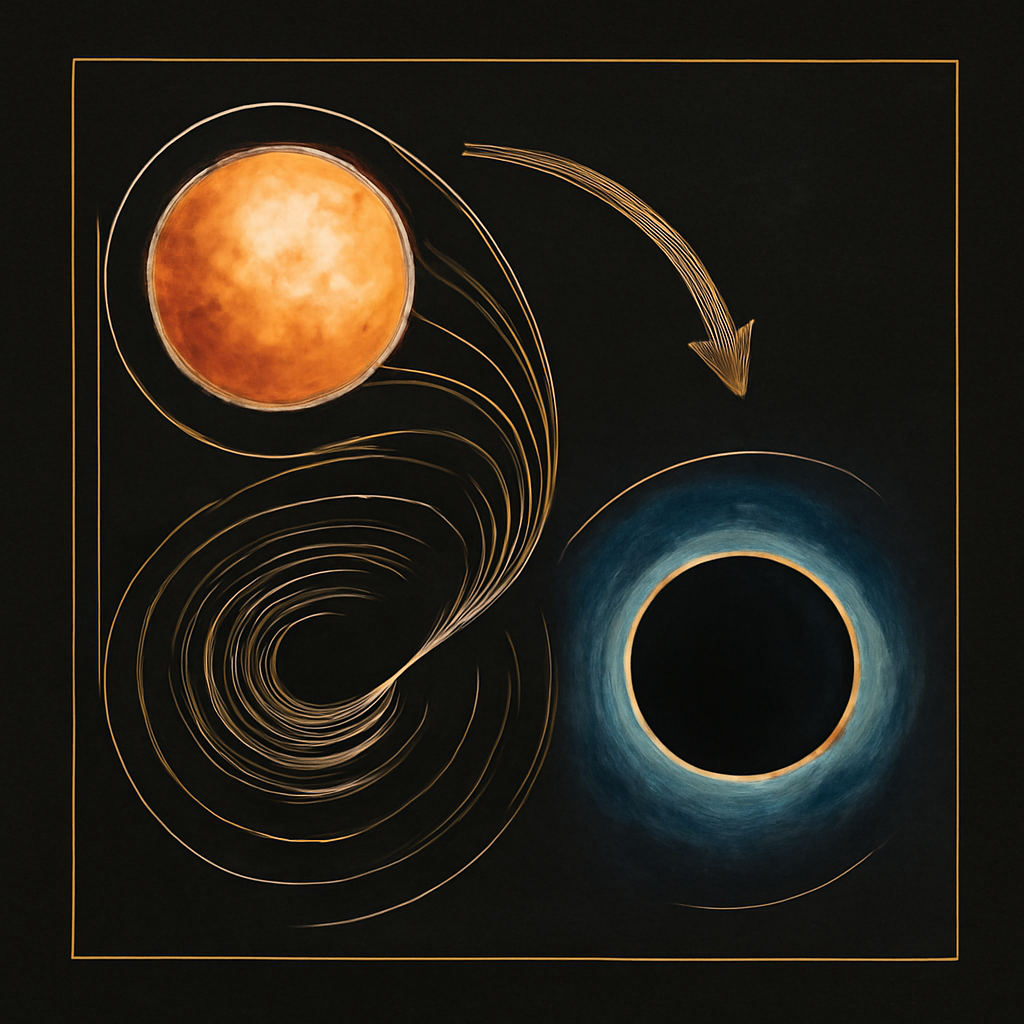
Think of a star as a giant tug-of-war. On one side, the star's immense gravity is trying to crush everything inward. On the other side, the star's nuclear engine is pushing outward with incredible heat. For millions of years, this struggle is a perfect tie. But eventually, the star runs out of fuel. The outward push stops. In a fraction of a second, gravity wins. The outer layers crash inward at a quarter of the speed of light.
This violent collapse squeezes the star's core into an impossibly small space. If the star is big enough—at least twenty times heavier than our sun—nothing can stop the squeeze. Not even atoms can hold their shape. The core collapses down to a single point of infinite density. It becomes a black hole, a place where gravity is so strong that not even light can escape.
“A star 25 times heavier than our Sun can collapse into a black hole in less than half a second—faster than the blink of a human eye.”
Reflect
If space and time warp completely inside a black hole, is the star's matter actually crushed to nothing, or has it passed into a different realm of physics we cannot yet see?
Research·2 sources·Established confidence·Investigated 1 Aug 2026(1 month ago)·Grounded; verification trace not recorded·Investigation may be outdated
Your next question, in
Visual Trail
See How a Star Collapses into a Black Hole
A guided visual explanation assembled from QE artwork and sourced documentary images.
01 / 05
QE visual interpretation
Frame 01
How a Star Collapses into a Black Hole
When a giant star runs out of fuel, its own gravity crushes it instantly into an invisible point of infinite pull: a black hole.
Image provenance and limitation
Source: AI-generated visual interpretation
Creator: Question Everything
Limitation: This image explains or evokes the subject. It is not documentary evidence and should not be used to verify a factual claim.
Evidence
What do we know?
Verified claims with confidence scoring and cited sources.
1 of 3 findings need extra caution. Finding 1 rests on weaker sourcing than the other findings.
Living footnotes
Claims remain in the reading flow. Select a citation number to inspect the source behind it.
01
ObservationalNot confirmed
Extremely heavy stars collapse directly into black holes when their fuel runs out because they cannot fight their own gravity.
Stars are in a constant tug-of-war. The heat from nuclear fusion pushes outward, while gravity pulls inward. When a giant star—one that is at least 25 times heavier than our Sun—runs out of fuel, the outward push stops. Gravity wins instantly. With nothing left to hold it up, the star's core crushes down under its own massive weight, collapsing completely into a black hole in less than a second.
02
ObservationalSupported
Some massive stars can fade away and collapse into a black hole quietly without exploding as a supernova.
We used to think all giant stars ended with a massive explosion called a supernova. But astronomers recently watched a star 25 times more massive than our Sun simply vanish. It flared up briefly and then disappeared. Instead of exploding, the star's core collapsed directly into a black hole, leaving only a faint red glow of dust. It literally went out with a whimper instead of a big bang.
03
ExperimentalSupported
If a dying star is spinning very fast, its core can split during collapse to form two black holes that quickly merge into one.
When a giant, rapidly spinning star collapses, it does not always stay perfectly round. Supercomputer simulations show that the spinning motion can warp the star's core into a ring shape. This ring can break apart into two dense clumps. Each clump collapses to form its own black hole. These two baby black holes then spiral around each other and quickly merge into a single, larger black hole, sending out massive gravitational waves.
The complete record below preserves every citation, confidence input and recorded limitation.
Read the full evidence record3 findings · citations · limitations
Evidence review3 findings2 openable sources
01
Finding 1 of 3ObservationalNeeds caution
0/0 verified
Extremely heavy stars collapse directly into black holes when their fuel runs out because they cannot fight their own gravity.
Stars are in a constant tug-of-war. The heat from nuclear fusion pushes outward, while gravity pulls inward. When a giant star—one that is at least 25 times heavier than our Sun—runs out of fuel, the outward push stops. Gravity wins instantly. With nothing left to hold it up, the star's core crushes down under its own massive weight, collapsing completely into a black hole in less than a second.
Not confirmedmodel score 30%
Scored as if sourced, but every citation failed verification.
NO SURVIVING CITATION
›View sources and limits— limits
Supporting passage
Stars are in a constant tug-of-war. The heat from nuclear fusion pushes outward, while gravity pulls inward. When a giant star—one that is at least 25 times heavier than our Sun—runs out of fuel, the outward push stops. Gravity wins instantly. With nothing left to hold it up, the star's core crushes down under its own massive weight, collapsing completely into a black hole in less than a second.
Citations (0 of 1 survived verification)
Nothing openable. Every citation was removed by provenance validation.
What limits this
All 1 citation on this claim failed verification and were removed. Nothing openable supports it.
02
Finding 2 of 3Observational
0/1 verified
Some massive stars can fade away and collapse into a black hole quietly without exploding as a supernova.
We used to think all giant stars ended with a massive explosion called a supernova. But astronomers recently watched a star 25 times more massive than our Sun simply vanish. It flared up briefly and then disappeared. Instead of exploding, the star's core collapsed directly into a black hole, leaving only a faint red glow of dust. It literally went out with a whimper instead of a big bang.
Supportedmodel score 90%
One source, not peer-reviewed. Thinner than the score suggests.
REFERENCE
›View sources and limits— 1 citation, limits
Supporting passage
We used to think all giant stars ended with a massive explosion called a supernova. But astronomers recently watched a star 25 times more massive than our Sun simply vanish. It flared up briefly and then disappeared. Instead of exploding, the star's core collapsed directly into a black hole, leaving only a faint red glow of dust. It literally went out with a whimper instead of a big bang.
Rests on a single source. No independent corroboration.
No peer-reviewed source among the citations.
The generator scored this 90%, which would read as “Established”. Its citations reach only “Supported”, so that is what is shown.
03
Finding 3 of 3Experimental
1
0/1 verified
If a dying star is spinning very fast, its core can split during collapse to form two black holes that quickly merge into one.
When a giant, rapidly spinning star collapses, it does not always stay perfectly round. Supercomputer simulations show that the spinning motion can warp the star's core into a ring shape. This ring can break apart into two dense clumps. Each clump collapses to form its own black hole. These two baby black holes then spiral around each other and quickly merge into a single, larger black hole, sending out massive gravitational waves.
Supportedmodel score 85%
One source, not peer-reviewed. Thinner than the score suggests.
REFERENCE
›View sources and limits— 1 citation, limits
Supporting passage
When a giant, rapidly spinning star collapses, it does not always stay perfectly round. Supercomputer simulations show that the spinning motion can warp the star's core into a ring shape. This ring can break apart into two dense clumps. Each clump collapses to form its own black hole. These two baby black holes then spiral around each other and quickly merge into a single, larger black hole, sending out massive gravitational waves.
Rests on a single source. No independent corroboration.
No peer-reviewed source among the citations.
The generator scored this 85%, which would read as “Established”. Its citations reach only “Supported”, so that is what is shown.
Interactive Exploration
Touch, drag, and discover
These visualizations respond to your curiosity. Interact to go deeper.
process flow
The Path to Direct Collapse
Fuel Depletion
Pressure Loss
Inward Fall
Event Horizon Forms
comparison table
Stellar Death Options by Mass
Death Method
Final Remnant
Low Mass (Under 8 Suns)
Gently sheds outer layers
White Dwarf
Medium-High Mass (8 to 25 Suns)
Supernova explosion
Neutron Star
Extreme Mass (Over 25 Suns)
Direct collapse or failed supernova
Black Hole
Tap any row to highlight and compare
Visual Gallery
Images & artifacts
Historical images, diagrams, and visual knowledge from Wikimedia Commons.
Perspectives
How is this interpreted?
Enter a viewpoint. Notice what it reveals, what it leaves out, and whether it changes the question for you.
The EmpiricistScientific viewpointEstablished lens
To scientists, stellar collapse is a masterclass in gravity's absolute power. When a star's nuclear engine stops, there is nothing left to balance the inward pull. If the dying core is heavy enough, it crushes past the limits of normal matter, past even the dense packing of neutron stars. Gravity becomes so intense that it warps space and time into a point of no return, proving Einstein's wildest theories.
What this lens notices
01Gravity is a fundamental force that always wins if mass is concentrated enough
02The collapse overcomes electron and neutron degeneracy pressures
03General relativity accurately predicts the formation of an event horizon
Application
Why does this matter to you?
Personal reflections and applications for your life.
Thought experimentSelf-Reflection
How do you handle the times when your own inner pressure runs out?
Why it changes the question
Just like a star needs outward pressure to balance gravity, we need internal motivation to balance life's heavy demands. Recognizing when you are feeling crushed helps you seek the support you need to rebuild.
Try this
Write down three 'outward forces' in your life—like hobbies, friends, or rest—that help you balance the daily 'gravity' of stress.
Media
QE Smart Glass
Curated media selected for this investigation.
QE Glass
YOUTUBE
Black Holes Explained – From Birth to Death
Kurzgesagt – In a Nutshell
Black holes. Lets talk about them. OUR CHANNELS ·························· German Channel: ...
QE Glass
YOUTUBE
Black Hole Star – The Star That Shouldn't Exist
Kurzgesagt – In a Nutshell
https://kgs.link/shop-172 You want to learn more about science? Check out our sciency products on the kurzgesagt shop – all ...
QE Glass
YOUTUBE
Black Holes 101 | National Geographic
National Geographic
At the center of our galaxy, a supermassive black hole churns. Learn about the types of black holes, how they form, and how ...
QE Glass
YOUTUBE
Black Hole's Evil Twin - Gravastars Explained
Kurzgesagt – In a Nutshell
Go to https://brilliant.org/nutshell/ to dive deeper into these topics and more with a free 30-day trial + 20% off the premium ...
QE Glass
YOUTUBE
How do stars die? (Black holes, neutron stars, red giants, supernovae)
ScienceWorld
How do stars die? What is a supernova? How is a neutron star or a black hole born? How will our sun die? All details and ...
QE Glass
YOUTUBE
Visualizing the formation of a black hole
ScienceClic English
What would we see when a star collapses? How does a black hole appear? How is the event horizon formed? All these answers ...
QE Glass
PODCAST
Black Holes
Radiolab
A beautifully produced episode that explains the mind-bending reality of black holes in simple, everyday language.
Keep Going
Where this leads
Questions this investigation opens up — and what QE has already looked into.
No AI help here — no suggestions, no autocomplete, nothing finishing your sentences. That is deliberate. Working out what you think is effortful, and the effort is the part that changes you: reasoning is trained like a muscle, and a muscle that is always carried gets weaker. Let something else do the thinking and you keep the answer but lose the capacity to have reached it.
Write your current position.
Not what the page says. What you think, having read it.0 words · Nothing written yet.
Sign in to leave a mark. Your draft is saved here in the meantime.