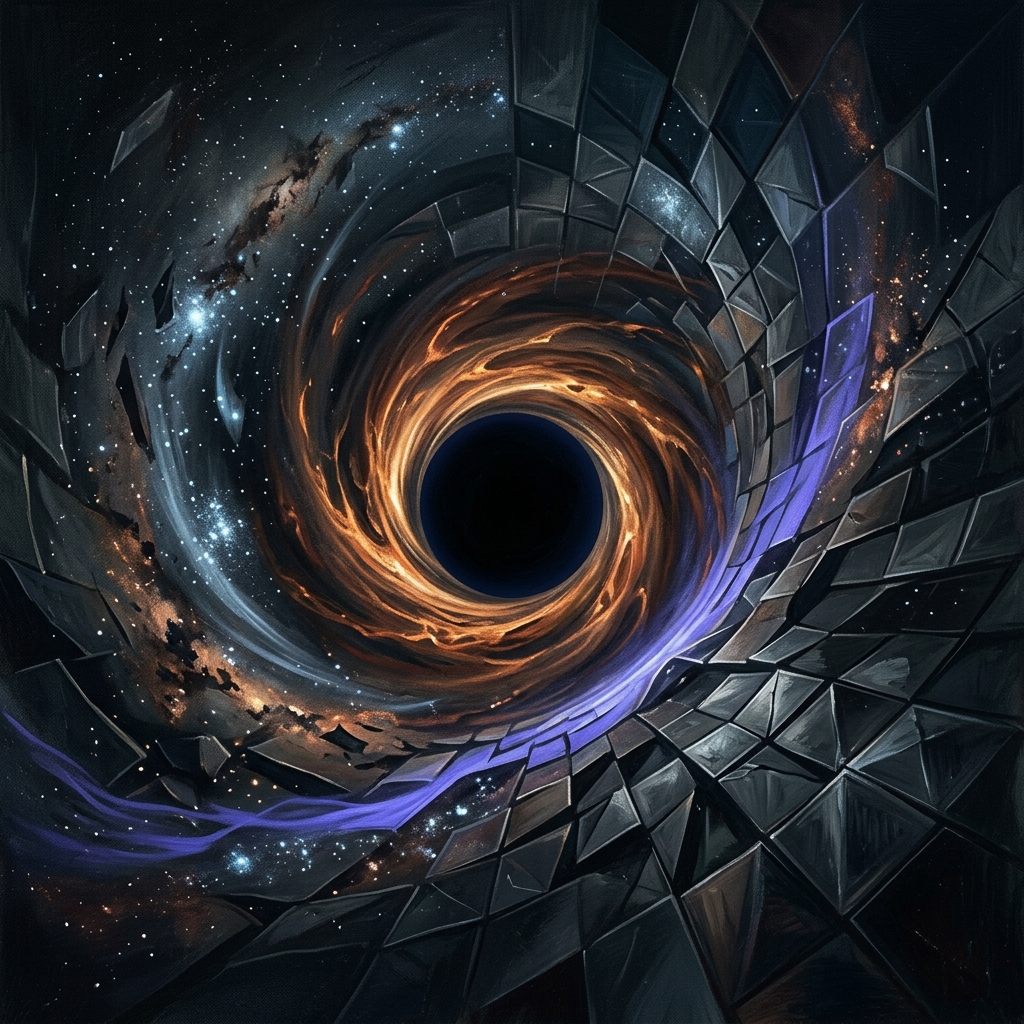
Look up at the night sky. It seems peaceful. Yet, scattered across the dark, there are invisible traps. These are places where nature has concentrated matter so tightly that the rules of the universe begin to break down. We call them black holes. They are not empty voids, but rather the most crowded spaces in existence. Gravity here is absolute. It is so powerful that nothing, not even light, can escape once it crosses the threshold.
For decades, these monsters existed only as wild equations on paper. Now, we know they are real. They lurk at the hearts of galaxies, steering the motion of billions of stars. They shape the cosmos. To study them is to look directly at the limits of human understanding, where space and time twist into shapes we can barely comprehend.
They are the ultimate graveyard of stars, but also the engines of cosmic evolution. By observing the ripples they send through space, we are beginning to unlock the deepest secrets of our universe. It is a journey to the very edge of reality.
“The energy released by the first detected black hole merger was so intense that, for a fraction of a second, it shone brighter than all the stars in the observable universe combined.”
Reflect
If you fell into a black hole, an observer outside would see you freeze at the edge forever, fading slowly into red light. Yet, in your own reality, you would plunge straight through to the end of time. Which story is the real one?
Research·5 sources·Well-Established confidence·Investigated 22 Jul 2026(1 month ago)·Grounded; verification trace not recorded·Investigation may be outdated
Your next question, in
Visual Trail
See Shadows in the Cosmos: The Reality of Black Holes
A guided visual explanation assembled from QE artwork and sourced documentary images.
01 / 05
QE visual interpretation
Frame 01
Shadows in the Cosmos: The Reality of Black Holes
Black holes are regions of space where gravity is so strong that nothing, not even light, can escape.
Image provenance and limitation
Source: AI-generated visual interpretation
Creator: Question Everything
Limitation: This image explains or evokes the subject. It is not documentary evidence and should not be used to verify a factual claim.
Evidence
What do we know?
Verified claims with confidence scoring and cited sources.
Living footnotes
Claims remain in the reading flow. Select a citation number to inspect the source behind it.
01
ObservationalSupported
Black holes form when massive stars collapse under their own gravity at the end of their life cycles.
When a giant star runs out of fuel, the outward pressure of nuclear fusion stops. Gravity wins. The star's core collapses inward, packing immense mass into a tiny volume. This collapse triggers a supernova explosion, leaving behind a dense stellar corpse.
If the remaining core is heavy enough, no known force can stop the collapse. It shrinks down past its own event horizon, creating a stellar-mass black hole.
02
ExperimentalSupported
Gravitational waves from merging black holes were directly detected in 2015.
For a century, ripples in the fabric of spacetime were just a theory. Then, the LIGO detectors felt a tiny tremor. Two black holes, millions of light-years away, spiraled into each other and merged.
The collision shook the very fabric of the cosmos. It converted three times the mass of our Sun directly into pure gravitational energy, sending out waves we could finally measure on Earth.
03
ObservationalSupported
The mass of a supermassive black hole correlates closely with the velocity dispersion of its host galaxy's bulge.
These giant black holes do not live in isolation. They grow in tandem with the galaxies that house them. By measuring how fast stars move in the central bulge of a galaxy, astronomers found a tight link to the mass of the central black hole.
This correlation suggests that black holes and their host galaxies shape each other's growth over billions of years.
04
AcademicSupported
A black hole's entropy is proportional to the surface area of its event horizon.
Physicist Jacob Bekenstein proposed that black holes have entropy, which measures the hidden information inside them. Instead of being proportional to the volume, this entropy scale depends on the area of the horizon.
This connection bridged the gap between gravity and thermodynamics, changing how we view space and information.
The complete record below preserves every citation, confidence input and recorded limitation.
Read the full evidence record4 findings · citations · limitations
Evidence review4 findings5 openable sources
01
Finding 1 of 4Observational
0/2 verified
Black holes form when massive stars collapse under their own gravity at the end of their life cycles.
When a giant star runs out of fuel, the outward pressure of nuclear fusion stops. Gravity wins. The star's core collapses inward, packing immense mass into a tiny volume. This collapse triggers a supernova explosion, leaving behind a dense stellar corpse.
If the remaining core is heavy enough, no known force can stop the collapse. It shrinks down past its own event horizon, creating a stellar-mass black hole.
Supportedmodel score 98%
2 sources agree, none peer-reviewed.
REFERENCE ×2
›View sources and limits— 2 citations, limits
Supporting passage
When a giant star runs out of fuel, the outward pressure of nuclear fusion stops. Gravity wins. The star's core collapses inward, packing immense mass into a tiny volume. This collapse triggers a supernova explosion, leaving behind a dense stellar corpse.
If the remaining core is heavy enough, no known force can stop the collapse. It shrinks down past its own event horizon, creating a stellar-mass black hole.
REFERENCEBlack Holes, Center for Astrophysics | Harvard & Smithsonian (2024)
What limits this
No peer-reviewed source among the citations.
The generator scored this 98%, which would read as “Established”. Its citations reach only “Supported”, so that is what is shown.
02
Finding 2 of 4Experimental
1
0/1 verified
Gravitational waves from merging black holes were directly detected in 2015.
For a century, ripples in the fabric of spacetime were just a theory. Then, the LIGO detectors felt a tiny tremor. Two black holes, millions of light-years away, spiraled into each other and merged.
The collision shook the very fabric of the cosmos. It converted three times the mass of our Sun directly into pure gravitational energy, sending out waves we could finally measure on Earth.
Supportedmodel score 100%
A single peer-reviewed source. No independent corroboration.
PRIMARY STUDY
›View sources and limits— 1 citation, limits
Supporting passage
For a century, ripples in the fabric of spacetime were just a theory. Then, the LIGO detectors felt a tiny tremor. Two black holes, millions of light-years away, spiraled into each other and merged.
The collision shook the very fabric of the cosmos. It converted three times the mass of our Sun directly into pure gravitational energy, sending out waves we could finally measure on Earth.
Rests on a single source. No independent corroboration.
The generator scored this 100%, which would read as “Established”. Its citations reach only “Supported”, so that is what is shown.
03
Finding 3 of 4Observational
0/1 verified
The mass of a supermassive black hole correlates closely with the velocity dispersion of its host galaxy's bulge.
These giant black holes do not live in isolation. They grow in tandem with the galaxies that house them. By measuring how fast stars move in the central bulge of a galaxy, astronomers found a tight link to the mass of the central black hole.
This correlation suggests that black holes and their host galaxies shape each other's growth over billions of years.
Supportedmodel score 95%
One source, not peer-reviewed. Thinner than the score suggests.
REPORTING
›View sources and limits— 1 citation, limits
Supporting passage
These giant black holes do not live in isolation. They grow in tandem with the galaxies that house them. By measuring how fast stars move in the central bulge of a galaxy, astronomers found a tight link to the mass of the central black hole.
This correlation suggests that black holes and their host galaxies shape each other's growth over billions of years.
Rests on a single source. No independent corroboration.
No peer-reviewed source among the citations.
The generator scored this 95%, which would read as “Established”. Its citations reach only “Supported”, so that is what is shown.
04
Finding 4 of 4Academic
1
0/1 verified
A black hole's entropy is proportional to the surface area of its event horizon.
Physicist Jacob Bekenstein proposed that black holes have entropy, which measures the hidden information inside them. Instead of being proportional to the volume, this entropy scale depends on the area of the horizon.
This connection bridged the gap between gravity and thermodynamics, changing how we view space and information.
Supportedmodel score 92%
A single peer-reviewed source. No independent corroboration.
PRIMARY STUDY
›View sources and limits— 1 citation, limits
Supporting passage
Physicist Jacob Bekenstein proposed that black holes have entropy, which measures the hidden information inside them. Instead of being proportional to the volume, this entropy scale depends on the area of the horizon.
This connection bridged the gap between gravity and thermodynamics, changing how we view space and information.
Rests on a single source. No independent corroboration.
The generator scored this 92%, which would read as “Established”. Its citations reach only “Supported”, so that is what is shown.
Interactive Exploration
Touch, drag, and discover
These visualizations respond to your curiosity. Interact to go deeper.
timeline
The Journey of Black Hole Discovery
Loading timeline…
process flow
The Death of a Giant: Stellar Collapse
Fuel Exhaustion
Gravity Wins
Supernova Explosion
The Singularity
statistics card
Scale of the Giants
4 million
Milky Way's Central Monster (Sagittarius A*)
The mass of our central black hole compared to our Sun.
3 solar masses
Energy Radiated in Waves
The mass converted entirely into gravitational energy during the 2015 merger.
20x
Stellar Mass Threshold
The minimum mass a star needs at birth, relative to our Sun, to potentially form a black hole.
comparison table
Types of Cosmic Abysses
Stellar-Mass Black Holes
Supermassive Black Holes
Origin
Death of a single massive star
Mergers and gas collapse in early galaxies
Mass Range
Roughly 3 to 100 times the Sun's mass
Hundreds of thousands to billions of Suns
Location
Scattered throughout galactic disks
Anchored at the very center of galaxies
Tap any row to highlight and compare
Visual Gallery
Images & artifacts
Historical images, diagrams, and visual knowledge from Wikimedia Commons.
Perspectives
How is this interpreted?
Enter a viewpoint. Notice what it reveals, what it leaves out, and whether it changes the question for you.
The EmpiricistScientific viewpointEstablished lens
To astrophysicists, black holes are the ultimate laboratories of gravity. They are active physical engines. They power quasars, shred stars, and steer the evolution of entire galaxies. By studying their accretion disks and gravitational waves, physics can test the absolute limits of Einstein's general relativity in extreme environments.
What this lens notices
01They allow us to test gravity in the strongest fields possible.
02They provide a way to study how matter behaves under extreme density.
03They help explain the energetic outputs of distant active galaxies.
Application
Why does this matter to you?
Personal reflections and applications for your life.
Thought experimentPhilosophical
How do you deal with the boundaries of your own knowledge?
Why it changes the question
Just as the universe has event horizons beyond which we cannot see, our lives are full of boundaries. We cannot know the future, nor can we truly know the minds of others. Embracing these limits, rather than fearing them, is a step toward wisdom.
Try this
List three things in your life that you cannot control or fully know, and practice letting go of the need to solve them.
Media
QE Smart Glass
Curated media selected for this investigation.
QE Glass
YOUTUBE
Black Holes 101 | National Geographic
National Geographic
At the center of our galaxy, a supermassive black hole churns. Learn about the types of black holes, how they form, and how ...
QE Glass
YOUTUBE
The Surprising Evidence our Universe is INSIDE a Black Hole
Math and Science
What if everything we know — every galaxy, every star, every atom — is actually inside a black hole? In this video, we explore the ...
QE Glass
YOUTUBE
Monster BLACK HOLE | Full Documentary
space and science
Black Holes are components of the our Galaxy. But what is a Black Hole and how Monster Black holes are formed? Scientist ...
QE Glass
YOUTUBE
Is Our Universe Inside a Black Hole?
StarTalk
Is our universe inside a black hole? Neil deGrasse Tyson breaks down intriguing new evidence along with other curious parallels ...
QE Glass
YOUTUBE
The Most Relaxing Facts About Black Holes to Fall Asleep To — No Adverts
Sleepy Science Channel
Support the channel → https://buymeacoffee.com/sleepysciencechannel Fall asleep while learning 100 fascinating facts about ...
QE Glass
YOUTUBE
Supermassive Black Holes | How the Universe Works
Science Channel
New discoveries reveal that black holes come in all sizes, from the very microscopic to the ultra-massive. Stream Full Episodes of ...
QE Glass
YOUTUBE
Making Black Holes is HARDER than you think!
The Science Asylum
Black holes aren't just a product of general relativity, but also require quantum mechanics. In this video, we'll take a look at how ...
QE Glass
YOUTUBE
Black Holes Explained – From Birth to Death
Kurzgesagt – In a Nutshell
Black holes. Lets talk about them. OUR CHANNELS ·························· German Channel: ...
Connected context
Connected entities
The people, places, concepts, and events that matter here.
Keep Going
Where this leads
Questions this investigation opens up — and what QE has already looked into.
No AI help here — no suggestions, no autocomplete, nothing finishing your sentences. That is deliberate. Working out what you think is effortful, and the effort is the part that changes you: reasoning is trained like a muscle, and a muscle that is always carried gets weaker. Let something else do the thinking and you keep the answer but lose the capacity to have reached it.
Write your current position.
Not what the page says. What you think, having read it.0 words · Nothing written yet.
Sign in to leave a mark. Your draft is saved here in the meantime.