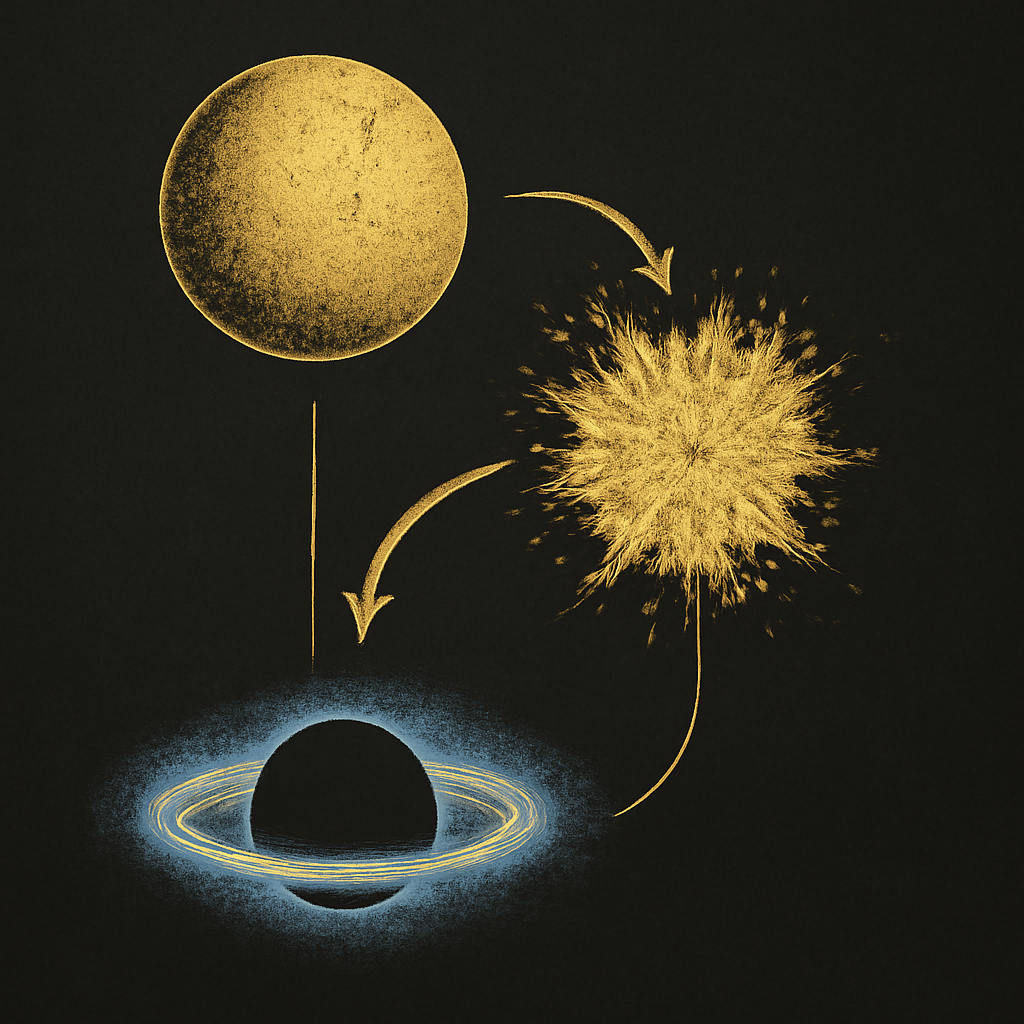
How Do Black Holes Form? The Cosmic Tale of Star Death and Gravity
Black holes are some of the strangest and most powerful objects in the universe. But how do they come to be? Most black holes form when massive stars run out of fuel and collapse under their own weight. Imagine a star many times bigger than our Sun. When it uses up all its fuel, it can no longer hold itself up, and gravity makes it fall inward until it becomes a tiny, super-dense point called a singularity. This point’s gravity is so strong that nothing, not even light, can escape it, creating what we call a black hole.
But not all black holes are born from stars. Some form from huge clouds of gas that collapse directly, skipping the star stage. These tend to be much bigger and may have helped create the supermassive black holes in the centers of galaxies. Black holes can also grow bigger by gobbling up stars, gas, and even other black holes. Scientists are still piecing together exactly how all these processes work, but we know black holes play a big role in shaping galaxies and the universe itself.
“Black holes form when massive stars collapse into a point so dense that their gravity traps everything, even light, creating a cosmic one-way door.”
Reflect
If we can’t see inside a black hole, what secrets about space and time might be hidden beyond the event horizon?
Research·3 sources·Established confidence·Investigated 19 Jul 2026(2 months ago)·Grounded; verification trace not recorded·Investigation may be outdated
Your next question, in
Visual Trail
See How Do Black Holes Form? The Cosmic Tale of Star Death and Gravity
A guided visual explanation assembled from QE artwork and sourced documentary images.
01 / 05
QE visual interpretation
Frame 01
How Do Black Holes Form? The Cosmic Tale of Star Death and Gravity
Black holes form when massive stars collapse or huge gas clouds directly implode, creating ultra-dense objects with gravity so strong that nothing can escape.
Image provenance and limitation
Source: AI-generated visual interpretation
Creator: Question Everything
Limitation: This image explains or evokes the subject. It is not documentary evidence and should not be used to verify a factual claim.
Evidence
What do we know?
Verified claims with confidence scoring and cited sources.
1 of 4 findings need extra caution. Finding 4 rests on weaker sourcing than the other findings.
Living footnotes
Claims remain in the reading flow. Select a citation number to inspect the source behind it.
01
AcademicSupported
Most black holes form when massive stars run out of fuel and collapse under their own gravity.
When stars much bigger than our Sun use up all their hydrogen fuel, they can no longer hold up against gravity. This causes their cores to collapse in a violent process. Sometimes this collapse triggers a huge explosion called a supernova, blowing away outer layers but leaving behind a very dense core. If this core is heavy enough, it keeps collapsing until it becomes a black hole, a point with gravity so strong that not even light can escape.
02
AcademicSupported
Some black holes form from the direct collapse of huge gas clouds without forming a star first.
In the early universe, big clouds of gas could collapse straight into black holes without ever becoming stars. These black holes are much bigger and are thought to be the seeds for the supermassive black holes we see at the centers of galaxies. This process is still theoretical because it would have happened very far away and long ago, so it’s hard to observe directly.
03
AcademicSupported
Black holes can grow larger by absorbing nearby stars, gas, and even merging with other black holes.
After a black hole forms, it doesn’t just stay the same size. It can pull in material from its surroundings — like gas clouds, dust, or even stars. Sometimes black holes collide and merge, creating even bigger black holes. This process helps explain how supermassive black holes, millions or billions of times bigger than our Sun, can form over time in galaxy centers.
04
ObservationalNot confirmed
The event horizon is the boundary around a black hole beyond which nothing can escape.
A black hole’s gravity is so strong that it creates a point of no return — the event horizon. If anything crosses this boundary, whether it’s light, gas, or a spaceship, it can’t get back out. That’s why black holes seem invisible and why they are called 'black.' The event horizon marks the edge of the black hole’s influence.
The complete record below preserves every citation, confidence input and recorded limitation.
Read the full evidence record4 findings · citations · limitations
Evidence review4 findings4 openable sources
01
Finding 1 of 4Academic
2
0/2 verified
Most black holes form when massive stars run out of fuel and collapse under their own gravity.
When stars much bigger than our Sun use up all their hydrogen fuel, they can no longer hold up against gravity. This causes their cores to collapse in a violent process. Sometimes this collapse triggers a huge explosion called a supernova, blowing away outer layers but leaving behind a very dense core. If this core is heavy enough, it keeps collapsing until it becomes a black hole, a point with gravity so strong that not even light can escape.
Supportedmodel score 98%
2 sources agree, none peer-reviewed.
REFERENCE ×2
›View sources and limits— 2 citations, limits
Supporting passage
When stars much bigger than our Sun use up all their hydrogen fuel, they can no longer hold up against gravity. This causes their cores to collapse in a violent process. Sometimes this collapse triggers a huge explosion called a supernova, blowing away outer layers but leaving behind a very dense core. If this core is heavy enough, it keeps collapsing until it becomes a black hole, a point with gravity so strong that not even light can escape.
The generator scored this 98%, which would read as “Established”. Its citations reach only “Supported”, so that is what is shown.
02
Finding 2 of 4Academic
1
0/1 verified
Some black holes form from the direct collapse of huge gas clouds without forming a star first.
In the early universe, big clouds of gas could collapse straight into black holes without ever becoming stars. These black holes are much bigger and are thought to be the seeds for the supermassive black holes we see at the centers of galaxies. This process is still theoretical because it would have happened very far away and long ago, so it’s hard to observe directly.
Supportedmodel score 90%
One source, not peer-reviewed. Thinner than the score suggests.
REFERENCE
›View sources and limits— 1 citation, limits
Supporting passage
In the early universe, big clouds of gas could collapse straight into black holes without ever becoming stars. These black holes are much bigger and are thought to be the seeds for the supermassive black holes we see at the centers of galaxies. This process is still theoretical because it would have happened very far away and long ago, so it’s hard to observe directly.
1 of 2 citations failed verification and are not shown.
Rests on a single source. No independent corroboration.
No peer-reviewed source among the citations.
The generator scored this 90%, which would read as “Established”. Its citations reach only “Supported”, so that is what is shown.
03
Finding 3 of 4Academic
1
0/1 verified
Black holes can grow larger by absorbing nearby stars, gas, and even merging with other black holes.
After a black hole forms, it doesn’t just stay the same size. It can pull in material from its surroundings — like gas clouds, dust, or even stars. Sometimes black holes collide and merge, creating even bigger black holes. This process helps explain how supermassive black holes, millions or billions of times bigger than our Sun, can form over time in galaxy centers.
Supportedmodel score 92%
One source, not peer-reviewed. Thinner than the score suggests.
REFERENCE
›View sources and limits— 1 citation, limits
Supporting passage
After a black hole forms, it doesn’t just stay the same size. It can pull in material from its surroundings — like gas clouds, dust, or even stars. Sometimes black holes collide and merge, creating even bigger black holes. This process helps explain how supermassive black holes, millions or billions of times bigger than our Sun, can form over time in galaxy centers.
Rests on a single source. No independent corroboration.
No peer-reviewed source among the citations.
The generator scored this 92%, which would read as “Established”. Its citations reach only “Supported”, so that is what is shown.
04
Finding 4 of 4ObservationalNeeds caution
0/0 verified
The event horizon is the boundary around a black hole beyond which nothing can escape.
A black hole’s gravity is so strong that it creates a point of no return — the event horizon. If anything crosses this boundary, whether it’s light, gas, or a spaceship, it can’t get back out. That’s why black holes seem invisible and why they are called 'black.' The event horizon marks the edge of the black hole’s influence.
Not confirmedmodel score 30%
Scored as if sourced, but every citation failed verification.
NO SURVIVING CITATION
›View sources and limits— limits
Supporting passage
A black hole’s gravity is so strong that it creates a point of no return — the event horizon. If anything crosses this boundary, whether it’s light, gas, or a spaceship, it can’t get back out. That’s why black holes seem invisible and why they are called 'black.' The event horizon marks the edge of the black hole’s influence.
Citations (0 of 1 survived verification)
Nothing openable. Every citation was removed by provenance validation.
What limits this
All 1 citation on this claim failed verification and were removed. Nothing openable supports it.
Interactive Exploration
Touch, drag, and discover
These visualizations respond to your curiosity. Interact to go deeper.
timeline
Timeline of Black Hole Formation
Loading timeline…
hierarchy
Types of Black Holes
Building hierarchy…
Tap nodes to explore the hierarchy
process flow
How a Massive Star Becomes a Black Hole
Star burns fuel
Fuel runs out
Collapse and explosion
Black hole forms
statistics card
Black Hole Sizes and Masses
5 - 20 times
Mass of stellar black holes
Usually a few times the mass of our Sun.
Thousands to millions of times
Mass of intermediate black holes
Much bigger, but smaller than supermassive ones.
Millions to billions of times
Mass of supermassive black holes
Found at the centers of most galaxies.
Visual Gallery
Images & artifacts
Historical images, diagrams, and visual knowledge from Wikimedia Commons.
Perspectives
How is this interpreted?
Enter a viewpoint. Notice what it reveals, what it leaves out, and whether it changes the question for you.
The EmpiricistScientific viewpointLive tension
Scientists study black holes using physics and astronomy. They use telescopes and simulations to understand how stars die and collapse. The discovery of gravitational waves confirmed that black holes can merge, producing ripples in space-time. Theories also suggest that different types of black holes exist, from small stellar ones to huge supermassive ones. Research continues to uncover how early black holes formed and grew so quickly in the young universe.
What this lens notices
01Observations of star explosions and remnants show black hole formation.
02Gravitational wave detections prove black hole mergers happen.
03Simulations help model black hole growth and galaxy evolution.
Application
Why does this matter to you?
Personal reflections and applications for your life.
Thought experimentSelf-Reflection
What does the idea of a black hole, where even light cannot escape, make you think about limits and boundaries in life?
Why it changes the question
Black holes remind us that some things have boundaries we can't cross or escape, much like challenges or situations in life. Reflecting on this can help us appreciate what is within our control and what is not.
Try this
Write down one challenge you feel stuck with and think about small steps you can take, instead of trying to solve everything at once.
Media
QE Smart Glass
Curated media selected for this investigation.
QE Glass
YOUTUBE
Black Hole Apocalypse: What's Inside a Black Hole? | Full Documentary | NOVA | PBS
NOVA PBS Official
Take a mind-blowing voyage to the most powerful and mysterious objects in the universe. (Aired January 10, 2018) Official ...
QE Glass
YOUTUBE
Black Holes. Explained. For 1.5 Hours.
PBS Space Time
Black holes are not just the strangest objects in the universe, they're the sharpest test we have of how reality actually works.
QE Glass
YOUTUBE
Black Holes 101 | National Geographic
National Geographic
At the center of our galaxy, a supermassive black hole churns. Learn about the types of black holes, how they form, and how ...
QE Glass
YOUTUBE
Black Holes Explained – From Birth to Death
Kurzgesagt – In a Nutshell
Black holes. Lets talk about them. OUR CHANNELS ·························· German Channel: ...
QE Glass
YOUTUBE
Black Holes Explained – From Birth to Death
Kurzgesagt – In a Nutshell
Black holes. Lets talk about them. OUR CHANNELS ·························· German Channel: ...
QE Glass
YOUTUBE
Are we in Danger? Black Holes and Killer Stars | How the Universe Works | Science Channel
Science Channel
Our Universe is ever expansive and dangerous. Learn all about Black Holes, Supernovas, Ultra Massive Black Holes and their ...
QE Glass
YOUTUBE
Are we in Danger? Black Holes and Killer Stars | How the Universe Works | Science Channel
Science Channel
Our Universe is ever expansive and dangerous. Learn all about Black Holes, Supernovas, Ultra Massive Black Holes and their ...
QE Glass
YOUTUBE
Sir David Attenborough: Black Holes Explained: The Darkest Secrets of Space | Full Documentary Movie
Paleora
Black holes are among the most mysterious and powerful objects in the universe. From their violent birth in the deaths of massive ...
QE Glass
YOUTUBE
Sir David Attenborough: Black Holes Explained: The Darkest Secrets of Space | Full Documentary Movie
Paleora
Black holes are among the most mysterious and powerful objects in the universe. From their violent birth in the deaths of massive ...
QE Glass
YOUTUBE
What is a Black Hole? Science For Kids
National Science Foundation News
What is a black hole? How do they form? What are they made of? Black holes have long fascinated the imagination yet ...
QE Glass
YOUTUBE
Black Holes Explained – From Birth to Death
Kurzgesagt – In a Nutshell
Black holes. Lets talk about them. OUR CHANNELS ·························· German Channel: ...
QE Glass
PODCAST
Radiolab: The Edge of Black Holes
Radiolab
A podcast episode exploring the mysteries of black holes and how they form.
Connected context
Connected entities
The people, places, concepts, and events that matter here.
Keep Going
Where this leads
Questions this investigation opens up — and what QE has already looked into.
No AI help here — no suggestions, no autocomplete, nothing finishing your sentences. That is deliberate. Working out what you think is effortful, and the effort is the part that changes you: reasoning is trained like a muscle, and a muscle that is always carried gets weaker. Let something else do the thinking and you keep the answer but lose the capacity to have reached it.
Write your current position.
Not what the page says. What you think, having read it.0 words · Nothing written yet.
Sign in to leave a mark. Your draft is saved here in the meantime.