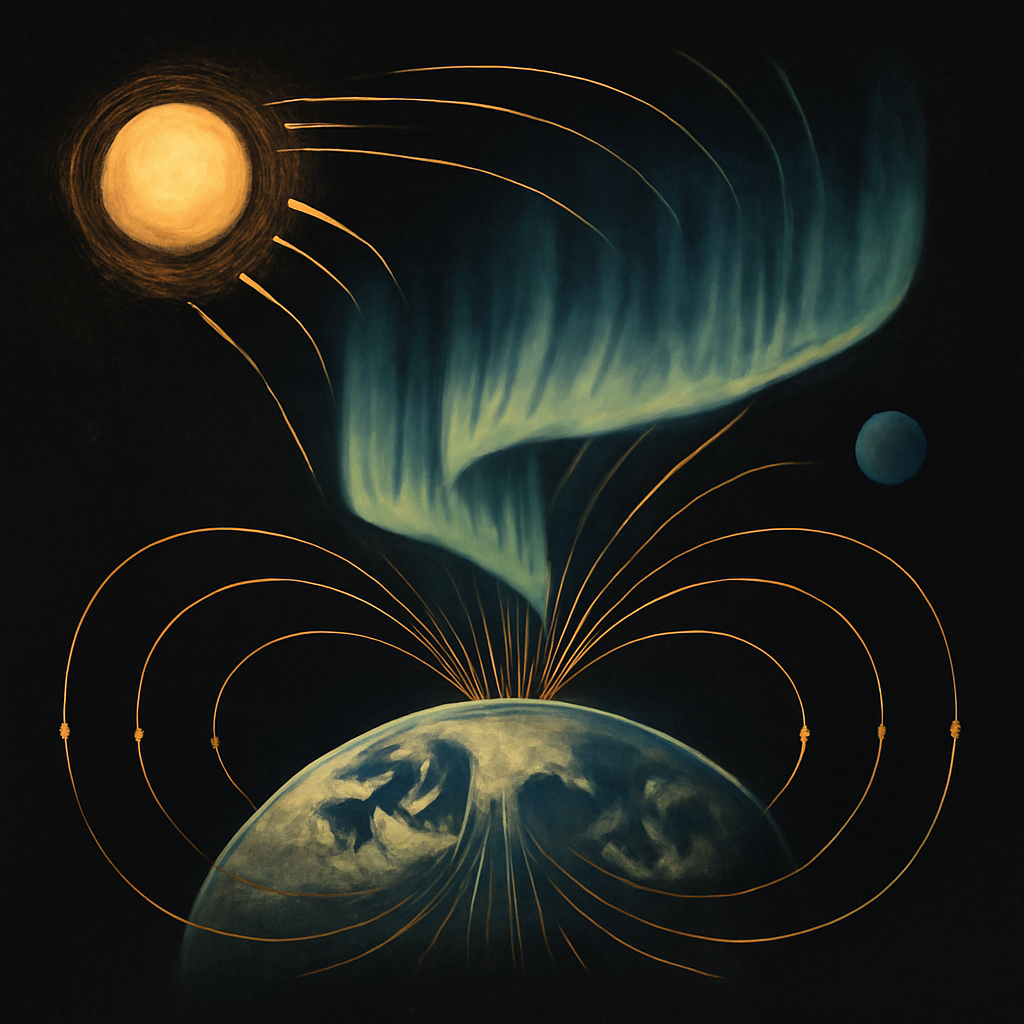
Imagine a giant, invisible shield wrapping around our planet. Every second, the Sun throws a wild storm of electric energy our way. Most of it slides right past us. But some of it slips through the cracks at the top and bottom of the world.
When these space particles crash into the gases in our sky, they light up. It is like a neon sign, but on a cosmic scale. This creates the glowing, dancing curtains of green, pink, and purple we call the Northern Lights. They are a beautiful reminder that our planet is constantly dancing with the star we orbit.
“The Northern Lights are actually space storms crashing into our atmosphere at over a million miles per hour, showing us our invisible magnetic shield in action.”
Reflect
If our eyes could see the entire magnetic shield protecting us right now, what would the sky look like during the day?
Research·2 sources·Developing confidence·Investigated 4 Aug 2026(1 month ago)·Grounded; verification trace not recorded·Investigation may be outdated
Your next question, in
Visual Trail
See What Causes the Northern Lights?
A guided visual explanation assembled from QE artwork and sourced documentary images.
01 / 02
QE visual interpretation
Frame 01
What Causes the Northern Lights?
The Northern Lights happen when tiny, electric particles from the Sun crash into Earth's sky and glow like a giant neon sign.
Image provenance and limitation
Source: AI-generated visual interpretation
Creator: Question Everything
Limitation: This image explains or evokes the subject. It is not documentary evidence and should not be used to verify a factual claim.
Evidence
What do we know?
Verified claims with confidence scoring and cited sources.
2 of 3 findings need extra caution. Finding 1, Finding 3 rest on weaker sourcing than the other findings.
Living footnotes
Claims remain in the reading flow. Select a citation number to inspect the source behind it.
01
ObservationalNot confirmed
The Sun constantly shoots a stream of electricity into space.
Our Sun is a giant, hot furnace. It doesn't just send us heat and light. It also blows out a constant wind of tiny, electric particles. During big space storms, the Sun throws out massive clouds of this electric stuff. These clouds travel through deep space at over a million miles per hour. That is fast enough to go from Earth to the Moon in just a few hours.
02
ObservationalSupported
Earth's magnetic field funnels solar particles toward the poles.
Earth has a giant, invisible magnetic shield. Deep inside our planet, swirling liquid metal creates this force field. It blocks most of the Sun's electric wind. But the shield has weak spots. These are at the very top and bottom of the world. The magnetic lines act like giant slides. They funnel the electric space particles straight down into the North and South poles.
03
ObservationalNot confirmed
Different gases in our sky glow in different colors when hit by solar particles.
When the electric space particles hit our air, they crash into natural gases. This makes the gases glow. It works exactly like a neon sign in a shop window. The color depends on the gas. Oxygen about sixty miles up glows a bright green. If the storm is extra strong and hits nitrogen lower down, we get beautiful purple and blue lights. High-up oxygen glows a rare, bright red.
The complete record below preserves every citation, confidence input and recorded limitation.
Read the full evidence record3 findings · citations · limitations
Evidence review3 findings2 openable sources
01
Finding 1 of 3ObservationalNeeds caution
0/0 verified
The Sun constantly shoots a stream of electricity into space.
Our Sun is a giant, hot furnace. It doesn't just send us heat and light. It also blows out a constant wind of tiny, electric particles. During big space storms, the Sun throws out massive clouds of this electric stuff. These clouds travel through deep space at over a million miles per hour. That is fast enough to go from Earth to the Moon in just a few hours.
Not confirmedmodel score 30%
Scored as if sourced, but every citation failed verification.
NO SURVIVING CITATION
›View sources and limits— limits
Supporting passage
Our Sun is a giant, hot furnace. It doesn't just send us heat and light. It also blows out a constant wind of tiny, electric particles. During big space storms, the Sun throws out massive clouds of this electric stuff. These clouds travel through deep space at over a million miles per hour. That is fast enough to go from Earth to the Moon in just a few hours.
Citations (0 of 2 survived verification)
Nothing openable. Every citation was removed by provenance validation.
What limits this
All 2 citations on this claim failed verification and were removed. Nothing openable supports it.
02
Finding 2 of 3Observational
0/2 verified
Earth's magnetic field funnels solar particles toward the poles.
Earth has a giant, invisible magnetic shield. Deep inside our planet, swirling liquid metal creates this force field. It blocks most of the Sun's electric wind. But the shield has weak spots. These are at the very top and bottom of the world. The magnetic lines act like giant slides. They funnel the electric space particles straight down into the North and South poles.
Supportedmodel score 100%
2 sources agree, none peer-reviewed.
REFERENCE ×2
›View sources and limits— 2 citations, limits
Supporting passage
Earth has a giant, invisible magnetic shield. Deep inside our planet, swirling liquid metal creates this force field. It blocks most of the Sun's electric wind. But the shield has weak spots. These are at the very top and bottom of the world. The magnetic lines act like giant slides. They funnel the electric space particles straight down into the North and South poles.
The generator scored this 100%, which would read as “Established”. Its citations reach only “Supported”, so that is what is shown.
03
Finding 3 of 3ObservationalNeeds caution
0/0 verified
Different gases in our sky glow in different colors when hit by solar particles.
When the electric space particles hit our air, they crash into natural gases. This makes the gases glow. It works exactly like a neon sign in a shop window. The color depends on the gas. Oxygen about sixty miles up glows a bright green. If the storm is extra strong and hits nitrogen lower down, we get beautiful purple and blue lights. High-up oxygen glows a rare, bright red.
Not confirmedmodel score 30%
Scored as if sourced, but every citation failed verification.
NO SURVIVING CITATION
›View sources and limits— limits
Supporting passage
When the electric space particles hit our air, they crash into natural gases. This makes the gases glow. It works exactly like a neon sign in a shop window. The color depends on the gas. Oxygen about sixty miles up glows a bright green. If the storm is extra strong and hits nitrogen lower down, we get beautiful purple and blue lights. High-up oxygen glows a rare, bright red.
Citations (0 of 2 survived verification)
Nothing openable. Every citation was removed by provenance validation.
What limits this
All 2 citations on this claim failed verification and were removed. Nothing openable supports it.
Interactive Exploration
Touch, drag, and discover
These visualizations respond to your curiosity. Interact to go deeper.
process flow
How Space Storms Become Sky Lights
The Sun's Burp
The Space Race
The Shield Collision
The Neon Glow
spectrum
The Color Scale of the Northern Lights
Low AltitudeHigh Altitude
20%
Blue & Purple
50%
Green
90%
Red
Perspectives
How is this interpreted?
Enter a viewpoint. Notice what it reveals, what it leaves out, and whether it changes the question for you.
The EmpiricistScientific viewpointEstablished lens
To a space physicist, the aurora is a giant, natural light show run by electromagnetism. It shows us that Earth is not isolated in space. We are deeply connected to the Sun's active life cycle. The lights help us study how space weather interacts with our planet's atmosphere and technology.
What this lens notices
01Tracks the strength of solar storms
02Shows how Earth's magnetic shield behaves
03Helps predict satellite and power grid disruptions
Application
Why does this matter to you?
Personal reflections and applications for your life.
Thought experimentSelf-Reflection
How does it feel to know we live inside a giant magnetic bubble?
Why it changes the question
Realizing that Earth actively shields us from space storms can make us feel safe, connected, and incredibly small all at once.
Try this
Go outside on a clear night, turn off your phone, and imagine the invisible shield guiding solar winds safely around you.
Media
QE Smart Glass
Curated media selected for this investigation.
QE Glass
YOUTUBE
What is an aurora? - Michael Molina
TED-Ed
Explore the science behind what causes the incredible light and color of the Aurora Borealis and Aurora Australis. -- Why do we ...
QE Glass
YOUTUBE
What Causes The Northern Lights?
BrainStuff - HowStuffWorks
There are many misconceptions about what causes the Aurora Borealis when it really requires solar winds, magnetic fields and ...
QE Glass
YOUTUBE
What Causes the Northern Lights?! | Space's Deepest Secrets | Science Channel
Science Channel
The aurora borealis is one of Earth's most incredible sights, and new discoveries finally explain why these mysterious lights ...
QE Glass
YOUTUBE
What causes the Northern Lights?!
CrunchLabs
QE Glass
YOUTUBE
What Is an Aurora?
NASA Space Place
An aurora looks like a beautiful display of lights in the sky. We can also see auroras from space! The name of an aurora changes ...
QE Glass
YOUTUBE
What Causes the Northern Lights?! | Space's Deepest Secrets | Science Channel
Science Channel
The aurora borealis is one of Earth's most incredible sights, and new discoveries finally explain why these mysterious lights ...
QE Glass
PODCAST
Aurorology (NORTHERN LIGHTS) with Dr. Elizabeth MacDonald
Ologies with Alie Ward
A fun, friendly chat with a space physicist about how auroras work, what they sound like, and how to spot them.
Keep Going
Where this leads
Questions this investigation opens up — and what QE has already looked into.
No AI help here — no suggestions, no autocomplete, nothing finishing your sentences. That is deliberate. Working out what you think is effortful, and the effort is the part that changes you: reasoning is trained like a muscle, and a muscle that is always carried gets weaker. Let something else do the thinking and you keep the answer but lose the capacity to have reached it.
Write your current position.
Not what the page says. What you think, having read it.0 words · Nothing written yet.
Sign in to leave a mark. Your draft is saved here in the meantime.