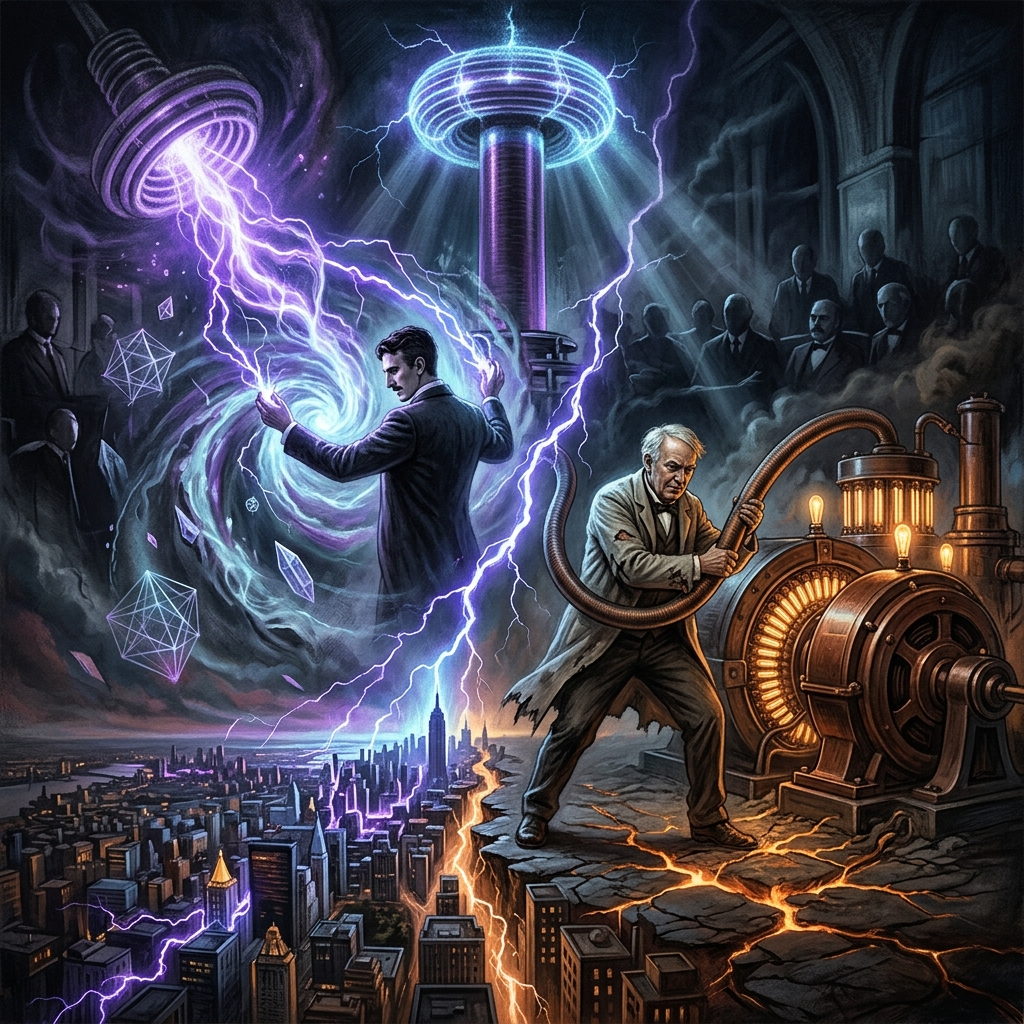
The War of the Currents: How Edison and Tesla Electrified a Rivalry
Imagine two brilliant minds trying to light up the dark. In the late 1800s, Thomas Edison was America's golden boy. He had invented the lightbulb and built a massive business empire. Then came Nikola Tesla, a tall, quiet immigrant from Serbia with wild ideas and a mind like a supercomputer. Tesla worked for Edison first. But they were like oil and water. Edison was a practical builder who ran endless experiments. Tesla did all his math in his head and envisioned a completely different future.
Their clash sparked a massive corporate war. Edison had invested everything in his own system, Direct Current. Tesla had a better idea called Alternating Current. To save his business, Edison started a smear campaign. He tried to convince the public that Tesla's system was a deadly menace. He even electrocuted animals in public to prove his point. It was a dirty, dramatic battle for the soul of the modern world.
In the end, this rivalry shaped our daily lives. Every time you flip a light switch or plug in your phone, you are using the winner's technology. But the fight cost both men dearly. It left one wealthy but bitter, and the other brilliant but broke.
✨
Wonder Moment
“Edison was so desperate to beat Tesla that he secretly funded the invention of the electric chair. He did this just to prove Tesla's electricity was dangerous, and even tried to get the public to use the word 'Westinghoused' to mean getting executed.”
Reflect
If Edison had succeeded in banning Tesla's technology, our cities would be crammed with dirty power stations on every single block. How many other world-changing technologies have been buried by powerful corporations looking to protect their profits?
1 source·Established confidence·Investigated 14 Jul 2026(1 month ago)·Investigation may be outdated
Your next question, in
Visual Trail
See The War of the Currents: How Edison and Tesla Electrified a Rivalry
A guided visual explanation assembled from QE artwork and sourced documentary images.
01 / 02
QE visual interpretation
Frame 01
The War of the Currents: How Edison and Tesla Electrified a Rivalry
Edison and Tesla fought a bitter, dirty war to power the world: Edison's short-range current versus Tesla's powerful long-range system.
Image provenance and limitation
Source: AI-generated visual interpretation
Creator: Question Everything
Limitation: This image explains or evokes the subject. It is not documentary evidence and should not be used to verify a factual claim.
Evidence
What do we know?
Verified claims with confidence scoring and cited sources.
Generated without source retrieval. QE did not fetch sources for this investigation, so no citation here was checked against a retrieved set. Claims reflect the model’s training data. 2 of 3 findings carry no openable link at all.
2 of 3 findings need extra caution. Finding 1, Finding 3 rest on weaker sourcing than the other findings.
Living footnotes
Claims remain in the reading flow. Select a citation number to inspect the source behind it.
01
HistoricalNot confirmed
Tesla quit working for Edison over a broken $50,000 promise
When Tesla first arrived in America, he went straight to work for Edison's company. Edison's machines were constantly breaking down and losing money. Edison allegedly told Tesla he would pay him $50,000—which was a fortune back then, worth over a million dollars today—if Tesla could redesign the generator machines.
Tesla worked incredibly hard for months. He barely slept. He redesigned the machines and saved the company. When he asked for his reward, Edison laughed. He told Tesla, 'You do not understand our American humor.' Instead of the massive bonus, Edison offered a tiny raise. Tesla felt cheated. He quit on the spot.
02
HistoricalSupported
Edison used public animal electrocutions to scare people away from Tesla's technology
Edison's power system could only send electricity about a mile. Tesla's system could send it for hundreds of miles. To stop Tesla from taking over, Edison tried to convince the public that Tesla's system was too dangerous to be allowed in homes. He paid local kids to bring him stray dogs and cats, and he electrocuted them in front of reporters.
Edison's team even went after larger animals. The most famous case was Topsy, a circus elephant that had killed three keepers and was sentenced to death. Edison's crew helped use Tesla's type of electricity to kill the elephant. They filmed it and showed the footage to terrified audiences across the country.
03
HistoricalNot confirmed
Edison helped create the first electric chair to link Tesla's system with death
In the late 1880s, New York state was looking for a more humane way to execute criminals than hanging. Edison saw a dark opportunity. He secretly funded the creation of the first electric chair, making sure it used the exact same kind of electricity Tesla championed.
Edison wanted people to associate Tesla's system with instant death. He even tried to invent a new word for execution. He wanted people to say criminals were 'Westinghoused' (after George Westinghouse, the wealthy businessman who funded Tesla's work). The plan backfired slightly because the first execution was messy and horrific, but it showed how far Edison would go to win.
The complete record below preserves every citation, confidence input and recorded limitation.
Read the full evidence record3 findings · citations · limitations
Evidence review3 findings1 openable sources
01
Finding 1 of 3HistoricalNeeds caution
0/0 verified
Tesla quit working for Edison over a broken $50,000 promise
When Tesla first arrived in America, he went straight to work for Edison's company. Edison's machines were constantly breaking down and losing money. Edison allegedly told Tesla he would pay him $50,000—which was a fortune back then, worth over a million dollars today—if Tesla could redesign the generator machines.
Tesla worked incredibly hard for months. He barely slept. He redesigned the machines and saved the company. When he asked for his reward, Edison laughed. He told Tesla, 'You do not understand our American humor.' Instead of the massive bonus, Edison offered a tiny raise. Tesla felt cheated. He quit on the spot.
Not confirmedmodel score 95%
Written from the model's own knowledge. No source was retrieved or checked.
UNVERIFIED — NO RETRIEVAL
›View sources and limits— limits
Supporting passage
When Tesla first arrived in America, he went straight to work for Edison's company. Edison's machines were constantly breaking down and losing money. Edison allegedly told Tesla he would pay him $50,000—which was a fortune back then, worth over a million dollars today—if Tesla could redesign the generator machines.
Tesla worked incredibly hard for months. He barely slept. He redesigned the machines and saved the company. When he asked for his reward, Edison laughed. He told Tesla, 'You do not understand our American humor.' Instead of the massive bonus, Edison offered a tiny raise. Tesla felt cheated. He quit on the spot.
Citations (0 of 2 survived verification)
Nothing openable. No sources were retrieved for this investigation, so none were checked.
What limits this
This investigation was generated without source retrieval. The model named a source but gave no link, and no verification step ran against it.
The claim reflects the model's training data, not a checked citation.
The generator scored this 95%, which would read as “Established”. Its citations reach only “Unresolved”, so that is what is shown.
02
Finding 2 of 3Historical
2013
1 dated source
Edison used public animal electrocutions to scare people away from Tesla's technology
Edison's power system could only send electricity about a mile. Tesla's system could send it for hundreds of miles. To stop Tesla from taking over, Edison tried to convince the public that Tesla's system was too dangerous to be allowed in homes. He paid local kids to bring him stray dogs and cats, and he electrocuted them in front of reporters.
Edison's team even went after larger animals. The most famous case was Topsy, a circus elephant that had killed three keepers and was sentenced to death. Edison's crew helped use Tesla's type of electricity to kill the elephant. They filmed it and showed the footage to terrified audiences across the country.
Supportedmodel score 99%
One source, not peer-reviewed. Thinner than the score suggests.
REPORTING
›View sources and limits— 1 citation, limits
Supporting passage
Edison's power system could only send electricity about a mile. Tesla's system could send it for hundreds of miles. To stop Tesla from taking over, Edison tried to convince the public that Tesla's system was too dangerous to be allowed in homes. He paid local kids to bring him stray dogs and cats, and he electrocuted them in front of reporters.
Edison's team even went after larger animals. The most famous case was Topsy, a circus elephant that had killed three keepers and was sentenced to death. Edison's crew helped use Tesla's type of electricity to kill the elephant. They filmed it and showed the footage to terrified audiences across the country.
Generated without source retrieval — citations here were not verified against a retrieved set.
1 of 2 citations failed verification and are not shown.
Rests on a single source. No independent corroboration.
No peer-reviewed source among the citations.
The generator scored this 99%, which would read as “Established”. Its citations reach only “Supported”, so that is what is shown.
03
Finding 3 of 3HistoricalNeeds caution
0/0 verified
Edison helped create the first electric chair to link Tesla's system with death
In the late 1880s, New York state was looking for a more humane way to execute criminals than hanging. Edison saw a dark opportunity. He secretly funded the creation of the first electric chair, making sure it used the exact same kind of electricity Tesla championed.
Edison wanted people to associate Tesla's system with instant death. He even tried to invent a new word for execution. He wanted people to say criminals were 'Westinghoused' (after George Westinghouse, the wealthy businessman who funded Tesla's work). The plan backfired slightly because the first execution was messy and horrific, but it showed how far Edison would go to win.
Not confirmedmodel score 95%
Written from the model's own knowledge. No source was retrieved or checked.
UNVERIFIED — NO RETRIEVAL
›View sources and limits— limits
Supporting passage
In the late 1880s, New York state was looking for a more humane way to execute criminals than hanging. Edison saw a dark opportunity. He secretly funded the creation of the first electric chair, making sure it used the exact same kind of electricity Tesla championed.
Edison wanted people to associate Tesla's system with instant death. He even tried to invent a new word for execution. He wanted people to say criminals were 'Westinghoused' (after George Westinghouse, the wealthy businessman who funded Tesla's work). The plan backfired slightly because the first execution was messy and horrific, but it showed how far Edison would go to win.
Citations (0 of 1 survived verification)
Nothing openable. No sources were retrieved for this investigation, so none were checked.
What limits this
This investigation was generated without source retrieval. The model named a source but gave no link, and no verification step ran against it.
The claim reflects the model's training data, not a checked citation.
The generator scored this 95%, which would read as “Established”. Its citations reach only “Unresolved”, so that is what is shown.
Interactive Exploration
Touch, drag, and discover
These visualizations respond to your curiosity. Interact to go deeper.
comparison table
Edison's DC vs. Tesla's AC
Edison's Direct Current (DC)
Tesla's Alternating Current (AC)
How it flows
One steady direction, like water from a tap
Shuffles back and forth, like a sawing motion
How far it travels
Short range (about 1 mile before losing power)
Long range (hundreds of miles without losing power)
Cost to build
Very high (needed power plants on every corner)
Low (needed fewer, larger power plants)
Who won the war?
Lost the grid war, but powers our phones/batteries today
Won the grid war, powers almost all home wall outlets
Tap any row to highlight and compare
timeline
Key Clashes in the War of the Currents
Loading timeline…
statistics card
The Brutal Power of Distance
1 Mile
Maximum reach of Edison's DC
To power a whole city, Edison would have had to build a noisy, dirty power plant in every single neighborhood.
20 Miles
First major run of Tesla's AC
Tesla sent power from Niagara Falls to Buffalo instantly. Today, AC power travels over 300 miles from a single source.
Perspectives
How is this interpreted?
Enter a viewpoint. Notice what it reveals, what it leaves out, and whether it changes the question for you.
The HistorianHistorical viewpointEstablished lens
Historians often see this clash as a classic battle between a pure scientist and a ruthless businessman. Tesla lived in his head, designing beautiful, complex systems. He did not care about money; he cared about progress. Edison was an innovator, but he was also a hard-nosed CEO who knew how to market products. He saw Tesla's superior technology not as a scientific step forward, but as a direct threat to his factories, patents, and livelihood.
What this lens notices
01Tesla died penniless in a hotel room because he gave away his patent rights.
02Edison employed teams of researchers to build his ideas and was master of the media.
03Tesla wanted to give wireless power to the entire world for free.
Application
Why does this matter to you?
Personal reflections and applications for your life.
Thought experimentSelf-Reflection
Are you more of an Edison or a Tesla in how you solve problems?
Why it changes the question
Edison solved problems by trying ten thousand different physical combinations until one worked. He called it 'sweat over inspiration.' Tesla solved problems by imagining the entire machine in his mind, running tests in his head, and building it perfectly the first time. Knowing your own style helps you work better with others.
Try this
Think of a problem you need to solve. Try Tesla's way: sit quietly and visualize the solution step-by-step in your head before touching anything. Then try Edison's way: quickly make three messy, imperfect drafts to see what fails.
Media
QE Smart Glass
Curated media selected for this investigation.
QE Glass
YOUTUBE
The Battle For Electric Power
Veritasium
A fantastic, easy-to-understand breakdown of the physics and the drama behind the historic fight.
QE Glass
PODCAST
Thomas Edison
The Dollop
A hilarious and deeply researched look at Edison's life, his business tactics, and how he treated his rivals.
Connected context
Connected entities
The people, places, concepts, and events that matter here.
Keep Going
Where this leads
Questions this investigation opens up — and what QE has already looked into.
No AI help here — no suggestions, no autocomplete, nothing finishing your sentences. That is deliberate. Working out what you think is effortful, and the effort is the part that changes you: reasoning is trained like a muscle, and a muscle that is always carried gets weaker. Let something else do the thinking and you keep the answer but lose the capacity to have reached it.
Write your current position.
Not what the page says. What you think, having read it.0 words · Nothing written yet.
Sign in to leave a mark. Your draft is saved here in the meantime.