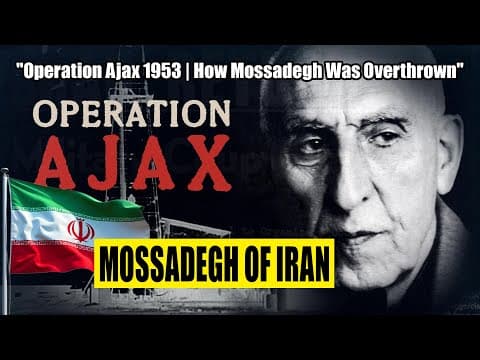
The Overthrow of Mohammad Mossadegh:… | Question Everything
history73% confidencepartly supported
19 min deep dive
Complexity
The Overthrow of Mohammad Mossadegh: Power, Oil, and Cold War Intrigue
In the early 1950s, Mohammad Mossadegh, Iran’s democratically elected prime minister, became a symbol of national pride and resistance. His bold move to nationalize Iran’s oil industry, previously controlled by the British, challenged powerful foreign interests. This act stirred global tensions during the Cold War, as Western powers feared losing influence in the strategically vital Middle East and worried about the spread of Soviet communism.
The CIA and British intelligence orchestrated a secret operation to remove Mossadegh, fearing his nationalist policies threatened their geopolitical and economic stakes. His overthrow in 1953 restored the Shah’s monarchy and reasserted Western control over Iranian oil. This moment left a lasting impact, fueling decades of distrust and shaping Iran’s modern history in profound ways.
“The 1953 overthrow of Mohammad Mossadegh was driven less by his communist ties and more by fears of Iran's political collapse and control over its oil.”
Reflect
How do global economic interests and fears about political stability shape covert interventions today?
Research·5 sources·Established confidence·Investigated 4 Sept 2026(13 days ago)·Source-verified·May need refresh
Your next question, in
Evidence
What do we know?
Verified claims with confidence scoring and cited sources.
2 of 4 findings need extra caution. Finding 3, Finding 4 rest on weaker sourcing than the other findings.
Living footnotes
Claims remain in the reading flow. Select a citation number to inspect the source behind it.
01
HistoricalSupported
Mohammad Mossadegh nationalized Iran's oil industry in 1951, threatening British oil interests.
Mossadegh's nationalization of the Anglo-Iranian Oil Company in 1951 sparked an international crisis by cutting off British access to Iranian oil revenues. This act ignited tensions as Britain sought to regain control and protect its economic stake, leading to secret attempts to destabilize Mossadegh's government.
02
HistoricalSupported
The U.S. and Britain feared Mossadegh's government might collapse, threatening Western oil supply and regional stability.
American policymakers perceived that Mossadegh's inability to secure oil agreements could trigger an economic and political collapse in Iran. This fear, rather than immediate communist threat, motivated the covert coup to preserve oil flow and prevent instability that could invite Soviet influence.
03
HistoricalMixed evidence
The British government solicited U.S. support for the coup fearing Mossadegh's alignment with communists.
Britain, concerned about losing control over Iranian oil and fearing communist expansion, persuaded the Eisenhower administration to join in overthrowing Mossadegh. The U.S., under Cold War pressures, accepted the plan, seeing it as a way to block Soviet influence in the region.
04
HistoricalMixed evidence
The 1953 coup led to the Shah’s return and the consolidation of a U.S.-backed dictatorship in Iran.
After the coup, the Shah was restored to power, ruling with U.S. support and suppressing political opposition through a secret police force. This authoritarian rule sowed resentment and eventually contributed to the 1979 Islamic Revolution.
The complete record below preserves every citation, confidence input and recorded limitation.
Read the full evidence record4 findings · citations · limitations
Evidence review4 findings6 openable sources
01
Finding 1 of 4Historical
2009
1 dated source
Mohammad Mossadegh nationalized Iran's oil industry in 1951, threatening British oil interests.
Mossadegh's nationalization of the Anglo-Iranian Oil Company in 1951 sparked an international crisis by cutting off British access to Iranian oil revenues. This act ignited tensions as Britain sought to regain control and protect its economic stake, leading to secret attempts to destabilize Mossadegh's government.
Supportedmodel score 90%
2 sources agree, none peer-reviewed.
REFERENCE ×2
›View sources and limits— 2 citations, limits
Supporting passage
Mossadegh's nationalization of the Anglo-Iranian Oil Company in 1951 sparked an international crisis by cutting off British access to Iranian oil revenues. This act ignited tensions as Britain sought to regain control and protect its economic stake, leading to secret attempts to destabilize Mossadegh's government.
The generator scored this 90%, which would read as “Established”. Its citations reach only “Supported”, so that is what is shown.
02
Finding 2 of 4Historical
2019
1 dated source
The U.S. and Britain feared Mossadegh's government might collapse, threatening Western oil supply and regional stability.
American policymakers perceived that Mossadegh's inability to secure oil agreements could trigger an economic and political collapse in Iran. This fear, rather than immediate communist threat, motivated the covert coup to preserve oil flow and prevent instability that could invite Soviet influence.
Supportedmodel score 90%
2 sources agree, none peer-reviewed.
REFERENCE ×2
›View sources and limits— 2 citations, limits
Supporting passage
American policymakers perceived that Mossadegh's inability to secure oil agreements could trigger an economic and political collapse in Iran. This fear, rather than immediate communist threat, motivated the covert coup to preserve oil flow and prevent instability that could invite Soviet influence.
The generator scored this 90%, which would read as “Established”. Its citations reach only “Supported”, so that is what is shown.
03
Finding 3 of 4HistoricalNeeds caution
0/1 verified
The British government solicited U.S. support for the coup fearing Mossadegh's alignment with communists.
Britain, concerned about losing control over Iranian oil and fearing communist expansion, persuaded the Eisenhower administration to join in overthrowing Mossadegh. The U.S., under Cold War pressures, accepted the plan, seeing it as a way to block Soviet influence in the region.
Mixed evidencemodel score 55%
Verification was mixed across 1 source.
REFERENCE
›View sources and limits— 1 citation, limits
Supporting passage
Britain, concerned about losing control over Iranian oil and fearing communist expansion, persuaded the Eisenhower administration to join in overthrowing Mossadegh. The U.S., under Cold War pressures, accepted the plan, seeing it as a way to block Soviet influence in the region.
1 of 2 citations failed verification and are not shown.
Rests on a single source. No independent corroboration.
No peer-reviewed source among the citations.
Verification was mixed — some citations supported the claim and some did not.
04
Finding 4 of 4HistoricalNeeds caution
0/1 verified
The 1953 coup led to the Shah’s return and the consolidation of a U.S.-backed dictatorship in Iran.
After the coup, the Shah was restored to power, ruling with U.S. support and suppressing political opposition through a secret police force. This authoritarian rule sowed resentment and eventually contributed to the 1979 Islamic Revolution.
Mixed evidencemodel score 55%
Verification was mixed across 1 source.
REFERENCE
›View sources and limits— 1 citation, limits
Supporting passage
After the coup, the Shah was restored to power, ruling with U.S. support and suppressing political opposition through a secret police force. This authoritarian rule sowed resentment and eventually contributed to the 1979 Islamic Revolution.
These visualizations respond to your curiosity. Interact to go deeper.
timeline
Key Events Leading to and Following the 1953 Coup
Loading timeline…
cause effect
Causes and Effects of the 1953 Iranian Coup
Causes — tap to reveal
Tap to reveal cause 1
Tap to reveal cause 2
Tap to reveal cause 3
↓
Contested
This one is genuinely argued over
Both cases are put as strongly as their own supporters would put them, from evidence rather than from who holds the view. Read them and decide for yourself.
The case that it's true
The U.S. and Britain overthrew Mossadegh primarily to protect their vital oil interests and prevent Iran from collapsing into chaos or Soviet influence. Given the Cold War context, the coup was seen as necessary to safeguard Western geopolitical and economic security by maintaining control over Iran’s oil and keeping the region stable.
What this rests on
Mossadegh’s nationalization threatened British oil revenues.
Fear of political and economic collapse motivated U.S. intervention.
Cold War fears of communist expansion influenced Western policymakers.
The case against
Critics argue the coup was an unjustified interference in a democratically elected government driven by imperial greed rather than genuine security concerns. They contend that Mossadegh was not a communist threat and that the coup ultimately undermined democracy, leading to decades of authoritarian rule and anti-Western resentment.
What this rests on
Mossadegh was a nationalist, not a communist.
The coup destroyed Iran’s democracy and enabled dictatorship.
Western fears were exaggerated and masked economic motives.
What both sides accept
Both sides agree that Mossadegh’s nationalization of oil triggered the crisis and that Cold War fears shaped U.S. and British decisions. It is also accepted that the coup had long-lasting effects on Iran’s political landscape, contributing to future unrest, though interpretations of the motivations and consequences differ.
Documented, and not in dispute
Oil nationalization was the immediate cause of conflict.
Cold War fears influenced Western actions.
The coup had significant long-term political consequences.
Application
Why does this matter to you?
Personal reflections and applications for your life.
Thought experimentPhilosophical
How should nations balance their own security interests against respect for other countries' sovereignty?
Why it changes the question
The overthrow of Mossadegh highlights the tension between protecting national interests and respecting democratic self-determination. Understanding this dynamic helps us reflect on ethical foreign policy today.
Try this
Reflect on recent global events where foreign intervention has been justified; consider alternative peaceful approaches.
Media
QE Smart Glass
Curated media selected for this investigation.
QE Glass
YOUTUBE
“It’s Always About Oil”: CIA & MI6 Staged Coup in Iran 70 Years Ago, Destroying Democracy in Iran
Democracy Now!
We look at the 70th anniversary of the August 19, 1953, U.S.- and U.K-backed coup in Iran, which took place two years after Iran's ...
QE Glass
YOUTUBE
How the US Turned Iran Into a Dictatorship: The 1953 Coup (Documentary)
Real Time History
Get Nebula with 40% off annual subscription with my link: https://go.nebula.tv/realtimehistory Nebula Annual Gift Cards ...
QE Glass
YOUTUBE
1953 coup d'état in Iran: How CIA stage-managed the fall of Mosaddegh
Al Mayadeen English
Professor of English Literature and Orientalism Mohammad Marandi highlighted a pivotal moment in Iranian history in tonight's ...
QE Glass
YOUTUBE
Iran 1953: How Britain and the CIA Overthrew a Country to Keep Its Oil
Uncover History
In 1953, Britain and the CIA orchestrated one of the most consequential covert operations in modern history — the overthrow of ...
QE Glass
YOUTUBE
The 1953 Coup: How the CIA and Britain Stole Iran’s Oil
World History Archive
In 1953, Iran's democratically elected Prime Minister Mohammad Mossadegh was overthrown in a coup backed by the United ...
QE Glass
YOUTUBE
Mohammad Mosaddegh (Iran 1953) : A Democracy Lost
Polis_history
Mohammad Mosaddegh was a principled nationalist operating in an unforgiving international system dominated by Cold War ...
QE Glass
YOUTUBE
The 1953 Iran Coup: How the CIA and Britain Crushed a Democracy for Oil
Think BRICS Chronicles
The 1953 Iran coup reveals how CIA Iran coup strategies and Operation Ajax removed Mossadegh, reshaping Iran oil history and ...
QE Glass
PODCAST
Radiolab: The Coup
Radiolab
An investigative podcast episode exploring the secretive nature of the 1953 Iranian coup.
Keep Going
Where this leads
Questions this investigation opens up — and what QE has already looked into.
No AI help here — no suggestions, no autocomplete, nothing finishing your sentences. That is deliberate. Working out what you think is effortful, and the effort is the part that changes you: reasoning is trained like a muscle, and a muscle that is always carried gets weaker. Let something else do the thinking and you keep the answer but lose the capacity to have reached it.
Write your current position.
Not what the page says. What you think, having read it.0 words · Nothing written yet.
Sign in to leave a mark. Your draft is saved here in the meantime.