The Shipyard Spark: How Solidarity Sh… | Question Everything
history42% confidenceweakly supported
23 min deep dive
Complexity
The Shipyard Spark: How Solidarity Shattered the Soviet Bloc
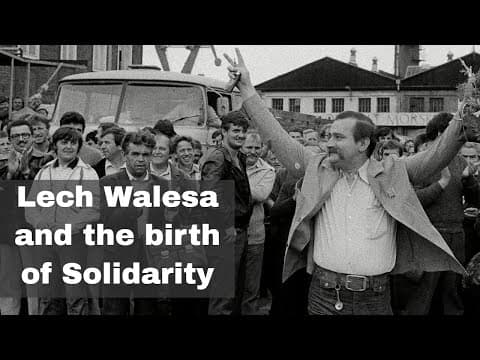
In the hot summer of 1980, inside the gritty Lenin Shipyard in Gdańsk, Poland, a spark ignited. Electrician Lech Wałęsa climbed over a fence and helped birth Solidarność—Solidarity. It began as the first independent trade union in a Soviet-bloc country. But it quickly morphed into something much grander. It became a massive, non-violent social movement of ten million citizens. They dared to demand dignity, worker rights, and freedom from a totalitarian regime.
Why does it matter? Because Solidarity cracked the monolithic wall of Soviet communism. By using the power of strikes, underground printing, and sheer collective will, these ordinary workers proved that the state's grip was fragile. They forced the regime to negotiate, leading to Poland's first free elections in 1989. This peaceful revolution triggered a domino effect. It ultimately brought down the Berlin Wall and ended the Cold War.
✨
Wonder Moment
“In 1980, a single Polish trade union grew to nearly ten million members in just a few weeks, capturing eighty percent of the state workforce and proving that a supposedly worker-led state was rejected by its own workers.”
Reflect
What happens when the very people a regime claims to represent collectively decide to opt out?
1 source·Developing confidence·Investigated 7 Aug 2026(20 days ago)·Source-verified·May need refresh
Your next question, in
Evidence
What do we know?
Verified claims with confidence scoring and cited sources.
2 of 3 findings need extra caution. Finding 2, Finding 3 rest on weaker sourcing than the other findings.
Living footnotes
Claims remain in the reading flow. Select a citation number to inspect the source behind it.
01
HistoricalSupported
Solidarity was founded in August 1980 at the Gdańsk Lenin Shipyard after massive strikes over food prices.
In the summer of 1980, deteriorating economic conditions and rising food prices sparked massive strikes across Poland. Under the leadership of Lech Wałęsa, an electrician, workers at the Gdańsk Lenin Shipyard organized the Interfactory Strike Committee. They demanded rights independent of the Communist Party. On August 31, the cash-strapped regime capitulated. This historic agreement birthed Solidarity, the very first independent trade union officially recognized within the Soviet sphere of influence.
02
StatisticalNot confirmed
Within weeks of its legalization, Solidarity's membership exploded to nearly 10 million workers.
The growth was staggering. Following its formal registration in late 1980, the union quickly united thirty-six regional groups. Almost overnight, eighty percent of Poland's state employees joined, including many rank-and-file Communist Party members. By early 1981, Solidarity represented ten million people. This massive, peaceful mobilization created a powerful alternative civic space. It completely undermined the regime's ideological claim to rule on behalf of the working class.
03
ObservationalNot confirmed
Solidarity's peaceful resistance eventually forced free elections in 1989, triggering the collapse of communism across Eastern Europe.
Despite severe government crackdowns and martial law, the movement survived underground. It sustained its struggle through a thick web of civic networks and clandestine publications. By 1989, economic crisis forced the regime back to the negotiating table. The resulting roundtable talks led to Poland's first partially free elections since the 1940s. Solidarity's landslide victory shattered the party's monopoly, creating a domino effect that dismantled the Soviet bloc.
The complete record below preserves every citation, confidence input and recorded limitation.
Read the full evidence record3 findings · citations · limitations
Evidence review3 findings1 openable sources
01
Finding 1 of 3Historical
2024
1 dated source
Solidarity was founded in August 1980 at the Gdańsk Lenin Shipyard after massive strikes over food prices.
In the summer of 1980, deteriorating economic conditions and rising food prices sparked massive strikes across Poland. Under the leadership of Lech Wałęsa, an electrician, workers at the Gdańsk Lenin Shipyard organized the Interfactory Strike Committee. They demanded rights independent of the Communist Party. On August 31, the cash-strapped regime capitulated. This historic agreement birthed Solidarity, the very first independent trade union officially recognized within the Soviet sphere of influence.
Supportedmodel score 100%
One source, not peer-reviewed. Thinner than the score suggests.
REFERENCE
›View sources and limits— 1 citation, limits
Supporting passage
In the summer of 1980, deteriorating economic conditions and rising food prices sparked massive strikes across Poland. Under the leadership of Lech Wałęsa, an electrician, workers at the Gdańsk Lenin Shipyard organized the Interfactory Strike Committee. They demanded rights independent of the Communist Party. On August 31, the cash-strapped regime capitulated. This historic agreement birthed Solidarity, the very first independent trade union officially recognized within the Soviet sphere of influence.
Rests on a single source. No independent corroboration.
No peer-reviewed source among the citations.
The generator scored this 100%, which would read as “Established”. Its citations reach only “Supported”, so that is what is shown.
02
Finding 2 of 3StatisticalNeeds caution
0/0 verified
Within weeks of its legalization, Solidarity's membership exploded to nearly 10 million workers.
The growth was staggering. Following its formal registration in late 1980, the union quickly united thirty-six regional groups. Almost overnight, eighty percent of Poland's state employees joined, including many rank-and-file Communist Party members. By early 1981, Solidarity represented ten million people. This massive, peaceful mobilization created a powerful alternative civic space. It completely undermined the regime's ideological claim to rule on behalf of the working class.
Not confirmedmodel score 30%
Scored as if sourced, but every citation failed verification.
NO SURVIVING CITATION
›View sources and limits— limits
Supporting passage
The growth was staggering. Following its formal registration in late 1980, the union quickly united thirty-six regional groups. Almost overnight, eighty percent of Poland's state employees joined, including many rank-and-file Communist Party members. By early 1981, Solidarity represented ten million people. This massive, peaceful mobilization created a powerful alternative civic space. It completely undermined the regime's ideological claim to rule on behalf of the working class.
Citations (0 of 1 survived verification)
Nothing openable. Every citation was removed by provenance validation.
What limits this
All 1 citation on this claim failed verification and were removed. Nothing openable supports it.
03
Finding 3 of 3ObservationalNeeds caution
0/0 verified
Solidarity's peaceful resistance eventually forced free elections in 1989, triggering the collapse of communism across Eastern Europe.
Despite severe government crackdowns and martial law, the movement survived underground. It sustained its struggle through a thick web of civic networks and clandestine publications. By 1989, economic crisis forced the regime back to the negotiating table. The resulting roundtable talks led to Poland's first partially free elections since the 1940s. Solidarity's landslide victory shattered the party's monopoly, creating a domino effect that dismantled the Soviet bloc.
Not confirmedmodel score 30%
Scored as if sourced, but every citation failed verification.
NO SURVIVING CITATION
›View sources and limits— limits
Supporting passage
Despite severe government crackdowns and martial law, the movement survived underground. It sustained its struggle through a thick web of civic networks and clandestine publications. By 1989, economic crisis forced the regime back to the negotiating table. The resulting roundtable talks led to Poland's first partially free elections since the 1940s. Solidarity's landslide victory shattered the party's monopoly, creating a domino effect that dismantled the Soviet bloc.
Citations (0 of 1 survived verification)
Nothing openable. Every citation was removed by provenance validation.
What limits this
All 1 citation on this claim failed verification and were removed. Nothing openable supports it.
Interactive Exploration
Touch, drag, and discover
These visualizations respond to your curiosity. Interact to go deeper.
timeline
Solidarity's Rise and Triumph
Loading timeline…
statistics card
The Scale of Solidarity
10,000,000
Peak Membership
Represented the vast majority of Poland's working population by early 1981.
80%
State Employees Joined
Showed that even workers employed directly by the communist state rejected its authority.
1st
Independent Trade Union
The first non-state-controlled labor union allowed behind the Iron Curtain.
Perspectives
How is this interpreted?
Enter a viewpoint. Notice what it reveals, what it leaves out, and whether it changes the question for you.
The EmpiricistScientific viewpointEstablished lens
Sociologists and political scientists view Solidarity as a masterclass in nonviolent civil resistance. Rather than resorting to physical violence, the movement used strikes, underground press networks, and parallel institutions to build civic capital. This strategic self-limitation kept the moral high ground and prevented the regime from easily justifying a bloody military response. It proved that organized social solidarity can be far more potent than state coercion.
What this lens notices
01Maintained strict nonviolent discipline
02Created parallel independent institutions
03Built massive civic capital
Application
Why does this matter to you?
Personal reflections and applications for your life.
Thought experimentPractical
How can you build trust and consensus within your own community or workplace?
Why it changes the question
Solidarity succeeded because it started with small, local connections that grew into a massive, unified network. Real change begins with finding common ground and supporting each other on a personal level.
Try this
Identify one shared challenge in your local community or workplace and organize a small group discussion to address it collectively.
Media
QE Smart Glass
Curated media selected for this investigation.
QE Glass
YOUTUBE
End of UAW Election Has Major Hopeful Implications for Labor Movement
No AI help here — no suggestions, no autocomplete, nothing finishing your sentences. That is deliberate. Working out what you think is effortful, and the effort is the part that changes you: reasoning is trained like a muscle, and a muscle that is always carried gets weaker. Let something else do the thinking and you keep the answer but lose the capacity to have reached it.
Write your current position.
Not what the page says. What you think, having read it.0 words · Nothing written yet.
Sign in to leave a mark. Your draft is saved here in the meantime.