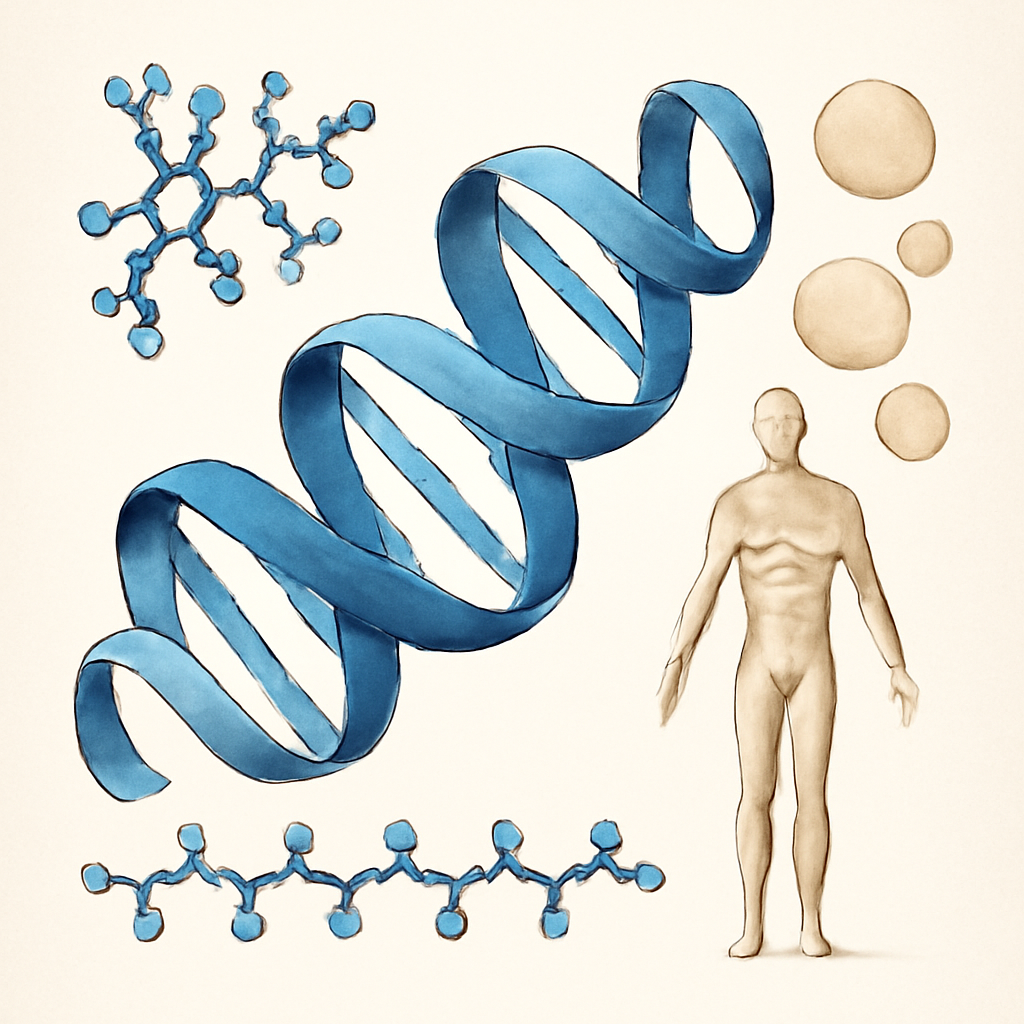
Peptides: Tiny Molecules with Big Roles in Human Health
Peptides are short chains of amino acids, the building blocks of proteins. These small molecules act as messengers and regulators within our bodies, playing crucial roles in everything from hormone signaling to immune responses. Unlike large proteins, peptides are more flexible and can quickly interact with cells, making them essential for many biological functions.
Scientists have discovered that peptides can be beneficial for human health in various ways. Some peptides act as natural antibiotics, others help heal wounds, and certain synthetic peptides are being developed into promising therapies for conditions like diabetes, cancer, and skin aging. As research advances, peptides are becoming a powerful tool in medicine, nutrition, and skincare, showing that sometimes the smallest components hold the greatest potential.
“Peptides are tiny chains of amino acids that act as powerful messengers, orchestrating vital processes like healing, metabolism, and immune defense in the human body.”
Reflect
If peptides can influence so many core functions, how might future medicine harness their potential without unintended risks?
Research·9 sources·9 primary·13 independent publishers·Strong evidence coverage·Well-Established confidence·Investigated 23 Oct 2026(11 days ago)·Source-verified
Your next question, in
Visual Trail
See Peptides: Tiny Molecules with Big Roles in Human Health
A guided visual explanation assembled from QE artwork and sourced documentary images.
01 / 03
QE visual interpretation
Frame 01
Peptides: Tiny Molecules with Big Roles in Human Health
Peptides are small amino acid chains that play vital roles in the body and offer many health benefits.
Image provenance and limitation
Source: AI-generated visual interpretation
Creator: Question Everything
Limitation: This image explains or evokes the subject. It is not documentary evidence and should not be used to verify a factual claim.
Evidence
What do we know?
Verified claims with confidence scoring and cited sources.
Living footnotes
Claims remain in the reading flow. Select a citation number to inspect the source behind it.
01
AcademicSupported
Peptides are short chains of amino acids that regulate important functions such as hormone activity, immune defense, tissue repair, and digestion in the human body.
Peptides, smaller than proteins, serve as messengers that tell cells when to produce hormones, repair tissues, or reduce inflammation. The body naturally produces countless types, each with specific roles. For example, insulin is a peptide that controls blood sugar, and growth hormone peptides aid muscle recovery. This fundamental role makes peptides essential for maintaining health and responding to bodily needs.
02
AcademicSupported
Some peptide-based medications, such as insulin and GLP-1 drugs, are FDA-approved and have strong scientific evidence supporting their effectiveness.
Synthetic peptides like insulin for diabetes and GLP-1 analogues for type 2 diabetes and obesity have been developed to mimic natural peptides. These drugs improve metabolism, control blood sugar, and support weight loss, with substantial clinical data backing their safety and efficacy. Their success highlights the therapeutic potential of peptides when carefully studied and regulated.
03
AcademicSupported
Most peptide supplements marketed for muscle growth, anti-aging, or general wellness remain experimental and lack robust evidence for safety and effectiveness in humans.
While peptides like BPC-157 and CJC-1295 show promise in animal studies for tissue repair and healing, human trials are small or absent. The long-term effects, optimal dosing, and potential risks, including possible cancer cell activation, are not well understood. Experts urge caution, noting that many peptides sold online are unregulated and could pose health risks without medical supervision.
04
AcademicWell supported
Dietary peptides, especially di- and tripeptides, can be absorbed in the human gut, but larger intact peptides generally do not enter the bloodstream in significant amounts.
Research shows that small peptides made from food proteins can cross the intestinal lining via specific transporters and may exert biological effects. However, intact larger peptides rarely survive digestion or cross into circulation, limiting the direct impact of dietary peptides beyond nutrition. This understanding shapes how food-derived peptides are studied for potential health benefits.
05
AcademicWell supported
Peptides derived from food proteins, such as collagen peptides, have been associated with improved muscle, bone, and skin health in humans.
Clinical trials indicate that collagen peptide supplementation can enhance physical activity levels, reduce pain, and improve skin appearance, especially with long-term use. Such peptides may support tissue repair and reduce inflammation, contributing to better musculoskeletal and mental health. These findings point to peptides as promising nutraceutical components with benefits beyond basic nutrition.
The complete record below preserves every citation, confidence input and recorded limitation.
Read the full evidence record5 findings · citations · limitations
Evidence review5 findings10 openable sources
01
Finding 1 of 5Academic
2
2/2 verified
Peptides are short chains of amino acids that regulate important functions such as hormone activity, immune defense, tissue repair, and digestion in the human body.
Peptides, smaller than proteins, serve as messengers that tell cells when to produce hormones, repair tissues, or reduce inflammation. The body naturally produces countless types, each with specific roles. For example, insulin is a peptide that controls blood sugar, and growth hormone peptides aid muscle recovery. This fundamental role makes peptides essential for maintaining health and responding to bodily needs.
Supportedmodel score 90%
2 sources agree, none peer-reviewed.
REFERENCE ×2
›View sources and limits— 2 citations, limits
Supporting passage
Peptides, smaller than proteins, serve as messengers that tell cells when to produce hormones, repair tissues, or reduce inflammation. The body naturally produces countless types, each with specific roles. For example, insulin is a peptide that controls blood sugar, and growth hormone peptides aid muscle recovery. This fundamental role makes peptides essential for maintaining health and responding to bodily needs.
QE used this as an authoritative first-party source. It appeared in 2 complementary searches.
“Peptides are short chains of amino acids (the building blocks of proteins) that can have a range of effects on the body. For example, peptides help orchestrate hormone activity, immune defense, tissue repair and growth, control of inflammation, and digestion. You can think of them as smaller and simpler versions of pr…”
QE used this as an authoritative first-party source.
“and 2024 suggest that peptides may help support metabolism, the immune system and muscle and bone health. [...] > Key points: > > Peptides are short chains of amino acids that help regulate important functions throughout the body. > Your body naturally produces peptides, and scientists have developed peptide-based med…”
This passage was checked against the claim.
Retrieved 23/10/2026
What limits this
No peer-reviewed source among the citations.
The generator scored this 90%, which would read as “Established”. Its citations reach only “Supported”, so that is what is shown.
02
Finding 2 of 5Academic
2
2/2 verified
Some peptide-based medications, such as insulin and GLP-1 drugs, are FDA-approved and have strong scientific evidence supporting their effectiveness.
Synthetic peptides like insulin for diabetes and GLP-1 analogues for type 2 diabetes and obesity have been developed to mimic natural peptides. These drugs improve metabolism, control blood sugar, and support weight loss, with substantial clinical data backing their safety and efficacy. Their success highlights the therapeutic potential of peptides when carefully studied and regulated.
Supportedmodel score 90%
2 sources agree, none peer-reviewed.
REFERENCE ×2
›View sources and limits— 2 citations, limits
Supporting passage
Synthetic peptides like insulin for diabetes and GLP-1 analogues for type 2 diabetes and obesity have been developed to mimic natural peptides. These drugs improve metabolism, control blood sugar, and support weight loss, with substantial clinical data backing their safety and efficacy. Their success highlights the therapeutic potential of peptides when carefully studied and regulated.
QE used this source because its retrieved passage directly addresses the claim.
“Dr. Tchang: The peptides I prescribe are FDA approved to treat diseases like diabetes or obesity. Insulin and GLP-1s are peptides, and in those cases, we have clear, scientific data showing they work. The GLP-1s, like Wegovy, Ozempic, Mounjaro or Zepbound, help people lose weight, improve satiety, and reduce food nois…”
QE used this as an authoritative first-party source.
“p regulate important functions throughout the body. > Your body naturally produces peptides, and scientists have developed peptide-based medications to treat certain medical conditions. > Some peptide medications, including insulin and GLP-1 drugs, are FDA-approved and supported by strong scientific evidence. > Many i…”
This passage was checked against the claim.
Retrieved 23/10/2026
What limits this
No peer-reviewed source among the citations.
The generator scored this 90%, which would read as “Established”. Its citations reach only “Supported”, so that is what is shown.
03
Finding 3 of 5Academic
2
2/2 verified
Most peptide supplements marketed for muscle growth, anti-aging, or general wellness remain experimental and lack robust evidence for safety and effectiveness in humans.
While peptides like BPC-157 and CJC-1295 show promise in animal studies for tissue repair and healing, human trials are small or absent. The long-term effects, optimal dosing, and potential risks, including possible cancer cell activation, are not well understood. Experts urge caution, noting that many peptides sold online are unregulated and could pose health risks without medical supervision.
Supportedmodel score 82%
2 sources agree, none peer-reviewed.
REPORTINGREFERENCE
›View sources and limits— 2 citations, limits
Supporting passage
While peptides like BPC-157 and CJC-1295 show promise in animal studies for tissue repair and healing, human trials are small or absent. The long-term effects, optimal dosing, and potential risks, including possible cancer cell activation, are not well understood. Experts urge caution, noting that many peptides sold online are unregulated and could pose health risks without medical supervision.
QE used this established reporting source for independently documented context.
“Here's what the research shows But many of the other peptides you can buy are, at best, experimental, and their purported benefits are unproven. [...] ### Bottom line Some of the popular peptides marketed online might have potential health and wellness benefits. But most haven't been well studied for efficacy and safe…”
QE used this source because its retrieved passage directly addresses the claim.
“A recent review in the _American Journal of Sports Medicine_ summed up the orthopedic and sports-medicine evidence: “While peptide therapy may possess significant therapeutic and regenerative potential, it is critical that orthopedic and sports medicine providers understand the current lack of evidence to support the…”
This passage was checked against the claim.
Retrieved 23/10/2026
What limits this
No peer-reviewed source among the citations.
04
Finding 4 of 5Academic
2
2/2 verified
Dietary peptides, especially di- and tripeptides, can be absorbed in the human gut, but larger intact peptides generally do not enter the bloodstream in significant amounts.
Research shows that small peptides made from food proteins can cross the intestinal lining via specific transporters and may exert biological effects. However, intact larger peptides rarely survive digestion or cross into circulation, limiting the direct impact of dietary peptides beyond nutrition. This understanding shapes how food-derived peptides are studied for potential health benefits.
Well supportedmodel score 90%
2 sources agree, 2 peer-reviewed.
PRIMARY STUDY ×2
›View sources and limits— 2 citations, limits
Supporting passage
Research shows that small peptides made from food proteins can cross the intestinal lining via specific transporters and may exert biological effects. However, intact larger peptides rarely survive digestion or cross into circulation, limiting the direct impact of dietary peptides beyond nutrition. This understanding shapes how food-derived peptides are studied for potential health benefits.
QE used this research source for direct evidence relevant to the claim.
“ampling, the transport of larger intact macromolecules across the intestinal endothelium of the healthy adult human remains a controversial issue as there is little unequivocal in vivo evidence to support this postulation. The aim of the present review was to critically evaluate the scientific evidence that peptides/p…”
QE used this research source for direct evidence relevant to the claim.
“In this contribution, we review the molecular and physiological barriers to oral delivery of peptides and nanoparticles. We discuss the opportunities and predictivity of various in vitro systems with special emphasis on human intestine in Ussing chambers. First, the molecular constraints to peptide absorption are disc…”
This passage was checked against the claim.
Retrieved 23/10/2026
What limits this
Nothing further is recorded. QE stores no methodology field, so absence here is not a clean bill of health.
05
Finding 5 of 5Academic
2
2/2 verified
Peptides derived from food proteins, such as collagen peptides, have been associated with improved muscle, bone, and skin health in humans.
Clinical trials indicate that collagen peptide supplementation can enhance physical activity levels, reduce pain, and improve skin appearance, especially with long-term use. Such peptides may support tissue repair and reduce inflammation, contributing to better musculoskeletal and mental health. These findings point to peptides as promising nutraceutical components with benefits beyond basic nutrition.
Well supportedmodel score 90%
2 sources agree, 2 peer-reviewed.
PRIMARY STUDY ×2
›View sources and limits— 2 citations, limits
Supporting passage
Clinical trials indicate that collagen peptide supplementation can enhance physical activity levels, reduce pain, and improve skin appearance, especially with long-term use. Such peptides may support tissue repair and reduce inflammation, contributing to better musculoskeletal and mental health. These findings point to peptides as promising nutraceutical components with benefits beyond basic nutrition.
QE used this as an authoritative first-party source. It appeared in 2 complementary searches.
“It has been reported that collagen peptides can enhance daily living (ADLs) activities, improve physical and mental health, and reduce pain in middle-aged adults. This analysis marginally emphasizes prospects for more significant advantages among specific groups, such as high-frequency workouts and females [32,33,34].…”
QE used this as an authoritative first-party source.
“In recent years, peptides have received increased interest in pharmaceutical, food, cosmetics, and various other fields. The high potency, specificity, and good safety profile are the main strengths of bioactive peptides as new and promising therapies that may fill the gap between small molecules and protein drugs. Pe…”
This passage was checked against the claim.
Retrieved 23/10/2026
What limits this
Nothing further is recorded. QE stores no methodology field, so absence here is not a clean bill of health.
The reference archive
Sources & Further Reading
Continue exploring the research, reporting and reference material available on this subject.
These were found while researching this question but are not used as evidence for any claim above.
These visualizations respond to your curiosity. Interact to go deeper.
process flow
How Peptides Work in the Human Body
Peptide Formation
Cell Signaling
Biological Effects
Breakdown
comparison table
FDA-Approved Peptides vs. Experimental Peptides
FDA-Approved Peptides
Experimental Peptides
Examples
Insulin, GLP-1 drugs
BPC-157, CJC-1295
Evidence
Strong clinical trials
Limited animal and small human studies
Safety Profile
Well studied, regulated
Unknown long-term safety
Usage
Medical treatment
Supplement or research use
Tap any row to highlight and compare
Visual Gallery
Images & artifacts
Historical images, diagrams, and visual knowledge from Wikimedia Commons.
Contested
This one is genuinely argued over
Both cases are put as strongly as their own supporters would put them, from evidence rather than from who holds the view. Read them and decide for yourself.
The case that it's true
Peptides hold vast promise as precise and powerful tools in medicine, capable of targeting specific biological pathways with fewer side effects than larger protein drugs. FDA-approved peptide therapies for conditions like diabetes and obesity demonstrate their potential. Emerging research on peptides from food and experimental therapies suggests they could revolutionize treatments for aging, tissue repair, and metabolism once properly tested in humans.
What this rests on
FDA-approved peptide drugs like insulin and GLP-1 analogues work effectively.
Peptides have high specificity and good tissue penetration.
Preclinical studies show peptides can support healing and metabolic health.
The case against
Despite excitement, most peptide supplements lack rigorous human trials, making their safety and benefits uncertain. Animal studies do not always translate to humans, and dosing remains unclear. Risks include unintended effects like activating dormant cancer cells. The unregulated market of DIY peptide use poses potential harm, suggesting caution until robust clinical evidence is available.
What this rests on
Most peptides marketed for wellness are experimental with limited human data.
Animal models differ significantly from human biology.
Potential safety concerns include unknown long-term effects and cancer risks.
What both sides accept
All sides agree peptides are biologically important molecules with proven roles in health and disease. Some peptide medications are effective and safe under medical supervision. Experimental peptides show promise but require more human trials. Both advocates and skeptics highlight the need for cautious, evidence-based approaches to peptide therapy and supplementation.
Documented, and not in dispute
Peptides naturally regulate key bodily functions.
FDA-approved peptide drugs are effective and safe.
More research is needed to validate experimental peptides in humans.
Application
Why does this matter to you?
Personal reflections and applications for your life.
Thought experimentSelf-Reflection
Are you considering peptide supplements for health or fitness benefits?
Why it changes the question
Understanding that many peptides are still experimental helps you weigh potential benefits against unknown risks. Consulting healthcare professionals ensures safe and informed choices.
Try this
Discuss any peptide use with your doctor and seek evidence-based advice before starting supplementation.
Media
QE Smart Glass
Curated media selected for this investigation.
QE Glass
YOUTUBE
Benefits & Risks of Peptide Therapeutics for Physical & Mental Health
Andrew Huberman
See Andrew Huberman live in New York, Los Angeles & San Francisco: https://go.hubermanlab.com/protocols-event In this ...
QE Glass
YOUTUBE
PEPTIDES EXPLAINED - Should You Actually Take Peptides?
Doctor ER
Peptides explained! Real doctor explains the truth about peptides and looksmaxxing in the fitness community. Dr. Jordan Wagner ...
QE Glass
YOUTUBE
Exposing The Truth About Peptides
Doctor Mike
I'll teach you how to become the media's go-to expert in your field. Enroll in The Professional's Media Academy now: ...
QE Glass
YOUTUBE
Peptides Explained
Arsenal Health
Peptides are short chains of amino acids, essentially tiny proteins that act as messengers in the body. They help regulate many ...
QE Glass
YOUTUBE
What is a peptide? Animated video
PolyPeptide Group
Short animated video, explaining what a peptide is, showing how and why we develop and manufacture peptides. "A peptide ...
QE Glass
YOUTUBE
Every Peptide & It's Effects Explained in 10 Minutes
A Whey to Explain
This video breaks down the most popular peptides in fitness, recovery, fat loss, and anti-aging explained clearly and naturally.
QE Glass
YOUTUBE
Every Peptide & It's Effects Explained in 10 Minutes
A Whey to Explain
This video breaks down the most popular peptides in fitness, recovery, fat loss, and anti-aging explained clearly and naturally.
QE Glass
YOUTUBE
Peptides Explained: What They Are and How They Work!
Chancellor Harn, ND, MS
Peptides are short chains of amino acids that act as powerful messengers in the body, helping to regulate and optimize various ...
QE Glass
YOUTUBE
Peptides and How They Help Your Body - Kurzgesagt
Kurzgesagt – In a Nutshell
A clear, animated explainer on what peptides are and their role in human biology.
QE Glass
PODCAST
Science Vs: Peptides - The Promise and the Hype
Science Vs
Investigates claims about peptides for muscle growth and anti-aging versus scientific evidence.
Keep Going
Where this leads
Questions this investigation opens up — and what QE has already looked into.
No AI help here — no suggestions, no autocomplete, nothing finishing your sentences. That is deliberate. Working out what you think is effortful, and the effort is the part that changes you: reasoning is trained like a muscle, and a muscle that is always carried gets weaker. Let something else do the thinking and you keep the answer but lose the capacity to have reached it.
Write your current position.
Not what the page says. What you think, having read it.0 words · Nothing written yet.
Sign in to leave a mark. Your draft is saved here in the meantime.