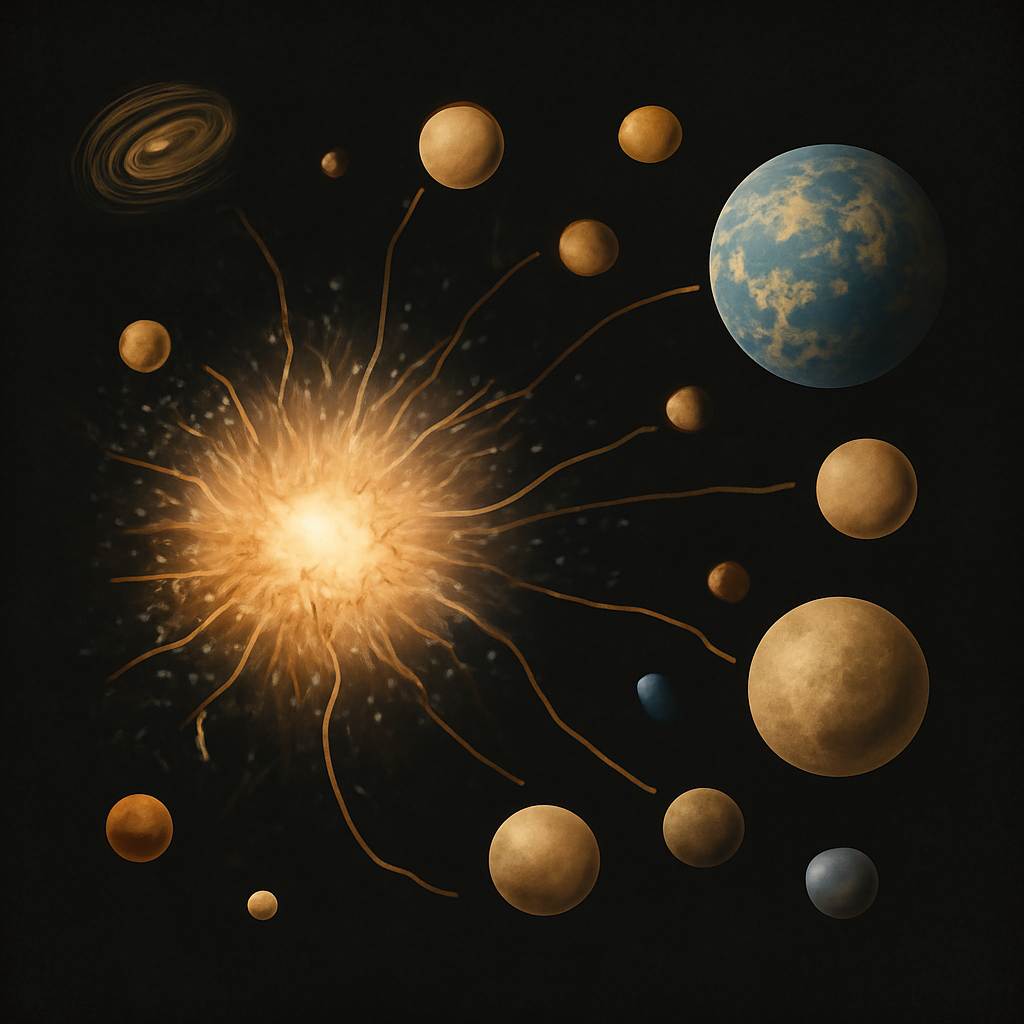
Imagine everything you see around you—the trees, the oceans, your phone, even the stars—squeezed into a tiny speck much smaller than a single grain of sand. About 13.8 billion years ago, this hot, crowded speck suddenly expanded. It was not a quiet puff of smoke; it was a sudden, violent stretching of space itself. We call this the Big Bang. In a tiny fraction of a second, the universe grew from nothing to something unimaginably vast, cooling down as it stretched.
Fast forward about nine billion years to the birth of our own planet. Out of the leftover dust and gas swirling around our young Sun, gravity started pulling giant rocks together. They crashed and melted, eventually forming a hot, liquid ball of rock. Over millions of years, the surface cooled into a hard crust, water filled the basins to make oceans, and the stage was set for us.
✨
Wonder Moment
“Our planet was once hit by a space rock four times the size of Mount Everest, but instead of wiping out everything, it actually delivered the essential nutrients that helped early life thrive.”
Reflect
If a destructive space collision could actually jumpstart life on Earth, what other chaotic cosmic events might be creating life elsewhere in the universe right now?
3 sources·Well-Established confidence·Investigated 15 Aug 2026(12 days ago)·Source-verified·May need refresh
Your next question, in
Visual Trail
See How It All Began: The Story of Our Universe
A guided visual explanation assembled from QE artwork and sourced documentary images.
01 / 05
QE visual interpretation
Frame 01
How It All Began: The Story of Our Universe
It all started 13.8 billion years ago when a tiny, super-hot speck suddenly stretched out to create space, time, and everything in our universe.
Image provenance and limitation
Source: AI-generated visual interpretation
Creator: Question Everything
Limitation: This image explains or evokes the subject. It is not documentary evidence and should not be used to verify a factual claim.
Evidence
What do we know?
Verified claims with confidence scoring and cited sources.
Living footnotes
Claims remain in the reading flow. Select a citation number to inspect the source behind it.
01
HistoricalSupported
Earth formed about 4.54 billion years ago from swirling dust and rocks left over from the birth of our Sun.
Imagine a giant cloud of dust and gas collapsing in space. This collapse formed our Sun. The leftover scraps swirled around the young star, crashing into each other and sticking together like giant snowballs. Over millions of years, these rocky clumps grew larger and larger until they became the rocky planets we know today, including Earth. It was a violent time filled with constant space collisions.
02
ObservationalSupported
A collision with a planet-sized body named Theia is believed to have formed our Moon.
When Earth was very young, it was not alone in its orbit. Scientists believe another planet, about the size of Mars, crashed right into us. This ancient planet was called Theia. The impact was so powerful that it blasted huge chunks of Earth's outer layer into space. These hot, rocky leftovers eventually clumped together to form the Moon we see in the sky tonight.
03
ExperimentalSupported
Early life on Earth likely began in shallow ponds or hot springs where sunlight could spark crucial chemical reactions.
Many people think life started in the deep, dark ocean. But scientific research suggests a different story. To build the basic building blocks of life, you need ultraviolet light from the Sun. This means life probably started on land in warm, shallow pools or volcanic hot springs. Here, sunlight and water mixed with chemical ingredients to create the very first self-replicating molecules.
The complete record below preserves every citation, confidence input and recorded limitation.
Read the full evidence record3 findings · citations · limitations
Evidence review3 findings3 openable sources
01
Finding 1 of 3Historical
2023
1 dated source
Earth formed about 4.54 billion years ago from swirling dust and rocks left over from the birth of our Sun.
Imagine a giant cloud of dust and gas collapsing in space. This collapse formed our Sun. The leftover scraps swirled around the young star, crashing into each other and sticking together like giant snowballs. Over millions of years, these rocky clumps grew larger and larger until they became the rocky planets we know today, including Earth. It was a violent time filled with constant space collisions.
Supportedmodel score 95%
One source, not peer-reviewed. Thinner than the score suggests.
REFERENCE
›View sources and limits— 1 citation, limits
Supporting passage
Imagine a giant cloud of dust and gas collapsing in space. This collapse formed our Sun. The leftover scraps swirled around the young star, crashing into each other and sticking together like giant snowballs. Over millions of years, these rocky clumps grew larger and larger until they became the rocky planets we know today, including Earth. It was a violent time filled with constant space collisions.
Rests on a single source. No independent corroboration.
No peer-reviewed source among the citations.
The generator scored this 95%, which would read as “Established”. Its citations reach only “Supported”, so that is what is shown.
02
Finding 2 of 3Observational
0/1 verified
A collision with a planet-sized body named Theia is believed to have formed our Moon.
When Earth was very young, it was not alone in its orbit. Scientists believe another planet, about the size of Mars, crashed right into us. This ancient planet was called Theia. The impact was so powerful that it blasted huge chunks of Earth's outer layer into space. These hot, rocky leftovers eventually clumped together to form the Moon we see in the sky tonight.
Supportedmodel score 90%
One source, not peer-reviewed. Thinner than the score suggests.
REFERENCE
›View sources and limits— 1 citation, limits
Supporting passage
When Earth was very young, it was not alone in its orbit. Scientists believe another planet, about the size of Mars, crashed right into us. This ancient planet was called Theia. The impact was so powerful that it blasted huge chunks of Earth's outer layer into space. These hot, rocky leftovers eventually clumped together to form the Moon we see in the sky tonight.
Rests on a single source. No independent corroboration.
No peer-reviewed source among the citations.
The generator scored this 90%, which would read as “Established”. Its citations reach only “Supported”, so that is what is shown.
03
Finding 3 of 3Experimental
1
0/1 verified
Early life on Earth likely began in shallow ponds or hot springs where sunlight could spark crucial chemical reactions.
Many people think life started in the deep, dark ocean. But scientific research suggests a different story. To build the basic building blocks of life, you need ultraviolet light from the Sun. This means life probably started on land in warm, shallow pools or volcanic hot springs. Here, sunlight and water mixed with chemical ingredients to create the very first self-replicating molecules.
Supportedmodel score 85%
One source, not peer-reviewed. Thinner than the score suggests.
REFERENCE
›View sources and limits— 1 citation, limits
Supporting passage
Many people think life started in the deep, dark ocean. But scientific research suggests a different story. To build the basic building blocks of life, you need ultraviolet light from the Sun. This means life probably started on land in warm, shallow pools or volcanic hot springs. Here, sunlight and water mixed with chemical ingredients to create the very first self-replicating molecules.
Rests on a single source. No independent corroboration.
No peer-reviewed source among the citations.
The generator scored this 85%, which would read as “Established”. Its citations reach only “Supported”, so that is what is shown.
Interactive Exploration
Touch, drag, and discover
These visualizations respond to your curiosity. Interact to go deeper.
timeline
The Timeline of Earth's Origins
Loading timeline…
process flow
How a Planet is Made
Cloud Collapse
Star Birth
Accretion Disk
Cosmic Clumping
Visual Gallery
Images & artifacts
Historical images, diagrams, and visual knowledge from Wikimedia Commons.
Perspectives
How is this interpreted?
Enter a viewpoint. Notice what it reveals, what it leaves out, and whether it changes the question for you.
The EmpiricistScientific viewpointEstablished lens
Scientists view the start of the world as a natural chain reaction of physics and chemistry. It began with the Big Bang, followed by gravity pulling dust together to make planets, and finally chemistry sparking life. There is no need for magic in this view; everything is explained by universal laws. By studying rocks, light, and space, we can piece together this beautiful, logical puzzle of our own cosmic history.
What this lens notices
01Gravity naturally forces cosmic dust to clump into planets.
02Chemical reactions driven by solar energy can create life's building blocks.
03The universe's history is written in the light of distant stars.
Application
Why does this matter to you?
Personal reflections and applications for your life.
Thought experimentSelf-Reflection
How does knowing you are made of stardust change how you view your daily worries?
Why it changes the question
Every atom in your body was forged inside an ancient dying star billions of years ago. Realizing this connects you directly to the deep history of the cosmos.
Try this
Step outside tonight, look at the stars, and remind yourself that you are literally a part of the universe looking back at itself.
Media
QE Smart Glass
Curated media selected for this investigation.
QE Glass
YOUTUBE
8 Hours Of Space & Our Extraordinary Universe | BBC Earth Science
BBC Earth Science
Sleep, study or get lost in the wonders of our Universe with our 8+ hours space compilation. Best of Earth Science: ...
No AI help here — no suggestions, no autocomplete, nothing finishing your sentences. That is deliberate. Working out what you think is effortful, and the effort is the part that changes you: reasoning is trained like a muscle, and a muscle that is always carried gets weaker. Let something else do the thinking and you keep the answer but lose the capacity to have reached it.
Write your current position.
Not what the page says. What you think, having read it.0 words · Nothing written yet.
Sign in to leave a mark. Your draft is saved here in the meantime.