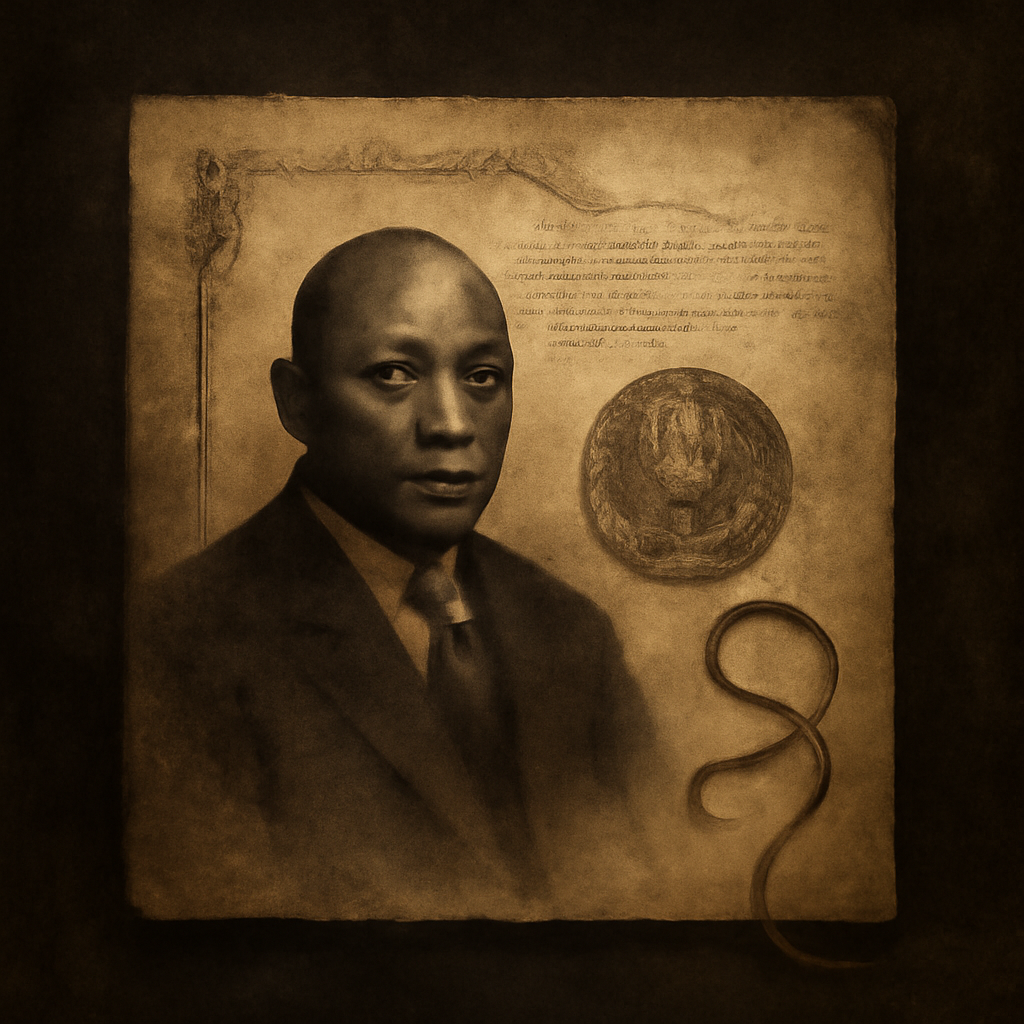
The Framing of Jack Johnson: Weaponizing the Mann Act
Jack Johnson was unstoppable. In 1908, he shattered boxing's color barrier to become the first Black heavyweight champion of the world. He was bold, wealthy, and unapologetic. Most infuriating to the white establishment of Jim Crow America, Johnson openly dated white women. Unable to defeat him in the ring, his enemies turned to the law. They found their weapon in the newly minted Mann Act of 1910, a statute designed to combat human trafficking across state lines.
The government twisted the law's vague wording about "immoral purposes." They prosecuted Johnson for traveling across state lines with his consensual white partner, Belle Schreiber. It was a targeted, racially motivated trap. Convicted by an all-white jury in 1913, the champion was forced into exile. This was not justice. It was a political hit job disguised as a moral crusade.
“The first Black world heavyweight champion, Jack Johnson, was sentenced to prison under a federal human trafficking law simply for traveling across state lines with his white partner.”
Reflect
How do we ensure that laws designed to protect the vulnerable are not turned into weapons against the marginalized?
Research·3 sources·Well-Established confidence·Investigated 5 Aug 2026(1 month ago)·Grounded; verification trace not recorded·Investigation may be outdated
Your next question, in
Visual Trail
See The Framing of Jack Johnson: Weaponizing the Mann Act
A guided visual explanation assembled from QE artwork and sourced documentary images.
01 / 02
QE visual interpretation
Frame 01
The Framing of Jack Johnson: Weaponizing the Mann Act
The US government weaponized a human trafficking law, the Mann Act, to target and silence Jack Johnson, the first Black heavyweight champion.
Image provenance and limitation
Source: AI-generated visual interpretation
Creator: Question Everything
Limitation: This image explains or evokes the subject. It is not documentary evidence and should not be used to verify a factual claim.
Evidence
What do we know?
Verified claims with confidence scoring and cited sources.
Living footnotes
Claims remain in the reading flow. Select a citation number to inspect the source behind it.
01
HistoricalSupported
The Mann Act was originally passed under the name of the White-Slave Traffic Act of 1910.
Congress passed this law during a wave of moral panic about forced prostitution. It banned transporting women across state lines for 'immoral purposes.' But the wording was incredibly vague. It did not define what 'immoral' meant. This loophole allowed federal agents to target consensual, private relationships instead of actual human trafficking networks.
02
HistoricalSupported
Federal investigators targeted Jack Johnson because of his relationships with white women.
Government officials began tracking Johnson almost immediately after the law passed. They were outraged by his success and his open relationships with white women. When his white wife, Lucille Cameron, refused to cooperate with prosecutors, investigators did not stop. They hunted down a former partner, Belle Schreiber, to build a case about a past train trip.
03
HistoricalSupported
Jack Johnson was convicted in 1913 and sentenced to a year in prison.
On May 13, 1913, an all-white jury convicted Johnson. He was sentenced to a year and a day in prison but fled the country to live in exile for years. He eventually returned to serve his time at Leavenworth. This conviction stands as a clear example of how the legal system can be manipulated to enforce racial hierarchies.
The complete record below preserves every citation, confidence input and recorded limitation.
Read the full evidence record3 findings · citations · limitations
Evidence review3 findings3 openable sources
01
Finding 1 of 3Historical
2004
1 dated source
The Mann Act was originally passed under the name of the White-Slave Traffic Act of 1910.
Congress passed this law during a wave of moral panic about forced prostitution. It banned transporting women across state lines for 'immoral purposes.' But the wording was incredibly vague. It did not define what 'immoral' meant. This loophole allowed federal agents to target consensual, private relationships instead of actual human trafficking networks.
Supportedmodel score 95%
One source, not peer-reviewed. Thinner than the score suggests.
REFERENCE
›View sources and limits— 1 citation, limits
Supporting passage
Congress passed this law during a wave of moral panic about forced prostitution. It banned transporting women across state lines for 'immoral purposes.' But the wording was incredibly vague. It did not define what 'immoral' meant. This loophole allowed federal agents to target consensual, private relationships instead of actual human trafficking networks.
Rests on a single source. No independent corroboration.
No peer-reviewed source among the citations.
The generator scored this 95%, which would read as “Established”. Its citations reach only “Supported”, so that is what is shown.
02
Finding 2 of 3Historical
2004
1 dated source
Federal investigators targeted Jack Johnson because of his relationships with white women.
Government officials began tracking Johnson almost immediately after the law passed. They were outraged by his success and his open relationships with white women. When his white wife, Lucille Cameron, refused to cooperate with prosecutors, investigators did not stop. They hunted down a former partner, Belle Schreiber, to build a case about a past train trip.
Supportedmodel score 95%
One source, not peer-reviewed. Thinner than the score suggests.
REFERENCE
›View sources and limits— 1 citation, limits
Supporting passage
Government officials began tracking Johnson almost immediately after the law passed. They were outraged by his success and his open relationships with white women. When his white wife, Lucille Cameron, refused to cooperate with prosecutors, investigators did not stop. They hunted down a former partner, Belle Schreiber, to build a case about a past train trip.
Rests on a single source. No independent corroboration.
No peer-reviewed source among the citations.
The generator scored this 95%, which would read as “Established”. Its citations reach only “Supported”, so that is what is shown.
03
Finding 3 of 3Historical
2013
1 dated source
Jack Johnson was convicted in 1913 and sentenced to a year in prison.
On May 13, 1913, an all-white jury convicted Johnson. He was sentenced to a year and a day in prison but fled the country to live in exile for years. He eventually returned to serve his time at Leavenworth. This conviction stands as a clear example of how the legal system can be manipulated to enforce racial hierarchies.
Supportedmodel score 95%
One source, not peer-reviewed. Thinner than the score suggests.
REFERENCE
›View sources and limits— 1 citation, limits
Supporting passage
On May 13, 1913, an all-white jury convicted Johnson. He was sentenced to a year and a day in prison but fled the country to live in exile for years. He eventually returned to serve his time at Leavenworth. This conviction stands as a clear example of how the legal system can be manipulated to enforce racial hierarchies.
Rests on a single source. No independent corroboration.
No peer-reviewed source among the citations.
The generator scored this 95%, which would read as “Established”. Its citations reach only “Supported”, so that is what is shown.
Interactive Exploration
Touch, drag, and discover
These visualizations respond to your curiosity. Interact to go deeper.
timeline
The Weaponization of the Mann Act
Loading timeline…
relationship map
The Web of Prosecution
Mapping relationships…
Drag nodes to rearrange — tap for details
Perspectives
How is this interpreted?
Enter a viewpoint. Notice what it reveals, what it leaves out, and whether it changes the question for you.
The HistorianHistorical viewpointLive tension
This viewpoint examines how the Mann Act served as an instrument of state-sponsored racial policing. Progressive Era reformers feared the changing social landscape of growing cities. They used the vague language of the law to punish Black men who dared to challenge the racial status quo. It was not about protecting women. It was about preserving white supremacy and control.
What this lens notices
01The law was used selectively against Black men
02Consensual relationships were criminalized
03Vague wording allowed for political targeting
Application
Why does this matter to you?
Personal reflections and applications for your life.
Thought experimentPhilosophical
How do you define fairness?
Why it changes the question
Think about the rules in your own community. Are any of them vague enough to be used unfairly against certain people?
Try this
Write down a rule you live by and try to rewrite it so it cannot be misinterpreted.
Media
QE Smart Glass
Curated media selected for this investigation.
QE Glass
YOUTUBE
Age of Jackson: Crash Course US History #14
CrashCourse
In which John Green teaches you about the presidency of Andrew Jackson So how did a president with astoundingly bad fiscal ...
QE Glass
YOUTUBE
The Black Panther Party: Crash Course Black American History #39
CrashCourse
Many organizations have made it their mission to expand the rights of Black Americans. The NAACP and the Urban League are ...
QE Glass
YOUTUBE
The War on Drugs: Crash Course Black American History #42
CrashCourse
The War on Drugs is a decades-long United States policy intended to curb illegal drug use and trafficking. Long story short: it has ...
QE Glass
YOUTUBE
Andrew Jackson - Good Evil & The Presidency - PBS Documentary
9/11 True Crimes
Copyright Disclaimer Under Section 107 of the Copyright Act 1976, allowance is made for "fair use" for purposes such as criticism, ...
QE Glass
YOUTUBE
The Rise and Fall of Richard Nixon | Full Documentary | American Experience PBS
American Experience | PBS
Richard Nixon — one of the most controversial and enduring figures on the American political landscape — is the subject of this ...
QE Glass
YOUTUBE
Inside Kennedy's Assassination: The Biggest Cover-Up In American Political History
Real Stories
The assassination of President John F. Kennedy remains the most debated and controversial moment in modern American history ...
QE Glass
YOUTUBE
Jack Johnson, Chuck Berry: The Weaponization of The Mann Act | Aisle Tell You What
Aisle Tell You What | A Love Black History Podcast
In our season 3 premiere episode, let's reminisce on the history of the Mann Act, a 1910 law intended to combat human trafficking ...
QE Glass
YOUTUBE
Unforgivable blackness: The rise and fall of Jack Johnson | book review| 4*
Indie Book Show Africa
Unforgivable Blackness: The Rise and Fall of Jack Johnson reviewed by Leslie Leigh. The story of a black boxer brought to life by ...
Keep Going
Where this leads
Questions this investigation opens up — and what QE has already looked into.
No AI help here — no suggestions, no autocomplete, nothing finishing your sentences. That is deliberate. Working out what you think is effortful, and the effort is the part that changes you: reasoning is trained like a muscle, and a muscle that is always carried gets weaker. Let something else do the thinking and you keep the answer but lose the capacity to have reached it.
Write your current position.
Not what the page says. What you think, having read it.0 words · Nothing written yet.
Sign in to leave a mark. Your draft is saved here in the meantime.