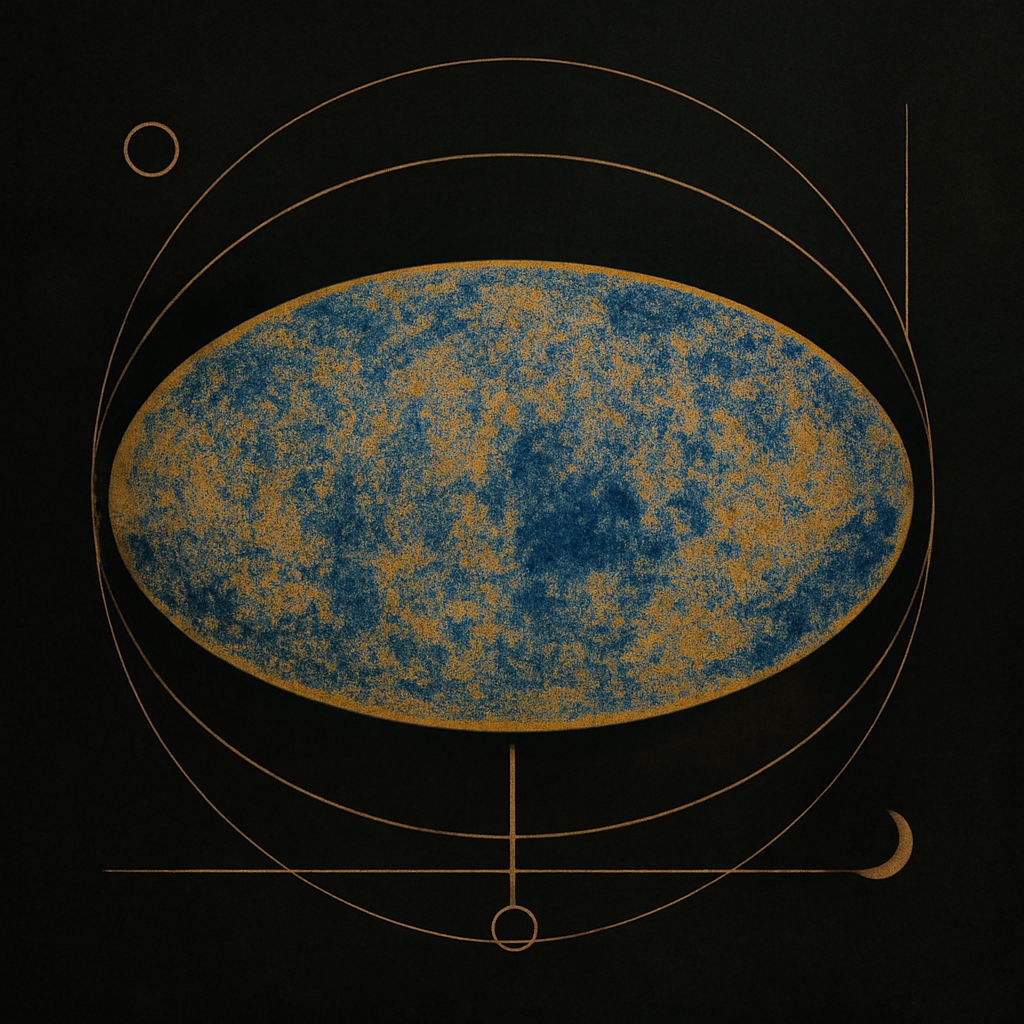
The Cosmic Microwave Background: Echoes of Creation
Imagine gazing into the past, not at ancient ruins or distant stars, but at the very genesis of time itself. The Cosmic Microwave Background (CMB) is precisely this: a faint, omnipresent glow of microwave radiation that bathes the entire universe, an ancient light released just 380,000 years after the Big Bang. It is the oldest light we can ever hope to observe, a direct snapshot of the universe when it was a mere infant, still hot and dense, before stars and galaxies had even begun to form.
This ethereal radiation, often called the 'afterglow' of the Big Bang, serves as a profound testament to our universe's violent beginning and subsequent evolution. Its subtle temperature variations, barely one part in 100,000, are not mere noise; they are the primordial ripples, the gravitational seeds from which all cosmic structures — from the smallest galaxy to the grandest supercluster — eventually blossomed. Unlocking the secrets of the CMB has transformed cosmology from a speculative field into a precision science, offering an unprecedented window into the fundamental forces that sculpted the cosmos.
✨
Wonder Moment
“The faint static you sometimes hear on an untuned analog radio or old TV (about 1% of the total signal) is actually the Cosmic Microwave Background — the literal 'echo' of the Big Bang, coming from every direction in the universe.”
Reflect
If the CMB is the oldest light, effectively a photograph of the universe at infancy, what would it mean to eventually detect an even earlier 'signal' — perhaps from gravitational waves generated during inflation — that precedes even light?
9 sources·Established confidence·Investigated 25 Jun 2026(2 months ago)·Investigation may be outdated
Your next question, in
Visual Trail
See The Cosmic Microwave Background: Echoes of Creation
A guided visual explanation assembled from QE artwork and sourced documentary images.
01 / 05
QE visual interpretation
Frame 01
The Cosmic Microwave Background: Echoes of Creation
The Cosmic Microwave Background is the oldest light in the universe, a direct echo of the Big Bang and a blueprint for cosmic structure.
Image provenance and limitation
Source: AI-generated visual interpretation
Creator: Question Everything
Limitation: This image explains or evokes the subject. It is not documentary evidence and should not be used to verify a factual claim.
Evidence
What do we know?
Verified claims with confidence scoring and cited sources.
Generated without source retrieval. QE did not fetch sources for this investigation, so no citation here was checked against a retrieved set. Claims reflect the model’s training data.
Living footnotes
Claims remain in the reading flow. Select a citation number to inspect the source behind it.
01
ObservationalSupported
The Cosmic Microwave Background (CMB) was accidentally discovered in 1964 by Arno Penzias and Robert Wilson.
While working at Bell Labs, Penzias and Wilson were testing a new horn antenna designed for satellite communication. They detected a persistent, annoying static, a faint hiss that seemed to come from every direction in the sky, independent of Earth's rotation or galactic position. Initially attributing it to equipment malfunction or even pigeon droppings, they meticulously removed all potential terrestrial interference. Unbeknownst to them, a team at Princeton University, led by Robert Dicke, had theoretically predicted the existence of such radiation as a leftover relic from the Big Bang. When the two teams connected, the accidental discovery was confirmed, providing the first robust observational evidence for the Big Bang theory. Penzias and Wilson were awarded the Nobel Prize in Physics in 1978 for their discovery.
This serendipitous finding marked a turning point in cosmology, shifting the debate definitively towards the Big Bang model over the competing Steady State theory. The CMB's uniform nature and blackbody spectrum, later confirmed with extreme precision by COBE, WMAP, and Planck missions, perfectly matched theoretical predictions for an expanding, cooling universe that originated from a hot, dense state.
02
AcademicSupported
The CMB represents the universe's 'last scattering surface,' originating when the universe was approximately 380,000 years old and had cooled sufficiently for atoms to form.
In the very early universe, the cosmos was a scorching hot, dense plasma of charged particles — electrons, protons, and helium nuclei — where photons were constantly scattering off free electrons, unable to travel far. This state is often likened to a fog, making the universe opaque. As the universe expanded, it cooled. Approximately 380,000 years after the Big Bang, the temperature dropped to around 3,000 Kelvin (about 2,700 degrees Celsius), allowing electrons to combine with atomic nuclei to form stable, neutral atoms (primarily hydrogen and helium).
This event, known as 'recombination,' dramatically reduced the number of free electrons. Consequently, photons were no longer constantly scattered and could 'decouple' from matter, streaming freely through space. These decoupled photons, having travelled across the vast expanse of the expanding universe for billions of years, constitute the CMB we observe today. Due to cosmic expansion, their wavelengths have been stretched (redshifted) into the microwave part of the electromagnetic spectrum, and their effective temperature has plummeted to just 2.725 Kelvin above absolute zero.
03
ObservationalSupported
Minute temperature fluctuations (anisotropies) in the CMB are the 'seeds' for all large-scale structure in the universe.
While remarkably uniform, the CMB is not perfectly smooth. Satellite missions like COBE, WMAP, and Planck have detected tiny temperature variations — anisotropies — in the CMB, on the order of just a few tens of microkelvin (about 1 part in 100,000). These slight differences in temperature correspond to regions of slightly higher or lower density in the early universe, long before galaxies or stars formed. These density fluctuations were gravitationally unstable: denser regions had a slightly stronger gravitational pull, attracting more matter over time.
Over billions of years, these tiny primordial seeds of density grew, eventually collapsing to form the first stars, then galaxies, and finally the vast cosmic web of galaxy clusters and superclusters we observe today. The precise pattern and amplitude of these anisotropies, meticulously mapped by these missions, provide crucial data for testing and refining the standard model of cosmology, including the amounts of dark matter and dark energy, and the properties of the early universe.
04
ExperimentalSupported
The polarization of the CMB can provide clues about the universe's inflationary epoch and gravitational waves.
Just like light reflected off a surface, the photons of the CMB can be polarized, meaning their electromagnetic waves oscillate in a preferred direction. There are two main types of CMB polarization: E-modes and B-modes. E-modes are generated by density variations (the same ones that create temperature anisotropies) and are readily observed. B-modes, however, are a much fainter and more challenging signal to detect. They are particularly exciting because they can be produced by two phenomena: gravitational lensing of E-modes by foreground matter, or, more tantalizingly, by primordial gravitational waves generated during the universe's rapid 'inflationary' epoch.
Detecting primordial B-modes would provide direct evidence for cosmic inflation, a theoretical period of exponential expansion immediately after the Big Bang that elegantly solves several outstanding cosmological puzzles. While experiments like BICEP2 initially reported a detection of primordial B-modes, subsequent analysis by the Planck mission showed that much of the signal was attributable to galactic dust. The search for clear, unequivocal primordial B-modes continues with ongoing experiments, representing one of the holy grails of modern cosmology and offering a window into physics at incredibly high energies in the very, very early universe.
The complete record below preserves every citation, confidence input and recorded limitation.
Read the full evidence record4 findings · citations · limitations
Evidence review4 findings9 openable sources
01
Finding 1 of 4Observational
0/2 verified
The Cosmic Microwave Background (CMB) was accidentally discovered in 1964 by Arno Penzias and Robert Wilson.
While working at Bell Labs, Penzias and Wilson were testing a new horn antenna designed for satellite communication. They detected a persistent, annoying static, a faint hiss that seemed to come from every direction in the sky, independent of Earth's rotation or galactic position. Initially attributing it to equipment malfunction or even pigeon droppings, they meticulously removed all potential terrestrial interference. Unbeknownst to them, a team at Princeton University, led by Robert Dicke, had theoretically predicted the existence of such radiation as a leftover relic from the Big Bang. When the two teams connected, the accidental discovery was confirmed, providing the first robust observational evidence for the Big Bang theory. Penzias and Wilson were awarded the Nobel Prize in Physics in 1978 for their discovery.
This serendipitous finding marked a turning point in cosmology, shifting the debate definitively towards the Big Bang model over the competing Steady State theory. The CMB's uniform nature and blackbody spectrum, later confirmed with extreme precision by COBE, WMAP, and Planck missions, perfectly matched theoretical predictions for an expanding, cooling universe that originated from a hot, dense state.
Supportedmodel score 100%
2 sources agree, none peer-reviewed.
REPORTINGREFERENCE
›View sources and limits— 2 citations, limits
Supporting passage
While working at Bell Labs, Penzias and Wilson were testing a new horn antenna designed for satellite communication. They detected a persistent, annoying static, a faint hiss that seemed to come from every direction in the sky, independent of Earth's rotation or galactic position. Initially attributing it to equipment malfunction or even pigeon droppings, they meticulously removed all potential terrestrial interference. Unbeknownst to them, a team at Princeton University, led by Robert Dicke, had theoretically predicted the existence of such radiation as a leftover relic from the Big Bang. When the two teams connected, the accidental discovery was confirmed, providing the first robust observational evidence for the Big Bang theory. Penzias and Wilson were awarded the Nobel Prize in Physics in 1978 for their discovery.
This serendipitous finding marked a turning point in cosmology, shifting the debate definitively towards the Big Bang model over the competing Steady State theory. The CMB's uniform nature and blackbody spectrum, later confirmed with extreme precision by COBE, WMAP, and Planck missions, perfectly matched theoretical predictions for an expanding, cooling universe that originated from a hot, dense state.
Generated without source retrieval — citations here were not verified against a retrieved set.
No peer-reviewed source among the citations.
The generator scored this 100%, which would read as “Established”. Its citations reach only “Supported”, so that is what is shown.
02
Finding 2 of 4Academic
2
0/2 verified
The CMB represents the universe's 'last scattering surface,' originating when the universe was approximately 380,000 years old and had cooled sufficiently for atoms to form.
In the very early universe, the cosmos was a scorching hot, dense plasma of charged particles — electrons, protons, and helium nuclei — where photons were constantly scattering off free electrons, unable to travel far. This state is often likened to a fog, making the universe opaque. As the universe expanded, it cooled. Approximately 380,000 years after the Big Bang, the temperature dropped to around 3,000 Kelvin (about 2,700 degrees Celsius), allowing electrons to combine with atomic nuclei to form stable, neutral atoms (primarily hydrogen and helium).
This event, known as 'recombination,' dramatically reduced the number of free electrons. Consequently, photons were no longer constantly scattered and could 'decouple' from matter, streaming freely through space. These decoupled photons, having travelled across the vast expanse of the expanding universe for billions of years, constitute the CMB we observe today. Due to cosmic expansion, their wavelengths have been stretched (redshifted) into the microwave part of the electromagnetic spectrum, and their effective temperature has plummeted to just 2.725 Kelvin above absolute zero.
Supportedmodel score 100%
2 sources agree, 2 peer-reviewed.
PRIMARY STUDY ×2
›View sources and limits— 2 citations, limits
Supporting passage
In the very early universe, the cosmos was a scorching hot, dense plasma of charged particles — electrons, protons, and helium nuclei — where photons were constantly scattering off free electrons, unable to travel far. This state is often likened to a fog, making the universe opaque. As the universe expanded, it cooled. Approximately 380,000 years after the Big Bang, the temperature dropped to around 3,000 Kelvin (about 2,700 degrees Celsius), allowing electrons to combine with atomic nuclei to form stable, neutral atoms (primarily hydrogen and helium).
This event, known as 'recombination,' dramatically reduced the number of free electrons. Consequently, photons were no longer constantly scattered and could 'decouple' from matter, streaming freely through space. These decoupled photons, having travelled across the vast expanse of the expanding universe for billions of years, constitute the CMB we observe today. Due to cosmic expansion, their wavelengths have been stretched (redshifted) into the microwave part of the electromagnetic spectrum, and their effective temperature has plummeted to just 2.725 Kelvin above absolute zero.
Generated without source retrieval — citations here were not verified against a retrieved set.
The generator scored this 100%, which would read as “Established”. Its citations reach only “Supported”, so that is what is shown.
03
Finding 3 of 4Observational
0/3 verified
Minute temperature fluctuations (anisotropies) in the CMB are the 'seeds' for all large-scale structure in the universe.
While remarkably uniform, the CMB is not perfectly smooth. Satellite missions like COBE, WMAP, and Planck have detected tiny temperature variations — anisotropies — in the CMB, on the order of just a few tens of microkelvin (about 1 part in 100,000). These slight differences in temperature correspond to regions of slightly higher or lower density in the early universe, long before galaxies or stars formed. These density fluctuations were gravitationally unstable: denser regions had a slightly stronger gravitational pull, attracting more matter over time.
Over billions of years, these tiny primordial seeds of density grew, eventually collapsing to form the first stars, then galaxies, and finally the vast cosmic web of galaxy clusters and superclusters we observe today. The precise pattern and amplitude of these anisotropies, meticulously mapped by these missions, provide crucial data for testing and refining the standard model of cosmology, including the amounts of dark matter and dark energy, and the properties of the early universe.
Supportedmodel score 99%
3 sources agree, 2 peer-reviewed.
PRIMARY STUDY ×2REPORTING
›View sources and limits— 3 citations, limits
Supporting passage
While remarkably uniform, the CMB is not perfectly smooth. Satellite missions like COBE, WMAP, and Planck have detected tiny temperature variations — anisotropies — in the CMB, on the order of just a few tens of microkelvin (about 1 part in 100,000). These slight differences in temperature correspond to regions of slightly higher or lower density in the early universe, long before galaxies or stars formed. These density fluctuations were gravitationally unstable: denser regions had a slightly stronger gravitational pull, attracting more matter over time.
Over billions of years, these tiny primordial seeds of density grew, eventually collapsing to form the first stars, then galaxies, and finally the vast cosmic web of galaxy clusters and superclusters we observe today. The precise pattern and amplitude of these anisotropies, meticulously mapped by these missions, provide crucial data for testing and refining the standard model of cosmology, including the amounts of dark matter and dark energy, and the properties of the early universe.
Generated without source retrieval — citations here were not verified against a retrieved set.
The generator scored this 99%, which would read as “Established”. Its citations reach only “Supported”, so that is what is shown.
04
Finding 4 of 4Experimental
2
0/2 verified
The polarization of the CMB can provide clues about the universe's inflationary epoch and gravitational waves.
Just like light reflected off a surface, the photons of the CMB can be polarized, meaning their electromagnetic waves oscillate in a preferred direction. There are two main types of CMB polarization: E-modes and B-modes. E-modes are generated by density variations (the same ones that create temperature anisotropies) and are readily observed. B-modes, however, are a much fainter and more challenging signal to detect. They are particularly exciting because they can be produced by two phenomena: gravitational lensing of E-modes by foreground matter, or, more tantalizingly, by primordial gravitational waves generated during the universe's rapid 'inflationary' epoch.
Detecting primordial B-modes would provide direct evidence for cosmic inflation, a theoretical period of exponential expansion immediately after the Big Bang that elegantly solves several outstanding cosmological puzzles. While experiments like BICEP2 initially reported a detection of primordial B-modes, subsequent analysis by the Planck mission showed that much of the signal was attributable to galactic dust. The search for clear, unequivocal primordial B-modes continues with ongoing experiments, representing one of the holy grails of modern cosmology and offering a window into physics at incredibly high energies in the very, very early universe.
Supportedmodel score 90%
2 sources agree, 2 peer-reviewed.
PRIMARY STUDY ×2
›View sources and limits— 2 citations, limits
Supporting passage
Just like light reflected off a surface, the photons of the CMB can be polarized, meaning their electromagnetic waves oscillate in a preferred direction. There are two main types of CMB polarization: E-modes and B-modes. E-modes are generated by density variations (the same ones that create temperature anisotropies) and are readily observed. B-modes, however, are a much fainter and more challenging signal to detect. They are particularly exciting because they can be produced by two phenomena: gravitational lensing of E-modes by foreground matter, or, more tantalizingly, by primordial gravitational waves generated during the universe's rapid 'inflationary' epoch.
Detecting primordial B-modes would provide direct evidence for cosmic inflation, a theoretical period of exponential expansion immediately after the Big Bang that elegantly solves several outstanding cosmological puzzles. While experiments like BICEP2 initially reported a detection of primordial B-modes, subsequent analysis by the Planck mission showed that much of the signal was attributable to galactic dust. The search for clear, unequivocal primordial B-modes continues with ongoing experiments, representing one of the holy grails of modern cosmology and offering a window into physics at incredibly high energies in the very, very early universe.
Generated without source retrieval — citations here were not verified against a retrieved set.
The generator scored this 90%, which would read as “Established”. Its citations reach only “Supported”, so that is what is shown.
Interactive Exploration
Touch, drag, and discover
These visualizations respond to your curiosity. Interact to go deeper.
timeline
Key Milestones in CMB Discovery & Research
Loading timeline…
statistics card
Key CMB Statistics
2.725 K
Current CMB Temperature
Just 2.725 degrees Celsius above absolute zero, after billions of years of cooling.
~380,000 years
Universe's Age at Decoupling
When the universe cooled enough for photons to stream freely, forming the CMB.
1 part in 100,000
Magnitude of Anisotropies
The tiny temperature fluctuations that seeded all cosmic structure.
13.8 Billion years
CMB Photon Travel Time
The approximate age of the universe, representing the distance the CMB photons have traveled.
process flow
The Formation of the Cosmic Microwave Background (CMB)
Primordial Plasma (Universe < 380,000 years old)
Cosmic Expansion & Cooling
Recombination (~380,000 years)
Photon Decoupling (The CMB Emerges)
Redshifting & Cooling (Today)
relationship map
CMB's Connections to Cosmology
Mapping relationships…
Drag nodes to rearrange — tap for details
Visual Gallery
Images & artifacts
Historical images, diagrams, and visual knowledge from Wikimedia Commons.
Perspectives
How is this interpreted?
Enter a viewpoint. Notice what it reveals, what it leaves out, and whether it changes the question for you.
The EmpiricistScientific viewpointEstablished lens
From a scientific standpoint, the Cosmic Microwave Background is a cornerstone of the Big Bang model and the foundation of modern precision cosmology. Its perfect blackbody spectrum, slight temperature anisotropies, and observed polarization patterns align remarkably well with theoretical predictions, providing the strongest empirical evidence for an expanding universe that originated from a hot, dense state. The CMB allows cosmologists to 'see' the universe at a time just a few hundred thousand years old, long before any stars or galaxies existed, offering critical data points that constrain cosmological parameters with unprecedented accuracy.
The detailed maps of the CMB's anisotropies, particularly from missions like Planck, have enabled scientists to determine the age of the universe, its expansion rate (Hubble constant), and the precise cosmic inventory of ordinary matter, dark matter, and dark energy. Furthermore, the search for specific polarization patterns (B-modes) continues to be a frontier, holding the promise of detecting the direct imprints of primordial gravitational waves generated during the inflationary epoch, which would further solidify our understanding of the universe's earliest moments and fundamental physics at extremely high energies.
What this lens notices
01Provides direct observational evidence for the Big Bang.
02Confirms the universe's expansion and cooling from a hot, dense state.
03Its anisotropies explain the origin of large-scale cosmic structure.
04Allows precise measurement of cosmological parameters (age, composition).
Application
Why does this matter to you?
Personal reflections and applications for your life.
Thought experimentSelf-Reflection
How does knowing we are observing the 'afterglow' of the Big Bang change your perception of time and your place in the universe?
Why it changes the question
Understanding the CMB connects us directly to the earliest moments of cosmic history. It shifts our perspective from viewing human civilization as ancient to recognizing its incredibly brief flicker in a cosmic timeline stretching back nearly 13.8 billion years. This insight can foster a sense of humility, wonder, and a profound appreciation for the forces that have shaped everything around us. It encourages us to contemplate our fleeting existence against the backdrop of an immense and ancient cosmos.
Try this
Spend some time stargazing, consciously contemplating the light traveling from distant galaxies, knowing that the 'empty' space between them is filled with the oldest light in the universe.
Media
QE Smart Glass
Curated media selected for this investigation.
QE Glass
YOUTUBE
Cosmic Microwave Background Explained
PBS Space Time
Want to ask some sort of crazy question about Space?: Tweet at us! @pbsspacetime Facebook: facebook.com/pbsspacetime ...
QE Glass
YOUTUBE
Decoding the Universe: Quantum | Full Documentary | NOVA | PBS
NOVA PBS Official
Dive into the universe at the tiniest – and weirdest – of scales. Official Website: https://to.pbs.org/3CkDYDR | #novapbs When we ...
QE Glass
YOUTUBE
Decoding the Universe: Cosmos | Full Documentary | NOVA | PBS
NOVA PBS Official
Explore big discoveries that have revolutionized our understanding of the universe. Official Website: https://to.pbs.org/3QMiyEm ...
QE Glass
YOUTUBE
Cosmic Microwave Background Radiation
Khan Academy
Courses on Khan Academy are always 100% free. Start practicing—and saving your progress—now: ...
QE Glass
YOUTUBE
What is the Cosmic Microwave Background Radiation? And what does it mean?
Physics Explained
This video provides an overview of the accidental discovery and explanation of the cosmic microwave background radiation, the ...
QE Glass
YOUTUBE
The Mystery of the Cosmic Microwave Background Explained | Space Documentary [4K]
Cosmic Crossroads
The cosmic microwave background (CMB) is like a snapshot of the universe when it was just a baby, only 380000 years old!
QE Glass
YOUTUBE
Cosmic Microwave Background: The Oldest Light in the Universe!
The Science Asylum
The cosmic microwave background, or CMB, is the oldest light in the universe. It's a remnant of the hot dense cosmic past.
QE Glass
YOUTUBE
What is the Cosmic Microwave Background?
Fermilab
The Cosmic Microwave Background, or CMB, is the remnant of the primordial fireball of the Big Bang. In this video, Fermilab's Dr.
QE Glass
PODCAST
From Alpha to Omega (part of series on beginnings)
Radiolab
While not solely focused on CMB, Radiolab often explores the nature of beginnings and scientific discovery in a compelling, narrative-driven style, likely touching on the CMB's role in the Big Bang story.
QE Glass
PODCAST
Mindscape Podcast: Discussing the Early Universe with a Cosmologist
Mindscape with Sean Carroll
Sean Carroll, a renowned physicist, often interviews leading cosmologists who delve into the latest findings and theories related to the CMB and the early universe, offering expert perspectives.
Connected context
Connected entities
The people, places, concepts, and events that matter here.
Keep Going
Where this leads
Questions this investigation opens up — and what QE has already looked into.
No AI help here — no suggestions, no autocomplete, nothing finishing your sentences. That is deliberate. Working out what you think is effortful, and the effort is the part that changes you: reasoning is trained like a muscle, and a muscle that is always carried gets weaker. Let something else do the thinking and you keep the answer but lose the capacity to have reached it.
Write your current position.
Not what the page says. What you think, having read it.0 words · Nothing written yet.
Sign in to leave a mark. Your draft is saved here in the meantime.