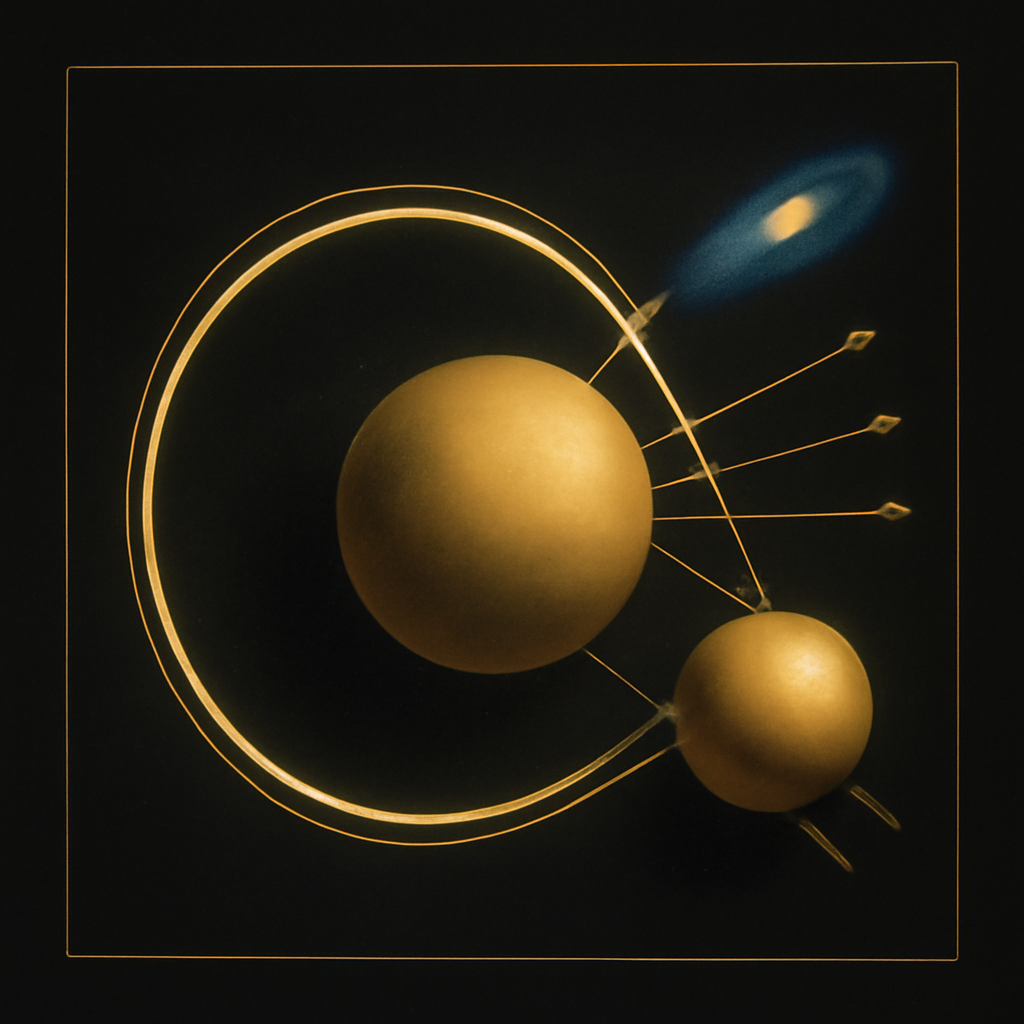
Space's Cosmic Magnifying Glasses: The Magic of Gravitational Lensing
Imagine space is a giant trampoline. If you drop a heavy bowling ball onto it, the fabric stretches and curves. That is exactly what massive galaxies do to the universe. When light from a distant star travels past one of these heavy spots, it cannot go in a straight line anymore. Instead, it slides along the curve, bending like light passing through a glass magnifying glass. This is gravitational lensing.
This cosmic trick does two amazing things. First, it acts as a natural telescope, boosting the light of incredibly distant stars so we can actually see them. Second, it exposes the invisible. By measuring how much the light bends, scientists can map out dark matter. This is the mysterious, invisible stuff that makes up most of our universe but normally hides in total darkness.
“The universe has its own built-in telescopes. By using the gravity of entire galaxies to bend light, we can see objects that are so far away their light has been traveling to us since the dawn of time.”
Reflect
If gravity can bend light, could there be parts of the night sky where we are actually looking at a warped reflection of our own galaxy from billions of years ago?
Research·3 sources·Well-Established confidence·Investigated 1 Aug 2026(1 month ago)·Grounded; verification trace not recorded·Investigation may be outdated
Your next question, in
Visual Trail
See Space's Cosmic Magnifying Glasses: The Magic of Gravitational Lensing
A guided visual explanation assembled from QE artwork and sourced documentary images.
01 / 05
QE visual interpretation
Frame 01
Space's Cosmic Magnifying Glasses: The Magic of Gravitational Lensing
Massive objects bend the fabric of space, acting like giant magnifying glasses that reveal invisible dark matter and distant galaxies.
Image provenance and limitation
Source: AI-generated visual interpretation
Creator: Question Everything
Limitation: This image explains or evokes the subject. It is not documentary evidence and should not be used to verify a factual claim.
Evidence
What do we know?
Verified claims with confidence scoring and cited sources.
Living footnotes
Claims remain in the reading flow. Select a citation number to inspect the source behind it.
01
ObservationalSupported
Heavy things in space bend the path of light by warping the fabric of space itself.
Imagine space is a giant trampoline. If you drop a heavy bowling ball onto it, the fabric stretches and sinks. That is what massive things like clusters of galaxies do to space. When light from a distant star travels past this heavy object, it cannot go in a straight line. Instead, it follows the curves in space, bending like light passing through a glass lens. Albert Einstein predicted this, and we first saw it happen during a solar eclipse in 1919.
02
ObservationalSupported
Gravitational lensing lets scientists find and map invisible dark matter in the universe.
Most of the stuff in our universe is completely invisible. We call it dark matter. It does not shine or block light, so we cannot see it directly. But it still has weight, which means it pulls on space and bends light. By looking at how background galaxies are stretched and twisted, scientists can work backward to map out where this invisible matter is hiding. It is like seeing water drops on a window by watching how the view behind them changes.
03
ObservationalSupported
Space telescopes use gravitational lensing as a natural magnifying glass to see the most distant galaxies.
Some galaxies are so far away and faint that even our best telescopes cannot spot them on their own. Fortunately, nature gives us a boost. When a massive cluster of galaxies sits directly between us and a far-off target, it acts like a giant magnifying glass. It boosts the light and makes the distant object look much brighter and larger. This cosmic trick has allowed telescopes like Hubble and James Webb to capture pictures of galaxies that formed just after the Big Bang.
The complete record below preserves every citation, confidence input and recorded limitation.
Read the full evidence record3 findings · citations · limitations
Evidence review3 findings3 openable sources
01
Finding 1 of 3Observational
0/1 verified
Heavy things in space bend the path of light by warping the fabric of space itself.
Imagine space is a giant trampoline. If you drop a heavy bowling ball onto it, the fabric stretches and sinks. That is what massive things like clusters of galaxies do to space. When light from a distant star travels past this heavy object, it cannot go in a straight line. Instead, it follows the curves in space, bending like light passing through a glass lens. Albert Einstein predicted this, and we first saw it happen during a solar eclipse in 1919.
Supportedmodel score 100%
One source, not peer-reviewed. Thinner than the score suggests.
REFERENCE
›View sources and limits— 1 citation, limits
Supporting passage
Imagine space is a giant trampoline. If you drop a heavy bowling ball onto it, the fabric stretches and sinks. That is what massive things like clusters of galaxies do to space. When light from a distant star travels past this heavy object, it cannot go in a straight line. Instead, it follows the curves in space, bending like light passing through a glass lens. Albert Einstein predicted this, and we first saw it happen during a solar eclipse in 1919.
1 of 2 citations failed verification and are not shown.
Rests on a single source. No independent corroboration.
No peer-reviewed source among the citations.
The generator scored this 100%, which would read as “Established”. Its citations reach only “Supported”, so that is what is shown.
02
Finding 2 of 3Observational
0/1 verified
Gravitational lensing lets scientists find and map invisible dark matter in the universe.
Most of the stuff in our universe is completely invisible. We call it dark matter. It does not shine or block light, so we cannot see it directly. But it still has weight, which means it pulls on space and bends light. By looking at how background galaxies are stretched and twisted, scientists can work backward to map out where this invisible matter is hiding. It is like seeing water drops on a window by watching how the view behind them changes.
Supportedmodel score 95%
One source, not peer-reviewed. Thinner than the score suggests.
REFERENCE
›View sources and limits— 1 citation, limits
Supporting passage
Most of the stuff in our universe is completely invisible. We call it dark matter. It does not shine or block light, so we cannot see it directly. But it still has weight, which means it pulls on space and bends light. By looking at how background galaxies are stretched and twisted, scientists can work backward to map out where this invisible matter is hiding. It is like seeing water drops on a window by watching how the view behind them changes.
1 of 2 citations failed verification and are not shown.
Rests on a single source. No independent corroboration.
No peer-reviewed source among the citations.
The generator scored this 95%, which would read as “Established”. Its citations reach only “Supported”, so that is what is shown.
03
Finding 3 of 3Observational
0/1 verified
Space telescopes use gravitational lensing as a natural magnifying glass to see the most distant galaxies.
Some galaxies are so far away and faint that even our best telescopes cannot spot them on their own. Fortunately, nature gives us a boost. When a massive cluster of galaxies sits directly between us and a far-off target, it acts like a giant magnifying glass. It boosts the light and makes the distant object look much brighter and larger. This cosmic trick has allowed telescopes like Hubble and James Webb to capture pictures of galaxies that formed just after the Big Bang.
Supportedmodel score 98%
One source, not peer-reviewed. Thinner than the score suggests.
REFERENCE
›View sources and limits— 1 citation, limits
Supporting passage
Some galaxies are so far away and faint that even our best telescopes cannot spot them on their own. Fortunately, nature gives us a boost. When a massive cluster of galaxies sits directly between us and a far-off target, it acts like a giant magnifying glass. It boosts the light and makes the distant object look much brighter and larger. This cosmic trick has allowed telescopes like Hubble and James Webb to capture pictures of galaxies that formed just after the Big Bang.
1 of 2 citations failed verification and are not shown.
Rests on a single source. No independent corroboration.
No peer-reviewed source among the citations.
The generator scored this 98%, which would read as “Established”. Its citations reach only “Supported”, so that is what is shown.
Interactive Exploration
Touch, drag, and discover
These visualizations respond to your curiosity. Interact to go deeper.
process flow
How Light Travels Through a Gravity Lens
Light Leaves the Source
Meeting the Lens
Bending Space
Reaching Earth
statistics card
The Scale of Cosmic Lensing
1919
First Proof
The year scientists first saw stars shift position during a solar eclipse, proving space bends.
100%
Einstein Ring
A perfect circle of light created when a background galaxy aligns perfectly behind a cosmic lens.
2x to 30x
Magnification Boost
How much a gravity lens can brighten distant, faint galaxies for our space telescopes.
Visual Gallery
Images & artifacts
Historical images, diagrams, and visual knowledge from Wikimedia Commons.
Perspectives
How is this interpreted?
Enter a viewpoint. Notice what it reveals, what it leaves out, and whether it changes the question for you.
The EmpiricistScientific viewpointEstablished lens
To astronomers, gravitational lensing is the ultimate scale. By analyzing how much light bends, scientists can calculate the weight of massive objects we can never touch. It is our best tool for studying dark energy, weighing entire galaxies, and even finding tiny planets around distant stars. It turns the cosmos into a giant physics lab, proving that gravity is not just an invisible pull, but the actual bending of space and time.
What this lens notices
01Allows us to weigh invisible dark matter
02Magnifies objects that are too faint for normal telescopes
03Confirms Einstein's theory of gravity with extreme precision
Application
Why does this matter to you?
Personal reflections and applications for your life.
Thought experimentSelf-Reflection
How often do you mistake a distorted view for the absolute truth?
Why it changes the question
Just as massive gravity warps the light from distant stars, our personal biases and experiences warp how we see the world. We rarely see things exactly as they are; we see them filtered through our own lenses.
Try this
Next time you disagree with someone, try to identify what personal 'lens' (like fear, past hurt, or pride) might be warping your view of the situation.
Media
QE Smart Glass
Curated media selected for this investigation.
QE Glass
YOUTUBE
How are Distant Galaxies Magnified Through Gravitational Lensing?
James Webb Space Telescope (JWST)
How can scientists study galaxies so far away that they're beyond the reach of the most powerful space telescopes? They take ...
QE Glass
YOUTUBE
Gravitational Lensing: What It Is And How It Is Helping Us Discover New Galaxies
Science ABC
What is gravitational lensing and how is it helping us discover hidden galaxies? In this video, we explain how gravity itself acts as ...
QE Glass
YOUTUBE
10 Mind Blowing Gravitational Lensing Events in Space
John Michael Godier
And exploration of 10 Mind Blowing Gravitational Lensing Events in Space. My new clips channel: ...
QE Glass
YOUTUBE
The Solar Gravitational Lens will Map Exoplanets. Seriously.
Launch Pad Astronomy
The Solar Gravitational Lens will Map Exoplanets. Seriously, there's a real plan to do just that. Using the Sun to gravitationally lens ...
QE Glass
YOUTUBE
Gravitational Lensing, The Furthest Galaxies, Light, Electrons, and Life in the Universe | ASMR
Let's Find Out
Want to leave a tip or connect?: https://linktr.ee/letsfindoutasmr Tonight is a look across the Universe. We begin with the first ever ...
QE Glass
YOUTUBE
The Strange Universe of Gravitational Lensing
PBS Space Time
Is what we see in the night sky a true representation of our universe? Find out about Gravitational Lensing in this episode and ...
QE Glass
PODCAST
What is gravitational lensing?
Daniel and Jorge Explain the Universe
An easy-to-follow audio guide that breaks down the physics of bent light using simple, everyday analogies.
Connected context
Connected entities
The people, places, concepts, and events that matter here.
Keep Going
Where this leads
Questions this investigation opens up — and what QE has already looked into.
No AI help here — no suggestions, no autocomplete, nothing finishing your sentences. That is deliberate. Working out what you think is effortful, and the effort is the part that changes you: reasoning is trained like a muscle, and a muscle that is always carried gets weaker. Let something else do the thinking and you keep the answer but lose the capacity to have reached it.
Write your current position.
Not what the page says. What you think, having read it.0 words · Nothing written yet.
Sign in to leave a mark. Your draft is saved here in the meantime.