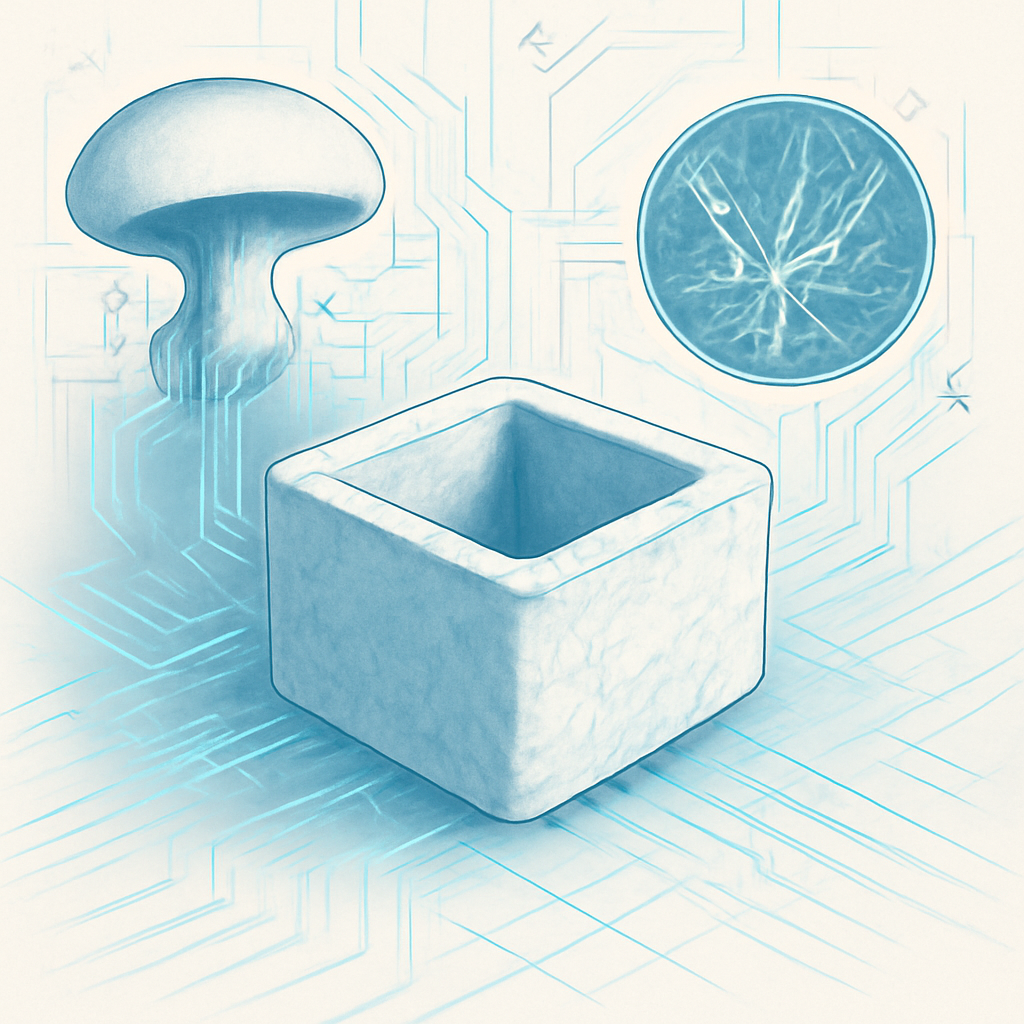
Mushroom root packaging is made from mycelium, which is the root-like part of a mushroom. People grow mycelium on things like wood chips or straw. As it grows, it sticks the materials together, forming a solid but lightweight shape. After it’s grown, the package is dried to stop it from growing further. This makes a natural, sturdy container that can replace plastic or foam.
This kind of packaging is used to protect things like electronics or food during shipping. It’s great because it breaks down naturally in the soil, unlike plastic that can last for hundreds of years. Big companies are starting to use it because it’s better for the planet and works surprisingly well as a cushion for fragile items.
Mushroom root packaging is made from mushroom roots grown on plant waste, creating natural, eco-friendly protective containers.
Image provenance and limitation
Source: AI-generated visual interpretation
Creator: Question Everything
Limitation: This image explains or evokes the subject. It is not documentary evidence and should not be used to verify a factual claim.
Evidence
What do we know?
Verified claims with confidence scoring and cited sources.
2 of 3 findings need extra caution. Finding 2, Finding 3 rest on weaker sourcing than the other findings.
Living footnotes
Claims remain in the reading flow. Select a citation number to inspect the source behind it.
01
ObservationalSupported
Mushroom packaging is made by mixing agricultural waste with mycelium, the root-like network of mushrooms, which grows and binds the material into shapes within days.
The process starts with agricultural leftovers like hemp stalks or corn husks. These are cleaned and combined with mycelium spores. The mycelium then grows, digesting the waste and binding it tightly to form a solid structure that takes the shape of a mold. This growth usually takes about 5 to 7 days, after which the product is dried to stop further growth and set the shape permanently.
02
ExperimentalMixed evidence
The packaging is fully biodegradable and compostable, breaking down naturally after use without harmful chemicals.
Unlike plastics that can last hundreds of years and pollute the environment, mushroom packaging can be safely thrown into compost or soil where it decomposes and enriches the earth. It contains no toxic substances and does not leave harmful residues, making it friendly to both people and nature when disposed of properly.
03
ObservationalMixed evidence
Mushroom packaging is used widely for protective packaging in industries like electronics, cosmetics, and food because it cushions and insulates products naturally.
The mycelium-bound material absorbs shocks and insulates temperature well, making it a great alternative to foam packaging. Electronics companies use it to protect fragile devices, while food brands use it for sustainable, plastic-free packaging that keeps products safe and fresh. Its natural texture also offers a unique unboxing experience that appeals to eco-conscious consumers.
The complete record below preserves every citation, confidence input and recorded limitation.
Read the full evidence record3 findings · citations · limitations
Evidence review3 findings4 openable sources
01
Finding 1 of 3Observational
2/2 verified
Mushroom packaging is made by mixing agricultural waste with mycelium, the root-like network of mushrooms, which grows and binds the material into shapes within days.
The process starts with agricultural leftovers like hemp stalks or corn husks. These are cleaned and combined with mycelium spores. The mycelium then grows, digesting the waste and binding it tightly to form a solid structure that takes the shape of a mold. This growth usually takes about 5 to 7 days, after which the product is dried to stop further growth and set the shape permanently.
Supportedmodel score 82%
2 sources agree, none peer-reviewed.
REFERENCEREPORTING
›View sources and limits— 2 citations, limits
Supporting passage
The process starts with agricultural leftovers like hemp stalks or corn husks. These are cleaned and combined with mycelium spores. The mycelium then grows, digesting the waste and binding it tightly to form a solid structure that takes the shape of a mold. This growth usually takes about 5 to 7 days, after which the product is dried to stop further growth and set the shape permanently.
QE used this source because its retrieved passage directly addresses the claim. It appeared in 2 complementary searches.
“t of the plants that cannot be used for food) to make their packaging. > “ > > “We’re using mushrooms to create an entirely new class of materials which perform a lot like plastic.” Mycelium is a fungal network of threadlike cells, that acts like a natural, self-assembling glue. It grows in 5-7 days without needing an…”
QE used this established reporting source for independently documented context.
“By adding mycelium to a substrate of organic agricultural waste, finished products are literally 'grown' within 3D-printed moulds made of renewable polymer. It's a quick process: the mycelium grows and binds within five days, and the finished products are dried in two days. Discarded moulds are shredded for in-house r…”
This passage was checked against the claim.
Retrieved 08/09/2026
What limits this
No peer-reviewed source among the citations.
02
Finding 2 of 3ExperimentalNeeds caution
1
1/1 verified
The packaging is fully biodegradable and compostable, breaking down naturally after use without harmful chemicals.
Unlike plastics that can last hundreds of years and pollute the environment, mushroom packaging can be safely thrown into compost or soil where it decomposes and enriches the earth. It contains no toxic substances and does not leave harmful residues, making it friendly to both people and nature when disposed of properly.
Mixed evidencemodel score 55%
Verification was mixed across 1 source.
REFERENCE
›View sources and limits— 1 citation, limits
Supporting passage
Unlike plastics that can last hundreds of years and pollute the environment, mushroom packaging can be safely thrown into compost or soil where it decomposes and enriches the earth. It contains no toxic substances and does not leave harmful residues, making it friendly to both people and nature when disposed of properly.
QE used this source because its retrieved passage directly addresses the claim. It appeared in 2 complementary searches.
“driven by design: eliminate waste and pollution, circulate products and materials (at their highest value), and regenerate nature., products can be designed to break down naturally after use as they would in the natural world. Ecovative’s environmentally friendly packaging has the protective properties of polystyrene…”
This passage was checked against the claim.
Retrieved 08/09/2026
What limits this
1 of 2 citations failed verification and are not shown.
Rests on a single source. No independent corroboration.
No peer-reviewed source among the citations.
Verification was mixed — some citations supported the claim and some did not.
03
Finding 3 of 3ObservationalNeeds caution
1/1 verified
Mushroom packaging is used widely for protective packaging in industries like electronics, cosmetics, and food because it cushions and insulates products naturally.
The mycelium-bound material absorbs shocks and insulates temperature well, making it a great alternative to foam packaging. Electronics companies use it to protect fragile devices, while food brands use it for sustainable, plastic-free packaging that keeps products safe and fresh. Its natural texture also offers a unique unboxing experience that appeals to eco-conscious consumers.
Mixed evidencemodel score 55%
Verification was mixed across 1 source.
REFERENCE
›View sources and limits— 1 citation, limits
Supporting passage
The mycelium-bound material absorbs shocks and insulates temperature well, making it a great alternative to foam packaging. Electronics companies use it to protect fragile devices, while food brands use it for sustainable, plastic-free packaging that keeps products safe and fresh. Its natural texture also offers a unique unboxing experience that appeals to eco-conscious consumers.
QE used this source because its retrieved passage directly addresses the claim. It appeared in 3 complementary searches.
“Mushroom packaging is gaining adoption in industries that need protective and lightweight alternatives. Electronics companies use mushroom packaging to protect devices without using synthetic foams. Cosmetics and skincare brands select mushroom packaging because it provides natural protection for glass jars and fragil…”
This passage was checked against the claim.
Retrieved 08/09/2026
What limits this
1 of 2 citations failed verification and are not shown.
Rests on a single source. No independent corroboration.
No peer-reviewed source among the citations.
Verification was mixed — some citations supported the claim and some did not.
The reference archive
Sources & Further Reading
Continue exploring the research, reporting and reference material available on this subject.
These were found while researching this question but are not used as evidence for any claim above.
These visualizations respond to your curiosity. Interact to go deeper.
process flow
How Mushroom Root Packaging is Made
Gather Agricultural Waste
Mix with Mycelium
Grow in Molds
Dry and Set
statistics card
Environmental Benefits of Mushroom Packaging
100%
Biodegradable
Breaks down naturally, unlike plastics that last centuries.
5-7 days
Growth Time
Fast production cycle compared to many materials.
Low
Energy Use
Much less energy required than making plastic foam.
Contested
This one is genuinely argued over
Both cases are put as strongly as their own supporters would put them, from evidence rather than from who holds the view. Read them and decide for yourself.
The case that it's true
Mushroom packaging is a promising green alternative that can replace harmful plastics. It uses natural materials and low energy, grows quickly, and breaks down safely after use, reducing landfill waste and ocean pollution.
What this rests on
Biodegradable and compostable
Uses agricultural waste, reducing resource use
Low energy and emissions in production
The case against
Despite its benefits, mushroom packaging faces challenges such as cost, scale, and durability limits. It can be more expensive than plastic, and the production process is still new and not yet widespread, which may limit its immediate impact.
What this rests on
Higher production cost
Scaling manufacturing is complex
Material may not suit all packaging needs
What both sides accept
Both sides agree mushroom packaging offers real environmental advantages and has potential in specific uses like protective packaging. However, more innovation and investment are needed to address cost and scalability before it can compete widely with plastics.
Documented, and not in dispute
Eco-friendly and compostable nature
Growing interest and research
Current limits on cost and scale
Application
Why does this matter to you?
Personal reflections and applications for your life.
Thought experimentSelf-Reflection
How much plastic packaging do you throw away each week, and how could you reduce it?
Why it changes the question
Knowing your plastic use helps you see where alternatives like mushroom packaging could make a difference. Small changes in choice add up to big impact for the planet.
Try this
Try to choose products with compostable or minimal packaging next time you shop and notice the difference.
Media
QE Smart Glass
Curated media selected for this investigation.
QE Glass
YOUTUBE
Mushroom Material
NOVA PBS Official
Move over peanuts, there's a new packaging material in town—and it's made of mushrooms. NOVA Facebook: ...
QE Glass
YOUTUBE
Mushroom Magic: Mycelium-Based Packaging Keeps Your Products Safe and Earth-Friendly
Dr EvoluSean
Mycelium, the root structure of mushrooms, is a key ingredient in Ecovative's mushroom packaging. When mixed with other natural ...
QE Glass
YOUTUBE
The Mushroom That Could Replace Plastic Forever
5W Frame
Headline: Can a fungus solve our greatest environmental crisis? Welcome to the Alchemy of Biology. About this Video: Every ...
QE Glass
YOUTUBE
The Future of Packaging - mushroom (mycelium) packaging decomposes in weeks
Process AG
How is Ikea using mushrooms to save the earth?! It is for the fact that this mushroom packaging will actually decompose in a ...
QE Glass
YOUTUBE
Is Mycelium Fungus the Plastic of the Future?
Undecided with Matt Ferrell
Is Fungus the Plastic of the Future? Use the code "Undecided" to get CuriosityStream for less than $15 a year!
QE Glass
YOUTUBE
Why Mushrooms are Starting to Replace Everything
Undecided with Matt Ferrell
Why Mushrooms are Starting to Replace Everything. Take your personal data back with Incogni! Use code UNDECIDED at the ...
QE Glass
YOUTUBE
How Mushrooms Are Turned Into Bacon And Styrofoam | World Wide Waste
Business Insider
A biotech company in upstate New York designs products made from the root structures of mushrooms. It takes about a week to ...
QE Glass
YOUTUBE
This Start Up Is Replacing Styrofoam with Mushroom Packaging!
The Better India
thebetterindia This isn't styrofoam—it's mushrooms! Styrofoam takes 500 years to break down. But Fungi Foam, developed by ...
QE Glass
YOUTUBE
Ecovative's Mushroom Packaging Process Explained
Ecovative Design
A clear visual walk-through of how mushroom packaging is grown and why it matters.
QE Glass
PODCAST
Radiolab episode on mushroom packaging innovation
Radiolab
An engaging discussion about eco-friendly packaging alternatives featuring mushroom roots.
Keep Going
Where this leads
Questions this investigation opens up — and what QE has already looked into.
No AI help here — no suggestions, no autocomplete, nothing finishing your sentences. That is deliberate. Working out what you think is effortful, and the effort is the part that changes you: reasoning is trained like a muscle, and a muscle that is always carried gets weaker. Let something else do the thinking and you keep the answer but lose the capacity to have reached it.
Write your current position.
Not what the page says. What you think, having read it.0 words · Nothing written yet.
Sign in to leave a mark. Your draft is saved here in the meantime.