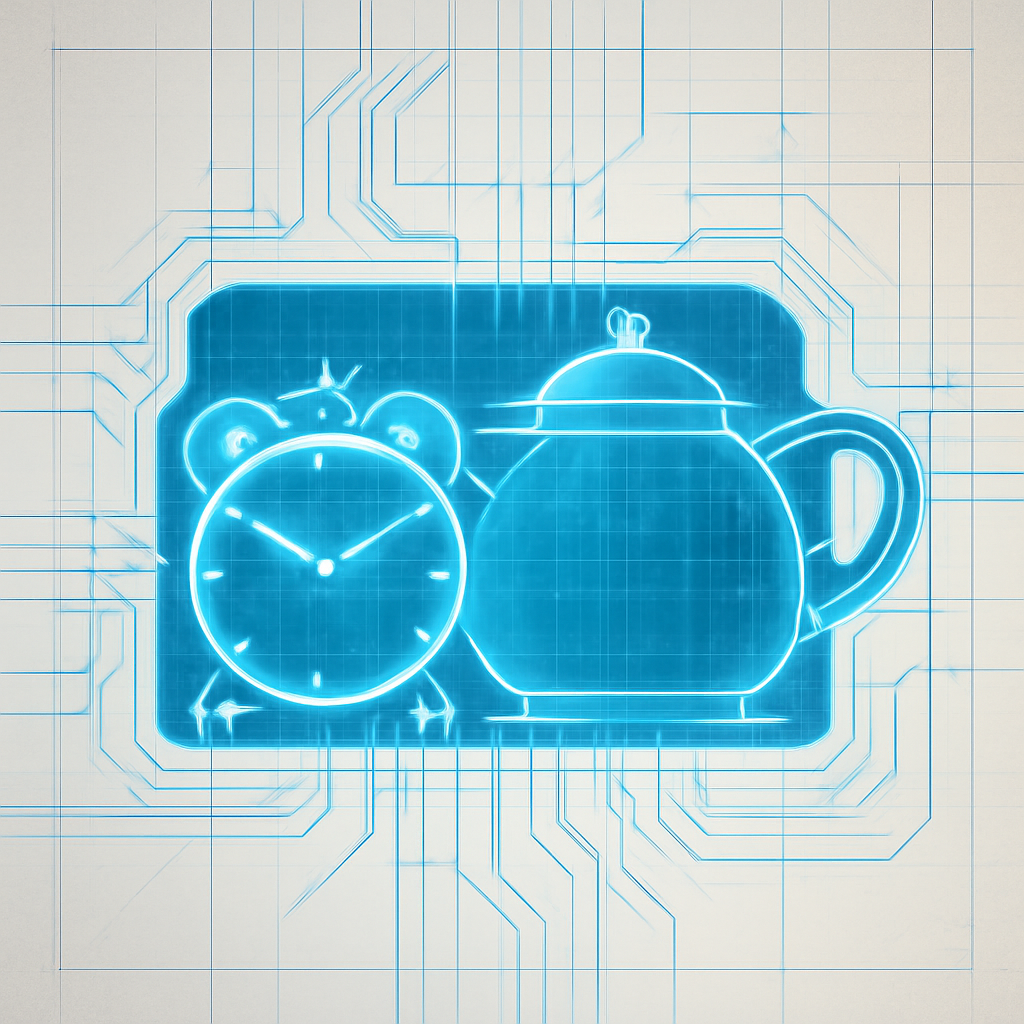
The Origin of the Teasmade: The Invention That Awakened a Nation
The Teasmade, a quaint yet ingenious device designed to brew tea automatically, was first invented in the early 20th century. Its creation is credited to the British inventor Leslie Hounsfield in 1933. Hounsfield's invention combined an alarm clock with a kettle, ensuring that a fresh cup of tea would be ready the moment you woke up. This clever fusion offered a seamless start to the day for many, especially in British households where tea is more than just a drink — it’s a ritual.
The motivation behind the Teasmade was simple yet profound: to save time and bring comfort. In an era when mornings were often rushed and cold, the Teasmade promised warmth and convenience without lifting a finger. It became a beloved symbol of British domestic life, blending technology with tradition, and remains a charming example of how everyday needs inspire thoughtful invention.
“The teasmade’s first electric model, patented in 1933 by George Absolom, used steam to push boiling water into a teapot, a principle still used today.”
Reflect
How might our mornings change if everyday routines like making tea were never automated?
Research·7 sources·11 independent publishers·Moderate evidence coverage·Established confidence·Investigated 6 Oct 2026(28 days ago)·Source-verified
Your next question, in
Visual Trail
See The Origin of the Teasmade: The Invention That Awakened a Nation
A guided visual explanation assembled from QE artwork and sourced documentary images.
01 / 02
QE visual interpretation
Frame 01
The Origin of the Teasmade: The Invention That Awakened a Nation
The Teasmade, invented by Leslie Hounsfield in 1933, was created to brew tea automatically as people woke up.
Image provenance and limitation
Source: AI-generated visual interpretation
Creator: Question Everything
Limitation: This image explains or evokes the subject. It is not documentary evidence and should not be used to verify a factual claim.
Evidence
What do we know?
Verified claims with confidence scoring and cited sources.
1 of 5 findings need extra caution. Finding 4 rests on weaker sourcing than the other findings.
Living footnotes
Claims remain in the reading flow. Select a citation number to inspect the source behind it.
01
HistoricalSupported
The earliest known automatic tea-making device was invented by Charles Maynard Walker in 1891.
In 1891, Charles Maynard Walker published detailed designs of an automatic tea-making machine called the “Early Riser’s Friend.” Although never patented or commercially produced, this invention laid the groundwork for future tea-making automation by integrating a clock and heating mechanism to prepare tea at a set time.
02
HistoricalSupported
Samuel Rowbottom patented an Automatic Tea Making Apparatus in 1891 that used steam to push boiling water into a teapot.
Samuel Rowbottom’s 1891 patent describes a device combining a clockwork alarm, a gas burner with pilot light, and a steam-driven water transfer system to brew tea automatically. Though it was never mass-produced, this invention introduced a key technical principle still found in teasmades today.
03
HistoricalSupported
Albert Edward Richardson designed the first practical teasmade, selling it to Frank Clarke who patented it in 1902.
Albert E. Richardson, an iron turner and fitter, created a practical automatic tea maker combining an alarm clock, spirit lamp, and tipping kettle. He sold the design to Birmingham gunsmith Frank Clarke, who patented it in 1902 as 'An Apparatus Whereby a Cup of Tea or Coffee is Automatically Made,' marking a significant advance toward commercial viability.
04
HistoricalMixed evidence
George Absolom patented the first electric teasmade in 1933, calling it the 'Teesmade.'
On May 2, 1932, George Absolom applied for a patent for an electric automatic tea maker, receiving it in 1933. His invention, marketed as the 'Teesmade,' integrated the alarm clock with an electric kettle and teapot in a wooden cabinet. It refined earlier designs by replacing gas with electricity, making the device safer and more practical for bedside use.
05
HistoricalSupported
Goblin popularized the teasmade with their 1936 electric model, helping make it a household item.
Following Absolom’s innovation, the Goblin company introduced their own electric teasmade in 1936, featuring improved design and marketing. Goblin’s models, often with integrated lamps and decorative cases, became iconic in British homes, especially during the mid-20th century when teasmades enjoyed peak popularity.
The complete record below preserves every citation, confidence input and recorded limitation.
Read the full evidence record5 findings · citations · limitations
Evidence review5 findings9 openable sources
01
Finding 1 of 5Historical
2/2 verified
The earliest known automatic tea-making device was invented by Charles Maynard Walker in 1891.
In 1891, Charles Maynard Walker published detailed designs of an automatic tea-making machine called the “Early Riser’s Friend.” Although never patented or commercially produced, this invention laid the groundwork for future tea-making automation by integrating a clock and heating mechanism to prepare tea at a set time.
Supportedmodel score 82%
2 sources agree, none peer-reviewed.
REFERENCE ×2
›View sources and limits— 2 citations, limits
Supporting passage
In 1891, Charles Maynard Walker published detailed designs of an automatic tea-making machine called the “Early Riser’s Friend.” Although never patented or commercially produced, this invention laid the groundwork for future tea-making automation by integrating a clock and heating mechanism to prepare tea at a set time.
QE used this source because its retrieved passage directly addresses the claim. It appeared in 2 complementary searches.
“Since then their use has declined, but they started to boast a partial revival in the 2000s, partly as a novelty retro item. The name teasmade is an example of a genericised trademark, now commonly used to refer to any automatic tea-making appliance. ## History On 19 September 1891, Charles Maynard Walker of Dulwich p…”
QE used this source because its retrieved passage directly addresses the claim.
“a making device was in the pages of Work Magazine in 1891, where Charles Maynard Walker published illustrations of an “Early Riser’s” Friend, and by the end of the year, Samuel Rowbottom had applied for a patent. Whilst it is unknown whether he ever sold his Automatic Tea Maker, Mr Rowbottom’s device worked using the…”
This passage was checked against the claim.
Retrieved 06/10/2026
What limits this
No peer-reviewed source among the citations.
02
Finding 2 of 5Historical
2/2 verified
Samuel Rowbottom patented an Automatic Tea Making Apparatus in 1891 that used steam to push boiling water into a teapot.
Samuel Rowbottom’s 1891 patent describes a device combining a clockwork alarm, a gas burner with pilot light, and a steam-driven water transfer system to brew tea automatically. Though it was never mass-produced, this invention introduced a key technical principle still found in teasmades today.
Supportedmodel score 82%
2 sources agree, none peer-reviewed.
REFERENCE ×2
›View sources and limits— 2 citations, limits
Supporting passage
Samuel Rowbottom’s 1891 patent describes a device combining a clockwork alarm, a gas burner with pilot light, and a steam-driven water transfer system to brew tea automatically. Though it was never mass-produced, this invention introduced a key technical principle still found in teasmades today.
QE used this source because its retrieved passage directly addresses the claim.
“, they only became practical with the availability of electric versions in the 1930s. In fact, in 1891 Samuel Rowbottom applied for a patent for his Automatic Tea Making Apparatus. The apparatus used a clockwork alarm clock, a gas ring and pilot light. Although there is no evidence that he commercially produced his te…”
QE used this source because its retrieved passage directly addresses the claim. It appeared in 2 complementary searches.
“The article was detailed and included illustrations, but the teamaker was never patented. On 17 December 1891, Samuel Rowbottom, of 82 Abbey Road, Derby, applied for a patent for his Automatic Tea Making Apparatus, the patent being granted in 1892. It used a clockwork alarm clock, a gas ring and pilot light. There is…”
This passage was checked against the claim.
Retrieved 06/10/2026
What limits this
No peer-reviewed source among the citations.
03
Finding 3 of 5Historical
2/2 verified
Albert Edward Richardson designed the first practical teasmade, selling it to Frank Clarke who patented it in 1902.
Albert E. Richardson, an iron turner and fitter, created a practical automatic tea maker combining an alarm clock, spirit lamp, and tipping kettle. He sold the design to Birmingham gunsmith Frank Clarke, who patented it in 1902 as 'An Apparatus Whereby a Cup of Tea or Coffee is Automatically Made,' marking a significant advance toward commercial viability.
Supportedmodel score 82%
2 sources agree, none peer-reviewed.
REFERENCE ×2
›View sources and limits— 2 citations, limits
Supporting passage
Albert E. Richardson, an iron turner and fitter, created a practical automatic tea maker combining an alarm clock, spirit lamp, and tipping kettle. He sold the design to Birmingham gunsmith Frank Clarke, who patented it in 1902 as 'An Apparatus Whereby a Cup of Tea or Coffee is Automatically Made,' marking a significant advance toward commercial viability.
QE used this source because its retrieved passage directly addresses the claim.
“He designed the first practical Teasmade based on an alarm clock, a spirit lamp and a tipping kettle. He sold the design to gunsmith Frank Clarke of Birmingham for an undisclosed sum, who patented it in 1902, calling it "An Apparatus Whereby a Cup of Tea or Coffee is Automatically Made". ## References | | | --- | | St…”
QE used this source because its retrieved passage directly addresses the claim. It appeared in 3 complementary searches.
“This happened shortly after Absolom's patent. Teasmade-machines-at-the-Science-Museum-London-UK [...] Another tea maker was invented by Albert E. Richardson. He was a worker from Ashton-under-Lyne. A gunsmith named Frank Clarke from Birmingham bought Richardson's machine and all its rights. On April 7, 1902, Clarke re…”
This passage was checked against the claim.
Retrieved 06/10/2026
What limits this
No peer-reviewed source among the citations.
04
Finding 4 of 5HistoricalNeeds caution
1/1 verified
George Absolom patented the first electric teasmade in 1933, calling it the 'Teesmade.'
On May 2, 1932, George Absolom applied for a patent for an electric automatic tea maker, receiving it in 1933. His invention, marketed as the 'Teesmade,' integrated the alarm clock with an electric kettle and teapot in a wooden cabinet. It refined earlier designs by replacing gas with electricity, making the device safer and more practical for bedside use.
Mixed evidencemodel score 55%
Verification was mixed across 1 source.
REFERENCE
›View sources and limits— 1 citation, limits
Supporting passage
On May 2, 1932, George Absolom applied for a patent for an electric automatic tea maker, receiving it in 1933. His invention, marketed as the 'Teesmade,' integrated the alarm clock with an electric kettle and teapot in a wooden cabinet. It refined earlier designs by replacing gas with electricity, making the device safer and more practical for bedside use.
QE used this source because its retrieved passage directly addresses the claim. It appeared in 2 complementary searches.
“Teasmade # 1932 Absolom Teesmade Absolom Teesmade 1932 On 2nd May 1932, George Absolom submitted an application for a patent on his invention, a "New or improved apparatus for the making of beverages" in the form of an electric automatic tea maker, soon to be known as the Teesmade (sic). The word ‘teesmade’ was certai…”
This passage was checked against the claim.
Retrieved 06/10/2026
What limits this
1 of 2 citations failed verification and are not shown.
Rests on a single source. No independent corroboration.
No peer-reviewed source among the citations.
Verification was mixed — some citations supported the claim and some did not.
05
Finding 5 of 5Historical
2/2 verified
Goblin popularized the teasmade with their 1936 electric model, helping make it a household item.
Following Absolom’s innovation, the Goblin company introduced their own electric teasmade in 1936, featuring improved design and marketing. Goblin’s models, often with integrated lamps and decorative cases, became iconic in British homes, especially during the mid-20th century when teasmades enjoyed peak popularity.
Supportedmodel score 82%
2 sources agree, none peer-reviewed.
REFERENCE ×2
›View sources and limits— 2 citations, limits
Supporting passage
Following Absolom’s innovation, the Goblin company introduced their own electric teasmade in 1936, featuring improved design and marketing. Goblin’s models, often with integrated lamps and decorative cases, became iconic in British homes, especially during the mid-20th century when teasmades enjoyed peak popularity.
QE used this source because its retrieved passage directly addresses the claim.
“Once the concept was aided by the development of electricity, George Absolom patented the first electric tea maker, which became known as the Teesmade. However, when Goblin created a similar device called the Teasmade in 1936, which featured a lamp, a kettle and could even glow in the dark. Goblin became the main supp…”
This passage was checked against the claim.
Retrieved 06/10/2026
What limits this
No peer-reviewed source among the citations.
The reference archive
Sources & Further Reading
Continue exploring the research, reporting and reference material available on this subject.
These were found while researching this question but are not used as evidence for any claim above.
These visualizations respond to your curiosity. Interact to go deeper.
timeline
Key Milestones in Teasmade Invention
Loading timeline…
relationship map
Inventors and Innovations Behind the Teasmade
Mapping relationships…
Drag nodes to rearrange — tap for details
Perspectives
How is this interpreted?
Enter a viewpoint. Notice what it reveals, what it leaves out, and whether it changes the question for you.
The HistorianHistorical viewpointLive tension
The invention of the teasmade was a gradual process with multiple inventors contributing key innovations over decades, reflecting evolving domestic needs and technologies from gas to electric heating.
What this lens notices
01Charles Maynard Walker's early design laid foundational ideas.
02Samuel Rowbottom introduced steam-powered water transfer.
03George Absolom’s electric model modernized and popularized the device.
Application
Why does this matter to you?
Personal reflections and applications for your life.
Thought experimentSelf-Reflection
How do you feel about automating simple daily tasks like making tea? Does it enhance comfort or reduce meaningful routine?
Why it changes the question
Reflecting on how automation shapes our lives can reveal what we value about convenience versus tradition. The teasmade embodies this balance between ease and ritual.
Try this
Try making a cup of tea manually one morning and compare the experience with using an automated device.
Media
QE Smart Glass
Curated media selected for this investigation.
QE Glass
YOUTUBE
Retro Teasmade Reconstruction
backofficeshow
TDL- Retro Teasmade Reconstruction At one time the best wedding present you could get, the pinnacle of drinks making ...
QE Glass
YOUTUBE
The TEASMADE - It's a Hot Drink Alarm Clock
s34nVideos
I maanged to finally buy a Step Up/Down Transformer so I can use my Teasmade in the US finally!! Happy days! If interested, this ...
QE Glass
YOUTUBE
$1 vs $10,000 Alarm Clock!
Topper Guild
QE Glass
YOUTUBE
The Automatic Coffee and Tea Maker with Alarm Clock Functionality
Techs Chief
Tea made, served in bed, with milk. Ease into the day with the sound of bubbling water and the smell of freshly brewed tea or ...
QE Glass
YOUTUBE
Goblin Teasmade + Raspberry Pi = Coffee Robot
VEEB
We updated the classic Vintage Goblin Teasmade and made a coffee robot. With a little help from a Raspberry Pi, a Relay Switch ...
QE Glass
YOUTUBE
Modern Marvels: The History of Tea (S12, E53) | Full Episode
HISTORY
After water, tea is the second most popular drink in the world. It has been around as a drink for 5000 years, and 6 billion pounds of ...
QE Glass
YOUTUBE
European clocks ran slow for a bit. British clocks didn't.
Tom Scott
Many people sent me this story: it covers my favourite topics of power grids and temporal anomalies. But when the mainstream ...
QE Glass
YOUTUBE
The Story of the Teasmade: Britain's Iconic Automatic Tea Maker
British Patents History
A detailed documentary exploring the teasmade’s inventions, key figures, and cultural impact.
QE Glass
PODCAST
Radiolab: Automating the Morning Ritual
Radiolab
This episode discusses the fascinating history and technology behind early household automation, including the teasmade.
Keep Going
Where this leads
Questions this investigation opens up — and what QE has already looked into.
No AI help here — no suggestions, no autocomplete, nothing finishing your sentences. That is deliberate. Working out what you think is effortful, and the effort is the part that changes you: reasoning is trained like a muscle, and a muscle that is always carried gets weaker. Let something else do the thinking and you keep the answer but lose the capacity to have reached it.
Write your current position.
Not what the page says. What you think, having read it.0 words · Nothing written yet.
Sign in to leave a mark. Your draft is saved here in the meantime.