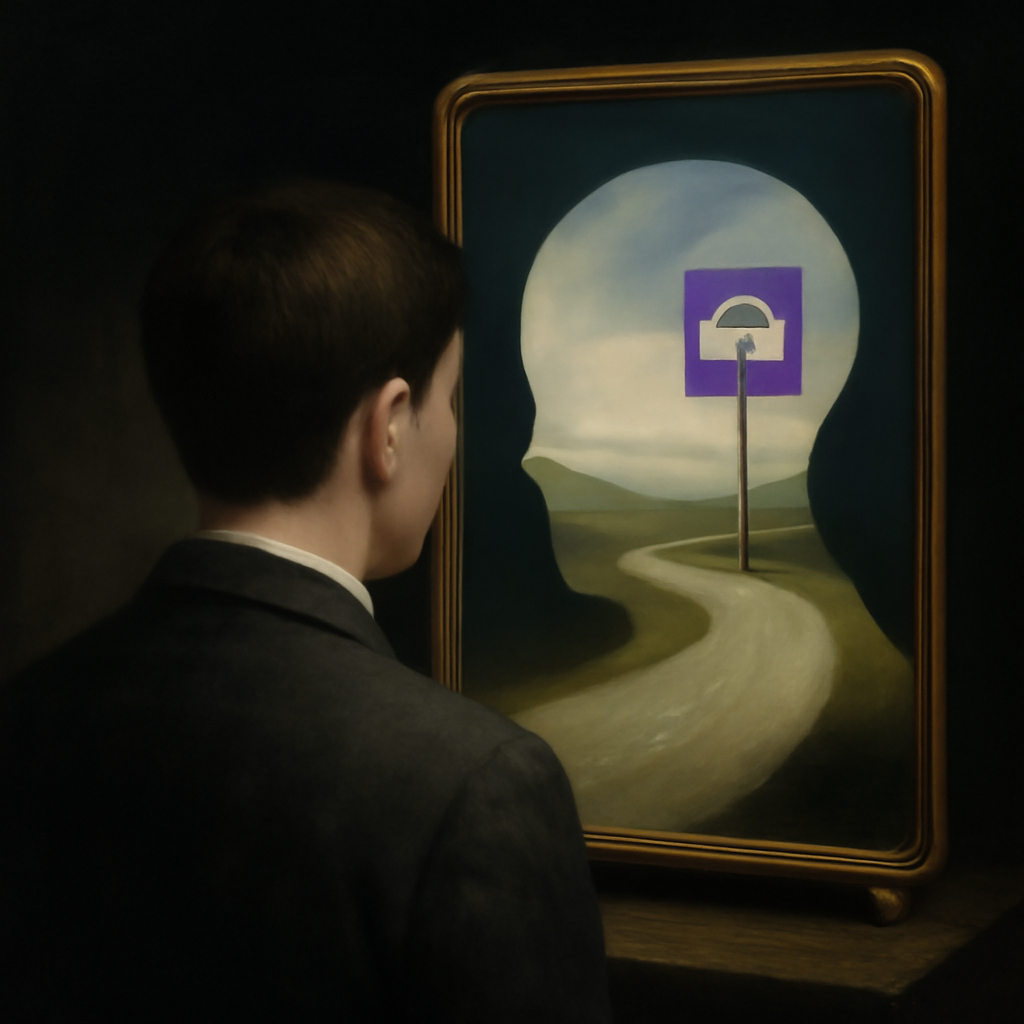
Let’s be honest. Opening that driving theory app feels like a giant chore. You find yourself washing the dishes, scrolling social media, or suddenly cleaning your room instead. This is not because you are lazy. It is a classic brain trap. Your brain loves quick wins, like a funny video or a tasty snack. The theory test, however, offers a reward that is weeks or months away. To your brain, that feels like trying to catch a shadow.
There is also a hidden fear at play. Every time you start a practice quiz and get a question wrong, your brain takes it as a personal attack. It feels uncomfortable to face what we do not know. To protect your mood, your mind whispers, "Let's just do this tomorrow." You are not avoiding the test itself; you are simply avoiding the bad feeling of getting answers wrong right now.
“Many learners fail their driving theory test simply because they try to memorise the exact questions instead of learning the actual rules of the road.”
Reflect
If we avoid studying because we fear failing, how does that same fear stop us from trying other big things in our lives?
Research·2 sources·Established confidence·Investigated 4 Aug 2026(1 month ago)·Grounded; verification trace not recorded·Investigation may be outdated
Your next question, in
Visual Trail
See Why You Keep Putting Off Your Driving Theory Test
A guided visual explanation assembled from QE artwork and sourced documentary images.
01 / 02
QE visual interpretation
Frame 01
Why You Keep Putting Off Your Driving Theory Test
You aren't lazy; your brain is just avoiding the uncomfortable feeling of getting questions wrong and prefers instant rewards instead.
Image provenance and limitation
Source: AI-generated visual interpretation
Creator: Question Everything
Limitation: This image explains or evokes the subject. It is not documentary evidence and should not be used to verify a factual claim.
Evidence
What do we know?
Verified claims with confidence scoring and cited sources.
1 of 3 findings need extra caution. Finding 2 rests on weaker sourcing than the other findings.
Living footnotes
Claims remain in the reading flow. Select a citation number to inspect the source behind it.
01
ObservationalSupported
Memorising practice questions instead of learning the underlying concepts often leads to failing the theory test.
When you study for your theory test, it is easy to fall into a trap. You might just memorise the answers to practice questions. But the official test will not use those exact same words. They will ask about the same road rules in different ways. If you only memorize the answers, you will struggle when the questions change slightly. You need to understand the actual rules, not just remember the letters A, B, or C.
02
ObservationalNot confirmed
Practical driving lessons can help reinforce theoretical knowledge by showing how road signs and rules work in real life.
It is hard to study dry facts from a book. That is why many learners find it helps to do practical driving lessons at the same time. When you see a road sign in real life, it suddenly makes sense. You see how it actually affects your driving in real time. This hands-on experience helps lock the textbook rules into your brain, making the theory test feel much less like a boring memory game.
03
ObservationalSupported
Test anxiety and nerves can cause learners to make uncharacteristic mistakes during the exam.
Feeling nervous before a big test is totally normal. But high stress can mess with your focus. It makes you make silly mistakes you would never usually make. To beat this, you should practice under real test conditions. Sit in a quiet room, set a timer, and do a mock test without looking at your phone. This gets your brain used to the pressure so you do not freeze up on the big day.
The complete record below preserves every citation, confidence input and recorded limitation.
Read the full evidence record3 findings · citations · limitations
Evidence review3 findings2 openable sources
01
Finding 1 of 3Observational
0/1 verified
Memorising practice questions instead of learning the underlying concepts often leads to failing the theory test.
When you study for your theory test, it is easy to fall into a trap. You might just memorise the answers to practice questions. But the official test will not use those exact same words. They will ask about the same road rules in different ways. If you only memorize the answers, you will struggle when the questions change slightly. You need to understand the actual rules, not just remember the letters A, B, or C.
Supportedmodel score 90%
One source, not peer-reviewed. Thinner than the score suggests.
REFERENCE
›View sources and limits— 1 citation, limits
Supporting passage
When you study for your theory test, it is easy to fall into a trap. You might just memorise the answers to practice questions. But the official test will not use those exact same words. They will ask about the same road rules in different ways. If you only memorize the answers, you will struggle when the questions change slightly. You need to understand the actual rules, not just remember the letters A, B, or C.
Rests on a single source. No independent corroboration.
No peer-reviewed source among the citations.
The generator scored this 90%, which would read as “Established”. Its citations reach only “Supported”, so that is what is shown.
02
Finding 2 of 3ObservationalNeeds caution
0/0 verified
Practical driving lessons can help reinforce theoretical knowledge by showing how road signs and rules work in real life.
It is hard to study dry facts from a book. That is why many learners find it helps to do practical driving lessons at the same time. When you see a road sign in real life, it suddenly makes sense. You see how it actually affects your driving in real time. This hands-on experience helps lock the textbook rules into your brain, making the theory test feel much less like a boring memory game.
Not confirmedmodel score 30%
Scored as if sourced, but every citation failed verification.
NO SURVIVING CITATION
›View sources and limits— limits
Supporting passage
It is hard to study dry facts from a book. That is why many learners find it helps to do practical driving lessons at the same time. When you see a road sign in real life, it suddenly makes sense. You see how it actually affects your driving in real time. This hands-on experience helps lock the textbook rules into your brain, making the theory test feel much less like a boring memory game.
Citations (0 of 1 survived verification)
Nothing openable. Every citation was removed by provenance validation.
What limits this
All 1 citation on this claim failed verification and were removed. Nothing openable supports it.
03
Finding 3 of 3Observational
0/1 verified
Test anxiety and nerves can cause learners to make uncharacteristic mistakes during the exam.
Feeling nervous before a big test is totally normal. But high stress can mess with your focus. It makes you make silly mistakes you would never usually make. To beat this, you should practice under real test conditions. Sit in a quiet room, set a timer, and do a mock test without looking at your phone. This gets your brain used to the pressure so you do not freeze up on the big day.
Supportedmodel score 90%
One source, not peer-reviewed. Thinner than the score suggests.
REFERENCE
›View sources and limits— 1 citation, limits
Supporting passage
Feeling nervous before a big test is totally normal. But high stress can mess with your focus. It makes you make silly mistakes you would never usually make. To beat this, you should practice under real test conditions. Sit in a quiet room, set a timer, and do a mock test without looking at your phone. This gets your brain used to the pressure so you do not freeze up on the big day.
Rests on a single source. No independent corroboration.
No peer-reviewed source among the citations.
The generator scored this 90%, which would read as “Established”. Its citations reach only “Supported”, so that is what is shown.
Interactive Exploration
Touch, drag, and discover
These visualizations respond to your curiosity. Interact to go deeper.
process flow
How to actually learn the rules (not just memorise them)
Take a quick mock test
Read the actual rules
See it in real life
Test yourself again
statistics card
The reality of the theory test
5 consecutive
Mock passes recommended
Aim to pass five practice tests in a row before booking your real exam.
30 minutes
Early arrival time
Arriving early helps you settle your nerves and avoid feeling rushed.
Perspectives
How is this interpreted?
Enter a viewpoint. Notice what it reveals, what it leaves out, and whether it changes the question for you.
The EmpiricistScientific viewpointEstablished lens
Scientists show that we do not avoid tasks because we are lazy. We avoid them because they make us feel bad. When you look at a thick book of road signs, you feel stressed or bored. Your brain wants to protect you from those bad feelings right now. So, it tells you to scroll on your phone instead. Procrastination is just a bad way of dealing with stress, not a lack of willpower.
What this lens notices
01We avoid tasks to escape short-term negative emotions
02The brain prioritizes immediate comfort over long-term goals
03Forgiving yourself for putting things off actually helps you start
Application
Why does this matter to you?
Personal reflections and applications for your life.
Thought experimentBehavioural
Can you commit to studying for just five minutes today?
Why it changes the question
The hardest part of any task is simply starting. If you tell yourself you only have to do five minutes, the task feels much smaller and less scary.
Try this
Open your theory app, set a timer for five minutes, and close it as soon as the timer goes off.
Media
QE Smart Glass
Curated media selected for this investigation.
QE Glass
YOUTUBE
How to overcome your mistakes
TED-Ed
Explore what prevents us from learning from our failures, and how to become more resilient through cultivating a growth mindset.
QE Glass
YOUTUBE
Why you procrastinate even when it feels bad
TED-Ed
Explore what happens in the brain to trigger procrastination, and what strategies you can use to break the cycle of this harmful ...
QE Glass
YOUTUBE
How to Use Your Mind to Heal Your Body With the #1 Harvard Psychologist
Mel Robbins
Order your copy of The Let Them Theory https://melrob.co/let-them-theory The #1 Best Selling Book of 2025 Discover how ...
QE Glass
YOUTUBE
Attachment theory is the science of love | Anne Power | TEDxWaldegrave Road
TEDx Talks
NOTE FROM TED: This talk only represents the speaker's personal views and understanding of the nervous system and ...
QE Glass
YOUTUBE
How to Deal with Uncertainty - Without Self-Sabotage
Therapy in a Nutshell
Struggling with uncertainty? Learn how to manage anxiety and stop self-sabotage with proven strategies for emotional resilience ...
QE Glass
YOUTUBE
The Subtle Art of Not Giving a F*ck - Summarized by the Author
Mark Manson
The Subtle Art of Not Giving a F*ck - Author's Summary This is the official summary of the mega-bestseller 'The Subtle Art of Not ...
QE Glass
YOUTUBE
Theory test 2026: official DVSA guide
Driver and Vehicle Standards Agency
Official DVSA guide to what happens during the theory test and what it takes to pass it - including the multiple-choice question and ...
QE Glass
YOUTUBE
Driving Theory Test UK 2025 Mock Test | Driving Theory UK
DRIVING THEORY UK
Scoring 45 at home and failing at the centre? Here's why that happens — and the free guide that fixes it. Free GOLDEN Nugget ...
Connected context
Connected entities
The people, places, concepts, and events that matter here.
Keep Going
Where this leads
Questions this investigation opens up — and what QE has already looked into.
No AI help here — no suggestions, no autocomplete, nothing finishing your sentences. That is deliberate. Working out what you think is effortful, and the effort is the part that changes you: reasoning is trained like a muscle, and a muscle that is always carried gets weaker. Let something else do the thinking and you keep the answer but lose the capacity to have reached it.
Write your current position.
Not what the page says. What you think, having read it.0 words · Nothing written yet.
Sign in to leave a mark. Your draft is saved here in the meantime.