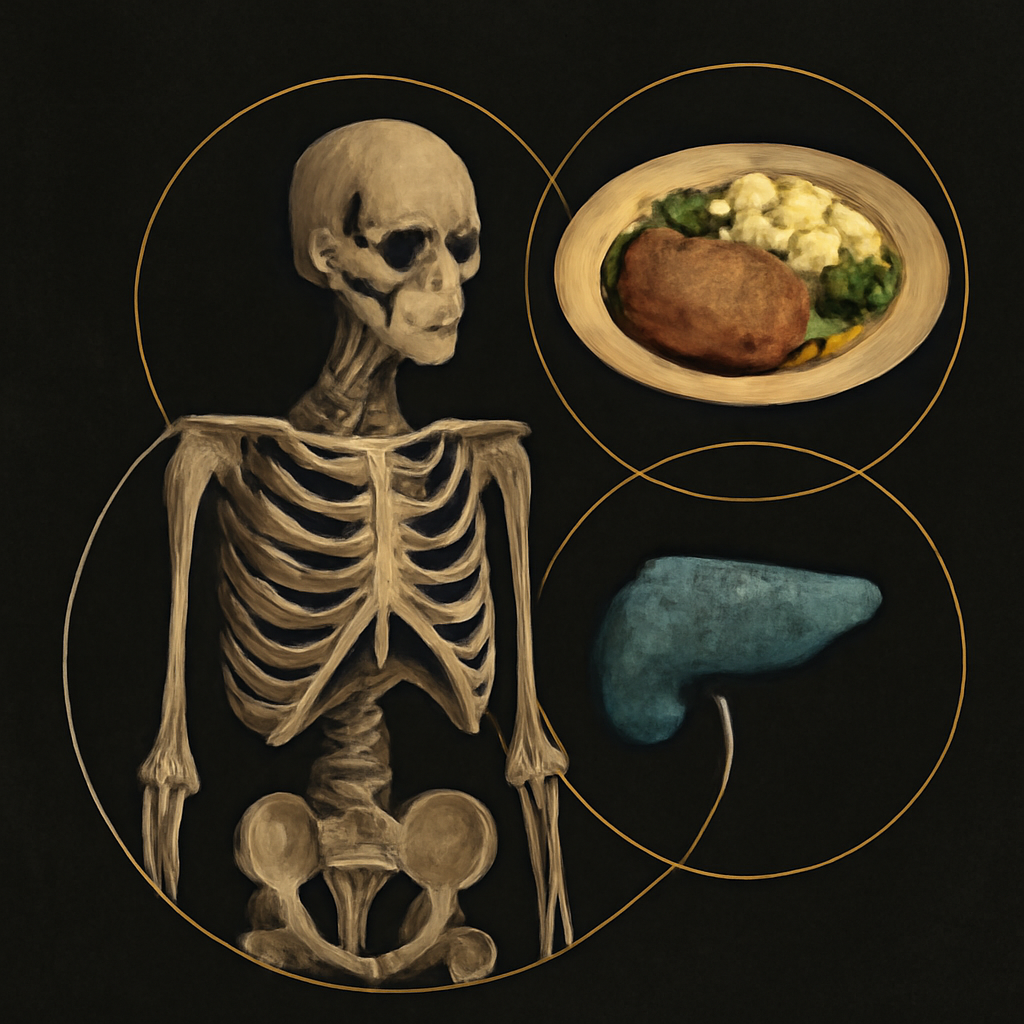
The Starving Feast: Why Type 1 Diabetics Lose Weight
Imagine a cellular banquet where the doors are locked. This is the cruel paradox of untreated or undertreated Type 1 diabetes. You eat, yet you shrink. The culprit is a missing key: insulin. Without this vital hormone, the glucose from your food drifts aimlessly through the bloodstream, unable to enter the cells that desperately need it. The body, screaming for energy, believes it is starving in the midst of plenty.
To survive, the body begins to consume itself. It breaks down its own muscle tissue and fat reserves for emergency fuel. Meanwhile, the kidneys work overtime to flush the unused glucose out through urine, literally washing away your calories. It is a frustrating, invisible drain. Gaining weight requires precise insulin therapy, ensuring the key is present to unlock the cells and let the energy in.
✨
Wonder Moment
“When insulin is scarce, a body can starve in the midst of a feast, literally flushing its dietary energy away in the urine while breaking down its own muscle and fat to survive.”
Reflect
How does our relationship with food change when we realize that eating is not just about swallowing calories, but about the microscopic keys that let those calories inside our cells?
Developing confidence·Investigated 8 Aug 2026(18 days ago)·Source-verified·May need refresh
Your next question, in
Visual Trail
See The Starving Feast: Why Type 1 Diabetics Lose Weight
A guided visual explanation assembled from QE artwork and sourced documentary images.
01 / 02
QE visual interpretation
Frame 01
The Starving Feast: Why Type 1 Diabetics Lose Weight
Without enough insulin, cells cannot absorb glucose, forcing the body to burn its own muscle and fat for energy despite eating more.
Image provenance and limitation
Source: AI-generated visual interpretation
Creator: Question Everything
Limitation: This image explains or evokes the subject. It is not documentary evidence and should not be used to verify a factual claim.
Evidence
What do we know?
Verified claims with confidence scoring and cited sources.
Living footnotes
Claims remain in the reading flow. Select a citation number to inspect the source behind it.
01
ObservationalNot confirmed
Uncontrolled Type 1 diabetes causes the body to burn its own fat and muscle tissue for energy.
Without enough insulin, the body cannot move glucose from the bloodstream into the cells. The cells send out urgent starvation signals. In response, the body begins to break down its own stored fat and muscle tissue to supply alternative energy. This metabolic self-cannibalization leads to rapid, unintentional weight loss. It happens even if the person is eating far more food than usual.
02
ObservationalNot confirmed
Frequent hyperglycemia causes excess glucose to be excreted through urine rather than stored as energy.
When blood sugar levels soar above normal thresholds, the kidneys simply cannot reabsorb the excess glucose. The body has no choice but to spill this precious sugar directly into the urine. This process drags water along with it, leading to dehydration and a massive loss of calories. The energy literally washes away before the body can store it as healthy fat or muscle.
03
AcademicNot confirmed
Resistance training combined with increased protein intake helps people with Type 1 diabetes safely build muscle mass and manage blood sugar.
Building healthy weight with diabetes requires a careful strategy. Resistance training triggers muscles to contract, which naturally increases appetite and stimulates muscle growth. Crucially, studies show this type of exercise actually improves blood sugar management in those with Type 1 diabetes. When paired with healthy proteins, it allows the body to gain lean mass rather than fat, keeping the metabolic system stable.
The complete record below preserves every citation, confidence input and recorded limitation.
Read the full evidence record3 findings · citations · limitations
Evidence review3 findings0 openable sources
01
Finding 1 of 3Observational
0/0 verified
Uncontrolled Type 1 diabetes causes the body to burn its own fat and muscle tissue for energy.
Without enough insulin, the body cannot move glucose from the bloodstream into the cells. The cells send out urgent starvation signals. In response, the body begins to break down its own stored fat and muscle tissue to supply alternative energy. This metabolic self-cannibalization leads to rapid, unintentional weight loss. It happens even if the person is eating far more food than usual.
Not confirmedmodel score 30%
Scored as if sourced, but every citation failed verification.
NO SURVIVING CITATION
›View sources and limits— limits
Supporting passage
Without enough insulin, the body cannot move glucose from the bloodstream into the cells. The cells send out urgent starvation signals. In response, the body begins to break down its own stored fat and muscle tissue to supply alternative energy. This metabolic self-cannibalization leads to rapid, unintentional weight loss. It happens even if the person is eating far more food than usual.
Citations (0 of 1 survived verification)
Nothing openable. Every citation was removed by provenance validation.
What limits this
All 1 citation on this claim failed verification and were removed. Nothing openable supports it.
02
Finding 2 of 3Observational
0/0 verified
Frequent hyperglycemia causes excess glucose to be excreted through urine rather than stored as energy.
When blood sugar levels soar above normal thresholds, the kidneys simply cannot reabsorb the excess glucose. The body has no choice but to spill this precious sugar directly into the urine. This process drags water along with it, leading to dehydration and a massive loss of calories. The energy literally washes away before the body can store it as healthy fat or muscle.
Not confirmedmodel score 30%
Scored as if sourced, but every citation failed verification.
NO SURVIVING CITATION
›View sources and limits— limits
Supporting passage
When blood sugar levels soar above normal thresholds, the kidneys simply cannot reabsorb the excess glucose. The body has no choice but to spill this precious sugar directly into the urine. This process drags water along with it, leading to dehydration and a massive loss of calories. The energy literally washes away before the body can store it as healthy fat or muscle.
Citations (0 of 1 survived verification)
Nothing openable. Every citation was removed by provenance validation.
What limits this
All 1 citation on this claim failed verification and were removed. Nothing openable supports it.
03
Finding 3 of 3Academic
0
0/0 verified
Resistance training combined with increased protein intake helps people with Type 1 diabetes safely build muscle mass and manage blood sugar.
Building healthy weight with diabetes requires a careful strategy. Resistance training triggers muscles to contract, which naturally increases appetite and stimulates muscle growth. Crucially, studies show this type of exercise actually improves blood sugar management in those with Type 1 diabetes. When paired with healthy proteins, it allows the body to gain lean mass rather than fat, keeping the metabolic system stable.
Not confirmedmodel score 90%
Scored as if sourced, but every citation failed verification.
NO SURVIVING CITATION
›View sources and limits— limits
Supporting passage
Building healthy weight with diabetes requires a careful strategy. Resistance training triggers muscles to contract, which naturally increases appetite and stimulates muscle growth. Crucially, studies show this type of exercise actually improves blood sugar management in those with Type 1 diabetes. When paired with healthy proteins, it allows the body to gain lean mass rather than fat, keeping the metabolic system stable.
Citations (0 of 1 survived verification)
Nothing openable. Every citation was removed by provenance validation.
What limits this
All 1 citation on this claim failed verification and were removed. Nothing openable supports it.
The generator scored this 90%, which would read as “Established”. Its citations reach only “Unresolved”, so that is what is shown.
Interactive Exploration
Touch, drag, and discover
These visualizations respond to your curiosity. Interact to go deeper.
cause effect
The Metabolic Starvation Loop in Type 1 Diabetes
Causes — tap to reveal
Tap to reveal cause 1
Tap to reveal cause 2
Tap to reveal cause 3
↓
comparison table
Dietary Approaches: Calorie Restriction vs. Diabetic Weight Gain
Resistance and strength training to build muscle mass
Tap any row to highlight and compare
Perspectives
How is this interpreted?
Enter a viewpoint. Notice what it reveals, what it leaves out, and whether it changes the question for you.
The EmpiricistScientific viewpointEstablished lens
From a biological standpoint, weight gain in Type 1 diabetes is a delicate dance of hormones. Insulin is the body's primary storage hormone. Without it, the metabolic machinery locks into a state of continuous breakdown, or catabolism. Scientists view weight restoration not simply as a matter of eating more calories, but as a precise pharmacological challenge. It requires balancing insulin doses perfectly to allow energy storage without triggering dangerous drops in blood sugar.
What this lens notices
01Insulin acts as the key to cellular glucose uptake.
02Catabolism must be arrested to prevent muscle wasting.
03Dosing must match caloric intake to avoid hypoglycemia.
Application
Why does this matter to you?
Personal reflections and applications for your life.
Thought experimentBehavioural
How can you restructure your daily meals to prevent blood sugar spikes while increasing calories?
Why it changes the question
Eating six smaller, nutrient-dense meals instead of three large ones helps build appetite and prevents sudden glucose surges. This steady approach allows your body to absorb nutrients more efficiently throughout the day.
Try this
Swap two of your standard meals for three smaller, high-fat, high-protein snacks like Greek yogurt with pumpkin seeds or avocado on toast.
Media
QE Smart Glass
Curated media selected for this investigation.
QE Glass
YOUTUBE
How To Gain Weight With Diabetes IF You are Underweight. SUGARMD
SugarMD
Head to Sugarmds.com to join our newsletter! Discover exclusive secrets on reversing diabetes and unique care methods you ...
QE Glass
YOUTUBE
How to Gain Weight With a Diabetic Diet
ehowhealth
How to Gain Weight With a Diabetic Diet. Part of the series: Controlling Your Weight. Gaining weight with a diabetic diet is ...
QE Glass
YOUTUBE
Why Am I Always Tired? Is It Diabetes? Boost Your Energy Now!
SugarMD
Head to Sugarmds.com to join our newsletter! Discover exclusive secrets on reversing diabetes and unique care methods you ...
QE Glass
YOUTUBE
4 Reasons You’re NOT Losing Weight on GLP-1 (Fix These!)
Dr. Jones, DC
QE Glass
YOUTUBE
10 Reasons You Are NOT Losing Weight On GLP-1s
Dr. G's Lifestyle Medicine Network
Dr. G discusses TEN reasons why some people may not get the weight loss results they want while on GLP-1 medications like ...
QE Glass
YOUTUBE
How does the thyroid work? / How diabetes works
TED-Ed
A beautifully animated explainer showing how insulin works as a key, and what happens when that key is missing.
QE Glass
PODCAST
Managing Weight and Type 1 Diabetes
Diabetes UK Podcast
An expert-led discussion on the unique challenges of managing weight fluctuations with Type 1 diabetes.
Connected context
Connected entities
The people, places, concepts, and events that matter here.
Keep Going
Where this leads
Questions this investigation opens up — and what QE has already looked into.
No AI help here — no suggestions, no autocomplete, nothing finishing your sentences. That is deliberate. Working out what you think is effortful, and the effort is the part that changes you: reasoning is trained like a muscle, and a muscle that is always carried gets weaker. Let something else do the thinking and you keep the answer but lose the capacity to have reached it.
Write your current position.
Not what the page says. What you think, having read it.0 words · Nothing written yet.
Sign in to leave a mark. Your draft is saved here in the meantime.